Episode Transcript
[00:00:03] Speaker A: Hello, I'm Mike King and welcome to the Freight Buyers Club. We're here in Air Cargo China in Shanghai and this episode is brought to you by Dimeco Express Group, connecting Asia with the world.
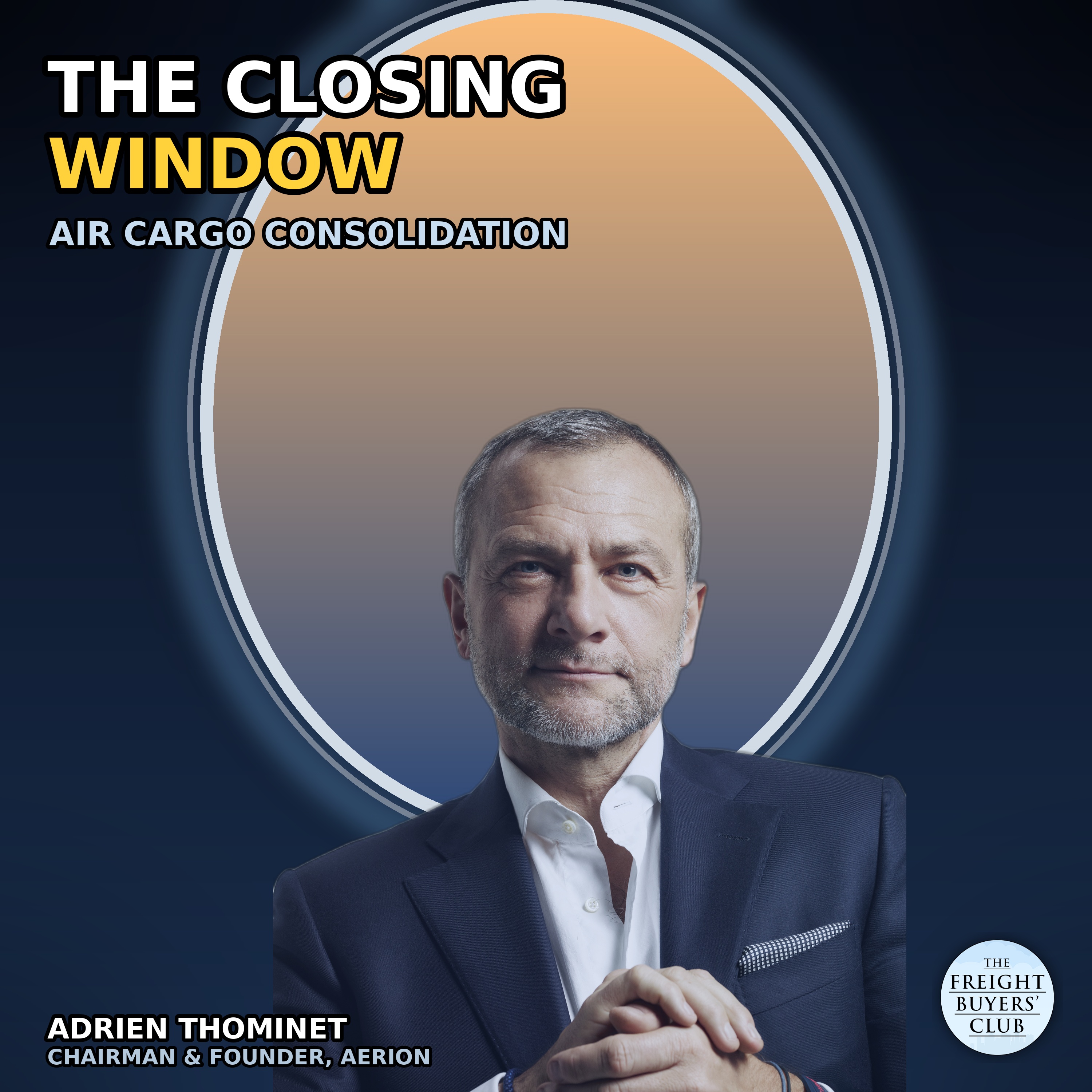
And I'm delighted to say I'm here today with Adrian Tominay who's a 25 year ECS veteran and he now, he now heads off Ariane. Welcome to the Freight Buyers Corps. Adrian Yu, thanks for inviting me.
Can you explain a little bit about Aryan? So you've got this background in gcsa. What is the difference from an airline point of view from what your GCA offers and what does Ariane offer and where do forwarders and shippers fit in with this mix?
[00:00:45] Speaker B: So first, Ariane is an absolutely new concept. So of course there is no comparison today in the market. And it comes from the fact that we do believe that the GSSA needs to evolve and to change by itself. Being a classic GSA for me was not really sustainable. So the idea was really to diversify our activities. So what can we do more as outsourcing solutions for airlines? And one of the best options was first to diversify the sales activity. So we created some what we call abilities, especially on niche markets like pharmaceutical expertise. So we have a complete new company called Healthcare Taking care of pharma expertise. And then we have the same on E Commerce. We are the only GSA having our own e commerce department called Mail and more. And then we further extended it to airline offering what we call now Total Cargo Management.
So we have a dedicated entity called TCE managing the total cargo management. And then of course the last five years we saw the importance of having digital transformation. So we have our own department called CargoTech. So when you consolidate all those kind of individual entities, we said we need now an umbrella company, a corporate approach to promote this entire set of services and not anymore a GSA approach. So Aerion is a kind of commercial holding covering, managing all those different activities that we are trying to combine through a corporate approach.
[00:02:11] Speaker A: So, well, can you just. You've called it a profit engine in the past. Do you want to elaborate a little bit more on that?
[00:02:19] Speaker B: Yeah, the airlines are permanently trying to optimize their revenue. So okay, the GSSA is a kind of classic sales vehicle for them going to niche markets like again, pharmaceutical, automotive, E commerce is really producing extra, let's say optimization of their revenues. Total cargo management, it's an extra layer on optimizing their revenues. The tech is improving the efficiency, the revenue management as well. So this is why we do believe that the combination of all those services is really helping the airlines to move to one level up in terms of revenue optimization overall compared to any kind of classic GSA organization.
[00:02:59] Speaker A: So you're talking about the airlines outsourcing more of their activities to you. Why would they be comfortable doing that?
[00:03:06] Speaker B: Because I think the model is very interesting for them. It's a very cheaper model because again, our costs are related to the revenue we bring them, only there is no fixed cost. And then I would say, thanks to the scale and the size of the group, we can offer the same solution in any of our offices in the world, whether it's from Cambodia into South America.
All the companies we're having are having the same set of services and service offered.
[00:03:31] Speaker A: When you look at your service offering across the spectrum that you've just covered there, do you feel like you have gaps in that coverage?
Is there a bit more of that airline business that you could maybe take in the future? And if so, what is the step to get to the. Is that expansion or no, it's an
[00:03:49] Speaker B: expansion, but there is a kind of snowball effect. You know, the different experience we are having are generating some notoriety. And indeed we have, let's say, proof of efficiency with those concepts. So we have more and more airlines coming to the Arian Partnership. Typically, we signed with Raal Brunei recently. This kind of partnership which is suddenly mixing the tech transformation, then the GSSA services, plus the niche abilities, and then they see the. Well, they see the added value for them. And then we can have a proof of the efficiency of this concept that we can distribute to the other airlines.
[00:04:24] Speaker A: I want to talk to you about the market in a moment, but I think let's just stick with this. I'm very interested in it. Is there a expediency about your strategic approach here?
Because I feel like we're in a time of great flux or change.
It's not just the geopolitics, it's technology as well. Do you feel like you've got a window here where if you can win this window, there's going to be consolidation in this industry and you want to be leading that? Is that part of that strategy?
[00:04:54] Speaker B: Very much. And thanks for the question, because this is exactly the point. I think this industry is trying to find its way on how to evolve, and then instead of waiting to see how it's moving on and then to adapt our response, we are trying to be proactively bringing solutions to this industry.
[00:05:10] Speaker A: So what's the next step for you then? Where do you see yourself in five years as a company across that broad.
[00:05:16] Speaker B: We have to be able to transform the GSA concept into a new name, like a general Logistics agent, something like that. Where again, we will continue to diversify the set of services, everything that can be outsourced to an airline. We would like to become one leading provider of solutions as well as the tech development as well, for sure.
[00:05:34] Speaker A: Does that involve. When you say logistics, does that mean adding on actual operations as well? Correct. Okay, so what beyond the airport?
[00:05:41] Speaker B: Well, there is the handling, there is the tracking solutions. There is this kind of consolidation business we can bring to an airline where we could jointly take risk on operating new flights. It's really to become a partner to an airline and not anymore a supplier,
[00:05:56] Speaker A: just on the market. Just see where we are at the moment. As I say, we're a lot of flux. Certainly we had a war. There's not the only war as well, but it's been a very interesting year for air cargo. So Iota has just downgraded its growth from I think, 2.5% to 0.7% for this year. At the same time, we've got higher yields, we've got higher rates. You're sitting on this big GSA network. How has that looked from your point of view as this year's gone on? I mean, is there any historical comparisons you can think of? It's been a strange year, and we've had a few in the. In the. The past decade.
[00:06:29] Speaker B: That's correct. It's always, let's say, scary at the very beginning. The chances, and I would say maybe one of the strengths of the group is the scale and the size of the network, because according to me, the logistics never disappear. Even if one market is blocked for embargo, for war, you always see the logistics being rearranged via another channel. And then your network is very important. So I give you an illustration. When the war started in Iran, Dubai was shut down immediately. We had to shut down the company to protect our staff. 25 guys were at home during two months. In the same time, we were opening Lebanon Company, a setup in Lebanon. And we have seen that all the business was moving via Lebanon in a very, very intense manner. So you see immediately the kind of balance with one market against the other. And this is where the size of the network is very important for us.
[00:07:19] Speaker A: Just on how global trade is evolving, we've covered this a lot on this podcast. Whether it's with ocean or with air cargo, we've seen a diversification of trade or at least those lanes where there's been growth. It's maybe been Asia into sub Saharan Africa or into Latin America or India's been growing strong. How has that looked from your side? And I'll add a secondary point. Two of the big things that are maybe an influence on that. We had the end of de minimis in the US last year and we've got the forthcoming July 1st massive change in the European Union as well. Has that been part of that restructure or diversification of trade or is it other factors as well?
[00:07:59] Speaker B: No, first you need to keep the flexibility. Typically, like you said, if you take the Chinese market, actually the E commerce players are changing their needs month by month. So actually typically from China the demand of the E commerce is very strong to Brazil. So suddenly you have to be able to be flexible and bring more capacity to Brazil to answer the needs as well. As you know that some markets would be, let's say going down. Typically we expect the trade from China to Europe to be slower in July for example, and in August and lately typically there is the Amazon prime days actually. So since three weeks we were expecting of a boom in the volumes as well. So it still have the capacity to permanently anticipate the situations. And again the flexibility to adjust your capacity offer.
[00:08:41] Speaker A: Have you seen a change in where you're sitting? You need that capacity, say over the last year, I'm thinking particularly from Asia into the US We've had massive changes in trade policy.
Some interesting data. We saw big growth out of Southeast Asia into the US Last year. There's also big growth China to Mexico. And then this year we were covering this on the last episode of Air Cargo Unpacked with some great data from Avian. Actually big, big increases this year of like laptops, hyperscalers from China into the US but also back out of the US and out of the Europe into Asia. Can you talk me through what that's looked like from you on the ground?
[00:09:18] Speaker B: Well, the fact that we are very close because we have a kind of very good market penetration in the key markets and then we see how we can anticipate a little bit the demands from the big shippers. So the key point is to bring them the flexibility to adjust again your capacity. If you take again the E commerce business, typically they have a new set of destinations that were not really expected for the next month. So suddenly you need to be able to reinvent permanently a new logistics solution for them. So you need to be agile, very flexible.
So this is where there is a big change compared to before. You cannot Have a kind of long term view. You only have a kind of a one month window maximum today.
[00:09:55] Speaker A: Can I get some insiders advice? We won't tell the airlines that you were giving this advice out to shippers if you were a shipper. Now in this market we've got charter rates are high this year. We've got spot rates, the highest since COVID I mean still massively down from COVID but higher since COVID if you're a shipper. Now is it all about locking in long term capacity or have you got a different view on where the market goes from here?
[00:10:18] Speaker B: I think again the shippers, the forwarders, they want not to reduce the kind of commitment that they have toward the rates and the capacity to keep this agility. And also to you know, there is a new kind of pricing approach from the airline which is called dynamic pricing. Where you need now to let's say to manage the up and downs and then to catch the best opportunities as well. So I believe this is the interest of the industry, airlines, forwarders, shippers to have less commitment on the long run. It's of course more fragile situation and on the other hand it gives you opportunity to catch the better revenue opportunities.
[00:10:51] Speaker A: From a bias point of view. If you had to pinpoint one area of risk, what would it be? Africa. Africa, what risk? Risk as in that's a difficult place to operate or.
[00:11:00] Speaker B: Exactly. It's very complicated and then there is a too much fluctuation on the volumes. So this is where it's a little bit complicated today. South America was down since one year because of the boom of the E Commerce Transpac. Now it's very massive, it's a very big market. Asia is huge, very, very steady, very strong development. So I would say one of the weakest market might be our fragile market, maybe Africa.
[00:11:23] Speaker A: And just to finish Adrian, we like a scoop on the freight buyers club. Is there anything you can secretly tell me that maybe is the next for Arian? What's the next step? Big, big purchase.
[00:11:35] Speaker B: There will be two major acquisitions that would be announced I believe in one or two months that will continue to diversify our activity a little bit too early to disclose the names but I promise I will give it to you as a priority.
[00:11:48] Speaker A: You're too kind. You're too kind. Adrian Tolminet, thanks for joining me today on the freight buyers club.
[00:11:52] Speaker B: Than. Thanks a lot. Great pleasure for me, thank you very much.