Episode Transcript
[00:00:03] Speaker A: Hello, Kungai Fat Choi to those enjoying the holidays. And welcome to this mini freight buyers club sponsored by Ontegos Cloud, the freight forwarder, profitability specialist.
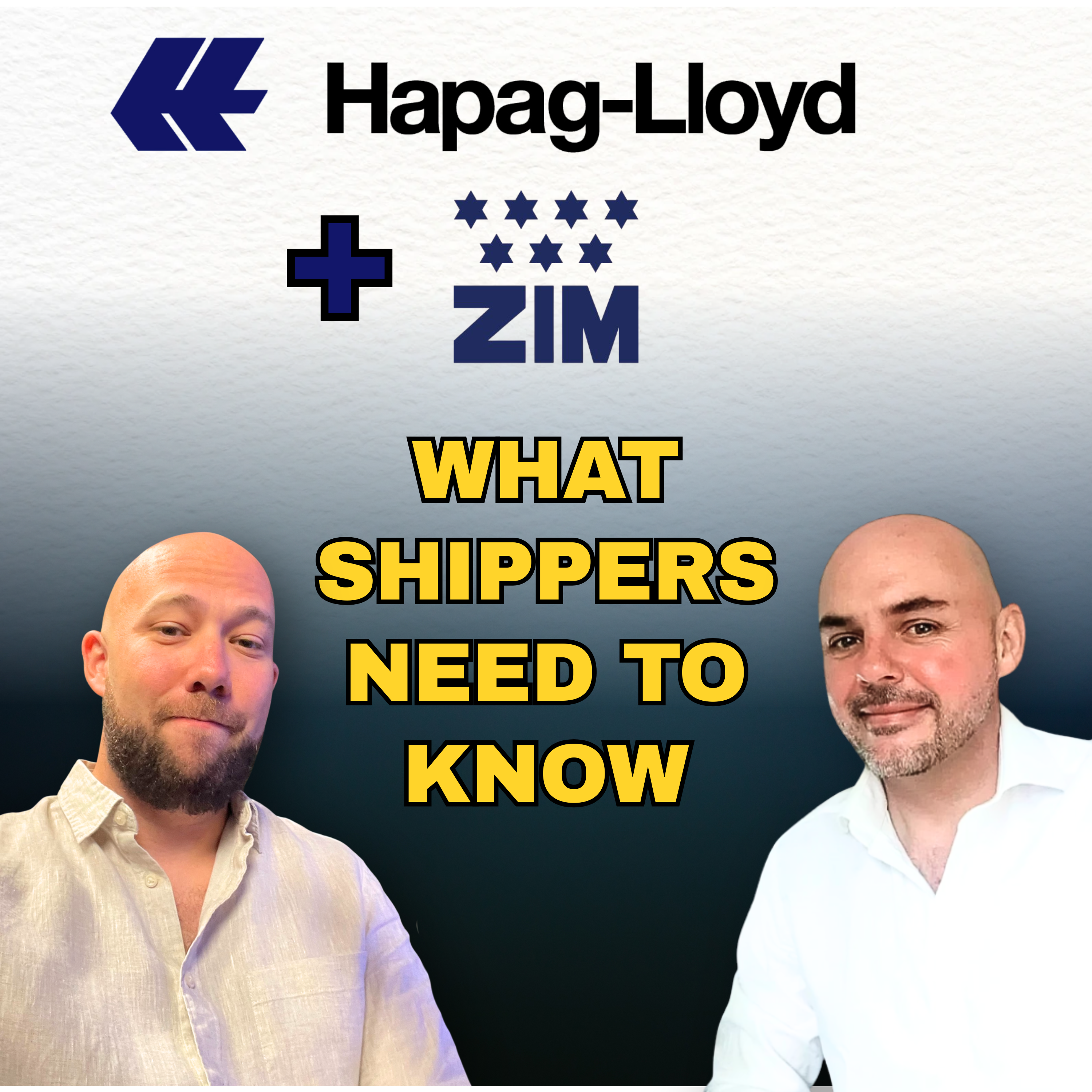
Big news has dropped in container shipping. So I'm joined today by Niels Rocher, former senior liner executive and now founder of Sullivan's Advisory, to help us break down exactly what the proposed Hapag Lloyden Zim major means for container shipping. But more specifically, what it means for all of you freight buyers out there that rely on their services. Nils, opening thoughts.
[00:00:36] Speaker B: All right. Hello Mike. Hello to the guru community. Well, opening thoughts is we thought that supply chains were important after Covid and we need you national champions. This might not be so true anymore. Right. And I think it's going to be also a kick down the road to see how solid the Gemini alliance is and open the door for many, many variations and potentially why not more M and A. Yeah, yeah.
[00:01:01] Speaker A: I think you make some good points there and we'll come back into all of those a little bit deeper. Let me just run through the basics of this agreement for for everyone, if anyone's just catching up. So Hag Lloyd is the world's fifth largest container line and he has agreed to requires him which is currently ranked 10th with 117 container vessels. You can see this on screen if you're watching rather than listening. For approximately the deal is around about 4.2 billion. That's $35 per share in cash represent a 58% premium on Zim's share price before the announcement. And that's a 126% premium on the unaffected price from back in August before takeover speculation began.
Now the combined entity will operate over 400 vessels with capacity exceeding 3 million TU. The deal is expected to close by late 2026, pending regulatory approvals and shareholder votes. Hapag is funding this with cash reserves plus up to $2.5 billion in external financing. The carriers expect to generate annual synergies of 300 to $500 million, mainly in network and procurement savings. I don't know, there's some question marks on that. Now this is. This references what Nils was talking about there in terms of the national ownership element. This is a twist because this isn't a simple acquisition. Hapag gets Zim's global operations, the fleet, the route and the tech division. But an Israeli private equity fund called Fimi F I M I is carving out a separate entity called new Zim with 16 Israeli flag vessels.
That's to satisfy Israel's Golden Share rules which require strategic Maritime assets to remain under Israeli control.
So commercially this is Hapag Lloyd. Politically, Israel keeps its national carrier capability.
So I guess my question to you Nils, is what does this mean for the liner, the shipping business and I should say for Anyone watching on YouTube, bit of a shout out here for Freight Buyers Club, but mainly for Robert van Trujan who was on the Freight Buyers Club last month and he predicted we'd see more merges ahead. So what does this mean, Nils? Firstly for the liner industry, but then let's look at then are we going to see some more some merges at some point?
[00:03:23] Speaker B: Yeah, sure, Mike. I think what it tells us is never bet against Robert, eh?
[00:03:29] Speaker A: Yes.
[00:03:29] Speaker B: Yeah. And more seriously, you can definitely have one thing in mind for your audience also is we have now, if things go through, one less player in the game and of course this player, depending on your trade, on your routes, they were in a partnership with someone else, but nevertheless is going to reduce the amount of deciders, which means then something that shippers know very well, blank savings programs will now be controlled by even less or fewer entities and players. That's the immediate D midterm effect, is that. Well, this reopens the dance of the alliances. While we thought that things were closed, I mean Ocean alliance is very stable and has again proven that they want to continue.
But MSC may be needing a new dancer, new partner and the last thing is.
Well, you would have told me a year ago, two years ago, there a carrier would be bolt and there would be an mna. I would have had a hard time to believe you because again, Covid need to control and to maintain some form of supply chain. We all had the thought that companies were important and also with a lot of cash in the bank. Right. But zim happened or is happening. So I think down the road we can imagine future M and A and we can talk about that later if you want. True.
[00:04:52] Speaker A: Cool. Thanks Nils. So Hapag Lloyd's claiming this deal will give it its network a boost in key corridors, particularly the Atlantic and the Trans Pacific. But as you reference there, the German carrier is one half of the Gemini cooperation with Maersk, which has been making really impressive strides in terms of boosting reliability on their combined services. Now referencing what you just mentioned there, XIM currently has a vessel sharing agreement with MSC on six Trans Pacific services. So what happens to how those arrangements are set up? What happens for Gemini? What do you think MSC does?
[00:05:27] Speaker B: So, you know, basically those arrangements are contracts. Contracts have a close to exit. Right. So it can be three Six months, maybe one year maximum, but usually three or six months. So don't expect an immediate change in any case. What happens? Well, today you have shippers that ship with Zim MSC on this partnership. Right. Where of course, Zim is maybe a minority.
Tomorrow this will be transferred to a Gemini network.
Now, if you look at TP as an example, tp today you have Ocean Alliance.
[00:06:02] Speaker A: That's Trans specific, Trans Pacific for US watchers and buyers.
[00:06:08] Speaker B: Cheers for that. So Trans Pacific Trade has the three alliance very well represented. So you have Ocean alliance very stable at the lead. And then you have Gemini and then you had this MSC Zim. Right. So you can imagine that somebody that is buying today or was considering to buy tomorrow, a Zim product on that lane might be tempted to stay on the same product that MSC will surely maintain because they have enormously more ships than anyone in the industry. Again, they may seek a new partner to mitigate some cost risk by sharing the cost burden. Second option, they may go with Ocean Alliance.
That is similar but a bit more reliable. Right. And then the last thing is, I guess what HAPAG is hoping is that when they buy those ships and they buy also the market share that goes with and the customers, in a way, I'm not sure that will happen, just by the very nature of how Gemini can be different and is different from the rest.
[00:07:04] Speaker A: So on the Trans Pacific, I mean, we're coming up to TPM 26 in Long Beach. Surely I know you're heading over there and we're saying hello to everybody. I might be making a late dash for the airport as well, subject to medical clearance. But we won't see anything in terms of the TPM's this big contracting round. Right, for the Trans Pacific. Everyone's all negotiating these contracts. This is not going to play out in this year when. When we're looking at a bearish market. And the boot is very much on, on the shipper's foot this year instead of the carrier's foot because it's very bearish market. But next year, assuming everything goes through, things will look slightly different for buyers, right? Is that what we're saying?
[00:07:46] Speaker B: Yeah, definitely. And again, your audience can link both questions and both things we have talked about. Less players means more control. More control means that the cars may be more reactive and more efficient in implementing their capacity adjustments. Right. And therefore the relationship with the shippers and Wu holds the cards, may indeed be affected quite well.
[00:08:10] Speaker A: Okay, so this deal, Nils, it needs regulatory approval. We've got European competition authorities, US Regulators, Israeli Government approval is needed. Do you see any major risks here?
[00:08:21] Speaker B: I just listened today to the Prime Minister of Germany that was saying that any deal that is not approved by EU within few weeks or few months should be declared approved. So maybe the EU will be faster this time.
But yeah, fun aside, this needs to go through a lot of things.
I don't see a big risk. It's not like P3, right? If you remember P3 back in the days that maybe was not a surprise but was full in the cancer.
This one is, you know, it should be straightforward but we never know.
[00:08:51] Speaker A: Okay, thanks. Final question. I'm sort of going, I'm going back to the start a little bit here, Nils, Is this the first domino? Should we expect more consolidation? And if so, and I'll just, for anyone watching on Spotify or on YouTube, I'll put up, you'll see on the screen now a list of the top 11 to 30 carriers sitting proudly as a carrier. I know, you know. Well Nils, that's PIL that you used to work for. Is that a target? Who's next? Who's next on that list?
[00:09:19] Speaker B: All right, maybe before answering what is a very interesting question, I just would like to touch base on one thing regarding the tomorrow Hapag buying Zim is not only a consequence on the Zim customers, it's also a consequence overall on the Gemini customers. Let me explain.
Today we said that Hapag and Maersk are the two faces of Gemini, but they are not equal in size. Today Roughly Maersk represents 60% of the ships of capacity and Hapag was 40%.
Now we could assume that across the 100 ships that are going to come with this purchase, Hapag will bring some of them into this partnership. Again the partnership is trade based. So if we talk about transpacific before, it would be quite natural for HAPAC to say, listen, I have now more ships. They should be part of our very good and very strong partnership. Are you okay with that? So it's going to be a question in discussions, right?
Bear in mind that in shipping, more ships means more share, means more decision power. And one thing that has become very important for our supply chain industry in total is now carriers. They also own terminals. So they want to go to the terminals they own, Right. For efficiency but also for equity. Right? So for money, any box that goes through is money.
So Hapag is going to ask basically that more volumes now go through Hapag terminals and not masks. So if we link that to what Vincent Clerk said recently, that they still Expect another billion or so of savings from this alliance. Maybe they won't see that from a so positive look.
So let's see are they strong?
[00:11:09] Speaker A: Very interesting point that Nils because I think in the the latest Maersk financials we saw a lot of those big. The big profits were coming from the port division.
[00:11:17] Speaker B: They are, they are Mike, and it's very natural and again that's also why you see less and less blank savings. I'm sure the shippers and they see that too there are less blank settings than there should be compared to supply and demand relationship. That's because a box that now move is not only little money for the carriers even if negative but it's also money in their terminal right now if I can look back to your very good question and what can be tomorrow the M and a merger and acquisitions that we can still see the consolidation.
[00:11:46] Speaker A: Those top 30 that 11 to 30 carriers just for people who don't know some of those companies it's a, it's a mix of many of them are Asian, a lot of them are regional carriers or feeder operators. Some of them are already owned by the likes of DP World or but we won't go into the details of all those but who's. Who's the target on that list?
[00:12:03] Speaker B: So we can go and look at the one just after Zim actually in that list and that's one High lines. One High is actually a very perfect profile for anybody in the sense that it has ships like the Feeders and the Panamax but there's also a lot of new ships 7k to 13k and more that are new, green, etc. And so you could see it as either the next MNA or a very good partner for MSC to replace Zim on the routes.
Now another very good candidate for the MNA actually is my former the company I used to work with, right this Pin Bil same as One Hai and they are actually cousin companies in a way in how they operate and what they do.
They have all the new ships so the share of new ships and green ships within their fleet is high. They own most of their ships right so close to 90 plus percent I believe as per Alpha Liner and their current owner management is Temasek. Temasek is a trust fund for the auditors that don't know about it. So the trust fund of Singapore State trust funds in general they like assets and companies that return a high yield, high return on investment which of course PIL has been doing. PIL is a champion of profitability for the past four years, five years.
Now if we go into a downturn market and the industry don't make 30%, 45% anymore of yields and only 0 or 5% maybe as we used to so long ago, maybe Temasek won't be so keen on keeping that asset. That coupled to the fact that now this Zim situation has proven that states don't absolutely need to own entirely and to have the, the liner at their hand may show that PL could be the next in line. And Mike, if we can say, I think the Zim thingy is actually very, very interesting from an M and A perspective. Of course, if people are know, working in M and A and listening to us, they will be like, yeah, duh, sure.
But for us in shipping, it's actually quite a new thing. What they do basically is a joint venture, right? FE will be an Israeli asset, an Israeli company based in Israel and keeping some ships and Hapag is taking control of the rest. So we could imagine the same concept for PIL or for any carriers maybe also the Koreans, right? Hmm is for sale every six months and then not for sale because only buyers are maybe buyers that are not the right profile they say. So maybe that's the new thing. Maybe have a GV with the state is the new key to unlock more consolidation in our industry.
[00:14:37] Speaker A: So it could be, it could be one of these. So when hmm is quite routinely linked to a potential buyer, we always end up coming back to the big South Korean conglomerate, the chaebol or chaebol, however you say it, we always come back to those companies as a potential buyer and there's this reluctance for it to go out to a non Korean buyer. But this is a new model for container shipping now. So you think that maybe that changes that equation?
[00:15:00] Speaker B: Yeah, definitely, definitely. And I mean you see it in a wider concept in the industries, right? So now if you want to sell cars in a country like Latin America, you need to build the cars there, right. For the BYD and the Chinese car companies. So I don't see why that model will not apply to shipping.
[00:15:19] Speaker A: I'm just going to throw a last one out there and sort of fly my pants type stuff. I've been doing a lot on U.S. maritime policy. We, we had Laura de Bella, the new FMC chair on and it's a much more expansive policy. There's words like maritime dominance, ship building. All of these things have been thrown into play. Why doesn't the US just buy a shipping line and be done with it? This is pocket change for the tech bros. Why don't they just do that instead of trying to build a whole industry?
[00:15:47] Speaker B: No, I think you have a point, definitely. And there's a lot of money right now that could be allocated to that. It's definitely cheaper, it's definitely easier. And politically also to say that now you're providing jobs to the Americans are very easy. But I don't think that CMA will sell back apl. Right.
So I wonder what the US could buy.
[00:16:11] Speaker A: I think I've got more chance of being right on this than there's a chance of CMA CGM actually doing all that investment it's promised Trump in the us.
Apologies to everyone in Marseille.
[00:16:22] Speaker B: Well, maybe, maybe through a GV again. Right?
[00:16:25] Speaker A: Yeah. Well, watch this space, everybody. Nils Rocher, always a pleasure. Thanks for jumping on a short note to break this down for everyone watching and listening. Make sure you follow us on YouTube and wherever you get your podcasts and leave a rating if you can. This has been a mini freight buyers club, brought to you by Ontega's Cloud, the freight forwarder profitability specialist. We'll see you next time.