Episode Transcript
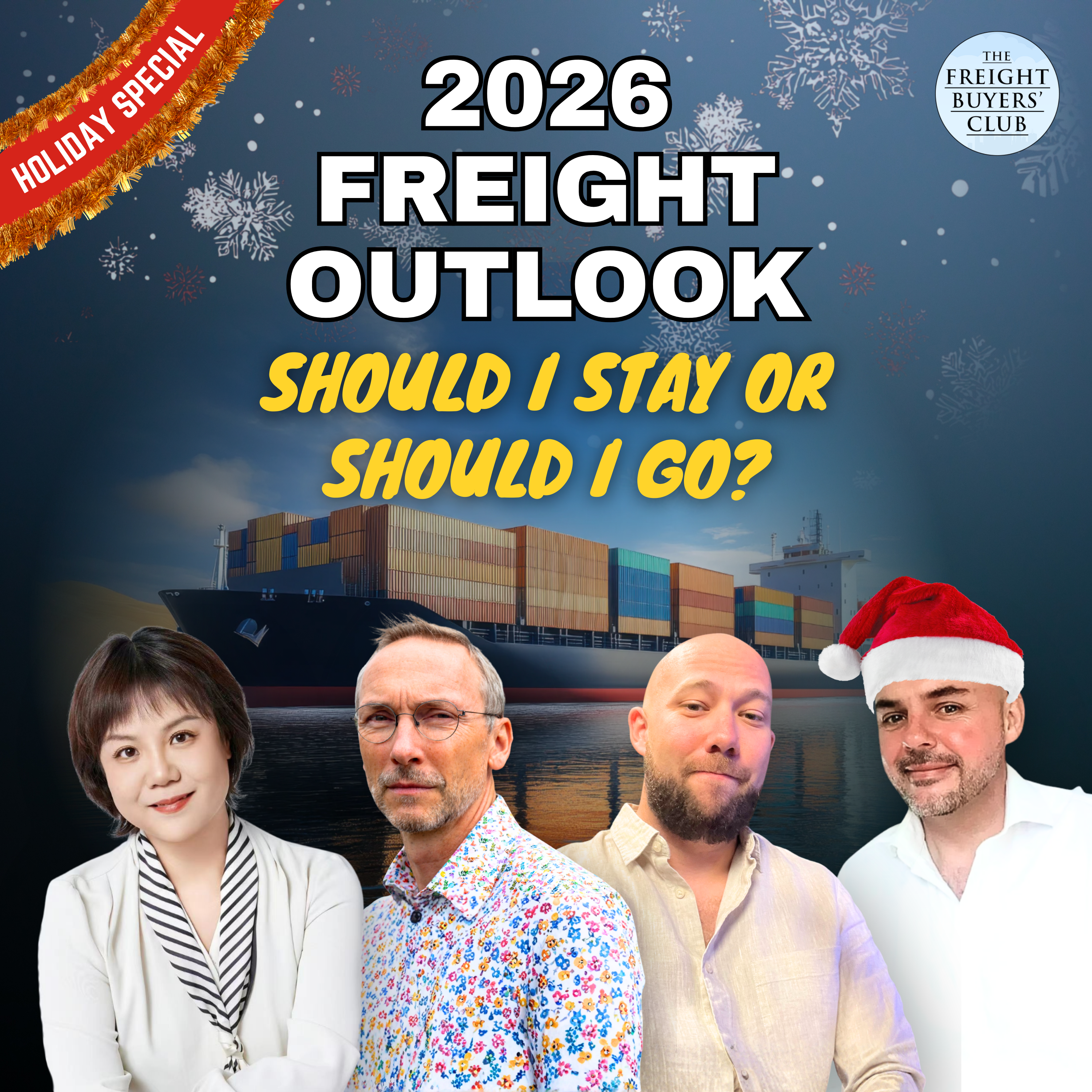
[00:00:04] Speaker A: The holiday season is upon us, which means two big things. Everyone's thinking about next year, and we've brought together three guests who can actually make sense of it and have a laugh while they're at it.
[00:00:16] Speaker B: And so for my losers, I have actually chosen the IMO Technocrats.
[00:00:21] Speaker C: I see them as the very unfortunate collateral damage to where the world is heading also into 2026.
[00:00:28] Speaker D: What we see is that it's Vietnam. It's the winner. Vietnam is really a rising star.
[00:00:33] Speaker B: Now, don't beat the donkey too hard during this Q4, because one, you never know when it's going to kick you back.
[00:00:44] Speaker D: You are listening to the Freight Buyers Club. This podcast is brought to you by your host, Mike King, and produced in partnership with Demurco Express Group, a global 3 PL that specializes in managing logistics too, from and within the Asia Pacific region.
[00:00:59] Speaker A: Hello one and all. I'm Mike King and welcome to the Freight Buyers Club. This episode is produced with the generous support of Demero Express Group. A bit of housekeeping before we start, please remember to follow us on YouTube and wherever you get your podcasts and leave a rating unless your feedback involves any criticism of our musical choices today. Now, that will make a bit more sense a little later on.
So, to my guests, first up, Peter sand, chief analyst at Zanetta, returning once more. Primarily, I understand, make fun of the performance, the woeful, woeful performance of my football team, whose name I can barely mention. Welcome, Peter.
[00:01:40] Speaker C: Thank you so much. And not a word about that Norwegian football style. You're playing with the Dutch coast, at least as of now, but amazing to be back in your good company, Mike.
[00:01:51] Speaker A: Always a pleasure, Peter. And joining us from China once more is the sage of all things, supply chain De Meo Express Group's head of sales, Kathy Liu. How goes it, Kathy?
[00:02:01] Speaker D: Hi, Mike. Oh, good. Nice to talk to you. Greeting from Shanghai.
[00:02:05] Speaker A: Thanks for coming on. And not last. Well, certainly not least is a rising star of international container shipping embarking on a new path. He previously held senior roles as dma, CGM and Maersk and, well, until a couple of months ago. He's deputy general manager for operations and procurement at Pacific International Lines over in Singapore. But he's now back in France. Nils Rocher, welcome to the Freight Buyers Club.
[00:02:32] Speaker B: Thanks, Mike. It's amazing to be here and the company is fantastic. I'm honored and humbled.
[00:02:37] Speaker A: Just before we get started, Nils, you're back in France. Now you know, what's the plan? What's next?
[00:02:42] Speaker B: Yeah. So I must say that leaving Singapore was not Easy. Neither leaving the careers themselves. But something more important in my life is starting a family. And with my wife, it took us to France. We have a lovely chateau in the countryside of Bordeaux and we will set up here the time to make this dream come true.
[00:03:01] Speaker A: Wow. Yeah. A different type of mountain to climb than container ship. And I can see. I'm sure you'll be very successful at that, too.
Okay, great. I want to have a look what's coming down the supply chain, shipping spoilers and other stakeholders in. In January and through the rest of 26 a bit later. But let's do this today chronologically and. And let's put a full stop on 2025 in three words. Guys, how would you all describe the year we've had and why? And while you're just thinking about that, I'll kick things off. I'm going with unpredictable adrenaline and fuels. I couldn't really fit a hyphen in there, so I've just done them as separate words. Between the policy whiplash out of Washington and trying to record podcasts while the ground kept shifting, that pretty much sums up my year at the Freight Buyers Club. Getting content out quickly was the name of the game in 2025. So, yeah, it was so difficult trying to avoid the leeches in news cycles, mostly courtesy of the White House. Some very close calls along the way. I can tell you. Peter, three words that sum up 2025, please, and explain why you chose them briefly.
[00:04:14] Speaker C: Yeah, thanks for asking. Because 2023 have sort of 2025 have been quite a crazy year. But. But I think the most crazy thing that tops it all are the tariffs. So Trump the tariff nightmares and he showered the shippers with was definitely one of the three words that. That needs to be mentioned here. Many shippers, forwarders, carriers may not like the fact that they found themselves paralyzed at some point in time in really not knowing how to get around all of these different aspects, just being thrown out left, right and center.
No legal necessarily solid background on the back of that, but they just needed to act in order to stay within some sort of reasonable, at least verbal compliance to it. So that's one word. Second word. The agility of Chinese exporters. That may be five words, but in essence, I think we have really seen the ability of China to diversify the customers of their production facilities like never before. It may have taken some by surprise that China have been so able to find new homes for its products, but I think it's been in the making for at least a decade. So it's just coming into the full brutal force now when they need it the most.
Finally, I think forecasting is one thing that's of course very close to my heart. What's next and how to deal with that. I think a lot of our customers are coming with a higher frequency and in bigger numbers than ever before, asking for what comes next, what should I do in terms of the next tendering season and where will rates be? So. So of course that one word, market intelligence, the one thing that will bring you to a better place, I think that probably sum it up. Thanks.
[00:06:08] Speaker A: Some of those issues we'll definitely be coming back to a bit later. Cathy, your three words that distill the year we've had in supply chain, please.
[00:06:17] Speaker D: Yeah, so my three words, the first one is very similar, like you both said. The first one is uncertainty. Because this year it's really full of surprise, you know, with the tariff, sometime here, sometime there, the market is floating like as same as how Trump says. And then the second word is agile.
So also similar like what Peter just mentioned, that I think all those customers, including logistics service providers like us, need to keep agile and then to response for all those change.
And then the last one is resourceful because, you know, under China plus one there's a lot of manufacturers, they are moving out of China and then. But in different countries, there's always different local policy or compliance you need to face and you need to handle with that and also design different logistics solutions.
So for us, we always need to be resourceful and to design different solutions for the customer in order to keep their supply chain moving. Yeah, Those are the three words I have. Yeah.
[00:07:28] Speaker A: And Mr. Roche, the baton has been passed to you. Your three words, please.
[00:07:33] Speaker B: All right, I'll start with growth, obviously. Right. Despite many expectations and some forecast 2025, the latest numbers saw healthy growth for container and volume strides. So it's positive. My second word would be Trump. President Trump, obviously, like him or not, things on the short term have been put in the air.
That's the least we can say. Right. And I tend to like when things move. My last one and in contrast to the two of the guests, I truly am not say orderly. I want to say calm, but I really mean orderly from a career point of view, if you will. When we faced new networks that was announced a year ago, none of us went wrong. Right.
Nobody want just a loan through SUS constantly.
Nobody implemented a strong blanking program.
Not so really. Any matter of new services launch? There has been a few, but it's mostly added Port of Call. I did Vietnam and, and sort of things. Right. So orderly.
[00:08:39] Speaker A: Ah, a very interesting point. I'm sure we'll come back to that. I wouldn't be surprised if Peter's got a few views on that. Carriers coordinating. Very orderly. That's a very, it's a very interesting point. Okay, let's see. Well, I think we might have some of these coming back around again because we've sort of touched on, on a few points. Who's, who's been the big winners and losers of, of 2025. So, so my take on this was China is actually my winner because despite all the noise around diversification and China plus one, its manufacture engine hasn't really, hasn't really dimmed at all. The exports are still competitive. It's found new markets. Yeah. So that China's my winner. Loser. It's got to be people paying tariffs in the U.S. i know the politicians like to say that it's exporters paying them, but it's not. It's those poor people who rely on those imports.
So we've heard on this podcast again and again from, from some of these shippers. They've been caught unawares, they've been stuck with bills they didn't understand and they're under a lot of financial pressure. So I think they've been the big losers of 2025 for me.
Nils, are you going to say that container lines are the winners though, even as we're looking at declining profitability, or have you got something else up your sleeve?
[00:09:48] Speaker B: Yeah, Mike, well, I will start to say that you chose an easy one. Right. China is winning on everything.
So maybe football sooner. So no, yeah, my, my winners definitely is Ocean Alliance. Ocean alliance has been a stable alliance, right. Since 30 plus margin for all of them customers that seems to be satisfied. So, so yeah, in term of. And again, I'm born in the carriers and I like network design. I like products.
The products that same the customers ultimately. So I do think that Ocean alliance for me are the big winners. And so for my losers, I have actually chosen the IMO technocrats, right. Where everybody went to mevc and thought things will happen without honestly to me, a very solid plan. Again, if I go to my board, my cfo, my C suite and I say I'm just going to take money and I don't know how I'm going to redistribute and I have actually no plan to support port infrastructure.
I may be sent away to be honest. And I think that's fair and in a way that's what happened.
[00:10:52] Speaker A: Peter, Your, your winners and losers. Please don't say Bayern Munich and Liverpool.
[00:10:57] Speaker C: I'll go, I'll go away from those horrendous matches of last night. But, but, but may I suggest Timoth Argyle and Air United as they actually won their respective games over the weekend. So, so you just need to, to, to align your focus as you need to to find the bright spots in well amongst the winners and losers of.
[00:11:17] Speaker A: Of container ship team in every league in Europe, haven't you?
[00:11:20] Speaker C: You've got to pick them nicely, right? Because if you, if you put all your eggs in in one red basket then, then you may wake up with, with too many devastating mornings because of a bad result last night.
[00:11:32] Speaker A: Right?
[00:11:32] Speaker C: So, so you just need to.
[00:11:33] Speaker A: Yeah, Bayern Munich lost to Arsenal. Yeah, I'm not even going to Liverpool. Right, let's back back, back away from football.
[00:11:40] Speaker C: But, but, but I mean it's all about ranking. It's all about finding out who who will be my, my better playmates right now we launched some carrier scorecard only a few weeks back where you can actually also put Those winners of 2025 up against one another. Right? Carriers of course is also one of my winners as they tend to get windfall profits and benefit every time Crazy stuff happening around the world in whichever form it may take, whether that's geopolitical disruptions, whether that's natural disasters or whether it's a regional disruption involving Houthi rebels or Israel Gaza, right? So, so carriers with their also ability to adapt. So the scale of these changes have really required a lot and that brings me basically perhaps to, to the losers of the game, right? Those supply chain logistics professionals that just want to operate and do their everyday job as good as they can, working close with their partners, whether they sit in a shipper's procurement department with a forwarder or carrier, right? They just want business to be smooth and they have spent decades optimizing for efficiency and now they find themselves optimizing for, for a geopolitical compliance agenda. I see them as the, the very say unfortunate collateral damage to where the world is is heading also into 2026.
[00:13:09] Speaker A: Very good points one and all. Cathy, your winners and losers of 2025, please.
[00:13:15] Speaker D: Yeah, for my point of view, the winner is also a country, but not China.
What we see is that it's Vietnam, it's the winner.
Vietnam is really a rising star now and we have seen from this year the production line to produce those finished goods to supply for the US market, Europe market. And it's really for among all those carriers, everybody talking about Vietnam and even for the passenger flights, it's full in and full out. So there's a lot of business opportunity over there, especially in Hanoi area because it's famous for all those electronic parts, those production lines and they are now full power and they are really the winner of the year. And I think it will continue to next year, that's for sure. And for the loser, I think that's similar concept as Mike. I think it's that let's say end users or consumers because doesn't matter of those general cargo under tariff or those diminished canceled by the government for E commerce but by the end all those high tariff actually bid by all those end consumers, they actually, they pay for that. It's not the manufacturing in China or in Southeast Asia, it's actually those end consumers over there.
[00:14:37] Speaker A: Absolutely.
Okay, the big stories of 2025. Well, let's stick with you. Cathy DeMeco has produced a new China plus one logistics and legal playbook with adults. You're Goddard in it and it ties in with what you've just said.
You cite the American Chamber of Commerce in China which found that 30% of US companies manufacturing there have either considered or already began relocating parts of their operations.
Southeast Asia and India are leading the way. Is this your big story of 2025?
[00:15:10] Speaker D: Yeah, sure, definitely. Because you know under China's plus one there's a lot of manufacturers they are moving into into Southeast Asia, those new countries.
And during the process start from actually 2023, we helped a lot of those companies, they are moving their production lines over there and help them to install the build up the manufacturer over there and to support them for those local compliance. So with all those experience because in the process we are also learning by doing together with our customers there. So we have accumulated some experience in that area. And this time we also work with a law firm headquartered in London to issue a we call the ebook. And then to help our customers who have the global expansion need to understand the logistics challenges and the local compliance issues and how our experience can help them. And also for when we talk about this year because we see those production line we helped one or two years ago start from this year, they start to really launch the production.
So they really actually have exports actually from this year, not last year because they need time to testing everything. So from this year we see more and more requests out of Southeast Asia countries, especially Vietnam as mentioned Thailand and Malaysia. But in the same time you know that the infrastructure cannot compare with China.
So the frequency of the airplane and also the capacity as well as the vessel, the liners. It's really there's not that much capacity to support this kind of sudden growing for the demand over there. So we also during this year we do a lot of this kind of multimodal transportation. For example, we will move those cargo from Southeast Asia back to China and then connect the vessel or airplanes in China into US Because China still have the biggest capacity into US including the biggest number of freighters. But because of the tariff issues actually in China this year the supply is more than demand.
So we use this kind of let's say the imbalance capacity wise. So we bring those cargo from Southeast Asia into China and then move out.
So this is a kind of new solution or innovation and it runs quite well. So we include all those our experience in that ebook. So if anyone interested, you always can find it on our website.
[00:18:02] Speaker A: Yeah, yeah, I'll put a link in the notes. I did have a look through it. It's very good. Cathy, there was an interesting point. There is when we think of China plus one we're often thinking about linking it to the White House policy and avoiding tariffs. But there is some good information in there about European manufacturers are making similar decisions sometimes favor in Eastern Europe. Is there a different type of motivation for the European companies to the US and what are the main barriers? Actually if I'll add that one on.
[00:18:29] Speaker D: Yeah. I think for those we call MNC customers, those multinational, those big big companies, they have no issues because they have their own legal team. They are compliancing, they are fully equipped. But what we see is for under this kind of situation the most challenge is to those small medium sized manufacturers. Because for them it's not easy that you you to sourcing out of China because over past decades that China government supported to build up the supply chain ecosystem in China. And you cannot just from one day to another to copy paste to other countries.
And also you know those policies always different by different countries. Especially when you split the sourcing to a couple of different countries in Southeast Asia. Then you need to consider the compliance in different political environment.
So this is the I think the big the challenge what we have seen for the SMEs.
[00:19:30] Speaker A: I think for me the big story probably I've just done a podcast on this.
People are listening to this. It came out last week.
It's around their cargo because most of the year everyone was saying it destined to crash. There was so many, so much disruption. There was. I don't know none of it it looks structurally like there was going to be issues with air cargo, particularly on the demand demand side and instead we've had volumes expanding rates have held up all this idea that there was not going to be a peak season. Looks like there's going to be a peak season when we can look back at where rates and volumes are de minimis end of, well, the end of de minimis exemptions into the U.S. we're going to see this in Europe as well in the coming years. But that didn't crash the market either. So that was E Commerce was that big driver of last year that didn't crash the market. So my big story was the pundits all getting it wrong on my podcast as well to be fair.
Nils, how about you?
[00:20:28] Speaker B: I would have said the explosion of the Fred Bios podcast, but I'm not sure if I can take this.
[00:20:33] Speaker A: Well, I've got numbers for that but yeah, yeah, I'll come back to that. We've got a lot, we've got a fair few new subscribers, but thanks for mentioning.
[00:20:42] Speaker B: So if I have to choose another one, it's hard to say big 25 without China again. So not to repeat too much what Kathy mentioned, but the ability of China to adapt and to go and diversify the customer portfolio towards emerging economies latam in Africa, I mean I've seen a lot of that in my previous job. It's impressive but also towards more what we call buyer free economies. Right. Australia or the EU.
The growth to the EU has been very impressive.
We talk about China plus 1 plus 2 plus plus insurances also as a thing and it's definitely a big thing. But if we put everything onto a scale, China remains and consummately the winner of it. Take Asia to Australia this year, a trade I know very well. Right.
Roughly you have China to Australia that grew 12% while Southeast Asia to China grew 1%. Right. So you see also some effect of what Katie has mentioned, the logic natural supply chain adjustment between the north of Vietnam maybe to the China. And though Southeast Asia has grown and in some markets more than 1%, I give you China remains an engine of production that is comparable, maybe just a last thing not to have a full bright picture and anything is good that means that we are reaching the structural infrastructure capabilities of China. I mean Kathy is in Shanghai. I'm sure from her office she can see a lot of ships waiting. Right.
China has barely invested into new ports and new terminals in the past years and now with all the volumes coming through and it's a Blessing we have two, three, four days in Shanghai that's never seen before because of the volume and I think it's going to get way much worse. Mark, maybe I can tell more on that later.
[00:22:32] Speaker A: Okay, we'll come back to that. And Peter, your big story of 2025.
[00:22:36] Speaker C: Yeah, I think linking on to what Nils just said before, was it, was it not the CEO of Maerskrin's Clark also going out the other day claiming that Europe and the European port infrastructure have been struggling for quite some time under investment clearly, but also I guess suffering from its own success. Right. So obviously when you see imports growing at large, you also need to make the investments concurrently. So you up your game to match that level of imports because it's not the sheer scale of business actually because exports have been falling and we see the same also out of us. Right. So it's not just the sheer operations but it's the imbalance between it all right. It's the huge amount of imports that just clocks up the facilities let alone of course the shippers may believing that, okay, my box sitting inside the port, I got my detention and the merge all paid for. So why should I rush it out? Well you should rush it out because the density, yard density of the ports impairs the ability of each terminal and port to actually deliver to you a little bit further down the road and to everyone else. Right. Using that port. So I would say that's definitely one aspect that have caught my attention in the past year is a big story because it just seems to be something that they cannot really solve and it's been in the making for a long time. And just looking ahead to the other big story of 2025, we will touch upon that also now Red Sea, right. Upon a full scale return.
If we saw 2025 as troublesome in terms of port congestion to northern European ports, we will see nothing like that. Upon a full scale return that's at least a little bit of doom and gloom. But it makes total sense if you see what's likely to come about when those ships going around the cable could hope arrive at the same point in time as those that went for the shortcut. Right.
So that's one theme that goes into 2026 from 2025 and only earlier this week I guess there was a little bit of confusion between parties of a meeting taking place in Egypt on what was actually agreed. So I think in reality it remains something that carriers in particularly watch very careful. The risk assessment we know is different from one carrier to the next Insurance is set by joint war committee. But CMA for sure have been have been leading the pack for, for a number of of of services. I mean they run the the service them in the MED5 as a part of the the ocean alliance, but it's only CMA ships. Right, so so again the more you know, the better you can also perhaps prepare your supply chains. Right. So during times of disruptions the go to modal shift should not necessarily be air freight. If you are in a rush it may be trained but then again different kind of obstacles on that. But it may just be that if you work with the carriers that actually do have still a running service through the Suez Canal that could also still bring your goods to the point of destination with a shorter transit time than those that goes around. So I think that's a BIG theme in 2025 and also for sure going forward, the more you know, the better you can also prepare yourself and the better you can set those key and essential relationship with your business partners within the supply chains. Right. Because they can only optimize if they know your requirements and the more you as a shipper know your requirements and can plan well to fill those bonded warehouses, to fill those free trade zones or, or just say stock up inventories as you fear the next massive disruption.
That's I think a big theme for, for 2025 and also going forward those changes to the supply ch as we once knew them and the ability and agility by everyone working within the sphere of logistics.
[00:26:41] Speaker A: Yeah, just a little bit of background there. So there was mixed messaging as we're coming up to the end of November between Suez Canal Authority and Maersk. One announced that Maersk was going back through the Red Sea. Then Maersk rode back immediately and sent a press release out to all of us guys saying absolutely no, we're not.
But that does make you think that maybe they're not far away. We're going to come back on that in a moment and we're going to have some more insight on freight markets, contracting and some forecasts for 2026. Stick with us.
[00:27:12] Speaker D: This podcast is proudly produced in partnership with Demerco Express Group, a trusted provider of global shipping and contract logistics services in Asia, Europe and North America. DeMurco's particular strength is in Asia, where it gives shippers the freight capacity and local market expertise to streamline freight movements to and the region, particularly for Trans Pacific lanes. With 130 forwarding and logistics locations across China, India and Southeast Asia, Demurco connects Asia with the world like no other global3PL. You are listening to the Freight Buyers Club.
[00:27:47] Speaker A: Welcome back. Okay, rates. You sort of touched on this already, Peter. The big driver of container freight rates, both spot and long term over the last year and a half, two years has been the de facto closure of the Suez Canal to most container services.
Diversions around the Cape have swallowed up all this capacity.
As you touched on, we're looking at capacity maybe coming back through the Red Sea sooner rather than later. Can you put some numbers to give us the context of what that means for global container shipping and the people that buy freight services, that use those services from carriers?
[00:28:21] Speaker C: Yeah, I'll be more than happy to do so. But let's look a little bit, just briefly back before we look ahead because if we just say focus for a moment on the spot rate development for 2025 year to date. So if we look at US West coast from January 1st to where we are today, those spot rates are down by 66%. Right. If you look at forage to met, they are halved just sitting shy of $3,000 right now, down from 6,000 at the start of the year. So the trend as it's become more and more the normal and supply chains are set up and running so, so smoothly, carriers are now also just being at the mercy of their own efficiency and operations now inching close to break even levels. Right. So that's, that's a part of the number game here. But looking forward also I think many of you hopefully found time to download our thoughts on the 2026 outlook. Right. And we see a further deterioration of the spot market to the extent of 25% as we set the base for the third quarter of this year. So there is still room for some downfall and that is not even considering that full scale return that you hint to Mike. But let me bring some numbers around for that. What would it mean to see carriers returning? Of course, first and foremost a massive say reshuffle of the services as they are set up right now. We know that when the alliance has got announced earlier in the year and, and late 2024, they all set out to be through Suez Canal, let alone they knew that they would all go round. But if we look at some of the numbers, we can see where there was some data from EC now acquired by Senator, we have more than 2 million TEUs of shipping capacity deployed to do this extra job. Right. So they need to find a new home. And where would that home be if not for the breaker yards? Well, well we need to see some idle fleet Ticking up, currently assessed at 0.8% of global fleet. That's next to nothing, right?
[00:30:25] Speaker A: That's historically low, right?
[00:30:27] Speaker C: So this is really low, super duper low. We've seen something that, that's been a little bit further down in the. During the COVID years, right. We got down below 0.5% or something like that. But 0.8 at this point in time, does it make sense? Well, apparently there's still stuff going on that we should be paying attention to closely in the sense that where are carriers in such a need? So they also need to really pay up. The high charter rates that we see right now as somewhat of a disconnect to the revenue stream coming in from the freight rates. But those 2 million getting back to those, I mean where will they find a new home? Well, everyone's guess. But if you look at some of the demand drivers for sure, in the years we have and we have seen it, the major demand drivers for Chinese exports have also been a little bit say short distance, right. We have seen massive growth, 20% up into India subcontinent, right. Middle east up by 14 and a half. And I'm talking about Chinese exports here year on year for the first nine months of this year. So massive growth but also short of distance. And you must realize also that when you take out sailing distance to the extent of one third out of global demand, which can be assessed around 17% if you include Asia to Europe and a bit of Asia also to North America, east coast, right then this is a seismic shift to the underlying conditions. So massive downward pressure on carriers, what to do with the excess capacity long term rates as we see them more stable, more solid as they basically run by a different tune in the sense that carriers need profits on the long term contracts. Shibas are aware of that. But the volatility on the short term is seen to be dramatic as the say return unfolds and subsequently downward pressure. Of course it makes sense with overcapacity to this scale to come into play. It'll be loss making for carriers. Hopefully it'll also be an opportunity for anyone out there to showcase that they can actually do a splendid service.
[00:32:41] Speaker A: I want to come back on that in a minute piece of it's the long term, short term and how you look at Asia, Europe because those contract negotiations are going all at the moment and there's that big unknown about how much capacity is going to come back through into that service.
But Nils, let's bring you on here.
So how does this play out from a carrier point of view? A lot of people who maybe aren't following container shipping over the years were probably thinking hold on, well if they're already struggling on rates, why would they put capacity back through the Suez Canal if that's definitely going to have downward pressure on markets, the boot will be back on the foot of shippers. Surely they learn the lessons of poor service equals good margins and tied up capacity is good for business. So is this turkeys voting for Christmas?
[00:33:28] Speaker B: Well that's a hell of a question. Thanks for that.
I'm going to try not to be a punk. A couple of things might the ones that have been here for at least one decade can seem from history that carriers often mocked and told to be oh, why did you build so much? Why do you have so much capacity? It doesn't make sense, right?
And then if I take 2016, right, which is the last year we had 6% of the fleet idle, we scrapped a number of ships, the highest I think if I recall, 750 or 900,000 to capacity. But what happened in 2017?
Well you all remember the volumes picking up, right? And then suddenly we needed ships and suddenly Maersk was happy to have scrapped tech mers because they are public and they chronicle data to scrapped about 11 or 18 ships only, right? So same happened for the Red Sea situation. We were mocked as carriers to have so many ships and suddenly something like this happened and everybody, the freight buyers included, are very happy that we have the ships to maintain supply chains in a way, right. The general sentiment for me in the carriers and my friends. Right is that you never know when an opportunity is going to be there and you need to have the assets to serve the opportunity. Now if I get quickly to the second question, why carriers are returning to Suez and reinjecting capacity in a market that obviously doesn't need it. Right.
Well, two things. One, you can testify now that carriers are not colluding. There is no collusion between us. We are not talking to each other and saying let's control the capacity.
It's really a boys game, I'm sorry to say.
It's individualism at its best where every carrier is saying my ship must be full, Peter, my ship must be full. My ship must have the best transit time. I'm going back if I can and therefore this will happen quite naturally. And then as for the first one goes maybe a second, we're going to go three or four being gone already, then even Maersk Risk Adverse and it's very good, will return eventually. If everybody else is going now, just One point, I mean Zenatal, no plug intended, but it's one of the best MMA I've seen in many years. Now you can really compare what you're paying for and the delivery of it. And I've been a fan of EC well before this podcast, as you know.
Imagine now if you use that data, I'm sure Peter can can see it through.
Some carriers today are missing sailings. So you think we have more ships than needed and you think we are deploying more capacity than needed, but we are missing departures. Some carriers are missing departure somewhere.
So let's say that the carrier might be a French carrier or a European carrier and it's quite natural therefore that they are the first ones that says I'm going back because I have sailings that I could be doing again, back to individualism, I could have a ship departing. And last point, just remember that in Ocean alliance, the contract, what you give is what you get. So to have BSA to have capacity over the trade, you need to deploy ships. So if you miss a sailing, you losing capacity on the overall trade. So just some insights to make you feel why some carriers may be more prone than others.
[00:36:39] Speaker A: And just going back, Nils, just another question on this. So everyone's been following what Gemini cooperation's been up to this year, which is promising schedule reliability. That's Maersk and Hapag Lloyd's Alliance. This is all about using hub and spoke networks to guarantee reliability.
I mean obviously they want to be paid a premium for all of this.
In a market that's looking like it's crashing, how are they going to get that premium and how are they going to maintain reliability if they start cutting services if that's the only way to keep the bottom line, some somehow stable.
[00:37:11] Speaker B: Right. To save time, I won't go into the discussion on what is reliability.
[00:37:15] Speaker A: Yeah, if you want to save that, we've got a separate podcast on that.
[00:37:20] Speaker B: If you want my piece on that, I also have a short article on my LinkedIn and the short of it is go to EC and have a look. But Mike, two things. If feeders were on time, we would have known by it since 100 years window shipping. If having a feeder serving an output would be cheaper, would be doing more of that 400 years already.
So just to come back on it, Gemini is delivering some form of consistency, right, that you can see.
Now imagine if the rates are indeed going down as Zenata and Peter are predicting, as many others carriers are going to lose money right now. Cars are not making money on most of the trades. Right. So the Q4 of most carriers you will see is at break even if rates continue to go down. And by 25%, an order of 25%, let's say that's cash bleeding. Do you really think that carriers are going to maintain the loops? Do you think that carriers are not going to terminate service like they have been forced to do in the past? So actually my advice for Fred buyers is don't beat the donkey too hard during this Q4 because one, you never know when it's going to kick you back anime.
And second, carriers may simply suspend service. And I think idolship, I'm not the one of those that think that scrapping will happen. But we can discuss that later.
[00:38:39] Speaker A: So hot layups maybe cold layups. Are we. Is that what we're looking at?
[00:38:43] Speaker C: Yeah.
[00:38:43] Speaker A: Hot, hot, hot, hot.
[00:38:45] Speaker B: Because again, you never know, you know, pre Chinese New Year next year might be excellent. You need to be there, right?
[00:38:51] Speaker A: Yeah. Yeah. So things could pick up. Yeah. So if anyone listening doesn't know the difference between hot, hot layup is where you keep every, all the crew, the ships ready to go. Cold layup actually has ongoing costs because you have to keep the ship maintained. But it's sort of mothballed as well. So there is a cost to that. It's not just a case of parking them. It's not like putting an aircraft in the desert or a car in a parking lot. I'm going to America. Listen to that. Lots to consider there. So Kathy, I mean maybe you want to come in on some of those issues and how you're looking at that from your point of view or is there something else that's keeping you awaken and wake at night when you look at 2026 and freight markets.
[00:39:29] Speaker D: Yeah, I think it's really something very same like what Peter and Niels just shared because from us we are more facing like customers and what we learned from our customers recent days because it's the period to discuss about Nixie as well. They all mentioned the vessel schedule reliability. That's really the key concern from them because you know one side that for sure, carriers like to keep the rate at certain level. They didn't like to see that the rate down that much.
So sometimes they will cancel some schedules, blank ceilings, this kind of things. And then but for our customers, especially from this year, for the cost reduction concerns, a lot of those cargoes, maybe they change the transportation mode from air to ocean.
So actually they rely on a lot for the schedule reliability. So if this cannot be relied on then let's say the deadline might be missed at the destination.
So this is some key concerns from the customer side. And actually we didn't see any sign that this kind of situation will be improved in next year.
[00:40:42] Speaker A: Okay, thanks Cathy. Okay guys, it's contracting season on Asia Europe now, but before long we'll be into long term Trans Pacific contracts too. Cathy, how are you looking at this on behalf of your clients?
[00:40:56] Speaker D: That's really still a lot of uncertainty. Let's say like this, you cannot really see, as I mentioned that what we see that the overall demand actually is less compared with years ago. But the supply in the market actually is more.
So under this kind of imbalance, if the carrier doesn't matter air or ocean, they like to keep the rate at the same level, for example as 2025 or last year, then there must be some adjustment on the capacity on the supply side.
So this is really something we not really see that clear for next year. But what we have learned from especially airfreight market, all those carriers, they still keep the same even higher than this year as the contract rate for 2026. So that's really the trend. And for Southeast Asia for sure it will be increasing because the demand is there from this year already everybody see this kind of trend. So for out of Southeast Asia, for long haul to us to Europe, it's for sure it will be increasing. But how to handle the China market? This is something that we need to wait and see. And also we heard from some customers, normally they sign like BCO contract with Lyna directly. But because of they really have not good experience this year for the schedule reliability from next year. I see that some of them they consider to use MBO CC service because then it's more flexible for them can choose different vessel schedules instead of just relying on a single one. This is something we see and also that how to sign the contract next year? I mean for customer side they would prefer short term or long term. This is also under discussion because before they like to have like one year rates to keep the stable logistic cost and the service. But from this year's experience looks like this is not the thing they are looking for. So maybe next year they also will change to short term contract like three months, even one month or more ad hoc requirements. So this is all those changes we have seen from customer side.
[00:43:15] Speaker A: Thanks Kathy. Nils, you already said be kind carriers in these negotiations.
Is there anything else freight buyers should be thinking about?
[00:43:25] Speaker B: Well, I'll be very short the capacity in terms of number of ships might be coming, but I think the bottleneck of capacity is going to transfer from ocean to the port.
So buckle up because I don't think capacity is going to be available to shippers so much.
[00:43:43] Speaker A: Thank you Peter. Just back on that Asia, you're a point. I mean there's a lot of unknowns at the moment. If you're negotiating a contract now, what's your advice to free players?
[00:43:51] Speaker C: Our risks are seen here, there and everywhere. And just connecting to what Nielse just said, I think more than ever going forward the extended arm of carrier operations into the ports and terminals will be critical going forward. We of course seen that as an integral part of the magic behind the improved reliability numbers from Gemini that they rely extensively on AVM terminals. We've also seen MSC catching up with the ongoing acquisition of Hutchinson Boltz terminals across the globe. Right. So it is essential assets to have within your own commercial business model going forward to to deliver that reliability. Because if we look at the numbers carriers seems like they don't care. Shippers talk about that all the time that they want predictability. So. So if I am to say one thing going into to the tender season, whether that's Asia, Europe or basically anywhere else, please be sure that you align also inside your. Yeah. Your freight buying company. Right. On the priorities. Right. So procurement pushes for lower cost, logistics pushes for service stability and finance pushes for stability. Can you have it all?
I think you can. If you start at least with a shared view of what matters the most to the business then you can make it more complex going forward. I mean go from a one year fixed level contract to a full scale index link with a hedging tool on on top of that is is a long way. So take small steps. Improve your ability, improve your position all along. Starting internally make use of the tools available. Then you can handle that information overload and complexity in the way that you get access to real time insights when when you need it the most. So I think that's probably the one thing going into to every tender season and then of course know your requirements better than anyone else and be sure to bring something else to the table. I mean Niels mentioned it also pretty well. You get what you deserve, right? So if you could bring some cool intel to the forwarders or carriers at the table, you're probably also the preferred shipper.
[00:46:05] Speaker A: Very interesting.
Okay, let's all get. Well, I was going to say we should all get off our fence but I'm not going to answer these ones. This is just for you Three some quick fire predictions the next year, one big call about freight market or the supply chain. Peter, do you want to go first?
[00:46:21] Speaker C: No, I'd rather go last.
[00:46:23] Speaker A: Can you?
Okay. Do you want to go last? Nils, do you want to go?
[00:46:31] Speaker B: Yes, sir.
[00:46:32] Speaker A: We've put Peter on the bench. Right.
[00:46:37] Speaker B: All right. At least nobody can say that I'm copy pasting the tenor of this industry.
All right, so 2026 for me might be the normalization year, but will be nothing like normal. What I mean by that is okay, supply is coming, as I said for me, bottlenecks have been transferred, so don't bet too much on that. And also honestly, I discussed that with Peter Tilfman in the podcast that I'm mounting.
[00:47:02] Speaker D: Right.
[00:47:03] Speaker B: The industry is not really responding anymore to Supply and Demand101. At least there are some aspects of it, but not so much gri. Pss. Those things used to be $50 increment, $100 increment. So when rates will go down versus 70, it will take so much time to go up. Now I have seen and you all have seen GRI of 2000, $3000. Carliers didn't know that that was possible 10 years ago or eight years ago.
So that is a fundamental change in the way.
So to me, and I take here a statement that I'm going to cause a lot of credibility, But I think 2026 might still be a good year for the carriers, if not breakeven, of course, but I'm even saying a little margin.
Take me on that. Next year we can all see it together.
[00:47:48] Speaker A: Okay. The year of the share charge. Cathy.
[00:47:51] Speaker D: Yeah, I think still the tariff will be in place and there will be some change, although I already cannot remember how many times they changed.
And then we'll see the front loading before the tariff effective or expired, whatever. So anyway, next year will be not like the normal traditional peak or slow season like we see in the past. It will be, I think will be similar like this year. Yeah, will be a lot of impact by the tariff.
[00:48:22] Speaker A: And Peter, I can see you ready to go from the bench here.
Have you jumped off that, that fence?
The stage is yours.
[00:48:32] Speaker C: Thank you so much. I think the bold prediction for this year will be for the first time ever, we will see shippers actually paying a bit of money for improved reliability.
I think it may finally be the point in time where they are so fed up with paying for a lot of nice promises. A fast service, promised Transit times of 44 days from Asia to Europe and then they get that good 60 days later.
So for sure, Gemini will lead the pack on that. But if they can actually prove that there is value to extract from a proposition like, well, we actually also deliver on our promises, I would love to see that happening in 2026. So bring that around as a quest for the entire industry.
We would love those supply chains to get back at just in time instead of all the additional just in case. That makes it also more complex and costly for. For everyone involved.
[00:49:36] Speaker A: Thank you all, guys.
Right, finally it is. It is the silly holiday season. So let's do some songs. Song for 2026. I'll go first. I'll give Peter a bit more time to prepare. I'm going with Should I Stay or Should I Go by the Clash? Because I think 2026 is all going to be about carriers making calls about whether to go through this, through Suez or not, and shippers deciding on China plus one or us plus one sourcing strategies. Peter.
[00:50:07] Speaker C: Well, I can only give, I mean, I need to give credit to two persons here. One is my good colleague Ellie, who basically set up now on Spotify, the Tinder soundtrack.
So we got 20 songs for you, right? So when you go into Tender Season, you can go Start Me up by Rolling Stones, Under Pressure by Queen or Don't Panic by Coldplay. Right? But if I am to single out one, it's not on the list yet, but I. Homage to the now later Osteosborne changes back from 1972. Prepare for the worst, hope for the best. So Changes would be the one on my list.
[00:50:44] Speaker A: What was that soundtrack called? Piece you say Tender Soundtrack or Tinder?
[00:50:49] Speaker C: Wishful thinking. I can tell, huh? No, it's a, it's called the Tender soundtrack.
[00:50:54] Speaker A: Right.
[00:50:55] Speaker C: So as simple as that, right?
[00:50:57] Speaker A: So.
[00:50:57] Speaker C: So when you, when you prepare and you need a break, maybe at the negotiation table, you just put it on, you got the negotiator, you got, of course, Money, money, money by ABBA.
[00:51:07] Speaker A: Excellent. Oh, excellent, Nils.
[00:51:09] Speaker B: Well, I'm born in 1991, despite what.
[00:51:12] Speaker A: You make, lucky you.
[00:51:13] Speaker B: And therefore, and therefore I have to go with the son of my generation. So I'm going with Baby One More Time by Britney Spears.
Let's make it one more time before the downward cycle, okay?
[00:51:27] Speaker A: Okay.
[00:51:28] Speaker C: Well, isn't it Hit Me Baby One more time.
[00:51:34] Speaker A: Yeah. Brittany. Check her out on YouTube. She's got some interesting videos of late. I'm told by my family you're more interested in that celebrity thing. Kathy, have you got a Britney song for us or is it something else?
[00:51:46] Speaker D: Yeah, I get another song I get the one from Lady Gaga. Poker face.
[00:51:51] Speaker A: Poker face.
[00:51:52] Speaker D: Yeah because you know you just like a gambling and you never know who holding what kind of card especially from our side we cannot see clear how carrier will play and also how the market will going so next year it's.
[00:52:07] Speaker A: Another gambling year Year of the gambler. Okay thanks. Thanks Kathy. Thanks Peter. Thanks Nils. Thanks for cutting through the noise and being well very good company. The takeaway this time, volatility isn't going away. So build flexibility into contracts diversify your sourcing and well assume your forecast and probably, well, definitely mine.
Maybe they're only half right. Big thanks to the MEO Express group for supporting the show. If this conversation helped you sanity check your planning for next year, please do share it with a colleague and don't forget to subscribe. Thanks also to Karen Ball and Tom Matthews for improving this show throughout the the year and their endless patience, mostly with me. We'll be back soon. I'm Mike King. This is the Freight Buyers Club.
[00:52:59] Speaker C: Sam.