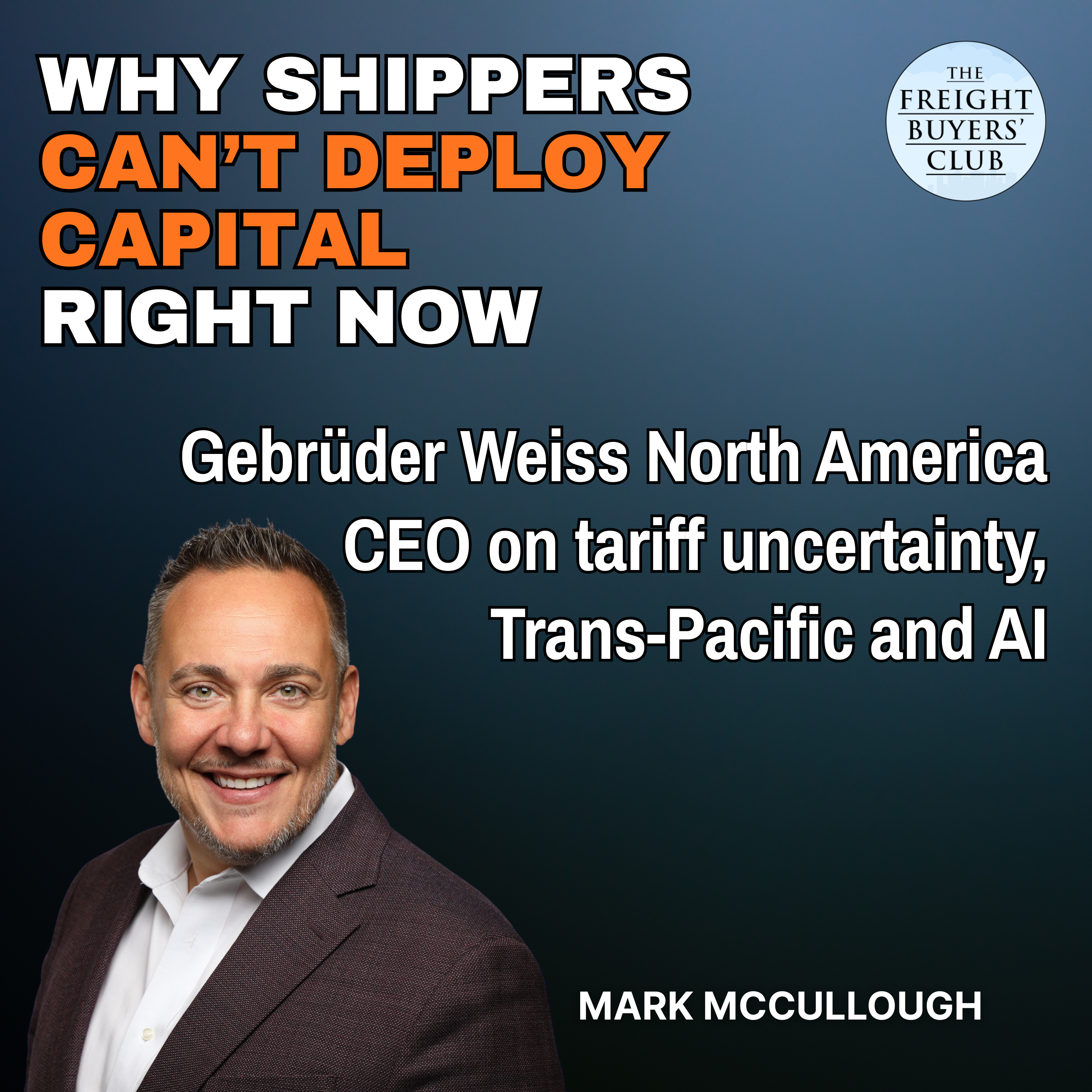
[00:00:03] Speaker A: Welcome to the Freight Buyers Club. I'm Mike King and today I'm joined by Mark McCullough, Chief Executive Officer of Brew Device North America, based out of Chicago. We're getting into carrier consolidation, tariffs, freight fraud, AI automation and how Mark ended up in this industry. Now that last one involves a funeral, a few beers and a South African relative. Let's get into it. Hello, Mark.
Welcome to the Freight Buyers Club.
[00:00:30] Speaker B: Morning, Mike, Good to be here. Thanks for having me. Pleasure.
[00:00:33] Speaker A: Mark. I think in that intro there I should have checked. We went through the pronunciation of GABRU Device and I didn't go through the pronunciation of your name and I feel like I might have just like Scouse. Liverpool massacred it because in Liverpool it's like, it's very Irish. We go, we go, McCulloch, McCullough. How do you, how do you say it?
[00:00:50] Speaker B: I say it McCulloch. But that's perfectly fine. Republic is perfectly fine. I think with your accent it plays well. So it's okay.
[00:00:57] Speaker A: Yeah, I, I can do, I can do a lot of damage to the German language as well.
[00:01:01] Speaker B: Let's stick away from that one, I think.
[00:01:03] Speaker A: Yeah, yeah, you pronounce it that way because no one can in your family can do like a Liverpool accent, is that it or. Well,
[00:01:12] Speaker B: we never even knew it. I mean I've got like 1% Irish in me. I'm like 88% Swiss. My DNA told me so. I, I don't know. You tell me. I have no idea.
[00:01:20] Speaker A: All right, let's get on with the shipping and logistics. I'm definitely digressing,
[00:01:25] Speaker B: Mark.
[00:01:26] Speaker A: Last week me and Nils Rocher broke down the proposed Zim Hapag Lloyd tile. How do you see that? Is that a good deal for freight buyers or just less competition dressed up as efficiency?
[00:01:37] Speaker B: Yeah, I think with these things, sort of depends who's buying whom, what their overall interests are. I think their long term interest, I think with Hapag Lloyd from a NVO freight forwarding perspective is a good partner. They have been for, for many, many years and continue to be. And from a Zim perspective, you know, we, we do a lot of work out of Israel as well and we've used them quite extensively over the years. We've always viewed them as a more value type of carrier, maybe not as reliable on the services and I think that, you know, hatbag, of course, if that deal does go through, I think we see more reliable services out of that area. I think you may have a little less competition, but I think overall freight rates are very, very Very low right now. And also from an NVO perspective, we don't mind higher freight rates. And, you know, if the steamship lines make a, a reasonable profit, I think it's better for everyone as opposed to the massive peaks and troughs that we've seen over the last decades.
[00:02:31] Speaker A: How do you think this plays in, into how, how people view the, the Trans Pacific? Maybe not in this contracting season, but maybe next. I mean, there's so many things going on in ocean freight at the moment as well. Possible Suez return, there might be an attack on Iran, I don't know.
Very quickly, excess capacity, there's more and more blank sailing.
[00:02:53] Speaker B: Yes.
[00:02:53] Speaker A: How are you viewing the ocean freight market and where do you think transpac is looking this year and maybe next year?
[00:02:59] Speaker B: Yeah, I think it's still, it's still depressed. I think everything you said right there is very clearly headwinds. Right. For the, especially the Trans Pacific, you know, transatlantic, obviously not quite as depressed, rates still remaining elevated. There's still good business happening there, you know, with the, the Trans Pacific situation right now. I mean, you know, just the added capacity alone, adding 7% year over year to total capacity over the next three years with the outlook that global GDP is, is not going to be as strong as it has been. So that's not a great recipe for, for booming commerce in the next 12 to 18 months. But listen, I think we're still bullish. I think that shippers are very resilient. They've become very agile, you know, again in that same time span. So, you know, we're still bullish on that. And I think as trends change, you know, ocean freight patterns change, trade lanes change, trade partners change. You know, we all have to remain agile as we have had learned to do really since the pandemic.
[00:03:57] Speaker A: So the message from GW is on oceanfrase at least, and there's a lot, all the powers now with, well, not with the carriers, as it has been for quite a few the last few years. Is that what you're saying?
[00:04:08] Speaker B: Yeah, I'd say the shippers are definitely in the driver's seat. I think, you know, coming into this contract season, which seems to become more and more delayed, you know, you're going to TPM in a couple of weeks or you're thinking about it. As I heard on a previous podcast,
[00:04:19] Speaker A: I'm pleased, I'm pleased to crash by on the flight.
[00:04:23] Speaker B: Right, okay. So you're in the starting block. Hopeful. You're hopeful. So, you know, there's probably not a lot of deals getting done. It's too early. Right. I mean, some people are talking about a price war in the Trans Pacific as well. You know, how long can the carriers hold out? People aren't going to sign at 1750. They're going to see $900, you know, in a price war sometime in July. And that's just some speculation there, but it's certainly possible. These are things we saw right before the GFC 0809. You know, prices got to record levels and that wasn't great either for the global economy. But we still need a bit of a reset in certain areas as well. I mean, it's way too cheap on the tp. Right. Obviously the trade there is depressed now. You have bottlenecks coming out of Southeast Asia where a lot of people have pivoted and shifted to right. Vietnam, Malaysia, Indo. You know, whether those are smaller feeder vessels coming in there and helping to improve the flow, which is obvious, obviously what it's going to have to be. They're going to not need necessarily these massive super carriers going from Shanghai to LA every 12 days. Boom, boom, boom. So a lot of capacity. Where do they park it? How long do they park it? Where do the next needs arise? Where do the next disruptions happen? I mean, you know, again, from a freight forwarding perspective, that's, that's how we make our money. Right. And when things are running very smoothly, there's not a great need for a high level service provider. When you have volatile regulatory landscape, when you've got ETS launching rockets, you know, various geopolitical issues, then, you know, people need to rely on their service providers, whether that's the customs consultant side, the freight forwarding side of it. You know, it's nice to have people that you can rely on as an extension of your business. And that's what we try to be.
[00:06:04] Speaker A: Obviously on the Trans pac. The big question for a lot of those, that ties in with a lot of those points that you just made as US Trade policy, where we're now on year two of the Trump administration.
Just to characterize it, I guess year one was tariffs, pauses, exemption, more tariffs.
[00:06:20] Speaker B: Sure.
[00:06:21] Speaker A: How are you feeling or how are your shipper clients feeling moving forward? Are they more confident about deploying meaningful capital at the moment? Does it feel like things have settled down a little bit more? Or. Or are we just getting used to the idea that this is what this market looks like now? This is what this administration looks like, this is what trade policy and the geopolitical landscape looks like, it's volatile and just accept it?
[00:06:48] Speaker B: I think that we don't have much choice in some of those regards. But I think that talking to business leaders, our partners and customers, and also industry peers, it's hard to formulate long term strategies when there's the possibility of major disruption within 24 hours, 48 hours, 60 days, 90 days, whatever the case may be. So I think that a lot of us are looking for a little bit more federal guidance. We should get some, some rulings out of the Supreme Court. And I think that, you know, as long as there are a process to this that gives it a little bit more predictability, business owners, business leaders can pivot more easily. Right. But you can't blame them for being a bit risk averse, you know, in this stage because, you know, if you go from India, they start buying fuel out of Russia again, 50% extra, right. I'm down here in Houston where again, you know, we've said it before, shippers have become incredibly resilient over the last few years with pandemics and what have you. But this town is booming in Houston, but it runs on steel, oil and gas and equipment, and everything runs on steel.
And we have the world's most expensive steel right now. Right. So shippers are trying to balance that. We're using bonded facilities, right, to mitigate the impact or at least be able to spread out the economic impact for these guys. And it still remains to be seen who will survive and who won't. Most newsreels or whatever that we see show that about 90, 95% of the tariffs are being absorbed by the consumer. So I don't see how long that plays out. You know, there's going to be players that don't survive this in terms of retailers, and they just don't know yet. So as a freight forwarder being in the middle, we certainly see a lot of the industry trends, but we also take on a lot of the risks, right? We take on the AR risks, we outlay the cash. We outlay a heck of a lot of duty as well, you know, for our customers at times. So, you know, we take on a lot risk for these guys, but that's why the partnerships are important. So we talk about these things in great detail with our customers and with industry peers. It's important to talk about these things and when necessary, you know, speak to your local senators. I mean, we have to push certain things through where possible.
[00:08:51] Speaker A: Mark, that's, that's a really interesting point you're making about the senators. Are you sort of saying that you're talking to people they're having these boardroom conversations about we, we want to do this, we want to do that with our inventory or where we're sourcing our product, but we can't because of the uncertainty. We would, maybe we would like to get out of China, but we just can't make that decision because we don't know what the, what's going to happen in Mexico. We don't know what's going to happen in India, we don't know what's going to happen in the US we don't know how much steel is going to cost, this type of thing.
[00:09:19] Speaker B: Correct, Correct. No, that's exactly what it is. I mean it is the uncertainty. Right. You can shift everything you want to Vietnam, where we seem to have a pretty good relationship right now from a geopolitical perspective. Right. But that can change relatively quickly. You know, with this administration. That uncertainty makes it very difficult to deploy meaningful capital or to enact, enact a long term strategy. So a lot of our customer partners do is they have a three tier strategy. Right. You have this up until that if this happens, we pivot to there. You know, they're getting manufacturing done in various areas. Some is coming back. Whether that's near. Shoring, friend, shoring. You don't know what the situation is going to be coming out of Canada, but clearly we need the minerals out of there. So it is volatile, you know, and it is uncertain. And I think again, you know, with just some, some more federal guidance, you're going to see a lot more confidence. I think you're going to see a lot more deployment of capital. There's a lot of dry powder on the sidelines. People are ready to spend money. But if your product is going to be 50% more expensive in the next three days and you don't know, it's incredibly hard to plan.
[00:10:21] Speaker A: Of course. That's great, Mark. Thank you. Let's take a quick break there.
[00:10:25] Speaker C: Boost your EBIT by 10% in just a few months. Sounds like another empty promise, doesn't it?
Maybe. We'll tell you it's magic. A sprinkle of fairy dust and poof. Your profits soar. But here's the deal. No fairy dust, just proven results. We've slashed late billing by 80%, recovered millions in missed revenues and cut cash cycles by five days for some of the world's biggest forwarders. Real numbers, real impact, real fast. If you are ready to find out how we do it, visit www.ontegos cloud.
[00:10:57] Speaker A: Welcome back, everybody. Right, this one I think will surprise people. Freight fraud is costing gebrew device hundreds of thousands of dollars a year. And it's targeting your sales culture specifically, how does that work and what are you doing about it? What type of fraud is this?
[00:11:15] Speaker B: Firstly, yeah, it's mostly related to ftl. Full truckload fraud, right?
We invested heavily in the full truckload about four years ago. We brought a director over, Kevin Sendry and his team, and they've done an incredible job. I mean, they've just done an amazing job bringing this product into Gebruder Weiss here in North America. But with that, of course comes some of the pitfalls with the fraud situation. And over the last four years, of course, it's only become more prevalent in this aspect of our business. So I was a little surprised to find out that it was up to $600,000 with GW loss last year. And it's, you know, it's, it, it starts out simple and it becomes more and more sophisticated. So I can tell you, you know, in the early days they would call us, we're you know, advertising on Google or you know, inbound logistics or wherever it may be when they call our sales guys and they say, hey, I got this urgent shipment, it's two skids out of la, I need it in Brooklyn tomorrow. Right? And of course we're excited. Boom. We don't ask questions, we pick it up, we ship it, we pay the carrier, who's got a legitimate motor carrier number, legitimate insurance certificates, everything checks out. With all the vetting tech that we have, we'll talk a little bit about that later. Everything checks, everything fine, right. But the salesperson doesn't ask, you know, why do we need two skins of rice from Long beach to Brooklyn in four days, right? So, you know, turns out $7,000. Absolutely double brokered. We paid the guy, the trucker never got paid, a situation, we're out 7,000. That's how it starts and how it's evolved over the last couple of years is what we have right now. And we get a call from a customer, they'd like to do some loads from Chicago to Ohio. Perfect. We do it. Everything checks out. The website checks out, the credit checks, mrc, everything checks out. So we're doing the loads. As soon as we post the loads on a trucking vet like that, dial a trucker, a trucking board, then a carrier comes on and says, boom. They give us a very favorable rate for that. They check out. Good, good history, everything vets. And we give them the load. Perfect. It's a legitimate shipper, legitimate consignee the load goes, we get paid, they get paid, everything works. We do two or three of those, it works amazingly. Now, two weeks later, they tell us, we have this new project. It's 10 loads, live loads, L A Brooklyn, right? 12,000 bucks. We need it here. Boom. You know, you get moving on it. Great, good customer, we're ready to rock and roll. We posted on the dashboard their carriers, their accomplices are waiting for that. They jump on it, they give us an incredibly favorable rate. Everything checks out, everything vets at motor carrier number, et cetera, Boom. We hire them, freight gets picked up, it's moving, they get paid. And that what they've done is they've already brokered it to somebody else. They didn't get paid. We paid the middle carrier $150,000, right? And it's gone, it's done. That guy's gone. I've got cargo that may or may not be even legitimate at this point. Because they've drug us in with legitimate loads in the beginning, right? And in most cases, they're not legitimate in the end. So you go and you look the executive, the cfo, everything matches with the legitimate company, right? But two letters in the last name, you know, one letter in the first name and the email address. And they're clever, they're sophisticated.
[00:14:28] Speaker A: Very sophisticated.
[00:14:29] Speaker B: It says yes. And it's, it's new stuff every week. I mean, we learn every week, you know, and again, this is something that we take on for our customers. You know, we have to make these commercial decisions, but we're learning through it. So it's a very expensive lesson, certainly, but we are learning for it. And that's why I think it's important again for us industry peers, you know, to share these stories, to get this stuff out there, because we're all victims. I'm just open about some of our wounds that have been inflicted, but I think it's important that we share these stories. You know, it's, it's not just us. You know, GW is not the only one.
[00:15:02] Speaker A: And this, this connects a little bit to your automation journey because I guess, you know, the one way of getting around this is deploying tech to protect against fraud.
[00:15:10] Speaker B: Correct.
[00:15:11] Speaker A: But we were talking earlier, we were going to meet in manifest and I couldn't make it originally. That's where you go and source a lot of this tech. You're now using bots to make carrier calls or you will be soon. And this is like document splitting, tracking updates, lead vetting, that type of thing. How is that going? And on the second point there, how do you go about then looking at how you might replace your shared service teams? I know you have them in Latin America or in Asia. How's that conversation going?
[00:15:40] Speaker B: Yeah, yeah. Though, I mean this is a very fluid and dynamic space, right. I think the Manifest Conference, which is an excellent industry conference, I highly recommend it. We started exhibiting there about three years ago, but really the partnerships that we made there from the tech perspective have really helped to carry GW and our products to the next level. Partners like Turbo on the FTL brokerage side that we then developed the LTL brokerage side together with Turbo, we're very proud about that. But then we add on tech like Fiway, who's vetting these carriers, who's up to the minute updates, you know, motor carrier number checks, insurance certificate checks, making sure these guys are legitimate, background checks on drivers. You know, it's just unbelievable. Tech that we had on Cardado does the same thing for us on the southern border, vetting carriers too, from Mexico. It's a tremendous partner. We've got organizations like Levity on the AI side and those are the ones that are helping us split documents. They're opening files for our operators. Right. Our operations process is estimated to still be about 35% manual. Right. That's what we want to automate. We train our freight forwarders at GW from A to Z. They don't just handle a delivery or a pickup. Right. They do the whole thing. So what we want to automate is them having to go to a copier or having to split documentation or you know, do stuff that a computer can update the actual times of departure, arrival, et cetera, et cetera. What's the custom status? Right. So this is all AI taking this in right now. And that for us has worked very, very well. Traditionally we have had teams in the Philippines, which we still work with today, very, very closely. Good partners of ours and in Latin America that do a lot of that work in the background that would update shipping details, that would make sure documentation was straight. And what's happening now with them in many cases is they're being upskilled to handle more difficult tasks. Right. So then they're actually now making sales appointments and calling. And this is things more complex conversations with shippers that bots can't quite, you know, do do quite yet. Right. And. And some shippers just don't appreciate bots. Right. So you have to balance that as well. So gw, we still want to have the personal touch, right. We think it's Important to train your freight forwarders from A to Z. Again, you know, this business is so complex as you know, listening to all your podcasts, you know, there's so many aspects and government agencies, regulatory authorities, third party influencers. But it's important for us to have incredibly good partners as well as we've strived to provide service to our partners.
[00:18:06] Speaker A: Everyone, everyone's talking about this, Mark. I mean it cool. It seems to me when I'm talking to people on the podcast and away from, away from it as well, there's this real rush across supply chains. Everyone knows they've got to be right on top of where tech's going to, particularly where AI is going. And everyone's also anxious about making the wrong decision. You know, didn't we want to grasp the opportunity? But they're worried about getting wrong. And there's so many providers out there at all try many of them probably won't be around next year. What's working for you and what would you say you've been getting wrong sometimes? I'm assuming that happens occasionally.
[00:18:40] Speaker B: Oh yeah, yeah, of course.
More than I'd like, Mike, for sure. But you know, you got to try things, right? You got to get out there and try something. You know what I think I find is that everything sounds great. Implementing it is another story oftentimes.
But what I've found is these tech guys, it started out manifest three years ago, hundreds of little booze and then one joins another, gets together, gets purchased. And what's actually happening is you would have three or four tech providers that's now consolidated into maybe one or two, and that has actually improved very well. I would say that, you know, what doesn't work necessarily is don't overestimate how good your own data is, because I think that that's where a lot of people go wrong. If your data is not in a good place right now, don't go and make those investments. Because I spent way too much money way too early and our data was crap, you know, to be perfectly frank. So, you know, it was all over the place. We didn't have right carriers in areas, whatever the case may be, and we needed to clean a lot of that stuff up, change some processes to make sure that the data was of an acceptable level, 95% in order for the AI to work properly. Because if you're only giving it bad data, that's really what it's going to spit out.
[00:19:53] Speaker A: Very interesting point you make there, Mark. I'm talking. I don't normally mention our sponsors, but I speak to Oliver Griff, who's the CEO of Ontegos Cloud, quite a lot and he's always banging home to me that none of this tech works. If you haven't got the foundation of understanding and being on top of your data. Can you give us a bit more of an example about how, why that makes things go wrong?
[00:20:17] Speaker B: Well, you know what the problem is, you've got the data in many cases, right? But in all cases, you know, organizations, larger organizations, you know, more easily, you get a little silent, right? You've got your contract logistics, you've got your legal, you know, you've got your compliance, whatever the case may be, ocean air, et cetera. And at the end of the day these things all work together in some way, right? And so the data, if you have too much, I literally had to train AI to clean our data. And the fact that we can do that now, I mean, I didn't do it. We have very clever people that are doing this, right? But the AI is teaching itself with the XML files that they're uploading, what is crap data and what is not, right? So until you can get to that point, you need to. Absolutely. Right. Have the right foundation. So you need to know what data you want, make sure, what's the key. Because if you get too much again, it just becomes noise, right? You can't even get, you know, decent dashboards, it just becomes too noisy. So data is key. Absolutely. Get rid of purge owed data whatever you can. And you can't start soon enough, take it from me. So, and that is more manual than you think and it takes time.
[00:21:22] Speaker A: Thanks for that, Mark. Just to finish on a lighter note, if we might, I sort of know this story, but I'd love it if you could tell it.
So a funeral, a few beers and a South African relative. Please tell us how you got into freight.
[00:21:37] Speaker B: Yeah, yeah, that's. It's a, it's a roundabout sort of way. So I'm originally from northwest Ohio, a small town outside of Toledo called Walbridge. And my uncle, my mother's brother, had married a South African woman and whatever, moved away and I really never saw him for a long, long time. And then his mother, my grandmother, passed away when I was about 19 and they came back from the funeral, right, was the first time I met Aunt Jane and she was in the freight forwarding business and in Johannesburg, South Africa. So you know, of course I was coming from northwest Ohio. You don't get out too often. Back in the late 90s there wasn't much Internet or anything like that. And I wasn't reading the encyclopedia, so it was very interesting for me. Right. You didn't hear people with accents very often in that part of the world. So the funeral came and went and everything. Good. Post funeral, you were at my uncle's house and. And she's had one or two, few, many white wines. And she begins telling me how I'm wasting my career and wasting my life and that I need to get amongst it and do something with my life. And then I should come to Africa and be in freight forwarding. And I said, sure.
Three weeks later, I was on my first international flight to Johannesburg. You could get visas very easily back in the day. And you know, the first time I left the United States by plane was to Johannesburg, South Africa. So I went there. I didn't know what the heck a freight forwarder does. What we did, she put me in sales because I had an American accent and I just learned it from the bottom up. So fortunately I had worked in warehouses and, you know, knew what a forklift was and a bill of lading and those types of things. So I was not a complete newbie, but. But pretty raw culture shop for sure. For six months. I didn't leave the house, but ended up staying for three years. And it was the greatest experience ever had. It was wonderful. Really beautiful place. Great place to learn freight forwarding, you know, a great place to learn freight forwarding. So changed the course of my life and I'm very thankful for it today. And then Aunt Jane actually came back and works for me. She ran my Dallas office for me for about 10 years and now she's retired in Florida and somehow still doing accounting tasks or something for the company. So it all comes full circle and it's been one hell of a journey. So it's been great.
[00:23:45] Speaker A: But a big thanks to and Jane. Then all this conversation wouldn't have happened.
[00:23:48] Speaker B: That's right. Yeah. For sure. I'd be working in some factory or getting replaced by AI right now. So, yeah, it'd be trouble.
[00:23:54] Speaker A: Well, enjoy your retirement. I'll tell you what, South African Karen, who's the production editor, will. Will cast a beautiful, magical spell. And hopefully on screen you can now see the good, the bad and the anc, which is my attempt to explain what the freight market's like in South Africa at the moment. Very interesting.
But Mark, brilliant conversation. Where can people find you next? Or if they want to get in touch.
[00:24:16] Speaker B: Yeah, I mean, listen, LinkedIn is always the easiest. You can find
[email protected] or Mark McCullough. Mark.mccullaworld.com you'll find me. It's easy enough out there. I look forward to it. Don't hesitate. Mike, thanks for the time. It was great catching up with you again, man. Good to see you.
[00:24:33] Speaker A: Thank you very much, Mark. Big thanks also Tom Ball and Karen Matthew for making our production look so good. Please do subscribe, leave a review and share this episode of the Freight Buyers Club with someone in procurement who needs to hear it. And thanks as always to Ontegos Cloud, the Freight Forwarder profitability specialist. I'm Mike King. See you next.