Episode Transcript
[00:00:03] Speaker A: You know, we've become more of a consumer protection agency.
[00:00:06] Speaker B: Shippers definitely have the leverage based on the overcapacity and demand not growing at that same pace.
[00:00:12] Speaker C: Nothing has really stopped the carriers from just their bad practice of poor billing.
[00:00:18] Speaker B: It's chaos or it's uncertainty because of what's going on globally, but also internal forces.
[00:00:24] Speaker C: And I should say I am hopeful. I'm not confident.
[00:00:26] Speaker A: We're always actionable.
Always action.
You are listening to the Freight Buyers Club. This podcast is brought to you by.
[00:00:36] Speaker C: Your host, Mike King and produced in partnership with Demurco Express Group, a global 3 PL that specializes in managing logistics to from and within the Asia Pacific region.
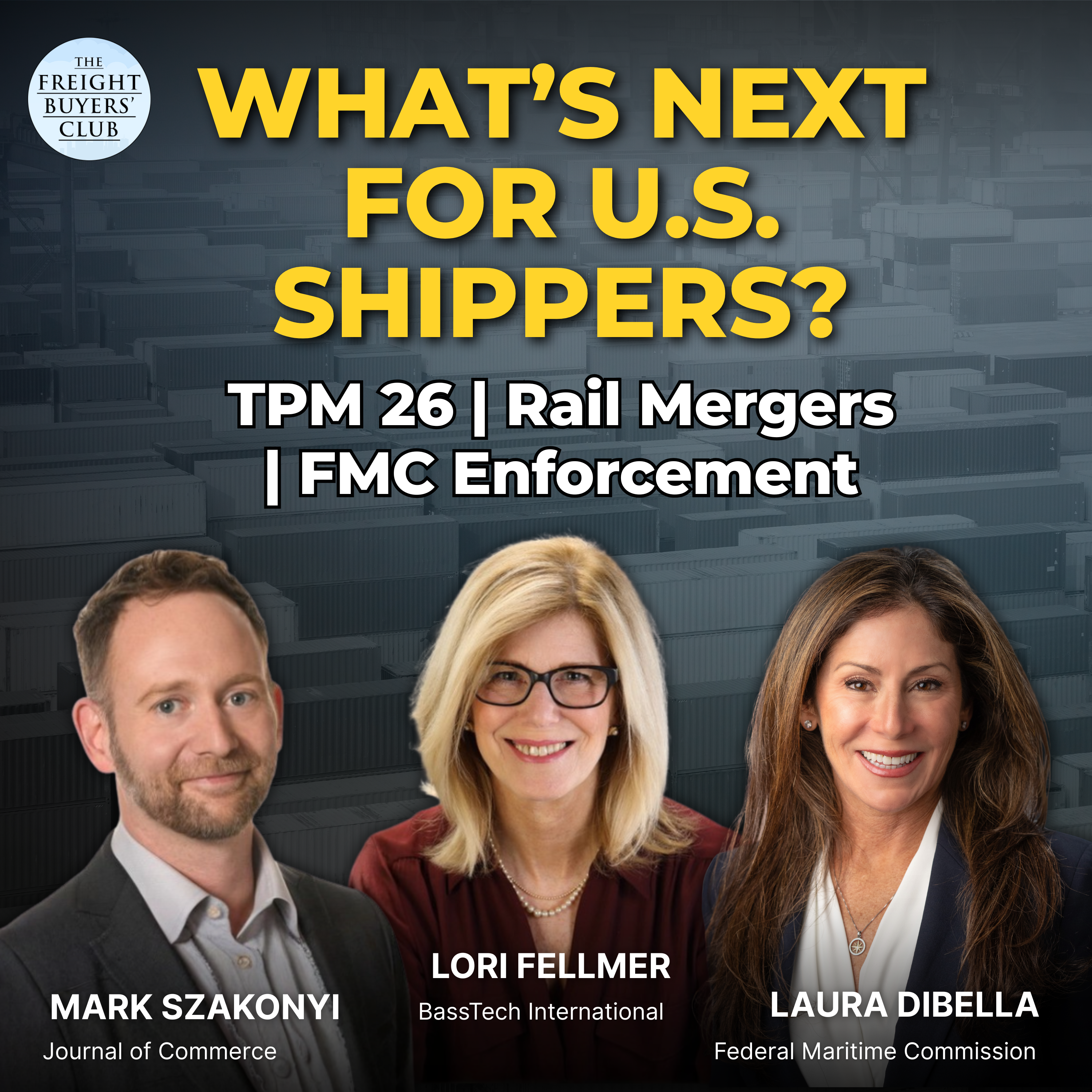
[00:00:47] Speaker D: Hello everybody, I'm Mike King and welcome to the Freight Buyers Club. As you just heard, this episode is produced with the generous support of Domeco Express Group. A bit of quick housekeeping before we dive in. You can find us on all major podcast platforms@the freightbuyersclub.com and of course in video on Spotify and YouTube. If you enjoy what we do and want to help us keep this content free, please take a second to like, subscribe and leave a comment. It really does help. Now, we've got a lot to cover today in Part two, stick around for an exclusive interview with the new Federal Maritime Commission chair, Laura dibella. She's shaping the FMC as a consumer protection agency with global enforcement powers. When I asked what Shiba should expect when foreign policies disrupt US Commerce, her answer was clear. Action.
Always action. You won't want to miss this. But first up, helping me decipher what to watch in freight markets and how to plan ahead for contracting season is Laurie Felmer, VP Logistics and Carrier Management at BASTEC International, and Mark Zacconi, Executive Editor at the Journal of Commerce. Hello, both.
[00:01:54] Speaker B: Good to have us.
[00:01:55] Speaker D: Mark, we've got TPM on the horizon at the start of March in Long Beach. Quick sales pitch. Give us some highlights, please.
[00:02:03] Speaker B: Well, I mean, it's the biggest shipping conference in the world. We've got Janet Yellen as our keynote speaker and numerous major carriers, bcos and forwarders. And there's a lot, a lot going on in the world. So we're thinking it's going to be nearly as busy, if not busier, than last year.
If you remember, we had tariff news breaking and we may even have some tariff news right on the precipice of tpm with the Supreme Court ruling coming possibly later this month.
[00:02:33] Speaker D: Yeah, certainly something to watch. Yeah. And I mean, last year it was. I think my podcast was actually called it's raining news.
Yeah, well I, surely it can't be as busy but if those tar, if that tariff ruling falls roundabout then it will be, it'll be very interesting.
TPM of course is the traditional place for carrier BCO talks as we head into contracting season.
So let's start by looking at demand on the Transpac. We've got this interesting situation where it's very difficult to see what exactly is going on. Sea Intelligence is saying US inventories aren't falling despite growth in retail sales. Containerized import volumes are forecast down slightly for 2025 year on year. But with more declines to come this year.
Lots of mixed signals. Mark, how are you viewing demand at the moment for container shipping into the us?
[00:03:23] Speaker B: Well, I mean it's obviously weak near double digits, particularly for China imports. I put a lot of stock in what the Global Port Tracker does with Hackett Associates and they're expecting year over year declines through April.
I think it's generally considered that this first half is going to be particularly weak in a sense is the second half is kind of still in play particularly as we watch some really interesting metrics in the last couple weeks whether it be the unemployment rates released yesterday or the conference board putting a consumer sentiment at some lows that we haven't seen since the financial crisis.
[00:04:03] Speaker D: Those first four months are sort of going to be quite interesting because we did have quite high volumes last year because of people were doing a bit of front loading for tariffs.
On the supply side we've had this specter of excess capacity looming over the global market for some time already. Thanks to record deliveries the oil to book stands at around 34% of the total fleet. Right now we're seeing this drip, drip of new services back into Suez. Depending on what happens with Iran, perhaps this could become a flood which further shifts the supply side in shippers favors. Mark, how, how do you see this playing out in 2026 and what are you expecting the Ocean Network Express CEO Jeremy Nixon to say about capacity management where when he speaks at tpm.
[00:04:50] Speaker B: Well, I mean you're right in that the central question is what is going to happen with the Suez. So let's, let's start there. I think from a geopolitical side and I'm not a geopolitic expert but at least from S and P analysis you know you still have a very hot situation in the Middle East.
So any, you know, the sense is that we may be seeing some short term peace now but things could get messy later.
Saying that, you know, we heard from Vincent Clark on the Maersk earnings just yesterday, noting that they were that they were restricted in terms of the return to the Suez by how much naval escorts or protection they could provide. So I mean, to me that the idea that the market is all of a sudden going to flood, yes, this is a world where it seems like anything could happen, but it doesn't look like it's moving toward that way.
[00:05:40] Speaker D: There is this school of thought that if you're going to realign all these networks, then right after Chinese New Year is the sensible time to do it in that sort of as we have that lull after that mini peak into Chinese New year, which starts 17th of February this year, you're not feeling that, Mark?
[00:05:56] Speaker B: Well, we haven't seen that in the actions. I mean, we saw CMA plan on expanding its SUS routing and then taking a step back. I mean, I'm looking at the amount of routings and the share of what that is for total trade, and it's still small. It can change, but there haven't been any major signs that that's happening.
[00:06:16] Speaker D: No, a few exploratory services.
Laurie, you spent a lot of time working for carriers and forwarders before jumping shipped to the BCO side of a computer like that. Can you give us an overview of the business you manage, where cargo and production is coming from, where it's being sold, and what challenges you've faced over the past year or two, especially around tariffs and US Maritime policy?
[00:06:39] Speaker C: Sure, Mike.
Our company is a small chemical distribution firm and we bring a lot of imported raw materials into the United States and ship them around the world, to be frank.
But part of the challenge is that when tariffs come on, we don't necessarily have the same sort of ability to pivot the way the consumer product firm might, because there's only so many places in the world where certain things are available, right. So that we are restricted that way. And when these tariffs came in, it really became a job for the logistics folks to to try to minimize the damage. And part of that was first being able to understand what the scope of the tariff was so that we knew what course of action to take to really minimize the impact, if at all possible, sharing costs with different parties in the supply chain. That's something left to the commercial folks, and that is done to some greater or lesser extents, but it's the unpredictability. And this is what we're used to living with now these days.
[00:07:50] Speaker D: Are you hopeful for more stability in policy from the White House this year, Laurie, or do events In Venezuela, Greenland, obviously, we just mentioned Iran there. In the Middle east, we've also had a few more tariff threats. Does that all point in the opposite direction?
I'm not hopeful.
[00:08:07] Speaker C: Well, I should say I am hopeful.
[00:08:09] Speaker D: I'm not caught in it, but optimistic.
[00:08:12] Speaker A: Optimistic, yeah.
[00:08:13] Speaker C: I'm not optimistic.
We've seen that. If there's one thing about this administration, it's a very whimsical way of taking decisions and it's very unpredictable.
But, you know, we just have to. We've learned how to read the signs, try to anticipate and roll with the punches and it's a big world, as you know, Mark was saying, the variety of things going on in the world, it doesn't have to just be coming from the White House. Anything can happen anywhere and we have to be able to prepare for it.
[00:08:44] Speaker D: Unfortunately, the nature of supply chains. Mark, your view on this, I guess. Should anyone be expecting anything less than chaos this year when they're looking forward?
Is this where we are now? A state of relentless unknowns on the Atlantic, the Transpac, and in the Americas as well, I suppose. Or are you looking at maybe new trade deals, Canada, Mexico, the EU and others coming into force and, and, I don't know, maybe balancing that ledger?
[00:09:12] Speaker B: Well, I mean, I won't speak to the unknowns, but I think you could make the argument that the administration's use of tariff policy seems to be easing a bit.
There is an easing of tariffs with India that was just announced.
There's been some walkbacks on other things and to a sense there may even be. The tariffs don't have the same power that they did six months ago.
Whether we should be expecting any growth from these trade deals, I would say no. I mean, in practice, trade deals take several years for true significant volumes that potentially materialize on an ocean trade.
So, yeah, no, I think, yes, we're going to see some stability probably eventually in terms of demand, at least on the US side. But yeah, it's. It's chaos or it's uncertainty because of what's going on globally, but also internal forces.
[00:10:10] Speaker D: There's also quite a long gap between when these, these deals are announced and when anything actually really happens. I mean, I think they're still negotiating the UK trade deal which was announced, when was that? Like, I know, Q2 last year, something like that. One of the first big ones, it was supposed to be a 10% tariff on the UK was heralded as this big, big great deal, better than the EU's, but still not a lot happening there. So we're not. I mean, when, when does India come into play? Next year, maybe.
A lot of those details are still being wrangled out. Trans Pacific contract season tends to hit full swing around tpm. Carriers of counterparty signing annual contracts which generally start May, June.
Mark, spot rates have been in decline. How are you looking at this contracting season? Is this, this a shipper's game?
[00:10:56] Speaker B: Well, I mean, the shippers definitely have the leverage based on the overcapacity and demand not growing at that same pace. What I would say is that, you know, the spot rates are not the contract rates. They are a barometer in terms of how the market is holding up and potentially the direction of pricing on the contract level.
Also, spot rates have fallen, but they've also been picked up. Again. We've seen pepping up of the rates that we're not seeing a complete crash. Yes, they're down about 40% year over year, but, you know, they're not collapsing either on the, on the contract rates. Yeah, I mean, we're, you know, we looked at some of Zenetta's collection of tender rates for Asia, the US West Coast. In January, Zanetta was showing that, you know, tender offers in the first two round of bids were about down a quarter from year over year. But yet, you know, we're also seeing tendering rates rise since then. So I think still there's a lot, a lot in play. But, yeah, I think generally there is more downward pressure on contract rates than there was last year.
[00:11:59] Speaker D: Laurie, someone who's been on both sides of these negotiations, how useful are spot rates? Right? I mean, if it favors you, you reference them. If it doesn't, you try and ignore them and say, oh, well, that's not a really real reflection of the market. Is that how it works for both sides?
[00:12:13] Speaker C: Yeah, I think that's a fair statement. But when shippers like to complain about carriers taking advantage. Right. And I'll be one of the first ones at that table. But on the other hand, in a market like this, it doesn't do a shipper any good to try to squeeze the last penny out of every rate, you know, and, and to reference things that are not really viable, you know, sudden dips in spot rates or what have you, it's, it's a very, you know, it's the same old story. You gotta work with your carrier partners. It's gotta be good for everyone. And frankly, I don't know. When you hear the financial news coming out of the carriers, I'm not sure that their senior management is gonna Be telling em to go sell the store to get volume. I just don't think that's a market plan anymore. That used to be something you could look forward to and take advantage of in this sort of market, but I don't think that's the methodology these days.
[00:13:09] Speaker D: So no taking revenge. Any more advice for shifters, Laurie?
[00:13:14] Speaker C: Find a good partner and go for whatever is important for your company. Whether it's a dollar value or consistency or surety of service. You have to do what's right for your business.
[00:13:23] Speaker D: Okay, excellent.
Laurie, at tpm you'll be giving an SME ship review on ocean supply chains.
On a general level, how, how do you think carriers treat SME shippers And are you thinking that with this bear market we've been discussing things might improve or are you more worried about things like maybe extra surcharges or a worse service? If carriers are trying to change that ledger slightly because we've just seen some results from Maersk for example, things were deteriorating in Q4 and they're not looking great for Q1, 20, 26.
[00:13:59] Speaker C: Well, carriers can always throw extra surcharges on there. That's certainly a something they have in their portfolio there to grab some money. But I think the way they specifically treat small or medium sized shippers is relative to their strategy for building out their shift based on contract cargo. So the ability to contract with a carrier and get commitments for weekly, you know, for service. Get commitments for service for your traffic is greatly diminished when you're a smaller enterprise because you can't commit a consistent high volume in a single lane every week. That's not the way small businesses operate. Do I think that the market might change that?
Yeah, I think the threshold might go a little bit lower, but it's not going to go so low that the traditional small shipper like myself is going to benefit immensely from that. I don't think it's a big change.
[00:14:57] Speaker D: And on reliability we saw some big improvements from, from Gemini Cooperation, that's Maersk and Hapag Lloyd. Are you seeing that translate into better service for shippers like Bastec or is it still a struggle? I mean maybe you don't use Gemini so. But the question's there better service.
[00:15:12] Speaker C: I'll go out and say I do use Gemini and I do think that their service is pretty darn good. This past year I think they did a very good job. I don't know that anyone else is scrambling to keep up with them as they're standard bearers or such.
And from the things I read I'm a little discouraged that it sounds that things may change because their services are being impacted by the general market and we'll see if they can, they can support that service offering.
[00:15:44] Speaker D: Well done, Gemini. Mark, what are you hearing from carriers I just referenced there? We've seen some relatively downbeat Q4 carrier results just coming out this month.
I'm hearing about deals, we're looking back on the contracting. I'm hearing about rates being offered by carriers that are way, way, way below where we are on spot rates. So what's your view on the carrier playbook? Are we going to see them try to defend contract pricing through service commitments and surcharges or should they just accept that this is the shipper's time, they've got the whip hand a container line just simply out of place, let's put it like that.
[00:16:22] Speaker B: Oh no, I wouldn't say that. I mean I think they are going to be judicial in terms of what contract rate levels they agree to and what they leave to the spot rate market.
I think based on what you've seen in terms of the capacity and action before, there's room for a major over correction or a correction in capacity. So yeah, no, I think and ultimately shippers are looking at a very uncertain year both in terms of demand and potential disruption. And there's a, there's a sense that they need stability. Yes, they are under probably intense pressure from the C suite, particularly if they're a small or medium sized importer because the tariffs are cutting into their bottom line ardor. But you know, ultimately I don't think we're going to see a complete clash at the, at the negotiating table.
[00:17:11] Speaker D: Okay, thanks, Marv. Right, let's talk about something that could reshape the entire North American rail landscape. That's Union Pacific's proposed acquisition of Norfolk South.
JOC has been all over this story for listeners. You aren't tracking it closely. What's the latest on the regulatory timeline?
[00:17:29] Speaker B: I think we're looking in the next year or two. There was a, the application was rejected and it's going to need to be resubmitted because there were some questions in terms of its completeness for us, particularly heading into tpbn. We're going to be hearing from Kenny Rocker of Union Pacific and others.
And you know, the central question is will this move the needle on attracting eastern cargo to the west coast because of this kind of transcontinental single connection, perfect steel wheel interchange. So we'll definitely be digging that. But that's the fundamental question for international shippers.
[00:18:07] Speaker D: Marc, which ports stand to gain or lose the most from a UPNS major? Are we looking at certain gateways becoming even more dominant for imported international freight then?
[00:18:17] Speaker B: Well, I would say La Long beach and Tacoma and Seattle. However, just because there's efficiencies gained through that merger doesn't mean that it's necessarily going to translate into more competitive IPI pricing. So yeah, there may be a play there, but ultimately it's going to be the railroads in terms of how competitive they want to price west coast moves.
[00:18:39] Speaker D: Laurie, do you see this merger as anti competitive and if so, talk us through. Why? What would your specific concerns be?
[00:18:46] Speaker C: I think I'll let the STB figure that one out.
Part of the application process is making sure that the merger rises to the benefits for the public interest and that it doesn't diminish rail to rail competition. I personally, I'm not an expert, but I personally don't see how this is going to meet those criteria. Now I think the STB has the ability to put conditions on any merger that's approved. So they might look at it and say this doesn't quite meet all the tests. But if we put these criteria around it, which the rail would have to adhere to, then that could really maybe keep the guardrails there.
It's a tough one. It's a tough one.
[00:19:35] Speaker D: Are you worried that shippers might lose leverage when they're talking to the railroad till this goes through? Is that what you're saying?
[00:19:41] Speaker C: Yeah, I'm not sure how much leverage they ever had, so I don't know.
[00:19:46] Speaker B: Well, I mean, I think they would lose leverage if they were a carload shipper. That's the bigger danger if they're, they're intermodal, not so much because that's going through the container lines.
[00:19:56] Speaker D: Coming up in a moment, we have an exclusive with new Federal Maritime Commission Chairman Laura DiBella. But let's finish on ocean shipping regulation first. Laurie, you chaired the National Industrial Transportation League. So you told me. This is called the Knit League, which I love, but you chaired their ocean committee and were heavily involved in pushing for the Ocean Shipping Reform act of 2022. The act brought in stronger detention and demurrage protections and gave a whole load more power to the FMC on a bigger budget. From your perspective, has this all worked? The ship is seeing some relief from this. Are they getting more support?
[00:20:30] Speaker C: It's a bit of a two pronged answer. On one hand, yes, the regulations absolutely benefit the shippers.
We do have protections that we can call when needed.
But unfortunately I can't tell you that it's really changed carrier behavior very much.
So while carriers might continue bad billing for demurrage and detention, the shippers do have a pretty good chance of fighting those and winning. But the problem is that every transaction can turn into a fight because nothing has really stopped the carriers from just their bad practice of poor billing. I think that's something that's still on the horizon that should and can be addressed in a broader way.
So let's hope that, that we can go there so that shippers don't have to continue to battle each individual instance.
[00:21:26] Speaker D: There's been a few DOJ rulings that I've pushed back on some of these powers as well.
Is that disappointing for you?
[00:21:34] Speaker A: It is.
[00:21:34] Speaker C: It took out one section of the regulation about to whom a bill can be issued.
So far I have not seen and I have not heard from anyone else any fallout where the carriers have reverted to those bad practices.
But we'll see, we'll see what happens. It is disappointing. The FMC does have the ability to make a rule. I think that's the right terminology to fill in the gaps that have been created by this change. But we'll see if they do it if they're inclined.
[00:22:07] Speaker D: Thank you, Laurie. Mark, what are you expecting from the FMC under Laura's leadership?
[00:22:11] Speaker B: Well, I mean, the continued investigation on airtime, chill points, foreign flagging, the investigation in Spain about accusing them of rejecting break bulk container cargo as it was tied to Israel.
So yeah, I mean, I think in her interview with the Wall Street Journal recently, she said that she was going to be making more of a geopolitical focus for the agency. I would note that there's limits to the agency's powers and there's four other commissioners on the commission.
But yeah, I think we'll see to the extent that she is able to shift the agency toward a, I guess a different type of role.
I guess my question is what does the shipper community really need and is this what they're looking for out of the regulator? But we still need to hear that.
[00:23:05] Speaker D: Well, I think there's a lot to look forward to with this interview that's coming right up because I've actually already done it and I can promise you we look at the geopolitical challenges that the US Is facing and where the FMC fits in with that. And we also look at that Spanish case along with a whole bunch of other stuff. So please hang on, that's coming right up. But for now, Laurie, Mark, thank you for your time and as ever, it has been my pleasure. Have a great tpm.
[00:23:30] Speaker B: Thank you.
[00:23:30] Speaker C: Thank you. Smoke?
[00:23:32] Speaker D: Please do stay with us, everyone. We'll be back with you in a jiffy.
If your supply chain runs through Asia, why not work with a company that has been connecting Asia with the world since 1971?
[00:23:47] Speaker B: Group.
[00:23:50] Speaker D: And now I'm very excited to say that I'm joined by Laura Dubella, Chairman of the Federal Maritime Commission. Laura, congratulations on your confirmation. Quite a start with a government lockdown to kick things off. How are you?
[00:24:02] Speaker A: I'm great, I'm great. I'm a little cold, you know, a little chilly, but we're out of the shutdown, so it lasted, it lasted a lot shorter than the, this cold snap that we're experiencing right now and I'm grateful.
[00:24:17] Speaker D: Well, thanks so much for coming on the Freight Buyers Club. We're glad to have you. You've got this fascinating mix of experience. So you're Florida Secretary of Commerce, Executive Director of the Florida Harbor Pilots Association.
You've got, it's business, it's lobbying, it's shipping, it's politics. Do you think that mix stands you in good stead at the FMC considering you're dealing with, with other arms of government and then this, this wide array of stakeholders?
[00:24:43] Speaker A: Yes, definitely. I mean, I've been fortunate enough to, you know, wear a variety of hats, both, you know, land and sea related and, and public and private, so in, in all aspects. So I like to say I have, you know, a pretty proprietary view of, of the economy, of the global economy, because when you're dealing with economic development at the highest level, but then also at the most granular level, you know, at the county level. So when in economic development and also commercial real estate, you know, you understand, you know, really where the rubber meets the road. But then you, you understand how to look at things from a 30,000 foot perspective and you know, and all the intricacies and nuances in between. So, you know, I feel very lucky to, to be where I am and to have the experience behind me and be able to talk the talk but also walk the walk.
[00:25:33] Speaker D: As you sort of reference there, the global trading landscape has been shifting the last few years, particularly right in front of our eyes.
I'm just interested in how this plays out in terms of your ambitions for the commission. I mean, this is a TPM 26 Long beach preview. So what should US industry, US shippers in the international supply chain sector, what should they all expect from your chairmanship, chairpersonship. However, you want to say it definitely.
[00:26:04] Speaker A: I want to say more of the same, but a much more expanded global overview of how the US Shipper is interacting in the global transportation space and any of the areas that we can help address and help make things more efficient, more competitive and just altogether easier so that commerce can move quicker, people can make more money on all fronts, you know, public, private, whoever it is. And just to keep our economy going, there's, there's always room for improvement. We've changed our kind of a little bit of a pivot over the past couple years to go from not only continental United States, but take it global. And I see that happening a lot more and I would love to have it to happen a lot more. I think our charter is so broad, it allows us to do so much and I think we've only scratched the surface of what we can actually do.
[00:26:57] Speaker D: Just on the international reach of the fmc. I'm very interested in exploring that.
You did say in another interview, I think it might have been for a good friend of this podcast, Paul Berger at the Wall Street Journal. I think you told him that now is the time to really put our foot on the gas and that President Trump is mandating we resurrect US Dominance in the maritime arena. They quote, what does that look like in practice for FMC policy and American shippers and that wider global community?
[00:27:27] Speaker A: I think, well, it is always, it's always a benefit to have the support of your, you know, and what you are looking to do. You know, the FMC is not new as, you know, has been around for a very long time. But, you know, the, the focus and attention on maritime altogether has really not been there until, you know, thanks to, shall we say, Covid. But then, you know, really thanks to our president today with, with what is happening, you know, the monies and resources turn towards, you know, shipbuilding, you know, everything as far as US interests are concerned.
But then also it's our. That's not in our wheelhouse, of course, but we're certainly supportive of that. But then how can we, the fmc, help on the American shipper side, which certainly supports the industry altogether. So we want to take advantage of this time and really, really exploit all of the attention and the love that we are receiving and want to enact the policies, you know, in the best way possible. Let's face it, we only have three more years with this president, so we need to hurry. Things don't happen quickly in our world and we need to hurry and get the United States, you know, at the Forefront, get the attention that they need and get, get American cargo, you know, where it needs to be as quickly as possible.
[00:28:42] Speaker D: No one's ever asked me to sort of take on a role like you've got here. People listening will not be surprised whatsoever about that. What's that process like? How do you get told, okay, this is your. Part of what we're trying to achieve. You know, who has that conversation with you is that the president is.
Just take us through that process of the commissioning element of it.
[00:29:01] Speaker A: It's, it's the president through his staff. And then of course, you know, with, with my amazing team here that has been working as long as they have on, you know, many of these priorities. So really delving into our charter, paying attention to what's happening in the world, you know, day in and day out, you know, we've. There's quite a bit of reading that we all do here in the, in the agency. And we, we look for market signaling, we look for all sorts of things that could touch on areas that we could be of assistance. Of course, we get a lot of feedback from the private industry, just the community at large, which helps elevate certain concerns. But certainly we understand the overarching priority, which is protect the American consumer. You know, have a more efficient, competitive global transportation system. But at the same time, you know, where are the pain points? How can we help through and understanding all the four corners of our charter? What can we do about it when these issues, good or bad, arise? How can we not only be reactive? And this is what I like to say is a big difference from maybe past to present, not necessarily under me, but continuing through me is the more proactive stance rather than the reactive stance that the FMC has had. How can we help moving forward? Not, how can we look, you know, behind us and say, oh, well, that shouldn't happen.
[00:30:24] Speaker D: Well, I'll, I'll come back on that. Because I mean, looking in terms of how I know the FMC from covering this industry for many years and how a lot of people know it, it was about competition, contracts, commercial disputes, detention, and demoria.
Making sure carriers offer space on fair terms, making sure alliances are fair as well.
But now you guys, you're investigating global choke point, shadow fleets, foreign policy barriers almost. It feels like a really big remit. Can you explain? I mean, maybe give us some examples. But how do you go about investigating all those other things on top of what you already did? It seems like a big workload.
[00:31:04] Speaker A: It is, it is. And for, you know, a mighty team of just over 100. It's how do you address the priorities and really have an efficient system in place here? So we're handling it quite well, and the team is excited, quite frankly. I mean, everyone here at this agency is very passionate about what they do and certainly passionate about what can be done.
And that's what I'd like to say is the overarching sentiment that we have here is that we all, I think, quietly understand that there's a lot of Runway ahead of us that we can really tackle as far as supporting the US Shipper. So it's really by taking on these new and exciting perspectives, shall we say, or initiatives that are taking a wider lens at the global environment, that's really the exciting point. And what can come out of that? And again, what are we going to determine on these investigations? I can't say just yet. I mean, we.
How do you go about looking at.
[00:32:08] Speaker D: Say, a choke point like Malacca or Suez, though? How do you get into that?
[00:32:13] Speaker A: Well, because it will affect the US Shipper. So how, how, you know, the, the litmus test ultimately is, is the US Shipper affected by this choke point? Yes or no? Yes. Okay, then that's where it goes into the, you know, the investigation column. So same with Suez, Panama Canal, you know, all of the other areas that, that are mentioned, you know, the Arctic, you know, any, anything like that.
So that's ultimately the question, the basic question that is asked when anything comes to us, be it an investigation or otherwise, is how is the US Shipper affected by this? Or are they. Are they? And then how. If so, so that's how we, that's where we begin. And then, you know, while we unpack, that there could be, based on the information that comes to us with these investigations, is how we determine how to proceed, either be it within our agency or with, you know, some of our partner agencies that we would work with.
[00:33:08] Speaker D: So, and who would that be? Like the State Department? Other arms of government?
[00:33:12] Speaker A: Yeah, could be State Department. It could be Department of Homeland Security.
It could be Coast Guard, you know, it could be Navy. It could be anyone. It could be anyone. So it really just depends on what, on what the conclusions we make within. And then, you know, how best do we address what, whatever information we, we uncover.
[00:33:31] Speaker D: So if there's like an investigation into Suez, just so I understand. So you would go, okay, there is, there has been issues for US Shippers, obviously, because of what's been going on in that region and, and the Houthi attacks on shipping going through Suez Canal has been Closed the best part, two years for most container shipping. We, we all, we know that so, and we know no one really wants that to continue. But what, what else can the, the FMC do beyond that? Is there any, anything there? I'm just trying to understand, get to the bottom of it.
[00:33:58] Speaker A: As far as the Suez. I see. I can't say because we don't have the information back on that. But what. Probably a better example when you're saying how can we be to help your constituents understand where we take these investigations, our Spain investigation is probably a good one to really bring.
[00:34:23] Speaker D: This goes back to 2024. This is three US flagged naval related vessels were denied access to ports in Spain. Right?
[00:34:31] Speaker A: That's right, that's right. So that investigation is still underway. So I can't say really how we're going to dictate where things will land, all of that. But if we determine that Spain did behave in such a way that prohibited US cargo at their ports, they could face penalties, they could face sanctions, they could face denial at our ports. That's the type of outcomes that could potentially happen. I'm not saying that they will.
Once again, we'll know better once all the information is received and determinations are made. But that's just again, the simple authority that we have that we can exercise on a global scale. A little bit different as far as you're talking about the other choke points, the Suez Canal. But again, it's unpacking information that perhaps would be helpful to our partner agencies, maybe not something that would be helpful for us.
[00:35:29] Speaker D: Okay, I see. So there'll be a research element to some of this.
I get you. When we think about, I know, supply chain pain, or call them choke points, whatever, often these are down to things like port access, equipment shortages, I mean, almost anything, not enough capacity at a port. These things happen for all. But other times it's like mistakes. Think Baltimore, think of the blockage of the sewers during the Suez Canal during the pandemic.
Is there a place somewhere down the road where the FMC looks at these as regulatory issues rather than just things that happen? Is that what we're saying?
[00:36:07] Speaker A: Yeah, and I can actually point to another investigation, you know, with like flags of convenience. So the flags of convenience investigation, I think kind of goes down that road in a sense where we're raising the issue. The issue is there and many in the community obviously understand it very well. But we're raising the issue even further to the highest levels of government saying these flags of convenience are a threat to not only our environment, but to our economy and for this, this and this reason.
So to take it from the seafarer standpoint and their safety, from the reputation standpoint of the industry, but also just the economic carnage that could happen to a port state should any of these dark fleet vessels or flags of convenience type types, you know, experience a terrible catastrophe on the water.
So it is.
We're so used to this us and I say we, you know, the industry, we're so used to this conversation day in and day out, but they're not.
So it's, we're really taking, taking this investigation and saying, hey, this is something that needs, needs to go beyond us and policies need to be, be established at the highest levels to ensure that this doesn't, that we're, we're not faced with these, these problems, nor anyone else for that matter. I mean, yes, we're talking about the United States here, but the US Shipper, but certainly many others would benefit from that exercise.
[00:37:34] Speaker D: We've seen the dangers right before for our eyes with the shadow fleet of tankers. So flags of convenience is another step down that road. Could we see a safer shipping in the future then? And if so, does the FMC and related government parties in the US have you got that ability to take on a judge and jewelry role rather than a referee for global trade? Is that how we could view it?
[00:37:57] Speaker A: I think so.
[00:37:58] Speaker C: Yeah.
[00:37:58] Speaker A: I think so, definitely.
[00:37:59] Speaker D: We certainly talk about more powers than the IMO have got.
[00:38:03] Speaker A: Perhaps.
[00:38:04] Speaker C: Perhaps.
[00:38:04] Speaker A: I mean, we have the, you know, we're.
I read this term the other day and I agree with it wholeheartedly. You know, we've become more of a consumer protection agency. So what does that involve? It could involve a lot of things, a lot of responsibilities and directives that could ultimately come about in different ways.
[00:38:23] Speaker D: For freight buyers, if they're seeing repeated bottlenecks or denied access or they're not getting, they're not getting the sort of services they want from carriers.
Should they be documenting all this and bringing it to the fmc? And if so, what would you say to them in terms of what you need from them?
[00:38:39] Speaker A: Yes, yes. To start. Absolutely. And I would say as much information as possible. I mean, what we don't. Again, this is Laura dibella speaking here.
We don't want to be the. We don't want to penalize people constantly. Like, it's not our job to penalize people. What we want to do is shape policy, policy through enforcement.
So if we can address an issue before it gets too far, before it becomes Too egregious. We provide the arena for that complaint to be addressed and hopefully remedied before it gets to a nuclear point. So I welcome open dialogue, you know, for shippers that are experiencing any issues, good or bad, you know, to communicate with us, with our agency, because it only helps us do our job, do our job better. But again, I don't think it's ever too early to start communicating with us if there's something that they've identified that could, could harm what they're trying to do.
[00:39:40] Speaker D: Just pulling back from sort of the. I guess we've gone geopolitical a little bit, pulling it back a little bit to the, to the more mundane supply and demand balance in container shipping. Now, most analysts would say we're looking at a bearish market in 2026. There's way too much supply, not enough demand. Is there anything you're going to be keeping a close eye on in terms of the service levels that American shippers will get?
Maybe linked to things like blank sailings, reliability, anything like that? Service levels, Put it like that.
[00:40:13] Speaker A: Yeah. I mean, in this, no matter the environment, you know, robust or a bit weaker, you know, as the projections are calling for an area of concern that has come to me just in this past month, you know, that I've been on the job, I think it's officially one month today, is largely has to do with the interior. Going back to what we said before. So Central Middle America is experiencing issues with containers. They have their own choke points as it relates to rail and containers and chassis and so on and so forth. So there's, you know, when you're talking about a slowdown that I think will only make that problem more acute because, you know, the containers are definitely not going to get to the interior, you know, at that point. So that's an area that is really rising to the top, shall we say, as far as the area that needs to be addressed in a pretty immediate way, especially after. Or the recent weather events that we've experienced here, you know, they've exposed many of the Achilles heels that still exist in Middle America and on the coast.
[00:41:24] Speaker D: Okay, so really looking at that domestic leg of international shipping as well. Just the last one, Laura, to finish up.
So a statement of intent to finish. When shipping lanes tighten or foreign policies disrupt American commerce, what should the industry expect from the FMC under you? Would it be observation, investigation, or action?
[00:41:48] Speaker A: Action. Action. Always action, always action. I mean, we're, we're, we're happy to observe.
[00:41:55] Speaker D: I handed that one to you.
[00:41:57] Speaker A: You did you did. You absolutely did. So. No, I Always action, Always action. I mean we're, we do all of the above. We do all of the above, but an action oriented person and certainly, you know, all those that, that work here. I, I defer to action all day long.
[00:42:15] Speaker D: Laura DiBella, chair of the Federal Maritime Commission, thank you very much for joining us on the Freight Buyers Club today.
[00:42:21] Speaker A: Thank you.
[00:42:23] Speaker D: And that part two Laura DiBella laying out a vision for a more assertive FMC, one willing to look beyond commercial disputes and into the geopolitical barriers that can choke off American trade. If you're a freight buyer, the takeaway is clear. Document your bottlenecks, understand your leverage, and know the Commission is ready to act when overseas constraints hit US Supply chains. Thanks for sticking with us all. My best regards to the Miracle Express Group for supporting the show. If this helped you prepare for TPM or your 2026 freight spend, share this content and subscribe thanks also to Karen Ball and Tom Matthews for their excellent production skills. I'm Mike King and this is the Freight Buyers Club.