Episode Transcript
[00:00:03] Speaker A: Trade policy is now being used as a tool really of coercion.
[00:00:07] Speaker B: Resilience costs money. Many companies are beginning to carry safety stock now.
[00:00:12] Speaker C: Multinationals really have to be flexible in this situation.
[00:00:16] Speaker A: Certainly has the potential to drive a wedge through the transatlantic alliance.
[00:00:20] Speaker C: AI accounted for half the growth in world trade last year.
[00:00:23] Speaker B: Visibility isn't necessarily enough.
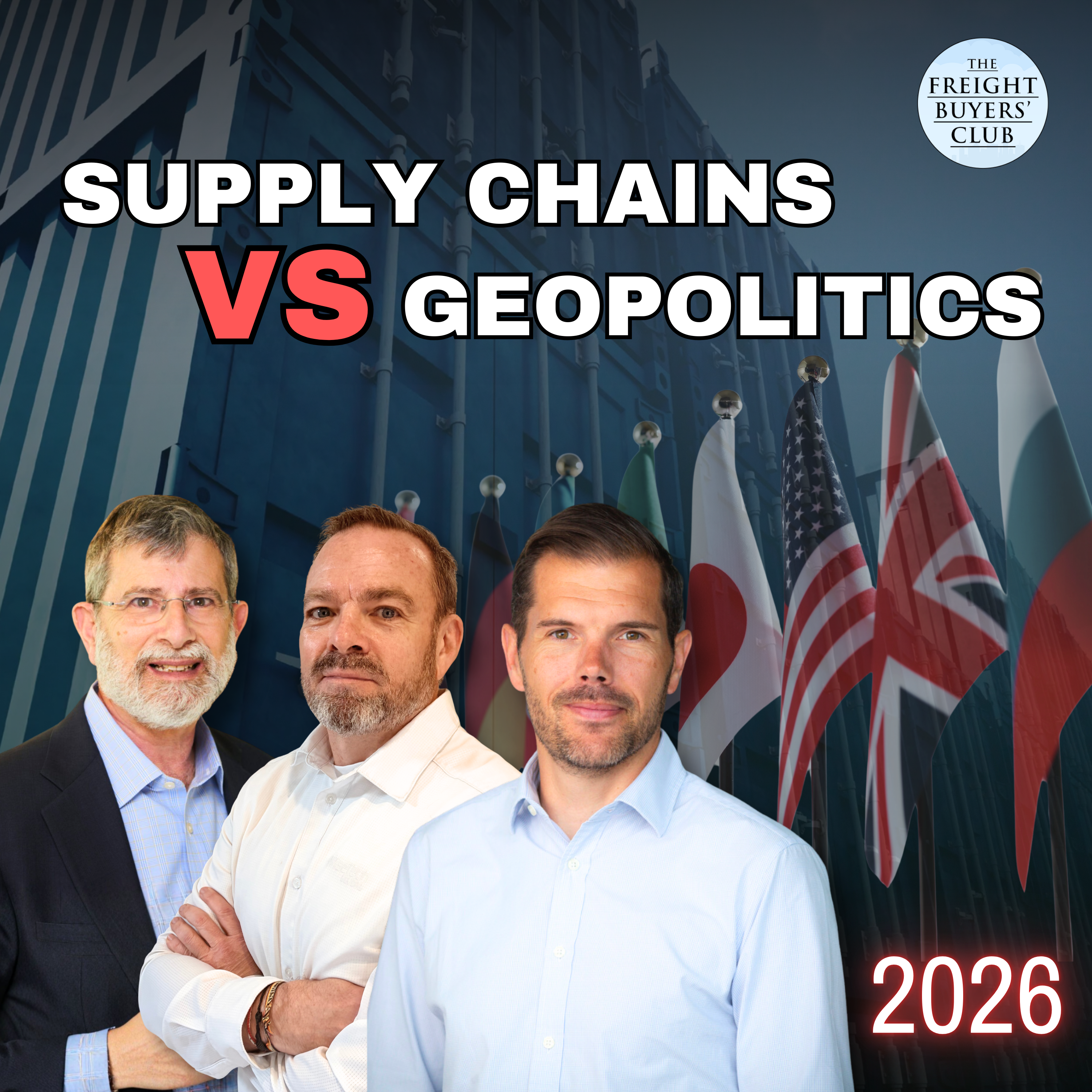
[00:00:29] Speaker D: Welcome to a special and rather timely Freight Buyers club roundtable. It's January 2026, and if you're planning global supply chains, you're dealing with three forces simultaneously. Geopolitical fracturing, structural changes in how trade works, and technology systems that can barely keep up. And if you've been paying attention to the headlines this week, you'll have noticed we're now threatening tariff wars over Greenland, which gives you a sense of where we are. I've brought together three people who see this from completely different angles. Neil Shearing is chief economist at Capital Economics and author of the Fractured how the Return of Geopolitics Will Splinter the Global Economy. Mark Levinson is an economic historian and author of Outside the How Globalization Changed From Moving Stuff to Spreading Ideas. And Ashley Scaniel is principal advisor, Carrier Integration and transformation at WiseTech Global and is here to give us some insight today on what's going on at the coal face of global trade. Neil, Mark, Ashley, welcome to the Freight Buyers Club.
[00:01:31] Speaker C: Thank you for having us.
[00:01:32] Speaker B: Thanks for having us. Thank you very much.
[00:01:34] Speaker D: Before we dig into what 2026 looks like, I want each of you to tell me from your perspective, what was the biggest surprise of 2025? Neil, I want to get some of your views in terms of what geopolitical forces are at play in how they'll impact trade in the future shortly. But first, up through that geopolitical economic lens, what caught you off guard last year? Or maybe you want to reflect on the start of 2026. It hasn't been quiet, has it?
[00:02:00] Speaker A: I think there's three things that perhaps came as a bit of a surprise last year. The scale of Trump's tariffs in Liberation Day, I don't think were necessarily a surprise, actually. They were broadly in line with what we were forecasting in aggregate terms, capital economics. But the distribution between economies was perhaps a bit of a surprise. Allies hit pretty hard as well as kind of foes and adversaries like China. Now, of course, some of that's been subsequently negotiated lower and the tariff rate on China has remained relatively high. But I think initially at least, the fact that the US seemed to be considering allies in the same way that it was considered in foes was a bit of a surprise. The second thing I think that was a bit of a surprise was the decision by the administration subsequently to relax tech controls on China, allow Nvidia to sell some of its most advanced chips to China. That certainly came as a bit of a surprise and has some implications for global supply chains as well as the AI race.
[00:02:58] Speaker B: And then as we move into 2026.
[00:03:00] Speaker A: It'S clear that trade policy is now being used as a tool rid of coercion around territorial expansion in the US and objectives there. And that's something that I don't think anybody had foreseen happening 12, 18 months ago.
[00:03:13] Speaker D: No. Quite a few surprises. Mark, you've worn quite a few hats over the years, including Finance and Economics Editor at the Economist and Senior Fellow for International Business at the Council on Foreign Relations.
But from your perspective as a trade historian looking at long term patterns, did the rapid changes in good flows that we saw last year surprise you or perhaps challenge your thesis that goods trade has been structurally slowing since 2008 or so?
[00:03:40] Speaker A: No.
[00:03:41] Speaker C: And first be clear. I'm not particularly expecting a decline in goods trade. What I have said is likely to happen is that goods trade becomes steadily less important as a share of the global economy.
That seems not to have been the case last year, but that's really exceptional. We've continued to see in general, goods trade becoming less important.
I think one of the things that's most surprising from last year is just how erratic policy has been, which really complicates trade decisions and supply chain decisions. I don't think anyone a year ago would have forecast that the United States would be threatening the war with Denmark. I don't think anyone would have forecast that we would put on 50% tariffs on certain countries and then cancel them and then put them back again at a lower rate and then raise them again.
This is really much more difficult for companies to deal with than simply a higher tariff rate. And that's greatly complicated trade flows. I think the thing that really has stimulated trade that probably was not foreseen as much was the strong interest in artificial intelligence. It's worth noting that the World Trade Organization estimates that AI accounted for half the growth in world trade last year. So that's been a very significant factor.
[00:05:03] Speaker D: Ashley, from your operational seat at Cargowise dealing with forwarders and shippers day to day, what changed most dramatically last year?
[00:05:10] Speaker B: Well, I mean, take your pick. Some of it's already been discussed. Tariffs, retaliatory tariffs, wars, abolition of the de minimis exemptions.
I guess it wasn't a surprise, the change of the alliances with 2M becoming or an effective most moving over to side with Hapang Lloyd in the Gemini experiment into schedule reliability.
But I mean, let's face it, in global trade, there's always something going on. It's the nature of doing business on a global scale. Right. You've got political influences, you've got social influences, you've got economic influences sometimes you've got ships that get stuck in Suez Canals, you've got all sorts of things.
So there's always something going on. But I think trade will persist. This year we had policy chaos. The tariffs started on a Monday, they were obsolete by Friday. They came back in again the next week.
Very difficult to predict what's going on there. You had Red Sea crisis, where I think this is a good example of where geopolitics, like a war and instability in a region, forces route changes.
Shipping companies simply took advantage of it. They made hay, they sailed around the Cape of Good Hope, and in so doing, they returned regularity to sailing schedules, which regularity is something that you want in the supply chain.
They took capacity out of the market and that had the effect of stabilizing freight rates, which again, is more regularity for the supply chain tariffs. You had winners, you had losers. But China kept on going. They just exported to different countries.
Vietnam, Mexico, they carried on growing. So I think bottom line is there's a lot of surprises. There were a lot of changes, there always are. But trades will just find a way to keep on going.
[00:07:05] Speaker D: Yeah, I think 2025 showed us that, that link between geopolitics and trade and operations on the ground, it's probably never been closer. Which brings me Back to you, Mr. Shearing. So, Neil, your book the Fractured Aid argues we're not seeing de globalization, we're seeing fracturing into competing trade box led by the US and China. Walk us through the key evidence and as anything since publication. Well, and not least, the US stick waving in early 26 against its own allies, as we're talking now in the third week of January, as any of the. Has any of these things made you reconsider your thesis?
[00:07:42] Speaker A: Yeah, good question. So the genesis of the book, the Fractured Age, kind of goes all the way back to President Trump's first term in office. Back then we had the start of trade wars, tariffs going up, frictions in the global system.
Lots of headlines in the financial press and the ft, the Wall Street Journal about countries turning in. Was the world de globalizing? Returning to the 1930s and you saw this rhetoric everywhere, but you couldn't really see it in the data.
Indeed, when we looked at world trade flows as a show of global GDP still close to record highs, global capital flows, it's not just about trade. Global capital flows off their 2007 highs, but still extremely high by historic standards. And despite the repeated efforts of Western governments to push back against big immigration, global migration flows, people flows, labor flows were still extremely high by historic standards too.
So we kind of asked ourselves at Capital Economics, well, what has changed? Because something clearly has changed. And the view that we came to when we looked at the data was that the central driving force in the global economy was not turning inwards, was not de. Globalizing. Rather it was a fracturing splintering of the global economy into two blocks.
One essentially centered on the US and another centered on China. And then that was forcing these two economies to pull apart and increasingly forcing countries to take a side. So if you think about to give a real life example of this in action, where the US gets its cell phones from now 1 FAQ 5 years China was the dominant supplier of cell phones, the US market supplying about 60% of US cell phones.
Today, China supplies barely one in five cell phones to the US market. And having supplied almost nothing five years ago, Vietnam and India are the two largest suppliers of cell phones to the US market. So a real life example there of how supply chasing becomes triggered around these geopolitical blocs. Big questions first of all is can this fracturing between the two blocks be contained to just geopolitically sensitive sectors, high things that involve high tech, dual purpose goods, semiconductors, biotech, smartphones, given the amount of data in them, for example, or is it a more pervasive spit?
How do different countries organize themselves? Who do they align with? Do they align with China? Do they align with the U.S. before the administer the Trump administration, about 60% of the world's GDP was in the U.S. block and only 20% was in the China bloc. And a few countries were neutral.
From our reading of the situation, some of the administration's policies have shifted some economies a bit further out to the US bloc and towards a more neutral category. Neutral.
So the question is, does that continue? So these are the questions that I'm being thinking, I'm thinking about now. Don't think it necessarily tears up the thesis thing actually supports the thesis. If you look at tariff rates on different countries, they're much higher on China from the US they're much higher on China than they are say on, on Europe at this stage, at this Stage being in the.
[00:10:56] Speaker D: Yeah, so what Bernard, like how did events over in Greenland at the moment and this potential conflict between Europe and the U.S.
does that push Europe a little bit further away from the US bloc? Is it way too early to talk about that?
[00:11:10] Speaker A: Well, I think it's probably too early to say.
[00:11:12] Speaker B: Right.
[00:11:12] Speaker A: I think it remains to be seen how this plays out. I think what we have learned from European leaders over the past 12 months is that they're going to take a pretty pragmatic attitude and stance on these kind of issues.
They're open to negotiation. I don't think that includes over the sovereignty of Greenland, by the way. I think that is a red line. But there are various mechanisms and deals that could be done that could eventually be presented by the US as a victory. So it remains to be seen exactly how this plays out, but certainly has the potential to drive a wedge through the transatlantic alliance. And if there was any attempt by the US to take Greenland by force and then yes, I think that would be a fundamental fracturing of that US block, wouldn't necessarily mean that the US and China became closer together. But maybe you get a third block analogy in this, in this fractured world.
[00:12:02] Speaker D: The US has more economic firepower over overall that US led bloc at least. But there's a lot of China has advantages in some areas that you know to technology and some critical minerals. And we've seen them leveraging this, this power in the negotiations with do other countries need to build alternative supply chains for things like rare airs or is that harder than say Washington thinks? And maybe Washington can build those supply chains, but can play other countries like Europe for example, or other bloc like Europe, can they build those alternative supply chains? Are they going to have to rely on Washington or I don't know, what's their alternative?
[00:12:39] Speaker A: Well, there's certainly a school of thought that would argue that if in this fractured world Europe should forge its own path, should become a third block in this increasingly splintered world world. I frankly have a hard time believing that Europe can do that, is capable of doing it, not because it lacks the economic heft it, you know, if you put this, all the European economies together, then there's a share of global gdp. They're similar in size to the US and actually larger than, than China.
But they're a collection of software estates. They struggle to speak with one voice, they move slowly, they're governed by consensus. All laudable qualities, but they don't necessarily make a global economic superpower and they lack the technological capabilities that both the US and Increasingly China has.
So I'm a bit skeptical that Europe can necessarily develop, particularly in areas of high tech supply chains that are independent of both China and the US if they wanted to do so for national security brands, which means that they'll be inevitably forced, I think, to pick a side at the moment, they will align more naturally with the US I think think that continues to be the case. This is only one, it's one administration. We'll wait to see what happens in 2028. The ties, the economic, social, historical, financial ties between the US and Europe remain extremely deep and it will take a lot to break those up. But they're being put into enormous straight, that's for sure.
[00:14:05] Speaker D: In this new world where supply chains are almost geopolitical weapons, we've got export controls, tariffs, government dictated procurement, closed market, all these rapid rule changes and almost the end of UN institutions that often have enabled the resolution of trade conflicts for multinationals caught in the middle. How do you plan when your supply chain could become a foreign policy target overnight? When there's no longer this, the UN or a global referee?
[00:14:34] Speaker A: Indeed, every single multilateral institution, whether it's the un, whether it's the wto, whether it's the imf, the World bank, they're all under pressure in this fractured world and they perhaps lack some of the kite that they once had. If you're a multinational, I think one of the lessons of the past several years has been that it's much better to move of your own volition and slowly and gradually than it is to be forced to do so rapidly.
Now, if you think about how European supply chains around energy shifted, that was clearly not because of US China fracturing, but it was a different example. It was Russian aggression in Ukraine.
But they were forced to change any of that very quickly and that imposed enormous costs through the supply chain. In contrast, I write about it in the book There's a case study in Toyota after the Fukushima nuclear power disaster, power plant disaster, they reorientated their supply chains to remove single points of failure within them and did it over several years. And it imposed all. The conclusion was they imposed almost zero cost to those supply chains.
So if you're a multinational firm, the first job to do is to identify whether you think you're operating in a sector that is potentially a bit more geopolitically sensitive and therefore vulnerable to some of these forces, subject to some of.
[00:15:52] Speaker B: These forces, and then to act.
[00:15:55] Speaker A: Don't try and wish it away, don't try and wish the world back to kind of Pre fracturing, globalized, multilateral rules based order to accept the world as you see it and to act. Because if you move slowly and you move gradually and you in anticipation of events, the cost that you imposing your supply chains is a lot smaller than if you're forced to by events.
[00:16:18] Speaker D: Mark, does this block formation story fit with your view of how global economies and trade structures are reconfiguring?
[00:16:24] Speaker C: Partially, but not entirely. I think one of the problems with the block formation idea is that there's at this point a great deal of instability in trade policy.
Last I knew, the United States had a free trade agreement with Canada and the two economies are very closely integrated. There are probably no two economies anywhere in the world that were more tightly part of a bloc. Well, now the United States has put up some trade barriers against Canada and Canada's put up some trade barriers against the United States. And the Prime Minister of Canada just recently went to China to improve Canadian Chinese relations. So they have more alternatives. The United States has a free trade agreement with Colombia, but that did not keep the President of the United States from threatening to imprison the president of Colombia the other week. So these blocks, at least under present circumstances, need to be pretty fluid. And I think that that makes things quite difficult for companies making investment decisions, making sourcing decisions.
I very much agree with Neil, though that multinationals really have to be flexible in this situation. I think you're starting to see companies making multiple choices about multiple sources of key inputs. Okay, we'd gone to China plus one. Now in a number of cases we're going to China plus two or three so that manufacturers and retailers can get their inputs from a multiplicity of places.
This has risks because in general it means higher costs for the producers and can threaten their competitiveness. But this is the world now that I think multinationals have to live in.
[00:18:09] Speaker D: Ashley, operationally, are clients preparing for this fracturing or turbulence or still hoping maybe it won't happen or not be as bad as, you know, as it could be? Or is this all just about building in resilience into supply chains and focusing on agility?
[00:18:25] Speaker B: Yeah, I think, you know, they're preparing. Our clients are mostly freight forwarders. And what they do is they provide a crucial role where they become a bit of a buffer, a hedge against volatility for the cargo owners because they have this capacity and flexibility built into their networks. If you can't book with a certain shipping company as a, as a company, you could go to a freight forwarder. They'll find a way to get your cargo moving or. Right.
And I think this is how they make money.
The greater the volatility there is, the higher the complexity, the higher the margin.
So are they hoping it won't happen? No, I wouldn't say so. I think they're preparing. They're prepared to a certain extent and they're preparing for what's happening ultimately. And I agree with the shifting in sourcing. They want to be where their clients are. Right. They want to be there to move the cargo, where the cargo is. Ultimately their focus is, is to do that. And the focus on the multinationals we were talking about is they want to stay in business. They want to continue to, to build the widgets that they're building and export them and sell them to different markets. And they're changing the way they're sourcing. But that's not just because of geopolitics, as Mark said. Right. With we've got China plus one, we've been doing that for years. Right. That was something that started way before 2025.
So I agree the shift is towards agility as a priority. And I think for them to be agile, they need well trained and well educated staff.
But they also need good technology, something that can provide them risk alerts, that can warn them of potential flashpoints or route disruptions.
So they're not sitting back, they're not taking sides. They're hoping to continue to do business and preparing for more of what happened in 2025.
[00:20:21] Speaker D: Okay, thanks for that, Ashley. Mark, in Outside the Box, which you referenced earlier, you identified three forces that taking away the importance of goods trade in terms of how we're developing economically, that was aging demographics, miniaturization and services replacing goods. Is that idea affected in any way or how you view the future? Is that affected any way by supply chains being these foreign policy, weapons or national security issues? How do you look at that now moving forward?
[00:20:54] Speaker C: It's interesting to see governments trying to restrain the flow of ideas. We're seeing that a lot more.
So something is now national security information related to the production of this or that. And a government is trying then to avoid scientific interchange, is trying to avoid the disclosure of information that might previously have appeared in patents, trying to control the intellectual supply chain as it might once have tried to control the physical supply chain. And I think we're finding that governments are not having a lot of success doing that. That's certainly the effort. And you see certain agreements by companies to do that. Okay. Some companies, for example, are saying we will do our research for the China market in China and we will do our research for the European market in Europe.
You can't believe that that's actually happening, right? Yes, officially that's what they're doing, but the reality is that they don't get any benefit from doing that if they're not sharing information within the company about new ideas and new approaches to production and new products and all the rest.
So there's a lot of information still flowing back and forth that is not recorded. And that's really, I think, where the action is in the international economy.
[00:22:12] Speaker D: Just back on Neil's fracturing theory. If they say the US block trades more internally and supply chains are more about resilience than efficiency, this does raise questions about how goods are moved and in what volumes. I mean, previously when we've spoken, Mark, you've been skeptical for one example of megaships, these massive 24,000 TEU vessels that the carriers keep ordering.
So if again, a flight of fancy. But if Europe and the US say, do turn away from trading with China, these ships are much use, are they?
[00:22:44] Speaker C: In a few places? For a few purposes. But I think we've seen a clear division among carriers. Okay. Some carriers have continued to buy vessels like that. Other carriers have opted for vessels of a somewhat smaller size. You've seen just in the past couple of years, very rapid shifts in trade patterns in Asia that I think relate to that. Okay. We've seen, for example, very rapid growth in trade between China and Vietnam. Seen very rapid growth in trade between China and India. Does it make sense to put a 25,000 TEU ship on a route between China and Vietnam where it's going to spend not very much time at sea and a lot of time being loaded and discharged?
I'm not convinced that it does. So I think that this restructuring of trade that we're seeing really weighs against having these extremely large vessels, except for certain purposes. There may continue to be demand for that between East Asia and Europe. But I think you're going to see that trade between East Asia and Europe is a diminishing share of the world's trade. And that means that there's going to be a limited demand for these kinds.
[00:23:54] Speaker D: Of vessels looking long term. How should the logistics industry and freight buyers prepare for these massive changes that we're considering today?
[00:24:02] Speaker C: It's tough in an industry where you've got to make a lot of capital investments.
One of the investments that I think is particularly challenging at this point actually is in the port industry.
There's a lot of money around the world Going into container terminals. It's not cheap, and yet we're seeing a lot of shifts in the pattern. So you could easily end up expanding a container terminal and then finding that the business is slow to come there. And I think that's going to be a challenge for a lot of people. I think that there's certainly a premium on flexibility and on risk management now, and we're seeing that. I think, all in all, the logistics industry has performed very, very well since the pandemic. And since these major shifts in trade policy, there's been surprisingly little interruption of goods trade, despite all that's going on. And that's really quite remarkable.
[00:24:57] Speaker D: I just want to dig deeper on some set Mark.
It's this shipping and geopolitical link in U.S. policy. This administration keeps talking about rebuilding its merchant fleet and shipbuilding base, but is that actually realistic or even necessary anymore?
[00:25:13] Speaker C: Oh, it's more than rebuilding the merchant fleet. The current US Administration is extremely fond of the word dominance, and so it's talking, among other things, of maritime dominance.
I'm not an expert on naval affairs by any stretch, so I'm going to leave the US Navy aside here. But when it comes to commercial shipping, the idea that the United States is going to be somehow a dominant player is crazy unless the United States is prepared to pour a lot of money into this.
We've seen, not just for years, but for decades, that the shipbuilding industry is extremely heavily subsidized. In some cases, the ship operating industry has been heavily subsidized. And I'm not sure the United States is prepared to play that game.
To have an effective maritime industry, in my view, the United States is going to have to rely very heavily on its allies. And you could envision perhaps a maritime industry that still builds its ships in Korea or Japan, but has components from many different places and is less reliant on China for components or for vessels potentially makes some sense. The idea that we're going to actually build a lot of commercial ships in Philadelphia or Pascagoula, Mississippi, I don't think that makes any sense at all. That's just not going to happen unless the United States is prepared to heavily subsidize the construction of these ships and the purchase of these ships, and I've seen no sense at all.
I might add that thanks to other trade measures, the United States now has by far the world's most expensive steel.
Steel in the United States costs well over twice what it costs in China, costs nearly twice what it costs in Europe. Oh, and by the way, steel is the largest single input into building a ship. So it's just not thinkable that we're going to be able to build ships in an efficient, cost competitive way in the United States and, and sell them to any commercial buyer without a lot, a lot of subsidies.
[00:27:20] Speaker D: I mean, do you even need US flagged hauls if you've got US flagged warships? I guess time will tell. Ashley, you manage carry relationships for Cargo WiseTech Global, a platform handling millions of shipments globally. You guys worked with Reuters last year on a white paper that surveyed over 450 supply chain professionals. 74% of supply chain leaders now call geopolitics their top threat. That's jumped from 33% a year ago. But what does that actually mean day to day and what does it mean in the future in terms of how companies and also you guys meet these concerns about this type of risk?
[00:27:59] Speaker B: That's a big question. There's another big jump actually in the stats or in the report about worry about regulatory changes, as we've been discussing, which jumped from something negligible last time of 8% to, to 59%. Right. And also in the report is the worry about transportation disruptions has fallen, certainly comparatively to the others. And despite things like Suez and despite everything else that's been going on.
And this is just indicative of how policy is now the main driver of volatility, as we've discussed. But also it drives what supply chain executives are worried about, not operational issues. Right. And this is shaping, as we've discussed, where companies source, how they source, how they move their goods, what it costs to move their goods. And ultimately supply chain decisions are moving away from being just about efficiency to being all about political geopolitical risk.
And that changes how companies operate. Right. Their supply chains have to become resilient by design. They have to become adaptable on the fly. It's not just about efficiency. I mean, you may have companies going from sourcing their goods out of one country, maybe with a backup supplier, let's say China. Right. With a shipping company, and maybe two. And that's it. It's very efficient. You develop a partnership with that supplier and your partners and you keep going. But that doesn't give you much resilience. It doesn't give you much if something were to recur. So moving now towards multiple suppliers, they're considering having different suppliers in different countries that are not affiliated to any of the blocks we talked about earlier.
They'll have several shipping companies to move those goods. They may throw a couple of freight forwarders in there just to provide a little bit of flexibility and maybe a contract with an air freight provider just to ensure that if there's an urgent need to get good out of the country, they can. Right.
And this becomes very complex. It's about building that redundancy so they have viable options.
But what does that ultimate mean for us, the tech providers? I mean, it's good news for us.
You can't do all of this on spreadsheets.
[00:30:22] Speaker D: Cost control is now the number one priority. 67% cite it in the white paper. But here's, I suppose the problem. 95% say it's extremely challenging. Building resilience. Geopolitical risk costs a lot of money.
So how do companies square that circle?
[00:30:38] Speaker B: Yeah, cost control is number one. And number two is increasing resilience to disruptions.
So, you know, it is a difficult one. Resilience costs money.
Many companies are beginning to carry safety stock now so that they've got a little bit of buffer built into their supply chains.
And we talked about a lot of different types of costs, tariffs, Fukushima, flooding. Not being ready is going to be excruciatingly expensive. I'd argue that actually if you're not ready for these things, that could cost you your company.
But I think, how do you square the circle? I think it's about being flexible with your costs. Some companies increase predictability by nearshoring and that may be somewhat more expensive in the short term, but it may pay off dividends in the long term or if an event occurs, because you have your supplier very near to where you want your goods to be consumed and you don't have transport, big transport distances, or different geopolitical factors to deal with.
Others in the report are talking about a more traditional method of cutting cost, which is squeezing your shipping companies, squeezing your suppliers on price. But ultimately they're not going to be the ones who are going to turn around and give you a favor and load your container on a ship or give you an extra production run.
If the proverbial hits the fan, they won't give you that flexibility.
The report points to this.
60% of these supply chain executives, they want to deepen their existing relationships. They want to create partnerships with their shipping companies, with their suppliers, with their ecosystem wary that they can't cut costs towards competitiveness. Right.
Two thirds of supply chain executives, in fact, according to the report, see technology as a critical investment.
And for them it's about adopting data driven operations as a way to sustainable savings. If you've got systems that can measure, you know, how your supply chain is performing, you can constantly, constantly look at it and improve and improve as you're going along.
So they're hoping to put themselves in a position to enable smarter decisions in real time and execute those decisions in real time by having access to this data and systems that can do that for them.
[00:33:09] Speaker D: Okay, thanks for that explanation. Something else that didn't make sense to me.
We had 64% of supply chain leaders plan to increase tech budget despite cost pressure. But 66% already use three or more platforms and only 4% say their systems work seamlessly. So this is where I was sort of stumped. If technology is the problem, why is more technology the answer?
[00:33:33] Speaker B: Technology is always the answer.
Spoken from a.
[00:33:37] Speaker D: You could say that.
[00:33:38] Speaker B: Of course.
I think it's a combination of technology and people. More tech isn't necessarily a the good thing, the right thing. Having the right tech, however, is something that I would argue for companies who are just buying technology.
These companies who have three or more systems, they're doing themselves a disservice and they're going to run into problems that manifest themselves in two ways.
Their people, these, these well trained people are going to have to learn new systems all the time. And these systems could be in different geographies and they could be replaced all the time.
So that puts a strain on the workforce.
And at the same time, if you're implementing all these multiple systems, again, different systems in different geographies where data isn't compatible, this is quite common. Where you have data in one country that's simply not compatible with other countries data, then your systems are not interconnected and you end up with islands of data and very little actionable insight into what's going on across your supply chain. And the report points directly to this as well.
Two of the biggest challenges to implementing new systems joint first in fact are training of the workforce and integration and interoperability.
So ultimately you can hire great people who have a lot of experience and who would know what to do if they have the right information.
But because so much of our day to day now is run on systems or apps on our phones or whatever it is, if they're not getting that information, they're flying blind.
There's a lot of really good technology companies out there. I'm not hitting on technology. Smaller technology companies, startups are great, right, because they're innovative, they're agile, they sell well into companies like this and companies buy it because companies are trying to build a best of breed solution that gives them an advantage over their competitors.
Something that's unique, right?
But you know, the problem is supply chains are big interconnected beasts.
And something that happens over here has effects all the way down the supply chain. And you do need a big interconnected system.
And this is where, as you say, 64% of respondents say that it's difficult to do and only 4% have actually done so.
And that just points to how difficult it is.
Again, it's more technology. It's not necessarily a good thing, but invest in the technology you've got, connect it.
And this is what we sell. At wisetech, we've been doing this for years.
We've seen a lot of companies reduce their tech stack. We've seen some Companies have over 100 systems and they have to reduce that down.
This is part of our go to market strategy.
Consolidate.
Build it all into one big system that is, that's connected throughout your supply chain, that's also connected to the outside world, connected electronically, maybe to your finance providers or to your suppliers or to your shipping companies.
But in, in a technology also where the vendor has the resources to build AI into it and, and to help automate a lot of the processes that are in there. And honestly, look, a dedicated tech provider can do this a lot better than most individual companies.
[00:37:04] Speaker D: A quick one to finish, Ashley, on this section. You're at wisetech, so you obviously benefit when companies consolidate platforms. But be honest, is the problem really too many tools or is it just that logistics technology hasn't caught up with what other industries can do?
[00:37:20] Speaker B: I'm conscious this is sounding a bit like a wisetech pitch.
Yeah, I mean, consolidation is good for us. As I said, it's one of our USPs and it's something we've been investing in for decades. And for that reason, I do take offense to you saying that logistics technology hasn't caught up with other industries.
Other industries. Technology works seamlessly.
As we've talked about today, supply chains are these big beasts. There's political and social and physical. There's weather factors. All sorts of things can, can go wrong. And so as the technology provider, we're constantly trying to catch up the whole time. It's like playing a massive global game of political whack a mole. But I think overall we do reasonably well.
And sometimes I liken it to the auto industry and it's like, I've been forced to buy an electric car. You might have bought an electric car. In the uk, governments are forcing one thing, which is legislation that says by 2030 or 2035, you can't buy anything other than an electric car.
But are they giving us incentives to do that?
You know, now they're charging road tax and now they're charging congestion charging to go into London. They're not exactly putting incentives in place for us to buy electric cars. So we, the consumers, we want internal combustion cars, we want to go long distances, we want. You know, the point I'm making is I think developing a car has a lead time. It takes years.
And an auto manufacturer needs to know, who am I building for? Am I building this for governments, am I building this for consumers? And, you know, then I need to start building. And it's similar for technology providers. It's not the same kind of lead time. But it takes a while for us to build these systems and fully test them and fully deploy them.
And when legislation changes to the left and to the right, all the time, we have to be as agile and adaptive as anybody else.
[00:39:24] Speaker D: Mark, I hesitate to draw your wrath as well, but you wrote about how the container revolutionized efficiency. Why hasn't. Well, my premise, I guess, why hasn't digital technology done the same for logistics?
[00:39:39] Speaker C: There are a lot of smart people asking that question and scratching their heads here.
I point to a big difference, and that is that very early in the development of containerization, there were agreements on the basic standards for a container. Everybody agreed where the doors should be, what the width should be, where the corner fittings should be, the length, all of those things.
In the area of technical standards, there are no agreements like that in the logistics industry. You've got thousands upon thousands upon thousands of participants and everyone has a reason why they don't want a standard. Rather, they'd like their own system to be the standard. And they don't want to take someone else's standard. They'd like to be able to obtain information seamlessly from other participants, but not give up their own information seamlessly to anybody. Okay, so you've got a lot of people who are in principle very keen on better technology and on seamless flow of information. But when it gets down to the nuts and bolts, well, maybe not quite so keen.
[00:40:53] Speaker D: All right, we've covered the macro forces, the operational reality and the tech sprawl. Now let's get specific. I want each of you to make one concrete call about 20, 26 that we can revisit in 12 month perhaps if, if you're all available, that is. Mark, China plus one has been the big story. Vietnam, Mexico, then we've got near shoring reshoring. Make you a call. Does manufacturing actually shift at scale in 26 or maybe 27?
Or do companies discover it's cheaper to pay the tariffs and stay put? And if you're right, what's the logistics industry still building or buying that we're about to need a lot less of?
[00:41:31] Speaker C: I think we're looking for pretty slow growth in international trade over the coming year. I think we're seeing companies really trying to feel this out, but I also think that we're dealing with macroeconomic conditions and demographic conditions that are leading to slow growth in international trade. We've seen, for example, slow growth in housing construction. We've seen not just in the United States, but in Asia and in Europe. Well, think about how much of what's traded internationally is related to people buying homes. The thing that's been supporting international trade this past year has been the growth of AI.
Maybe people continue to order a lot of servers and a lot of chips, but I think there are a lot of factors out there that are going to slow down the growth of trade.
[00:42:19] Speaker D: Ashley, you see the platform data in real time. Make your call for 2026 and tell me when the next shock hits, where will companies discover their flying blind and what won't they have visibility on?
[00:42:33] Speaker B: I'll take the second one first. Visibility.
I think it's not about visibility. We've seen a lot of companies invest in tracking over the last year or so, and tracking is good because it lets you know when something's gone wrong.
But it's not good because it doesn't know what impact that has on your business and on your costs and your customers and all that sort of stuff. It just lets you know that something's happened. So visibility isn't necessarily enough intelligence. Investing in intelligence, that would be the thing, right? Companies need systems that can model risk test scenarios, show the cost and service impacts of various different things in real time.
But I mean, my prediction for 2026, you got to bear with me on this one.
It may be hope, it may be somewhat prediction. But I come from a position where I look after the ocean carriers here at wisetech, and there's a lot of conversations around what's going to happen when Suez opens. So my prediction is Suez is going to open, obviously.
But when Suez opens, my prediction is that freight rates won't suffer as much as we fear because there's going to be a flood of vessels starting to go through Suez. It's going to hit ports that are already congested, in some cases quite heavily. So it could be China, it could be Northern Europe, whatever It may be. And you don't need multiple ports to be congested for the system to slow down. Right. A ship just needs to wait outside Shanghai for a week or so and you're taking that ship and the capacity out of the market and that's going to have an effect on prices.
We saw this during COVID right. Compound that with something Lars Jensen said from this push maritime, which has stuck with me, which is in the past, shipping companies have needed to reduce freight rates in order to get the cash flow so that they could keep the ships operating.
However, after Covid, they have built themselves massive war chests and they now in a position potentially to use those war chests to pay for that and to keep freight rates artificially elevated.
And they compound that with something that was said on your podcast, actually, the fact that the top four carriers, there's a massive concentration of about 60% of the market. That's where it sits.
It's not a lot of carriers who need to make a decision to keep the freight rates elevated for it to actually stick. So it's probably a left field one, maybe a hopeful one, but that's my prediction.
[00:45:16] Speaker D: Interesting, interesting, Neil, plenty to choose from on this one, but if I can put you on the spot, if a supply chain director is preparing for one geopolitical failure point this year, what would you choose? What's your advice?
[00:45:30] Speaker B: Goodness me.
[00:45:31] Speaker A: Just one, I think three if you want.
[00:45:35] Speaker B: I think one of the points that.
[00:45:36] Speaker A: We'Ve learned over the past 12, 18 months and indeed actually go back further over the last five, six years is that global supply chains are far more flexible and resilient than we might think in the face of some major shocks. Covid, the war in Ukraine and now Trump's tariffs. We've seen global trade volumes remain close to record highs. So my prediction would be the global trade as a share of global GDP, world GDP remains relatively high through 2026 and into 2027. Now within that we could get some big patterns, shifts in patterns emerging. And I think one that we'll continue to see potentially is trade between the US and China diminish. We've already got out at a record low if you look at the Chinese data. And I think that's going to continue heading in that direction over the course of this year.
[00:46:31] Speaker D: Okay, well, let's have a look at that in a year's time. Okay guys, that's great. If you're a freight buyer or supply chain director planning for 2026. What's your one piece of practical advice? Neil, you first.
[00:46:43] Speaker A: Well, I mentioned this earlier. I think that you've got to try and cut through some of the noise on tariffs. Don't get lured into reacting too far and too fast to some of the tariff news because it's going to gyrate all over the place. I think one of the defining features of the global economy over the next 10 years, and of course it's over that type of horizon that supply chain managers are planning, is, as I say, this kind of geopolitical fissure between the US And China. I think that will outlive Trump and outlast Trump.
And my advice would be to get planning for what that future state of the world looks like and the implications for your business.
[00:47:18] Speaker D: Ashley, one piece of advice for our supply chain director planning for 2026 would.
[00:47:23] Speaker B: Be to manage your supply side risk and it's actionable. I think a lot of companies have a lot of visibility into their tier one suppliers. They know them, but they don't have a lot of visibility into Tier 2 and Tier 3 suppliers. These are the factories that are producing the components and the materials that actually determine whether your supplier can supply you.
So my piece of advice is look into the multiple tiers of your suppliers, build knowledge into that, see where the risk could be and guard yourself against it.
[00:47:58] Speaker D: And Mark, to you, I think people.
[00:48:00] Speaker C: Have to await another year of instability and uncertainty in these sorts of things. I see a particular issue in the increasing attention of policymakers to the relationship or the purported relationship between trade and national security.
We're seeing an expansive view of what types of trade have some relationship with national security. We're not simply talking about semiconductors. And there are a lot of political forces, I think, in a number of countries that are leading to more and more types of goods being categorized as national security related items. And this is going to make life really difficult, I think, for logistics managers, supply chain people.
[00:48:49] Speaker D: Okay, thanks guys. Let me pull the threads together. Trade isn't ending. It's fracturing along political lines while simultaneously slowing due to structural economic forces. Technology is both the solution and part of the problem. We're drowning in tools but starving for integration.
And 2026 is going to be about making smart trade offs. Cost versus resilience, speed versus reliability, innovation versus consolidation. Thanks to Neil Shearing from Capital Economics, Mark Levinson and Ashley Scanhill from WiseTech Global. If you want to dig deeper into these themes, I highly recommend both Neil's the Fracchi's Age and Mark's Outside the Box, two essential books for understanding where global trade is heading. If you want to dig deeper into the data we discussed today. The Reuters white paper. Leaner, smarter, faster and more connected is available link in the show notes. Thanks to Karen Ball and Tom Matthews for production. I'm Mike King. This is the Freight Buyers Club. We'll see you next time.