Episode Transcript
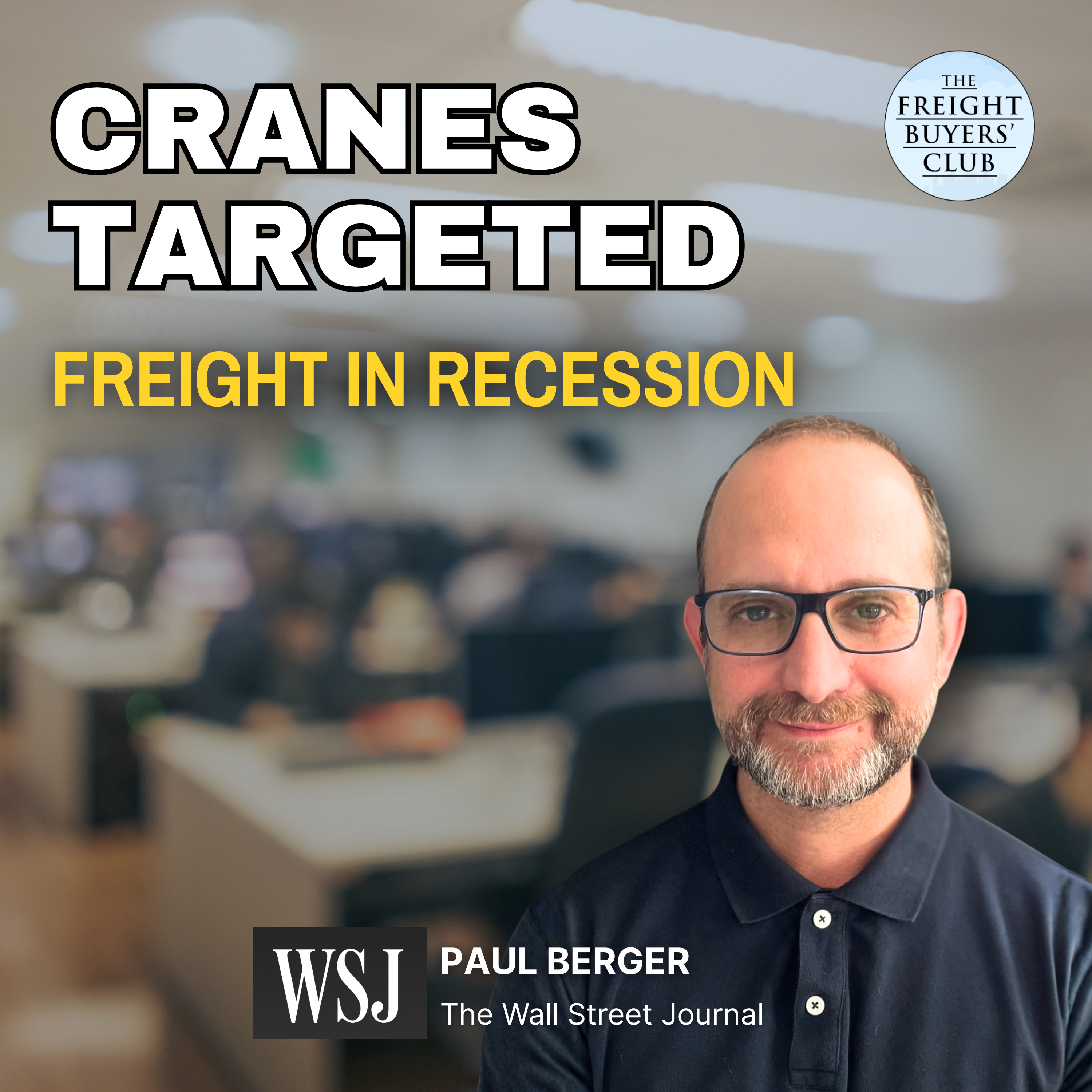
[00:00:03] Speaker A: Welcome to the Freight Buyers Club, sponsored by Freight Forwarder Profitability Specialists on Tegos Cloud. I'm Mike King and today I'm joined by Paul Berger from the Wall Street Journal's Logistics Report. Welcome, Paul.
[00:00:15] Speaker B: Thanks for having me, Mike.
[00:00:16] Speaker A: Paul, we both look at global supply chains and talk to the people that make the move as journalists, but your remit is markedly different at a Wall Street Journal.
Just to start, can you carve your beat off a bit? How do you see your business audience and how you go about serving it?
[00:00:33] Speaker B: Yeah, I actually don't know if the audience is that dissimilar, Mike.
You know, the WSJ Logistics Report is aimed at a professional audience. So when I'm thinking about stories, the main kind of people that I might have in mind would be maybe the chief supply chain officer or head of logistics at point, a major retailer or a manufacturer.
[00:00:56] Speaker A: Very similar indeed.
[00:00:57] Speaker B: Yes. Yeah. And then on top of that, obviously there are the executives at the logistics companies themselves. So it might be a port terminal operator, someone on an ocean carrier. Obviously, in trucking, it kind of runs the gamut from the small owner operators all the way up to the major publicly listed companies.
I'd say that's kind of like the core audience that my colleagues and I are always thinking about.
And then I guess the one difference might be that, you know, we're also thinking more broadly about Wall Street Journal readers. So perhaps somebody who isn't in the industry at all, but has an interest in it and, you know, we want to write the most interesting stories we can for the broadest possible audience on the logistics report.
[00:01:41] Speaker A: How do you and your team coordinate or work with the rest of the newsroom? And presumably this year it's been quite interesting for you guys because, I mean, supply chains and trade policy have been bank central to anything to do with U.S. business.
Have they been picking your brains to sort of get a bit of insight from your area of expertise so they can plug into what they do?
[00:02:03] Speaker B: Yeah, yeah, yeah. One of the great things about the Journal is the newsroom is absolutely massive. And, you know, we have a lot of colleagues who specialize in all sorts of different areas. And there are often times when I and my colleagues go to them for advice. Maybe it be something about cybersecurity or finance or perhaps a company that's going to have an ipo. I've certainly found in the last few years, there's always once or twice a year when you feel like the newsroom turns around and starts looking at you. We had the bankruptcy of Yellow, the trucking company. A few years ago, there was certainly the shutdown of the east coast ports and the strike. That was a time when people were turning to us. This year, obviously, there's been a lot about tariffs and trade. And so I feel as though that kind of April, May period, you know, after the tariffs.
Yeah. The Liberation Day tariffs. And suddenly everybody wanted to know about the ports of Los Angeles and Long Beach. They wanted to know about cargo flows and then the end of de minimis. So there have been a few times. Yeah. Where people have turned to us and it's just always great to be able to help.
[00:03:08] Speaker A: How have you gone about covering tariffs on tariff off, de minimis exemptions, all these geopolitical curveballs out of Washington? Because from my point of view, one of the big. It was the sheer pace of change in 2025 as being the issue in terms of interviews could just become obsolete. Well, almost in the same day. That did actually happen a few times for me and I had to re record them. How have you been coping?
[00:03:31] Speaker B: Yeah, yeah. No, it's happened to me too. And I think in the early weeks, particularly of all the tariff news, it was a little confusing.
There was one particular moment, I think probably the worst for me was I was actually headed to the airport to fly to California to do a story about the fall off in trade. Do you remember when the tariffs on China were up around 145%? Yeah. And literally as I was on the way to the airport that came in, that President Trump had reduced them to 10%.
[00:04:03] Speaker A: When I got caught out. It was the tariff cruise. Right. It was the overnight. I think it was announced on the Sunday. I had four interviews booked on Monday. So I moved from recording Thursday, Friday, from Monday, Tuesday, to recording on Mondays for Tuesday, Wednesday, because to avoid obsolescence. But I still got caught out. I started doing the interviews on Monday morning and it started filtering through what the tariff truce was. And the early Monday recordings had to be redone on Monday night and Tuesday morning because they were already gone. It was all old news.
[00:04:33] Speaker B: Yeah, yeah, yeah. Well, you know, and. And that's the thing, like, you just have to pivot, I guess. I guess it's been a year of pivoting. And I've found I, I think there's been. I can. I think there was maybe one time where we had to just spike a story and move on, but other times, you know, it's still possible to, to keep reporting. You just have to basically rewrite sections of the story, but the subjects themselves. Right. The, the tariffs, the geopolitics, the trade flows, they're still fascinating subjects and you can still pull stories out of them, even if you have to change them at the last minute.
[00:05:06] Speaker A: Well, absolutely. I mean, U.S. trade policy has become central to global supply chains and geopolitics. It's quite, quite a weird sort of interaction. Talking of pivots, let's look at one of those Washington policies because it feels like that might actually be pivoting or has pivoted during 2025. Washington's been talking about wanting to rebuild US maritime strength to bolster security, amongst other things. We're talking yards, fleets, cranes, the whole works. But there's been all of these announcements, but real progress and investment seems to have been quite slow. I mean, that's at best, port fees on Chinese vessels were supposed to fund this, but they've been shelved.
What's your take on this? Is it a serious goal for the US to get into ship owning, building and operating once more? I mean, is there any plan behind any of this, or is it a case of wait and see?
[00:06:01] Speaker B: I think the United States is serious about reducing its reliance on the Chinese maritime industry and also about building up the domestic maritime industry. I think it's just going to take time. Right. And I think as reporters, we're often used to looking and saying, oh, they made an announcement six months ago, nine months ago, one year ago. Where are they now?
With some issues, there might be some quick fixes, easy wins. But when you're talking about building up the maritime industrial base, that that is going to take a long time.
The reason that I think that the United States is serious about its maritime strategy is this isn't just coming from this one administration. Right. The investigations that the US Launched into the Chinese maritime industry were launched under President Biden. President Trump has kind of continued with this push and I guess in some ways is trying to supercharge it. But again, as I say, you know, it's going to take time. There was the executive order that came out, I believe it was back in the spring. You asked about the plan, right?
[00:07:08] Speaker A: Yeah.
[00:07:08] Speaker B: In that executive order, there was supposed to be a maritime action plan that was supposed to be some sort of blueprint for the way forward.
I think that document was due several weeks ago, but that got delayed because of the government shutdown. So we're waiting for that to come out any day now. I think the one thing that we can say for sure is that the US has this target in mind, but that it's going to take several administrations to see whether the the country has been successful in achieving any of its goals.
[00:07:40] Speaker A: It's very difficult when China's so dominant in so many of these industries. And if that's the target of the rivalry.
Just on your point on the Biden administration, I remember having a chat at the end of a conference to a US Naval security big wig, let's call him that.
This gotta be about six or seven years ago. He was very central to security policy within the Biden administration. I won't name who it is. He was telling me off the record about China built poor cranes being a real security concern to the US and no policy relating to poor cranes is something that you've been covering lately. What is the policy from Trump is this. It seems to be disincentives for buying the cranes. But how are ports reacting to this and what is the current policy?
[00:08:23] Speaker B: I guess the policy, yeah, is to try to deter ports and terminal operators from buying the cranes. And they're doing that by putting tariffs on them. So we had a 25% tariff on the cranes that was instituted last year under President Biden. And then more recently this year, only a couple of months ago, the administration put a further 100% tariff on the Chinese made cranes, which basically made them unaffordable for everybody. That 100% tariff was paused as part of the trade truce between the US and China that was announced a few weeks ago. And so when that pause happened, it actually made me question how serious the administration was about deterring ports from buying the cranes. But from talking to people in the industry, what they told me is that because it takes about more than two years from ordering the cranes to delivering the cranes, the one year pause in effect was kind of meaningless. And so what I'm hearing from people in the port industry and also in the ship to shore crane manufacturing industry is that basically America has stopped buying Chinese ship to shore cranes.
Some ports and terminal operators are looking to these other companies outside of China to supply the cranes.
Those cranes are a little more expensive and also they just don't have the capacity to serve the US market. And so what we're actually starting to see now, which I'm finding really interesting, is that ports are looking at extending the life of the existing cranes that they have that might be upgrading the technology systems, it might be raising the height of the cranes or even extending the booms. But basically I think a lot of ports are adopting a kind of a wait and see approach before they put in fresh orders. And perhaps they're hoping that, you know, if they can, either this administration changes its policy or they can outlast this administration, that under the next administration they might be able to go back to buying from China.
[00:10:24] Speaker A: I mean, just for listeners. So ZPMC is the big Chinese manufacturer of cranes. I went to their offices years ago actually. I'm not sure how many people have ever got in previously. It wasn't a great story that came out. They didn't tell me anything. But they're a massive manufacturer and they do the biggest cranes. I mean they've got, they've got a two year waiting list for a crane to be delivered anyway. All there actually alternatives. And I guess going back to my original point, is this policy about trying to get cranes built in the US trying to get them from, bought from somewhere else or, and is it a, is it a bargaining chip on trade or is, is this about security? Like my initial point is, is this about security or is it something else?
[00:11:03] Speaker B: I think there are people or there have been people in both administrations who believe that it is a security issue. There are concerns in the security establishment that the CR can be used to spy on the US or that if there were to be a war that the Chinese could shut US ports down. I think when you talk to a lot of the ports themselves and the terminal operators, they're quite skeptical about that. But if you want to at least give the U.S. security officials some leeway, they're the ones at the end of the day who are responsible for this country's national security.
There are these other companies, there's Liebherr that makes its cranes in Ireland.
There's Packo that makes its cranes in Japan. And there is a push, yes, that you know from the conversations I've been having with sources, there is a push to restart ship to shore crane manufacturing in the United States, but it's going to take many, many years to do that. And from the conversations I've had, it seems obvious that an American made ship to shore crane is going to cost more than a European or an Asian made ship to shore crane.
[00:12:13] Speaker A: I should think so, yeah. Okay, let's, let's have a look at another area that you've been covering. I'll put my hands up now and say sometimes it gets me slightly annoyed. It's what in America you call the freight market. So this quite often references in the US trade press, they just talk about the freight market, which for me and anyone else from an international overview, they're like, well which one? There's loads of them. Whether you're talking about air cargo, shipping, you're talking about geography. The UK domestic freight market is a market. What they mean is the US domestic freight market, which mostly means US trucking. So we're talking. This is like the World Series approach to freight markets. We're only talking about the us, nowhere else.
[00:12:58] Speaker B: We don't call it the world freight market, though.
[00:13:01] Speaker A: You may as well. You may as well. You assume we all know what you mean and you don't. Sort it out, guys. But I'm sure you don't do that, Paul.
No, not me, but you do cover domestic trucking and it is a really good barometer for the state of the US economy. This is the fourth year of recession of the freight market. What's going on?
[00:13:22] Speaker B: You mean of the US freight market? Yes.
[00:13:25] Speaker A: Thank you, Paul.
[00:13:26] Speaker B: The US surface freight market.
Yeah.
I think we're about to enter the fourth year of the downturn and there are several forces at play here. So on the one hand you have an oversupply of trucking which has come about because of the pandemic. During the pandemic there was a lot of money in trucking and a lot of drivers struck out on their own. We saw a lot of new carriers enter the business and then, you know, we had the downturn that started three odd years ago and normally the cycles last about 18 months to two years. That's what everybody has been used to. But I think because so many people made so much money during the pandemic, they've been able to hang on for longer than they ordinarily would be able to. And so what we've been waiting for is enough carriers to go out of the business to try to help drive up freight costs, freight rates. Sorry, but that hasn't happened yet. So on the supply side we have too much supply. On the demand side, there just hasn't been enough demand either.
We've seen these massive fluctuations in import levels, but ocean imports only make up a fraction of. Yeah.
[00:14:41] Speaker A: Significant percentage, but still 20, 25% or something. I think I remember seeing some figures for.
[00:14:47] Speaker B: Right, yeah, right. And U.S. manufacturing, on which U.S. trucking also relies quite heavily, hasn't been that strong. And so between the oversupply and the weak ish demand, we've just been in this extended downturn. And I've written the stories of people in Q1 looking forward to the second half of the year, I think twice now. And I think, I think people are kind of in a sense getting a bit tired at hoping that the second half of each year is going to be the upturn. But I anticipate that that is going to be the story heading into 2026.
[00:15:27] Speaker A: So I mean, we haven't got a deadline on how long this could run. Let's say it runs in through 2026. What are the implications?
[00:15:34] Speaker B: Well, I mean, the implications are more and more carriers are going to go out of business. But that's the thing, right. What we've seen this year, and I wrote a story about it not too long ago, is that we are seeing some of the healthier carriers start to go out of business.
And so that has been happening this year. In addition to the kind of supply demand dynamics that are going on, carriers have been under a lot of pressure because of rising costs, rising labor costs, rising equipment costs and also rising insurance costs.
And so, sorry, I almost made a prediction that next year we're going to see a.
[00:16:15] Speaker B: We'Re going to see the freight market come back and carry it. Sorry, the US Domestic freight transportation market. Yeah, thank you. Come back.
But yeah, there are certainly signs that there's a significant amount of stress. And although that's not necessarily a good story story for the carriers involved, that obviously is what the other carriers are waiting for, which is enough people to leave the market to maintain healthy freight rates so that everyone else can survive.
[00:16:48] Speaker A: While we're on this market. I mean, there has been a. Well, there is a bit of an EV push in terms of what's going on in terms of infrastructure and rollout. Where is that at the moment for EV trucks?
[00:16:59] Speaker B: EV trucks were doing really well. I think there was a significant amount of momentum in the United States, particularly in California, over the last few years.
I don't know if it would be an exaggeration to say that it's stalled, but it's certainly been struggling this year in large part because of the Trump administration, which has managed to either block or roll back some of the regulations that were beginning to push carriers into taking up the EV trucks.
The fact is that the equipment costs are high and the costs of setting up charging infrastructure is also high.
And the carriers I've been talking to this year basically say that shippers don't want to pay a premium for, you know, zero emission technologies. And it's extremely difficult, you know, for Paul Berger Transportation with a fleet of 20 EV trucks to compete with Mike King down the road, who's running a bunch of diesel trucks and can undercut me on price. So, you know, that's where we're at today.
The thing I'm hearing from the carriers I talk to is that folks are pulling back on their EV ambitions and kind of slowing them down a little bit. And we're just gonna have to see over the next few years if it starts to bounce back again.
[00:18:18] Speaker A: One to watch. Okay, Paul, let's look at something else that we've been covering on the Freight Buyers Club. And I know you've also been looking at it as well. It's how tariffs have changed cargo flows now within North America.
Obviously, Canada's been, well, it's certainly in the firing lane from President Trump. A lot of its ports, its container ports say of US Market. How have this trade reset with Canada? How has that been playing out for ports and supply chains using Canada to serve North America?
[00:18:47] Speaker B: Yeah, actually, as far as I'm aware, I don't think that.
[00:18:53] Speaker B: The trade war itself has changed very much in the sense that Canada for some time now has been seen as one of the gateways to get into the United States.
I think that what is starting to shift in Canada is this realization that something like 80% of Canada's exports are to the United States and that as Canada seeks to become less reliant on the US for trade, it's going to be relying more and more on its seaports to try to reach other markets.
[00:19:30] Speaker A: You did a story on Montreal recently that's expanding. What's going on there?
[00:19:35] Speaker B: Yeah. So Montreal has been looking for quite some time now to expand, basically build a new container handling terminal just outside the city.
And the story that I was basically in Quebec for the American association of Port Authorities Conference and so was able to just take a trip down there and go out to the site and see it. The thing that for me was really interesting about visiting the site, which is at a place called Contrecoeur, is that the Canadian government has basically selected this particular infrastructure project as one of five infrastructure projects of national significance.
They've set up an office that's there to kind of help these large infrastructure projects basically fast track them because there are, you know, so many points at which they can be delayed. And so Contre Coeur, the new terminal at Montreal, is being fast tracked as part of this process and is really being seen as a way for Canada to increase its trade with places like Europe and India.
[00:20:40] Speaker A: Okay, interesting. Well, we'll see how those Canadian ports fare and what trade policy throws up this coming year. As we're looking at 2026 after this year of policy turbulence, shifting trade lanes, all this political noise, are you expecting another year of almost too much, too much news? I was going to say noise, too much news. Or do you think maybe that there's a dimming of this energy coming from the White House, a settling or a. I don't like the word normalization.
Feels like a reach.
But okay, let's. A stabilization of US Trade policy, especially how it affects the rest of the world.
[00:21:21] Speaker B: Yeah, I have no idea. I mean.
[00:21:25] Speaker B: I see myself as a reporter rather than a pundit who's going to make any predictions.
All I know is that heading into each year, whatever it was that I was expecting that year never turns out to be the way I thought it would be.
[00:21:41] Speaker B: But I do think that there are some really big things that we already know are going to happen over the coming weeks and months. So we haven't even talked about it, I don't think yet. But there's the Supreme Court decision on the so called reciprocal tariffs. Right? That decision, I mean, you were talking about things changing. I don't know when this podcast is going to go out, but maybe, maybe by the time the podcast goes out.
[00:22:07] Speaker A: We'Ll have the decision straight away, my friend.
[00:22:10] Speaker B: All right, well then we're on safe grounds. Hopefully. Let me just check my phone.
[00:22:16] Speaker B: But yeah, so we could have the decision on that, you know, in the next week or in the following months. Right.
[00:22:21] Speaker A: Could be a big change. I mean that, that creates a whole new industry of everyone trying to get their money back or waiting to see what the next type of tariff might look like if the Supreme Court rules against the White House and we, and we have replacements.
[00:22:34] Speaker B: Right. So the one thing we know is that if the court does strike the tariffs down, this administration is probably going to look for other means of bringing in tariffs under other trade laws. We also have the renegotiation of the, the U.S. mexico, Canada trade agreement. Who knows what kind of tensions that's going to throw up next year.
[00:22:55] Speaker A: We also these every 10 years, isn't there?
[00:22:58] Speaker B: Yeah, we also have the, the ships going back to the Suez Canal. It may or may not happen. We don't know. But if it does happen, we know that's going to potentially cause significant disruptions at European ports. And also that could have enough when we have the extra capacity suddenly freed up because the ships are no longer going around the Cape of Good Hope, that could have an impact on freight rates. So just those three things alone to me seem like significant stories. And then there's all of the Donald Rumsfeldian unknown unknowns that have yet to appear. So I anticipate I'm going to be busy.
[00:23:37] Speaker A: I think. Yeah. Well, for anyone listening, if you want to get a bit of an insight into what happens if the Suez Canal or when the Suez Canal reopens, it look, it's looking more likely to happen quite soon than. Well, a lot depends on what happens with the Houthis, but we're assuming that this might happen quite quickly. We covered this in quite a lot of detail with Nils Roche, Peter sand and Cathy Liu on a previous podcast from last week. You can check that out on all podcast platforms. Paul, any other stories on your radar for 2026?
[00:24:07] Speaker B: There were the ones that we just discussed. Then I think just going back to one of the topics that we were discussing earlier, just this, America's desire to rebuild its maritime industrial base.
I found that story really fascinating this year and that's something that I'm really looking forward to following in 2026.
And I think also the other thing that we were discussing earlier, right, that the.
Sorry, I want to say the freight market.
[00:24:36] Speaker B: But U.S. trucking. U.S. trucking.
[00:24:38] Speaker A: You stick to that?
[00:24:39] Speaker B: Yeah, yeah, I am looking forward to tracking that and hopefully seeing a recovery because it has been very painful for a lot of people for a long time.
[00:24:50] Speaker A: Well, I will look forward to following all your stories. Paul, thanks for coming on the Freight Buyers Club today.
[00:24:55] Speaker B: Thank you for having me, Mike.
[00:24:56] Speaker A: Big thanks to Ontegos Cloud for support the show. Check out their website if you're a forwarder looking to boost profits. If you enjoyed this episode, do follow the Freight Buyers Club wherever you get your podcasts and we'll catch you next time.