Episode Transcript
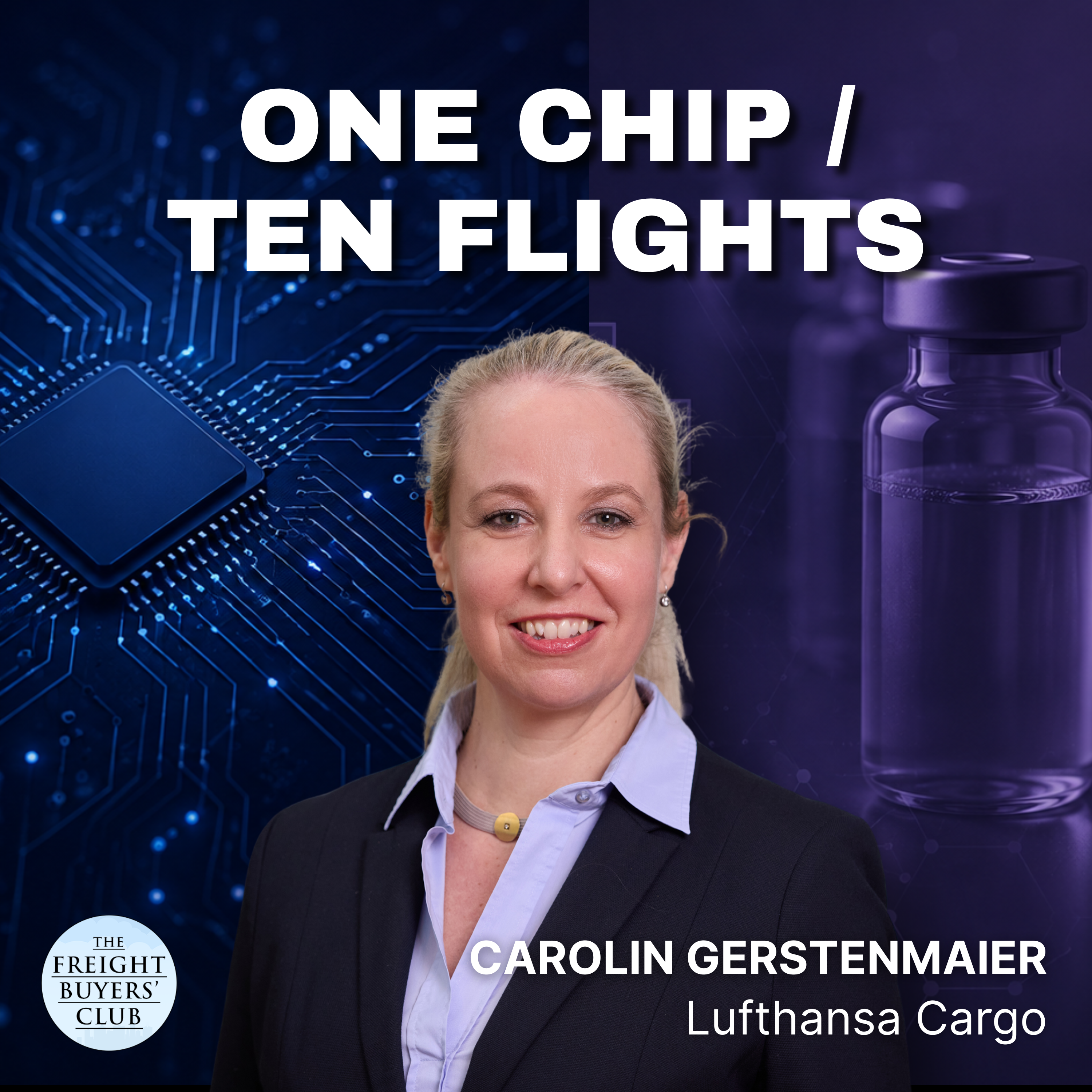
[00:00:03] Speaker A: Hello again, Mike King here at the Freight Buyers Club. This episode is brought to you by Democo Express Group, connecting Asia to the rest of the world. And I'm delighted to say that here in Air Cargo China in Shanghai, I'm joined by Carolyn Gestenmaier, who is head of industry development at Lufthansa Cargo and a bit of an expert in pharma and semiconductors. Carolyn, welcome to the Freight Buyers Club.
[00:00:33] Speaker B: Thank you. Thanks for inviting me to your interview and to your channel.
[00:00:38] Speaker A: Carolyn, you're very welcome. Can you just give us the sort of the. I know the big picture. Where are we looking in terms of pharma and semiconductors, in terms of the growth that you're expecting to see in the years ahead?
[00:00:51] Speaker B: Basically the industry and also we at Lufthansa Cargo, we focus on a variety of industry to really strongly develop those industries for our customers. But especially pharma and semiconductors are the highest value and strongest growing two industries.
Maybe to give you an insight regarding the size. So for pharma, the overall logistics volume is around US$140 billion of revenue per year.
And the air freight related, this means a growth of 3.3% per year. Whereas for semiconductors we have a market volume of around 124 billion per year and even bigger growth of 4.8% per year.
[00:01:39] Speaker A: And this comes after a decade of strong growth, I guess as well.
[00:01:42] Speaker B: That comes after a decade of strong growth. And those figures, they are already on average five years until 2030. And so we really see the growth continue.
[00:01:55] Speaker A: Okay, so a big mover in terms of air cargo demand just on the semiconductors. Can you give me a little bit more insight on how that demand has developed and what that's meant for Lufthansa Cargo and how you meet that demand.
[00:02:09] Speaker B: So regarding silicon and the development of the demand, it's important to understand how exactly the industry itself has developed first.
So looking back 30 years, when it all started with the semiconductor manufacturing, 80% of the manufacturing were based in the US and in Europe and Asia was still very small. Today, like 30 years later, Asia covers around 80% of everything which is semiconductor related and produced. And Europe and the US are only at 20%. So there's a higher shift but still a great interconnectivity between all regions.
[00:02:51] Speaker A: So Carolyn, can you tell me a little bit about the specific demands of the semiconductor business in terms of security, I guess, reliability, safety? I mean, it's quite a unique business, isn't it?
[00:03:04] Speaker B: It's a unique business, but at the same Time it's not a one size fits all business.
So when we talk about semiconductors, we always talk about one industry. But this industry breaks down to a variety of commodities and products which are really very different from each other. So we talk about chips, wafers, lenses, opticals, capital equipment, everything. And all of them really have very different requirements. And we as Lufthansa Cargo and the whole industry has of course to meet those requirements.
And safety and security, personal supervision, specific insurance, careful handling are all relevant features, but they are combined differently for the different commodities. Regarding semiconductor, how do you make sure
[00:03:54] Speaker A: that that is consistent right through the supply chain? Say if you're bringing something into Europe
[00:03:58] Speaker B: from Asia, generally you have a modular offer. And the modular offer first of all consists of of a basic product that customers can choose, then a specific speech and then add on services like add on services are like ancillaries, you can book on top. And like everywhere in the world, customers can put together this overall product that they need to have for their specific commodity, for their specific product. And this works worldwide.
[00:04:28] Speaker A: We talked before about the growth of demand, which obviously is very impressive.
How has that been changing by origin?
We talk a lot on this podcast about things like China plus one and the loss of manufacturing in Europe and the U.S. we've seen that in the semiconductor industry and we'll see that more going forward as well.
[00:04:46] Speaker B: Yes, that's true. So basically Today Asia covers 80% of semiconductor manufacturing, and out of those 80%, China covers more than half of it. And then is Malaysia is relevant. Korea, Japan and the US and Europe are small, but still very important.
So it's a shift, but it's not a regionalization and localization, which means that air traffic goes down, but everything is interconnected with each other. So just to give you an example, a chip might be designed in the US because there's no design in any of the Asian countries for a specific, specific kind of chip. Then the raw material comes from somewhere in Southeast Asia. Then it might be assembled in China and it will be packaged in Europe.
And there's up to 10 airfreight transportations.
[00:05:46] Speaker A: So complex supply chains, one product.
[00:05:48] Speaker B: So it's really complex and the complexity is going to increase, not to decrease. Although focusing on Asia will continue.
[00:05:57] Speaker A: And Lufthansa would be involved at all those different stages of that supply chain. Or are you focused on a particular, you know, from origin to final destination?
[00:06:05] Speaker B: No, basically we are involved in all of those steps, of course dependent on our network. But we are heavily investing also to cover all of Those specific requirements that the different steps might have. So currently we are working on enhanced tracking solutions, on enhanced documentation solutions which the industry requires on new careful handling offers. So we develop all the time to be up to speed regarding the market situation.
[00:06:37] Speaker A: Let's pivot to pharmaceuticals. Can you just give me an overview about what that industry looks like and how Lufthans are involved?
I'm guessing that's evolved in a slightly different way. The semiconductor business. From my shallow understanding of the geography of pharmaceutical global trade in general, the
[00:06:56] Speaker B: pharma industry is the second largest growing industry.
[00:07:01] Speaker A: Is that by volume or by value?
[00:07:03] Speaker B: I guess value both basically.
But by volume it's around 3.3% of growth every year forecasting like five years.
And we have a very specialized forecasting method as well. And it shows that also pharma is going to continue.
However, the focus countries are different than a semiconductor. So the US is still very big and we are always looking of course in export and import.
And the US is importing 50% of the air freight related pharma business and exporting around 30, Asia around 20%, in Europe around 10% and still it connects all continents. And of course it's relevant to be able to offer the full network.
Regarding trends in pharma, we see a trend and that's the most important trend in my perspective. Going from blockbuster medicine, which will still of course remain relevant and cover a broad majority of the demand, but to a specialized, very individualized medicine like radioactive medicine or salad.
[00:08:14] Speaker A: Radioactive medicine doesn't sound like it'd be very good for you.
[00:08:17] Speaker B: Yeah, but it is, it's rather.
[00:08:19] Speaker A: Rather you than me.
[00:08:21] Speaker B: Yeah, it's rather new. And basically radioactive medicine is to heal cancer or to support okay cancer, but also like before cancer or some types of cancer have even started. So it can help to support however this kind of doses that are produced. They have to reach the patient in 24 hours. So it's all about speed, time to market, reliability. And this time to market and reliability aspect is basically, I guess this is
[00:08:52] Speaker A: cold chain as well though this is got to be very important for that type of medicine I would guess.
[00:08:57] Speaker B: But speed is like it's cold chain as well. And cold chain has always been important for pharma transport. But now the speed and reliability part is increasing a lot because if the doses doesn't reach the patient within a specific short period time window, then it's. You can't use it anymore and it's gone. And so it's one shipment for one patient to flight. Critical logistics and that's very critical and of course completely different regarding the requirements than like the blockbuster medicine.
[00:09:25] Speaker A: Can you give us any insight into the way that you see the pharma business changing in the years ahead?
[00:09:30] Speaker B: Like pharma business, as I said, this is one of like the greatest strengths. Then of course what is also true, but also for semiconductors as well as for pharma is the need and the demand of customers to also include the aspect of sustainability into their logistics. Because as we all know, I mean we have to meet sustainability goals. And of course also many companies intend to develop here. So we also offer sustainable add on services with sustainable aviation fuel, et cetera. So this is really a trend. Also here in Shanghai we discuss a lot about with customers. And then of course artificial intelligence also in the pharma business becomes more and more relevant. And we are developing more in the direction of real time tracking, more traceability, more visibility for customers. For ourselves, for example, smart ULDs.
[00:10:28] Speaker A: Is this customer driven then?
[00:10:30] Speaker B: This is customer driven, yeah, this is a requirement of customers. And like in everyday life, you always want to know where your package you ordered from somewhere.
[00:10:40] Speaker A: I need to know, I need to know all of the time, all of the details.
[00:10:44] Speaker B: And of course our customers want to do it as well. And we are investing heavily in this direction. And this is closely connected with AI. So this is also one trend which will become more and more relevant.
[00:10:56] Speaker A: I mean the technology is one way our industry changing. I think the other way is the trading landscape is almost changing right before our eyes. Whether that's because of geopolitical tensions or more protectionism or tariffs, this type of thing, or more free trade agreements. How does that change in landscape play out for pharma and for semiconductors or any of the other industries that you look at? How do you see that developing?
[00:11:22] Speaker B: I mean of course like tariffs or other geopolitical developments, they are relevant, but basically they don't interrupt our business. They might bring like a small interruption in a specific area of the world. But air cargo and generally aviation has always been very dependent on geopolitics and on external factors. And whether it is Russia and Ukraine or Middle east or tariffs of the U.S. we always have to adapt really quick. We adapt our network sometimes. We also benefit of course from the situation is also part of the truth. But I think speed, adaptability and a large network where you can shift capacity from one area of the world to another is key. And control the controllables, but adapt to what you can't control, that comes in
[00:12:21] Speaker A: with compliance as well. Obviously there's quite strict compliance regulations in both of those industries.
You need to be flexible to adapt to those as well. Can you tell us a little bit more about how you go about doing
[00:12:30] Speaker B: that, especially in the pharma industry? Of course those compliance related issues and like the standardized framework for pharma logistics is key. You need it, you can't get around it. And of course we are very close to the developments. Of course we do a lot of certifications. Like the Lufthansa cargo network has more than 230 stations that we are covering and around 40 are GDP certified. And a part of those 40, 40 are CEIV certified, especially our hubs. And of course we're investing to keep up to quality standards and the framework we are given, and this is due respect as well.
[00:13:14] Speaker A: Where do you see these industries going in the next few years? You did say that there's going to be a bit of growth. I mean, have you got different levels of projections in terms of where that growth would be? I mean, is there more upside than what we've already discussed?
[00:13:27] Speaker B: Yeah, basically we have an industry dashboard where we are very closely evaluating and calculating where the demand was. But as we just discussed, of course geopolitics are
[00:13:40] Speaker A: lots of unknowns.
[00:13:41] Speaker B: Lots of unknowns. But generally regarding semiconductors, I would see looking into the future until 2030. Basically like a hundred more manufacturing plants like those so called fabs are being planned because governments and also private companies invest a lot. And the investment is also with the CHIPS act of the US and the European CHIPS Act. There will be also a lot of investment in the EU and US and like China and Asia will grow at the same time and the interconnectivity will also increase as well. Well, so basically he will see an increase in Europe and US while Asia does like keeps us the status. And regarding pharma, we also assume that like the three biggest parts of the world, like India, us, Europe and at a specific level, Asia will remain important.
[00:14:38] Speaker A: Carol and Gerstenmaier, thank you very much for joining me today on the Freight Buyers Club.
[00:14:42] Speaker B: Thanks a lot for having me.
[00:14:45] Speaker A: That's it from the Freight Buyers Club. Big thanks to Jamerica Express Group for supporting independent journalism. I'm Mike King. We'll be back with you soon.