Episode Transcript
[00:00:02] Speaker A: If your supply chain runs through Asia, why not work with a company that has been connecting Asia with the world since 1971? DiMerco Express Group.
[00:00:18] Speaker B: Our long term rates are barely break even.
[00:00:20] Speaker C: We don't have the traditional peak season anymore.
[00:00:22] Speaker B: It will be a total game changer
[00:00:24] Speaker C: for us on Trans Pacific and Treasury have returned about $86 billion thus far out of about 121.
[00:00:30] Speaker B: We don't have enough ships. We're really struggling just to keep the network together.
[00:00:35] Speaker C: We continue to ask that question every day.
[00:00:42] Speaker A: Hello and welcome to the Freight Buyers Club. I'm Mike King and this episode is produced with the support of DiMerco Express Group, your partner for Asia and the people to talk to about sourcing manufacturing and building China plus one supply chains, well, that hold together when their foundations are shaken. Which is exactly what's been happening this year, not least in ocean freight. Now cast your mind back and you might be able to remember that 2026 was meant to be.
Meant to be being the active part of this sentence. The year that container market settled down. Well, they haven't. This month American ports are forecast to handle more boxers than in any month on record.
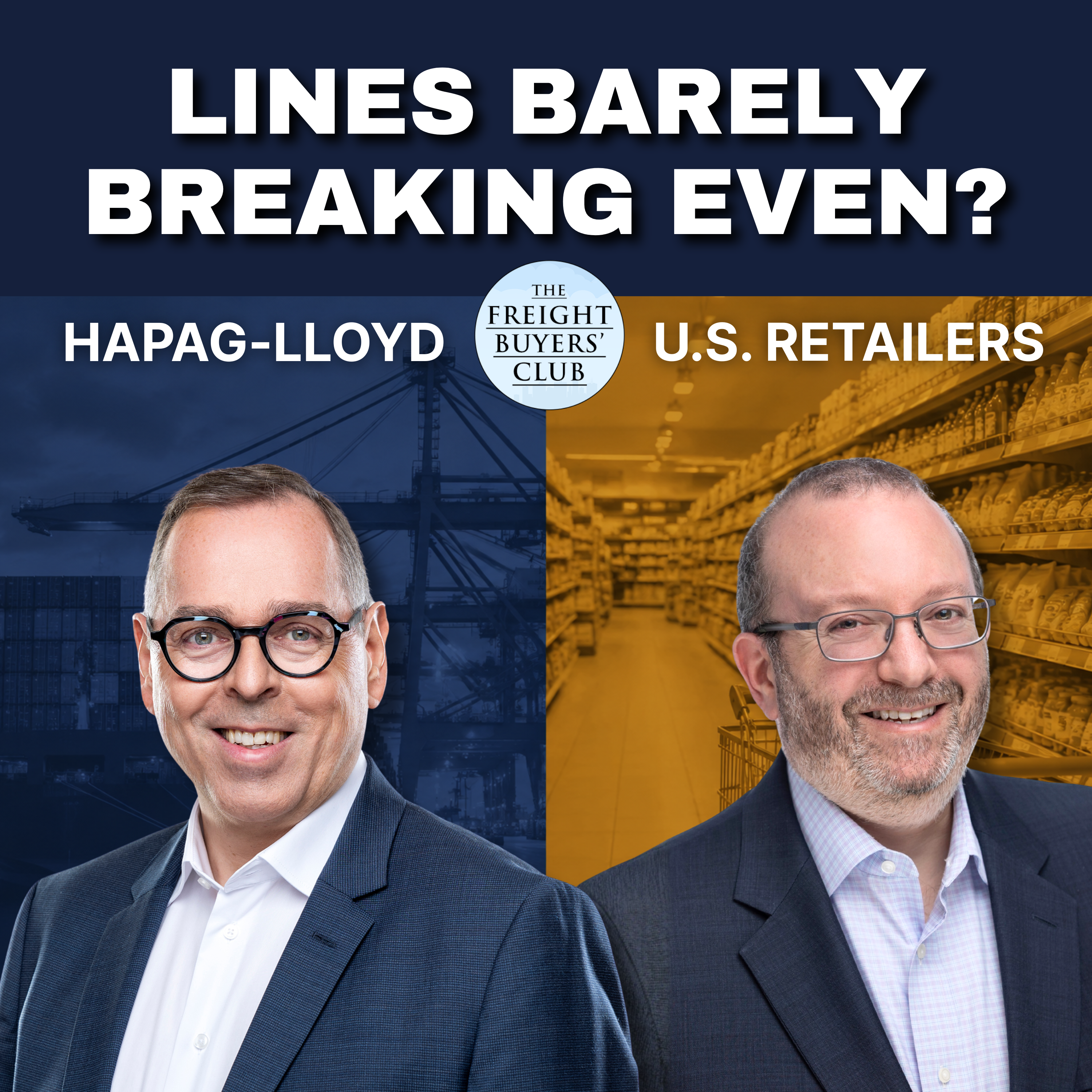
But then they start falling in what should be oh well, the old traditional peak season carriers are raising profit forecasts and almost every reason why is something that's gone wrong. Well, certainly for shippers footing the bills cargo shipped daily to beat the tariffs ship still going around Africa tightening up the global capacity of container shipping fleet war risk surcharges, take your pick. There's a tariff deadline the day after this episode goes out as well and another few queued up behind it. Nowhere is all this felt harder than on the Trans Pacific. So I've got two people who see that trade from opposite sides. Thorsten Hartman runs the Trans Pacific for Hapag Lloyd and John Gold speaks for America's retailers at the National Retail Federation. Welcome both.
[00:02:09] Speaker C: Morning, Mike. Morning, Thorsten.
[00:02:11] Speaker A: I want to start quickly because we'll dig into all of this as we go, but in three words. How would you describe 2026 so far? And please give me a quick line on why Torsten and then John.
[00:02:22] Speaker B: Yeah, I would say three words down and up.
So we really started out the year with a surprise. That Chinese New Year was not nearly as strong as we usually would see. In fact, I would say that this is the first time I've ever seen that the short term rates did not increase during the Chinese New Year.
So of course it was with a little bit of a worry. We went into the second Quarter. But lo and behold here, now we are back at the roller coaster and things have turned back up again and we're now seeing the reverse and we're seeing a fairly strong market here.
[00:02:56] Speaker C: Yeah, I think from the retail perspective, I think it's continued uncertainty. We kind of came out of 2025 and things are continuing now with not knowing what tariffs are going to be put in place day. We've got ongoing geopolitical issues, we've got the ongoing issue in the Middle east which has flared back up again and we don't know what's coming next. So I think it's that continued uncertainty that's certainly having a big impact on the economy and the market as a whole.
[00:03:23] Speaker A: Okay, well, let's start with one of the, one of those key areas of uncertainty in the Middle East. The Strait of Hormuz has been a running sore. We've had ceasefire after ceasefire. Nothing's really held.
At one point there was talk of a 20% fee on all cargo in July, but by the next day it was basically a plan that no longer existed. Now there's renewed talk of attacks at the entrance to the Red Sea and Suez, where we've had some services coming back onto that route. None of this is actually happening on the Trans Pacific, but then container shipping is global and we always see a domino effect when there's a disruption somewhere like in the Middle East.
Torsten, how much has that uncertainty shaped your year and how much do you just price it all in and carry on?
[00:04:08] Speaker B: I think, I think two things from the crisis we saw in the Arabian Gulf and that is still ongoing, is that of course whenever the oil prices take up, it affects all trades. So irrespective of whether it's Trans Pacific or not, oil prices impacts the whole trade, it impacts people's ability to buy and so on. So I think that is a global impact we see there. And of course also the ships that were previously deployed on this strait here, they go somewhere so they're not just sitting idle and doing nothing while the, while the strait is closed. So those ships have been redeployed to extra loaders on Pacific, extra loaders to Europe, plugging holes to Latin America. So there's a global impact from this no matter how you turn it.
[00:04:52] Speaker A: John, are US importers looking at this in the same sort of way, this sort of this knock on effect, whether it's fuel, whether, whether it's surcharges, whether it's, I don't know, extra service options?
[00:05:02] Speaker C: Oh, absolutely. I think that's One of the things we continue to see, it's the ongoing fees that are being applied. How are they being applied? I think many retailers want better clarity in the fuel surcharges and bunker fees that they're seeing. The increased freight rates that we're seeing as a result of all the movement of ocean vessels all around, I think there's concern about there was lack of capacity at this point. That's driving up some of the cost increases as well.
So it all, as Torsten said, it's a trickle down and it's not just on kind of the ocean freight but you're seeing it on domestic trucking as well as they're being impacted on fuel costs and capacity and even consumers, they're seeing the higher gas prices. So it has a trickle down effect on everybody that's impacting the economy.
[00:05:48] Speaker A: Okay, thanks John. Let's look at where those spot rates are. Drury's World Container Index has Shanghai to Los Angeles just over $6200 a box. Still up 123% on the year, but down 3% on the week. We're talking third week of July. If you're following on YouTube and Spotify you can see some of these numbers on screen now. Shanghai to New York, bit flat.
So Torsten to you.
I'm sure most of your volume on the Transpac moves on contract rather than spot.
These contracts are generally signed and sealed by May, June at the latest.
Where did you end up on contracts this year?
How much have you seen an early peak, a front loading push perhaps while you were negotiating them? And what do you make of the spot market coming off a little bit now?
[00:06:39] Speaker B: I think, I mean through the contracting. I mean many of these discussions of course start months back. So this is something that's been ongoing in the tender process that typically takes months. Rates this year were slightly lower than they were last year. Last year we managed to recover some of the cost increases that we have seen. This year we gave a little bit back and now of course we in a scenario where the short term rates are significantly above the long term rates which is seems to be a trade of the past few years. If you go years back pre, pre Covid there was not a big difference between short and long term rates as we went through the year that has significantly changed and now you can see we have thousands of dollars of difference between the two, the two rates. And this is of course also what drives the volatility in the market and that we see some of the pressure on the short term rates right now is of course that we see extra loaders being deployed and so on. The demand is still there.
The bookings I receive on a daily basis is the same as I got a month ago. So there is no abating of the demand.
But there's more capacity that has been deployed in the market, especially to the West Coast. So as you pointed out, the east coast is holding up a little bit better because there is not a significant amount of capacity being injected there. But extra loaders to the west coast has an impact on the short term rates right now.
[00:08:02] Speaker A: Are you expecting those extra loaders to change? Because we've had a lot of talk about and we'll go through some numbers and forecasts in a moment with John, but we've had a lot of talk about front loading. We've got some big tariff deadlines as well.
You sound quite confident that demand's holding up irrespective of these recent spot rate declines.
[00:08:21] Speaker B: I think that's at least what we hear from our customers, is that this demand will stay at least through August and then, you know, we'll see how, how this, how this. Fans are. Some of them are predicting it to the end of the year, but I think, you know, the prevailing position is that this will last through, through August and then it will kind of taper off as we go into the fall.
[00:08:43] Speaker A: I'm going to bring the National Retail Federation numbers in shortly on that. But Thorsten, obviously this bounce that you're talking about has come through in your Hapag Lloyd's results. Earlier in July you guys raised profit forecasts for the year.
Talking about the strong market demand and these rates.
Ebitda now forecast, EBITDA, which I always struggle to say now forecast between 2.7 and $3.7 billion up from a range that started at one point.
So how much of that upgrade is real demand? I mean you sound very bullish on later in the year, but there's so much talk about front loading or maybe surcharges. You know, sometimes there's a little bit of a lag on fuel surcharges that can help on that revenue, I would say.
[00:09:31] Speaker B: I think in terms of profitability, our long term rates are barely break even. So we are in a situation where we're not seeing a lot of profit coming through from our long term contracts. That basically is all down to what we can gain from the short term market. The surcharges we have implemented for the fuel are really, you know, a little bit of a band aid on things. As you saw, we had the EFS charts in the second quarter. That was just an average and really very small compared to the actual expense that we were, that we were faced with. Now we are back to the normal bunker formulas here from the beginning, from the third quarter and yes, that will help some but as you can see, the volatility is extreme. Now we're seeing oil prices being back about $90 again a barrel and I mean, two weeks ago it was down to 70.
So we are really seeing a lot of volatility here. So unfortunately it's not the surcharges that's going to save the day.
[00:10:31] Speaker A: John, we've spoken in the past about different types of surcharges. Container shipping, surcharge, detention, Demoridge, peak season, fuel.
How are your members feeling about this period of container shipping in 2026 with all of this change and these surcharges, does everything feel fair? And a second point which seems quite apt as we've just finished with the World Cup Final and we had some referee controversies.
The US shippers have got their own referee in the shape of FMC chair Laura DiBello, who kindly came on the Freight Buyers Club when she was just being appointed earlier this year.
Are you happy with the role that she's playing or do you think she's going to be a bit more active as everyone gets used to the way the container shipping market is at the moment?
[00:11:20] Speaker C: Yeah. So a couple things I think when it comes to all the different fees and surcharges that are being applied to, to not just retailers but cargo owners overall, I think there's a continued push for the need for more clarity on the surcharges. I think a lot of folks continue to ask, you know, how are these being developed, how are they being applied, how long are they being applied for?
You know, obviously lots of discussion within the contracts themselves on how the fees are applied for those that have contract rates. Obviously it's a little bit different when you're on spot. But I think, you know, what I continue to hear from my members is just the need for more clarity on the different fees and surcharges that they're seeing and how they're working. I think when it comes to the FMC and Chairman DiBella, I think, look, we're excited to see where the new FMC goes. Obviously they've got a lot more authority coming out of OSRA from a few years ago.
I think from a lot of our perspectives and a lot of different groups I talked to, we'd love to see the FMC take a moment to evaluate where ocean shipping is now because obviously things have changed a lot over the past, you know, since Oscar even passed, the past four to five years, we've seen some changes.
So I think we would love to see some, you know, definitely take a look at kind of how things are operating. What else needs to be done, what can be done to help clarify some of these, these elements. I think as we look at, you know, the dispute process, how do we make improvements there? I think one of the challenges that many of my, my guys see is that just it takes too long to resolve some of the changes or some of the kind of the back and forth if they are going to dispute a fee or a charge or something. It seems to take a little while to kind of work through that. And two years later it's like, oh, you know, we finally got it. But you know, it took too long to get there. So I think from our perspective we'd like to see more kind of upfront discussions when it comes to different disputes and how to resolve it up front before even getting to that point.
[00:13:15] Speaker A: Torsten, you mentioned before these extra loaders that are coming into the market.
We've also got a lot of new build capacity coming this year and next.
Are you worried? A little bit. I mean, obviously this comes back to being a global problem, but you're worried about excess capacity maybe even in 2026. And a second question to that, which I feel is slightly linked. There's a lot of talk about blank sailings. Have you guys been blanking many?
Either your own services or the services or through the Gemini cooperation with Maersk or are you providing consistency for your custom?
[00:13:52] Speaker B: I think, I mean that's the whole hallmark of Gemini is that we do provide this consistency to customers and we have no active blanking program. In fact, we try not to have any blanks. We want to provide a seamless service that covers every week. Of course we do have Chinese New Year, Golden Week and so on where there will be. But apart from that, we sail the ships we have and we don't have enough ships. We really struggling just to keep the network together. So this past week with typhoons in, in the Pacific, so all that disruption takes a lot of careful handling in terms of we need to omit ports because there's congestion, then we need to move the containers to a different port in order to pick them up again on the, on the intended ship and so on. Right. So I would say that's quite a, quite a lot of work going around. We Certainly are not trying to not have the capacity we have. We trying to service customers in any way we can. In terms of your first question about the capacity, I think that has been the talk of China the last three years. There's always been this prediction we're buying too many ships and eventually it's going to come and hurt us. And I mean, there's some truth to that, obviously that we are buying a good amount of ships. But I think there's two things that needs to be remembered in this, in this connection here.
Number one, the infrastructure in the world is really the limiting factor. We can buy all the ships we want, we can put all the ships in the water we want. It doesn't take long. But if you look at the at the port capacity, the inland capacity and so on, that has not changed.
So we are looking at infrastructure that cannot handle any more volume as it is right now. If we look at North America, there's not a greenfield project that's been built with a port since Norfolk, Virginia which was I think 30 years ago.
So we're looking at infrastructure that is really cannot keep up with this. If they could build infrastructure as fast as we could build ships, there wouldn't be a problem. But that's not the case. The second point I have is that we always look at this, we look at global trade and say our global Trade is growing 2% but supply is growing 5%.
Well, what is really the real comparison is that you need to look at what is the growth on the dominant lakes.
So it could be the dominant lake is growing 10% and the other way it's dropping 10%. And then, you know, conclusion is well, it's up or down by some percentage point. What you really need to look at is what is the dominant lakes, how much are they growing? Because this is what effectively we need to carry. So if Trans Pacific or Far East Europe is increasing by 10% in the dominant lake, it really requires 10% more capacity. Even though maybe that the other lake is dropping, that's not going to help us. We still need to carry that capacity. So I think sometimes it's a little bit skewed in terms of what is the conclusion on how does global trade impact this with the supply.
[00:16:47] Speaker A: Thank you, Torsten. I just want to look at a chart here from Alpha Lana on fleet deployment because it intrigued me and it says something about Hag Lloyd that we don't really, I don't think I've ever heard this from you guys when we've done interviews in the past if you look at the three European carriers on YouTube or Spotify now we've got MSC, Maersk, CMA, CGM. Top two trades for all of them, Asia, Europe and Latin America. Africa also features heavily for these other European carriers. But Hapag Lloyd stands alone, really with the Trans Pacific, representing a massive 21% of your business. Torsten, your second biggest trade, how did that come about?
[00:17:27] Speaker B: I think chiefly what has happened in the last two years is that we got a bit of tailwind from the Gemini network.
Not so much because we deployed more capacity, but because we have many more sailings than what we used to have in the past.
So our market share on the Trans Pacific grew from roughly 4% to 7% in a matter of the past year. And of course that's, you know, a relatively robust growth that we almost doubled our, I mean, from four to seven. Of course it's not very dramatic from a market perspective, but for us, of course it was, it was a fairly big, big growth that we were handed there. And that is what has propelled the Trans Pacific trade into being one of the bigger trades in Haberdoid. Of course, keeping in mind that we have basically capacity all over the world and it just so happens that they may be more balanced in our company than they happen to be in some of the other of our competitors.
[00:18:23] Speaker A: I think that brings us to zim. Hapag Lloyd did a big deal with Zim. It's waiting for that to go through with regulators, maybe later in the year. If you look where Zim sits on the same chart From Alpha Liner, 52% of its capacity on Asia to North America, one of only two carriers in the top 10, putting more than half of its fleet on a single trade.
So the European carrier, already unusual for its Trans Pacific exposure, is buying the carrier most concentrated on it.
How do you see that playing out, Thorsten? I suppose it gives you, well, a lot of options or maybe a lot of power in the future.
[00:18:59] Speaker B: I mean, certainly if and when it comes through, it will be a total game changer for us on Trans Pacific. So SIM has more or less the same size as we have today on the Trans Pacific.
So that will then double our share into something to the June of 13% market share, which will take us into the top three of the carriers on the Trans Pacific. And that of course will have a very big impact on our ability to, to be present with customers, be larger with certain of the bigger customers and so on. Right. So yes, it will indeed be a very big change for us even when this materializes.
[00:19:39] Speaker A: John, are you worried about container shipping consolidation? Does that help your members? And we've already seen the FMC cancel large parts of the World Shipping Council agreement for antitrust immunity for running ships.
Is this a concern for you?
[00:19:54] Speaker C: I don't think at this point. I think folks are very interested to see how the process is going to work out and what services are retained or improved. So I don't know if there's concern as of yet, but obviously it's something that folks are paying very close attention to, especially as we continue to have different capacity related issues. I think that's kind of one of the biggest things folks want to ensure is that capacity continues. And if this helps improve, that's great.
But I think folks are going to be paying very close attention to how this all shakes out.
[00:20:21] Speaker A: Okay, we'll just take a quick break there, then we'll be coming back. On tariffs.
Are you struggling to manage today's complex tariff environment?
Work with a3PL that combines global shipping with an expert knowledge of Trade Compliance. DiMerco Express Group. Connecting Asia with the world since 1971.
Welcome back, John. The National Retail Federation publishes the Global Port Tracker every month with Hackett Associates.
July is forecast at 2.47 million TEU of imports. That would be the biggest single month American box ports have ever handled. This is bigger than anything in the pandemic, although volumes. Last year we didn't see a lot of growth into the US but after this record month, we've got year on year downturns, August, September, October, November.
Can you tell me what we're seeing there?
[00:21:13] Speaker C: Yeah, I think part of this is retailers as well as other cargo, you know, beneficial cargo owners trying to get ahead of some of the tariffs that are expected to come, you know, later this week. I think folks are trying to get ahead of the uncertainty and make sure they've got product here on time for consumers. You know, the one thing I continue to hear from folks is, you know, what is peak season? It's like we don't have the traditional peak season anymore. I think that's been gone for several years now because of a variety of different episodes. You know, that traditional peak would always run, you know, August, September, October, and you know, it's now been lengthened out to starting in late May in some times. And part of that is because there's so much uncertainty built into the supply chain. We've had incident after incident, disruption after disruption. And I think for many retailers, it's trying to make sure that they've got product here. In time to meet those, the demands of the consumer. Because the other thing we've seen too is over the years the consumers are buying earlier and earlier in the holidays.
So retailers have to be prepared for that. So you're seeing this big rush June and July and you'll see things trend down a little bit in August and then drop off later in the year. The focus will really be kind of on the restocking and spring shipments.
[00:22:25] Speaker A: How do you tally this sort of record volumes? Q2 volumes at sea.
But all this talk about affordability for consumers in the US It's a challenge.
[00:22:38] Speaker C: I mean we came out earlier this year prior to the war and other things, looking at overall retail sales were going to increase 4, you know, 4.4% over last year. And you've seen continued, you know, increase in retail sales over the past nine months. They've, they've grown, the consumers continue to spend despite all the headwinds they're seeing in the economy.
Obviously we've got a significant challenge with the kind of the K shaped economy with, you know, more of an impact on lower income consumers, especially as, you know, gas prices now start to tick back up again and they're changing their shopping habits. But even higher range consumers are still, they're trading as well. They're changing their shopping habits, you know, trading down for what they're buying. But the consumer continues to spend despite all the headwinds that, that we're seeing.
You know, many have already started their back to school shopping. I think over 60% have already engaged in back to school shopping. I know I did a bunch of back to school shopping last weekend, just happened to be in Target. I was like, oh, all the school supplies are on sale, let's get them now. So you know, spent spend a bit on, on you know, back to school for, for second and third graders. But yeah, it's, it has been a challenge. But the consumers continue to spend and the retailers are trying to make sure they do everything they can to make sure product is available and ready to go when the consumer's in the store.
[00:23:54] Speaker A: John, just on the tariffs, I'll just recap for people who haven't been following it. The Supreme Court struck down the emergency tariffs earlier this year, the IPA. Then we had a temporary 10% global tariff, went in under section 122 in February to replace them. That expires just about when this podcast comes out.
24th of July as we're talking though this week of July.
It's not the only tariff deadline, is it? Do you Want to give us an update?
[00:24:21] Speaker C: There's quite a few, sure, yeah. So we had the IPA tariffs that went into effect last year.
Started with Mexico, Canada and China, then it went to Liberation.
Well, it started with China, Mexico and Canada over fentanyl and immigration related issues.
Then April we saw the Liberation Day tariffs on everybody.
And then we saw again Brazil and India got hit with the IPA tariffs. And then in February the Supreme Court ruled that the IPA tariffs were illegal and struck them all down. Immediately thereafter, the administration implemented the Section 122 balance of payments tariffs, the 10% global which is limited to 150 days, which expires on July 24.
Since then we have several other 301 investigations that are in the process.
We've got the Brazil specific that was announced final last week with a 25% tariff starting on July 22. And then we have the potential for the Forced Labor 301. And this was a 301 investigation looking into 60 economies, whether or not they have a ban on the importation of products made with forced labor. That could become final this week as well. USTR has gone through the hearings. They collected comments. They initially had a range of 10 to 12 and a half percent tariffs that could take effect depending upon where the country was. Our expectation is that those 301 tariffs could take effect right after the 122 tariffs expire. So maybe July 25th. But you know, today is July 20th. We're waiting to get notice from USTR as to whether or not that's going to be the case or when those are going to take effect.
And on top of that we have additional 301 investigation on excess capacity, focusing on 16 economies including all that were in the forced labor one, trying to figure out what that is going to be. USTR hasn't moved forwards with the remedy phase of that investigation yet. But again, that's going to hit a lot of different countries that we rely upon. And again, how does this all stack? And on top of all this we've got a new investigation into Vietnam. And then we've got the ongoing Section 232 investigations on a wide variety of products which are all kind of product specific.
Probably the biggest ones we're paying attention to are semiconductors and robotics because that can have a pretty big impact on warehouse operations. And semiconductors could be on anything because everything relies on a semiconductor now. So you know, how far down the line are they going to go with derivative products?
[00:26:51] Speaker A: The old tariff roller coaster, just on those forced labor enforcement tariffs, you said 60 economies, 10 to 12% might come in on July 25, essentially to replace the tariff that ends on July 24. But in my head it's screaming why? Why would the uk, the EU and Canada that already have forced labour import bans, why are they in this? Why are they included? It doesn't seem logical to me, and I'm sure a lot of people listening would feel probably the same way.
[00:27:23] Speaker C: Mike, we continue to ask that question every day.
The issue is that while they might have forced labor laws on the books, they haven't been implemented to the satisfaction of USTR and the US Government.
And again, part of the thing that we raised in our testimony is what is the off ramp? What do these countries actually have to do to get out from under the tariffs? Are we looking for each country to implement a UFLPA type enforcement like we have here in the United States on the weaker Forced Labor Prevention Act?
Countries aren't going to be able to do the same thing. So I think what we need to do is provide support for all these countries on how they do this, but recognize that they've got very different systems and it can't just match what we do here in the United States. But again, to your point, what is the end goal and what constitutes the right enforcement to get countries out from under the tariff regime?
[00:28:17] Speaker A: Yeah. Is this, though, some sort of overwhelming concern in the White House about enforced labor that has just sort of come about, or does it tie in with the fact that tariffs need to be a weapon in trade negotiations or any other negotiations?
[00:28:31] Speaker C: I think if you look at all the trade policy, it all kind of ties together. Obviously, you know, this administration talks about forced labor as being a big issue.
You know, we've had UFLPA on the books for quite a while now and looking at that as the success. But again, whether it was negotiated as part of USMCA because there were forced labor provisions in those agreements, in that agreement, in the agreements on reciprocal trade, there were forced labor as part of that.
So again, if these countries implement, I guess, to the satisfaction of the United States, will those tariffs come off?
Unclear, because there's no off ramp written into how this is being put in place.
[00:29:10] Speaker A: Yeah. Okay. I remain confused, but thank you for your insight.
Let's get the money that's already been paid on these tariffs that have now been ruled inadmissible or illegal by the Supreme Court.
How are people going about getting their money back? Is everyone happy with this process?
[00:29:28] Speaker C: So CBP has their CAPE system that they launched in June, I believe it was, I think folks are getting their money back. I've heard from a number of members who are getting refunds. Customs, I think has and treasury have returned about $86 billion thus far out of about 121that they deemed as being eligible.
So I've heard from small businesses as well as large businesses who have received their refunds. There are some who are still stuck in the process.
They're filing in cape and it's being processed, but they haven't gotten their money back. Customs is now moving on to their phase three, looking at liquidated entries. So there's concern there, but they're appealing part of the decision on certain entries that have been fully liquidated where companies haven't filed the suit yet, saying they shouldn't have to refund that, despite Judge Eaton from the CIT saying no, no, you collected all this money illegally. It all needs to be returned to everybody who paid it. So there's an ongoing fight there over that.
That part of the litigation, I think that covers about six and a half billion dollars worth of, of the trade.
But you know, the refund process is, is continuing and companies are getting money back. Might be slow drips for some, but you know, they are making, getting some of that money back.
[00:30:48] Speaker A: Yeah, it's been great if you're a middleman in all of this, helping people implement and work out what they should pay and then getting the money back.
But big overheads that probably didn't need to be there.
Just on this confusion and uncertainty around all these different tariff regimes that we've seen over the last year or so and even just this week, how does it affect people's ability to invest?
Whether that's talking about not investing in China and maybe investing somewhere else, maybe it's talking about investing in more regionally in North America, in South America, or maybe it's talking about reinvesting in the U.S. can anyone make an investment decision at the moment?
[00:31:26] Speaker C: It's extremely challenging because you just don't know what the tariff rates are going to be and who they're going to be applied to. And for many retailers who are Planning their business 6, 9, 12 months ahead, they need that certainty. And even if you're going to invest here in the United States, you're still getting hit on US Manufacturers who are getting hit on equipment being hit with a tariff, inputs to production being hit with the tariff.
So even if you want to bring stuff back here, you're still going to still be more expensive because of the tariffs and all the other pricing issues. That happen fuel and everything else.
So it's a challenge for folks. And again, when they want to put that diversification in their supply chain, it takes time to do. It's not something that can be done overnight.
It could take years to find a vendor that can meet your capacity and quality, that you have the infrastructure in place so that the ports can handle the larger vessel calls. I know Torson can certainly talk about the shift you're seeing into Southeast Asia and the impact that's having on ports there, but it takes time to make those changes. It's not something to be done overnight. It takes a lot of money and ability to do that. The other challenge, too, is for small businesses that don't have that flexibility, they're kind of stuck. Either they're the importer of record or they're relying on somebody else as the importer of record. So they're certainly challenged on what they're their vendors can do, what their suppliers can do.
[00:32:48] Speaker A: Torson, I'll come back to you in a second on that because I would like to hear how you've been adapting your network to these changes in volumes, if at all. But just one final one, John. On E Commerce, we saw the end of de minimis exemptions in the US Last year. So this hit a lot of E Commerce B2C operations straight into US consumers. We've seen something similar this month in Europe as well.
It's addressing unfair competition from China.
The upshot in the US Seems to be we've seen this shift from air to ocean, but it seems mounting evidence that we're also seeing a shift in who carries this cargo. Chinese platforms increasingly seem to be using Chinese freight companies. Chinese lease warehouses. Chinese backlash mile carriers. Asian firms took a fifth of US warehouse leasing last year, 2/3 of that Chinese.
And the cost gap is the part that stops you. Well, makes you think about this. It's around $0.60 a package against $2 if you're using America. American operator, how much of this supply chain change is due? Well, maybe it's duty avoidance, but your opinion would count on that one more than mine. But how does it affect US Retailers if they're competing against these rebuilt China only supply chains for Chinese exporters, yeah,
[00:34:04] Speaker C: it certainly is a challenge. I think that's part of the reason why you saw the administration put out their Customs Enforcement executive order a few weeks ago, where a lot of the focus there is on changing requirements for foreign importers of record, which is certainly going to hit those E Commerce companies wanting more data on that. Who's actually doing the importing but making sure they're applying the right tariffs because I think there's serious competition issues and questions about that. So I think that as customs rolls out that executive order and new requirements, you're going to see some, some changes to that whole business model, I believe.
[00:34:45] Speaker A: Thorsten, do you guys ever get approached for this kind of end to end E commerce work, particularly over the last year for these Chinese retailers as they've moved more of their cargo onto the ocean?
Or is this business that you're shut out and you just expect Chinese carriers to get it?
[00:35:05] Speaker B: I think this is largely done by the Chinese carriers and since we don't engage in land logistics part, we're not really being approached for this kind of opportunities.
[00:35:18] Speaker A: Of course, of course. Just on John's point there about the shift away from China into Southeast Asia, how's that affected your network, if at all?
[00:35:25] Speaker B: I mean certainly, I mean there's definitely been a big push to move cargo from China to Southeast Asia, particularly Vietnam. I would say we've seen a big, big growth. China is still by far and away the biggest producer in Asia.
So that remains a big part of what we do. But of course, yes, we do move capacity towards where customers they want it and we see a lot of requests for wanting to have more capacity out of Southeast Asia and that's of course something we look at all the time and, and we try and deploy as much capacity as is needed.
[00:36:02] Speaker A: We've seen these big leches in demand. Thorsten, around tariffs.
How do you plan though? Because you can't react instantly as a carrier and change your network based on policy announcements that come a very, very short notice. As John was explaining. How do you plan for this?
[00:36:20] Speaker B: Yeah, good question. I mean we would love to plan for it of course, but as, as John, he alluded to, I mean this happens basically without notice and suddenly be finding ourselves in a position where we see a lot more demand and we need to somehow find a way of dealing with it. And of course sometimes we see as I gave you the example earlier, Chinese New Year this year was really a non event. I mean there was really no rush and this is the first time I think I've seen for my 10 years in trans Pacific that has never happened before.
So yes, it's very difficult to predict what will happen. It's also equally difficult to plan for it because it just comes with little if any notice and we just need to adapt to it and do the best we can.
[00:37:06] Speaker A: Torsten, when you know, we've had Quite a surprising year for container shipping. Things have gone a lot better as your upgrade to your forecast made clear. Is this as good as it gets or. I mean, I guess there's an awful lot of unknowns out here. We don't know what's going to happen in 2027. How upbeat are you?
[00:37:23] Speaker B: Well, I think at least this was a, a welcome surprise, so to speak that we suddenly saw an, an increase in, in demand. As I, as I told you earlier, the long term contracts we have this year are really at very best break even.
So we do need, in order to turn a profit, we do need that we see a meaningful improvement in the short term market which we have seen and, and that's of course helpful. I would like to see a broader support of this that we see that also the long term segment sees an improvement next time around when we do the contracts next time. So if we're able to do that then I think we, we should be in a good place. If demand stays where it is. I think there's all the reason to believe that, that we can do that. If we see a demand that is going in the opposite direction, then we may be in for, for a difficult year next year.
[00:38:16] Speaker A: And John A two pronger for you, if you could, if your members could. I'm not going to talk about Hapag Lloyd specifically here, but container lines in general. If your members could get one thing from container lines over the next year, what would it be? And if you could get one thing from Washington on trade policy, what would that be?
[00:38:32] Speaker C: I think, you know, for my members the want for the carriers is better information sharing. I think that's just one of the things that always comes up is the need for clarity on certain events, making sure that there's ongoing communication, you know, when things happen that they fully expect and understand what the changes are going to be. But again as we get into things like the fuel costs and fees, again there that clarity and understanding of how that works. So I think communication is key and it's just one thing that I continue to hear from my members on. They just want to see better communication throughout the supply chain so they can plan accordingly.
I think the one thing from Washington on trade is certainty. We can have the debate on tariffs and everything else, but what we need to provide for all businesses is certainty so they can plan their businesses, both small and large companies need that going forward.
I think if there's understanding of when tariffs are taking effect, how they're taking effect, what the rates are going to be, whether or not. We're actually going to stay in USMCA or not. I think overall just can plan accordingly and then provide for their customers. I think that's at the end of the day, what they're all trying to do is meet the needs of the customer, especially as we're talking affordability. Having that certainty in the supply chain is going to help them provide affordability and certainty for their customers.
[00:39:53] Speaker A: What's one thing you'll be watching for the rest of 2026, John? If we haven't covered that already, I
[00:39:58] Speaker C: guess it's what's Next.
Still have 5 months left in the year. So I think that's the one thing we're all looking for.
We know something's coming. It's just the way the supply chain's been working over the years. It's just what's next.
You know, obviously we've got the November elections. What impact is that going to have on trade policy going forwards for next year or for the next two years after that? That's a big issue that we're all kind of paying attention to. But it's the overarching question of kind of what's next and how do we ensure that we're all in a good place to be able to respond and address whatever those next challenges are going to be.
[00:40:37] Speaker A: And you, Torsten, what do you worry about or what do you watch like a hawk?
[00:40:42] Speaker B: Well, I think again, like what John said, I mean, predictability is something that, that will help the whole industry in trying. If we can get some stability into, into, you know, supply, demand, that would help, I think all of us. You gave John a wish. I also have a wish. I wish that we as shipping lines could, could introduce terminal handling charts in North America.
Because I really think that the expenses we have in this connection is something that is flying under the radar. As you know, we have made contracts that comes with quite some increases in North America. And that is something, of course, that we as carriers, we absorb because there is no terminal handling charts on the, on the US side. But that is something I would like to not so much for the monetary value, but to visualize to people what a significant cost this is out of the freight race that we get. And, and this may come as a surprise to a lot of customers. I'm sure it does come as a surprise to you, John, but I mean, an average handling cost in North America is 4 or $500. So you can take that out of a freight rate that I need to pass on to the terminal. That's not money I'm collecting. This is money I'm just passing on. So this is something I would like to see, just to visualize to people that we're not all the money. When I get $1,500 on the US West Coast, I am. I'm in reality only getting a thousand. Right. And to me, that is something that I would love to be a little more open about so that you could the. That this was clear to everybody.
[00:42:13] Speaker A: I think that's a whole new podcast.
[00:42:15] Speaker B: I'm ready for that, Mike. I would be. I would love to do a podcast on psc.
[00:42:20] Speaker A: Right?
[00:42:20] Speaker B: Yeah. Yeah.
[00:42:22] Speaker A: Well, maybe another time. I don't know how many people would get in, but I mean, I've looked at those numbers and yeah, they, they are quite confusing.
John Torsten, thanks for joining me today on the Freight Buyers Club.
[00:42:33] Speaker C: Thanks, Mike. Appreciate it.
[00:42:34] Speaker B: Thanks very much, Mike. Thanks for having me.
[00:42:36] Speaker A: And thank you all for listening. This episode was produced with the support of the America Express Group, keeping independent journalism independent and your partner for Asia sourcing, manufacturing and China plus one supply chains. If you got something out of our chat, follow the show wherever you're listening or Find us on YouTube. I'm Mike King. See you soon.