Episode Transcript
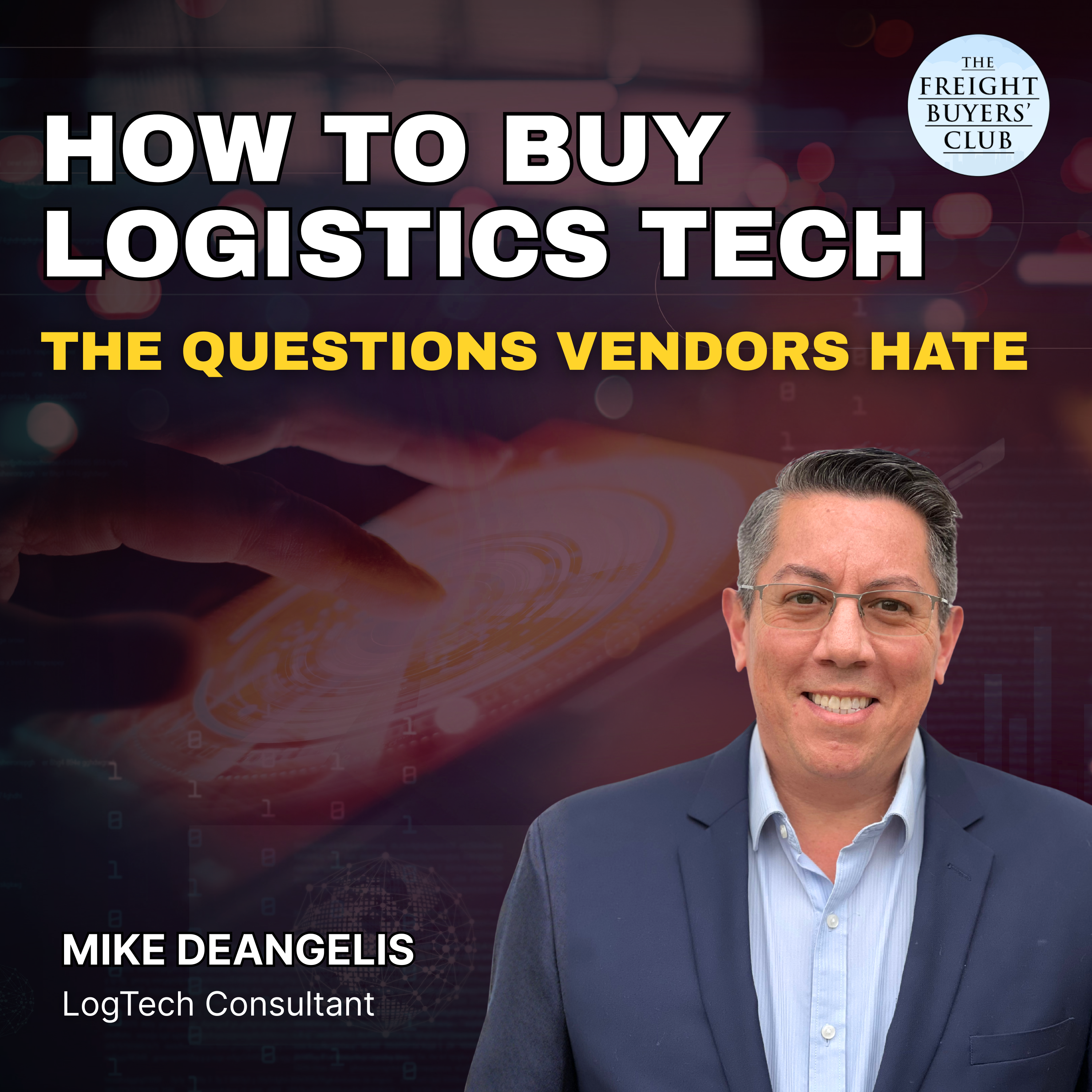
[00:00:03] Speaker A: Welcome to the Freight Buyers Club. We're over at TPM 26 in Long beach and this, this bit of content brought to you by Ontegos Cloud, the freight forwarder, profitability specialist and I'm delighted to say I'm with Mike DeAngelis. Welcome to Freight Bicycle, Mike.
[00:00:20] Speaker B: Thanks for having me, I appreciate it.
[00:00:21] Speaker A: Yeah, we're going old school with Mike today. So just for a bit of background, Mike is a logistics tech industry veteran of cargo wise intra forekite project 44.
I think I've got most of them X Maersk as well.
But you're, you're not attached at the moment, which makes you beautifully independent.
So you're giving us a unique perspective because most people in this industry seem to be selling something.
[00:00:48] Speaker B: It is true. I think this is the first time I'm coming to tpm. Not associated with a particular company, not having a particular agenda.
[00:00:54] Speaker A: What's the biggest misconception for forwarders and shippers or freight buyers when they're dealing with logistics tech?
[00:01:01] Speaker B: It's the sales and marketing speak versus reality. So really try not to pay for a roadmap of items that you're being sold that don't actually exist in the software. Make sure what you're buying is, you know, here and now, software capabilities versus capabilities that may or may not come on any particular time frame.
[00:01:22] Speaker A: We talked off camera a little bit and everyone's talking about AI at the moment and everyone seems to be talking about clean data, but when we were chatting you were saying a little bit about why this is so important, but maybe start with somewhere else, what's dirty data and then how do you make it clean?
[00:01:38] Speaker B: Yeah. So I don't mean to say that data can be particularly dirty if it's not from a primary source. So where I consider data clean is when it comes from a primary source or at least as close as possible to a primary source. And what I'm finding is the more parties that are involved, the more chance you're going to get that the data is not accurate, complete and timely. And you need those in order to sort of manage your use cases.
So if the data is not really coming from the source, be that a carrier, be that a port or terminal at some point, be that from an IoT device. Right. That primary data you can trust a bit more, that's going to be fulfilling, that accurate, complete and timely sort of trio of prerequisites so that again, you feel confident building on top of it, you feel confident giving it to your employees and into your customers.
[00:02:33] Speaker A: What's the difference, Mike, between firsthand data. So this could be from a carrier or an original source and then aggregate data, which in my understanding means it's from an intermediary. What's the distinction and why does that matter in terms of getting to where you want to get with your logtech?
[00:02:48] Speaker B: So I think I covered the primary source, let's go to that sort of aggregated source. And I don't again mean to say that it's necessarily across the board, you know, unreliable data. It can be coming from a primary source and hopefully with very little delay, very little translation, unless of course, that's normalizing it, which I guess could be a good thing, working across separate carriers in separate ports and terminals. But when you're taking data from third party sources, one of the risks can be that that data is again not necessarily timely. So if your use cases are trying to do something as quickly as possible, let's say it involves detention and demerge charges, or on time in full, avoiding the penalties that might come from, from not being on time and in full, you don't want to know that there is an SLA from one of the parties in the background of three hours, three days in some cases where getting the data from a primary source, you more often than not should have a lower latency or a lower expected time frame between when the event actually happened and when you were going to receive that event.
[00:04:01] Speaker A: Why is all of this so important when it comes to AI? Does this raise the stakes? Is that the thing?
[00:04:08] Speaker B: It does, and we've seen this before, I think with blockchain, I think AI is a bit more mainstream than we can get into blockchain versus AI another time. But what my point is is be able to avoid garbage in, garbage out. Right? And that isn't a new concept. It it's just really trying to make sure that you're not amplifying issues downstream or even upstream. In some cases by utilizing data that isn't necessarily the correct data or timely data.
And again, AI, when using clean data or accurate data, should give you the effect that you're looking for.
But if you're giving it data that actually is inaccurate or not timely, you can actually do more harm than good. And that harm can get amplified and actually require a lot more effort to clean up than the initial benefit from the AI that you were expecting.
[00:05:07] Speaker A: I was going to say you don't need to name vendors, but actually if you wanted to, there's no problem with that here. Fire away. But when a buyer is going to Talk to a vendor, how do they know or how do they trust that vendor is genuinely sourcing the data in a way that's going to work for their business?
[00:05:26] Speaker B: So I think there's two ways of going about it. You can ask that vendor, hey, can you broadly tell me where your sources are? That could be for over the road data, for air cargo data, for ocean data, and look to see what their answer is and if it's vague or fluffy, start to sort of narrow down. Okay, you know, so you're saying you're getting the sources from a third party or aggregated sources, you know, is that from carriers or ports and terminals or from the truckers or all of the above to try to get down to an answer that you can actually work with or you can go about it. And this is what I recommend saying, okay, what are the use cases that you're actually looking to move forward with or what are the outcomes that you're looking for? I mentioned detention and demurrage avoidance or avoiding penalties for not being on time.
You can avoid these by making sure that if you go to the vendor and say, this is the outcome I'm looking for, how can your data sources allow me to fulfill these use cases or to get that outcome and see what they say? Because again, a vague answer gives a little room for concern. It just may be that the party you're talking to doesn't have that depth of knowledge and they might need to go and check back with their team. But more often than not, a vague answer is a little bit of a warning sign.
[00:06:50] Speaker A: Avoid vagueness. There now that makes a lot of sense. Whatever you're buying, is there any other questions that people should be asking of tech platform just to be finish up?
[00:06:58] Speaker B: Yes, absolutely. So I think one would be get a live demo. Right? PowerPoint presentations are great, they look fancy, they can take, you know, minutes or hours, you know, to put together, but they don't actually tell you the does this match what I'm looking for? Is this going to give me the outcome I'm looking for? And some of these providers have, you know, engineering teams or have, you know, customer facing teams that can get on, you know, a call, get to your facility and actually walk you through the software where you can see, okay, I understand your use case. Let me show you how to go about that in our software.
That's what I would be looking for. Another good recommendation would be the users. The users are actually going to use the software versus, you know, your VP getting in there because he's a Decision maker gets a sales pitch, likes it moves on one way or the other. Okay, but it does it actually mean something to the user is going to be using it every day. Right. I think that that's probably one of the most important suggestions I have. And then lastly, it's reference customers. And you know, you can get a reference customer from their website, but I would really ask for one that is in your industry and really has sort of the same either geography or the same needs that you have. Because when you get that reference customer's feedback, I think that's one of the most powerful ways to find out. All right, you know, going back to what I said initially, am I being sold something that doesn't exist, or is someone actually getting value already? And I can go back to my team confidently and say, hey, you know, these customers are using the software the same way we're going to use it or we intend to use it. And these are the outcomes are getting, you know, better or for worse and use that to help give you the best decision possible on whether it's the right software for you.
[00:08:54] Speaker A: And if people wanted further advice, Mike, where would they find you?
[00:08:58] Speaker B: Easiest place to find me would be via LinkedIn.
[00:09:01] Speaker A: Thanks for coming on the Freight Buyers Club today.
[00:09:02] Speaker B: Well, thanks for having me and thank
[00:09:04] Speaker A: you all for listening. This content today was brought to you from on Teagos Cloud and we'll be coming back with more excellent interviews from TPEB 26 in the coming days, so stay tuned.