Episode Transcript
[00:00:03] Speaker A: What a boring start to the year.
It's not really, is it?
2026 was supposed to be the year trade policy settled down. Instead we've got geopolitical turmoil, multiple trade deal negotiations, container land playing will we or won't we? On using the Suez Canal, and a US President threatening to invade Greenland. It's definitely more abnormal than normal. Freight Buyers Club will be here to guide you through it all throughout 2026. And today I'm joined by two people who've seen every side of this game, one who spent decades inside the carriers and one who spent years fighting them on behalf of shippers.
[00:00:41] Speaker B: And I'm sure there's a lot of head scratching going on as we go into contract season about what proportion of your volume you actually put into your contract mix.
[00:00:49] Speaker C: If you pay 10 times EBITDA for an acquired company, you have to be able to deliver that value.
[00:00:56] Speaker B: If you like your job unpredictable, not quite knowing what's going to be happening by the end of the week. Being a freight buyer is the place to be in 26.
[00:01:04] Speaker C: The gap between the top four carriers globally and the rest of the field is increasing to an uncomfortable size.
[00:01:11] Speaker B: We run a competition every now and again when things get really bad in GSF called Surcharge of the Week. You know, tell us the most imaginative, creative way that carriers have invented to earn a little bit more money.
[00:01:23] Speaker D: You are listening to the Freight Freight Buyers Club. This podcast is brought to you by your host, Mike King, and produced in partnership with Demerco Express Group, a global 3 PL that specializes in managing logistics to, from and within the Asia Pacific region.
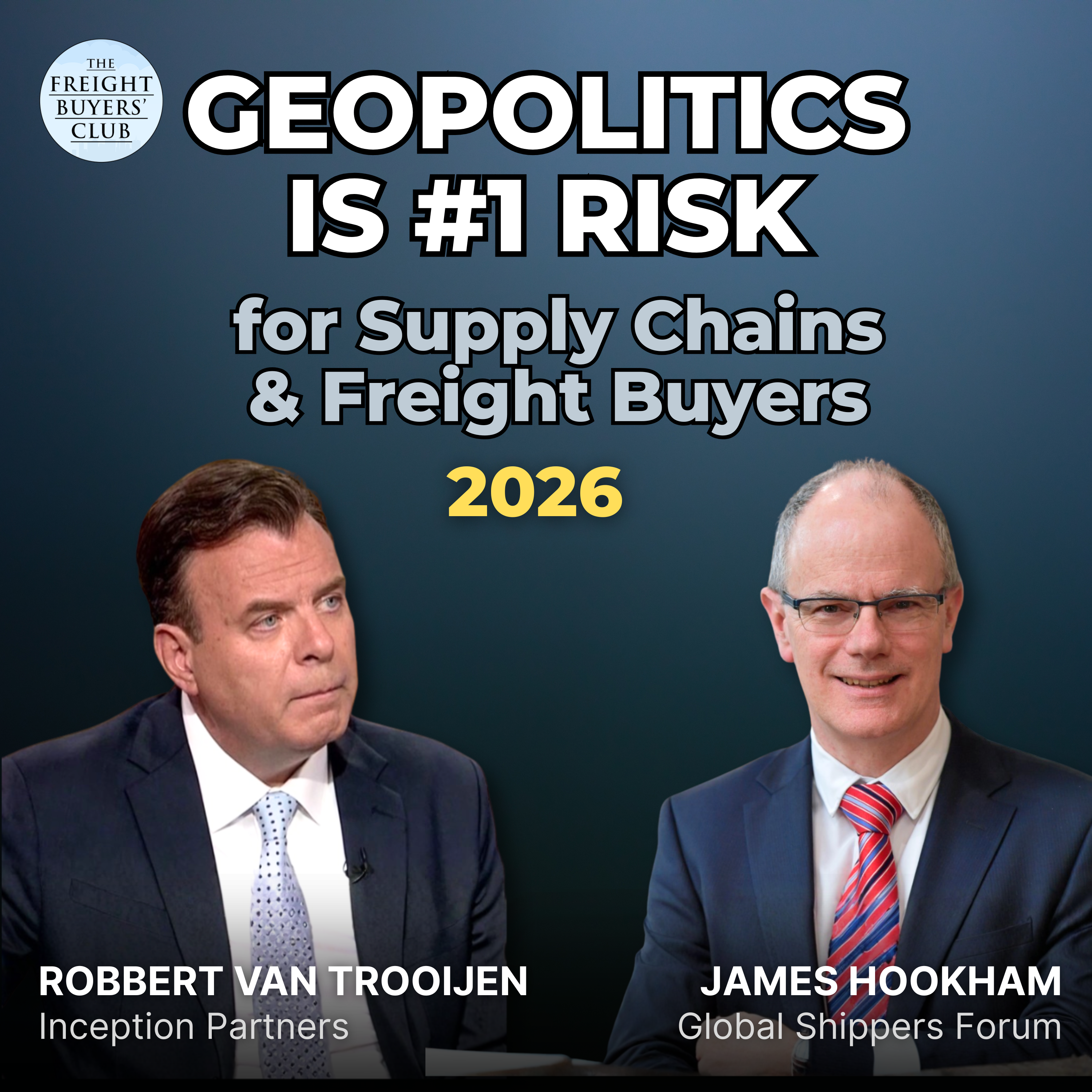
[00:01:38] Speaker A: Hello everybody, I'm Mike King and welcome to the Freight Buyers Club. And as you just heard, this episode is produced with the generous support of Demerco Express Group. A bit of quick housekeeping before we dive in. You can find us on all major podcast platforms@the freightbuyersclub.com and and of course video on Spotify and YouTube. And if you enjoy what we do and want to help us keep this content free, please take a second to like subscribe or just leave a comment. It really does help us keep things rolling. With no further ado to my two distinguished guests, first up is James Hookham, Director of the Global Shippers Forum. James represents cargo owners worldwide and has been one of the loudest voices calling for carriers to deliver solutions, not surcharges. James, welcome back to the Freight Buyers Club.
[00:02:28] Speaker B: Hey, Mike, good to be back. Thanks for inviting me.
[00:02:31] Speaker A: Yeah, you're always welcome, James. And joining James today is Robert Van Trujan, founder of consultancy Inception Partners. Robert spent decades in line of shipping and forwarding, including 15 years as a regional president for Maersk when I interviewed him many times, actually, and I managed to get his name pronunciation wrong every single time. So maybe you'll correct me today.
[00:02:51] Speaker C: Wrong.
[00:02:52] Speaker A: Robert is an independent advisor helping clients navigate this increasingly chaotic shipping market. Robert, great to have you on.
[00:02:59] Speaker C: Always a pleasure to be here, Mike. Thanks for inviting me.
[00:03:01] Speaker A: Did I get it right? No, I didn't do that.
[00:03:03] Speaker C: You did it fine.
[00:03:04] Speaker B: Yeah.
[00:03:04] Speaker A: Very kind, very kind. I know that's not true. Okay, guys. Geopolitics. Am I right to say that the trends of 2025 and of the last month illustrate that geopolitics is reshaping the future trading landscape before our eyes and is now, and I'll quote Bjorn Van Gensen, who appeared on this podcast last week. Is Geopolitics now the number one line item on everyone's risk list for 2026? Robert?
[00:03:32] Speaker C: Well, I for one would never disagree with Bjorn Van Jensen, who spent as many years in the industry as I have, but certainly geopolitics is a major risk. I happen to be reading a book called Chop Points, which is a similar story about how economic warfare can control physical choke points. Panama Canal, Suez, commodities like earth and oil, and then US Dollar as a global currency. So I'm very much in alignment that geopolitics is a big factor.
[00:04:01] Speaker A: Yeah, I'm reading a book at the moment. I'm interviewing Neil Shearing, Group chief economist at Capital Economics, later this month. He's written the book I'm reading. It's the Fractured how the Return of Geopolitics Will Splinter Global Economy. And I'd age anyone interested in the future of global economics and what it means for trade to check it out. In it, he, he talks about, essentially, it's like a new world of two blocks led by the US And China. And he, he says many countries will have to decide whose side they're on. Robert, I'm interested in your take on what this future world looks like.
[00:04:33] Speaker C: But.
[00:04:33] Speaker A: But maybe through your recent lived experience, you were based in Panama, which has had to make a clear choice since the Trump administration started, particularly over the Panama Canal.
But you're now in Indonesia.
Maybe Indonesia's got to make a choice in the future. So how do you see all this playing out?
[00:04:53] Speaker C: Well, the first thing I believe is that we need to separate rhetoric from what actually happens. Everyone has learned to follow social media closely, and posts have been very strong. And rhetoric, as you know, I worked in China for many, many years and countries like China have learned to play the long game in geopolitics, which means that they don't respond to every tweet or every post.
You mentioned Panama. I still remember very much the Panama Ports discussion from early 2025.
Most people have forgotten about that and moved on to the next headline. But let's take the case of Panama ports in Hutchinson. The original deal was blocked and as far as I know there is no deal in place as we speak. But it could very well be that we move from a privately owned Hong Kong company as owner of Panama ports to having a Chinese state owned enterprise as one of the shareholders.
So in any case, you know, you see that what the original plan was doesn't always work out as intended. And when it comes to Panama Canal, as per the handover agreement, the US government always has the right to step in if there's a national security interest at stake.
So I think that these choices are not necessarily as drastic as the tweets and the websites and the social media would imply.
[00:06:11] Speaker A: James, from a ship perspective, does this kind of geopolitical unpredictability fundamentally change how global supply chains need to be structured? Are we back to thinking about supply chains as clear and obvious targets in great power competition? This is like neo Mercantilism from 19th century and stuff like that, isn't it?
[00:06:30] Speaker B: I think it is Mike. I think that any shipper will be really thinking now about their sourcing policies not just because of sort of the China plus one ideas which are sold yesterday now. I mean it's almost an America plus one as well because you've got to be thinking about your tariff policies in different countries. You've got to be thinking about the vulnerability of particular supplies, you've got to be thinking about those choke points as Robert was mentioning.
So I mean in a day to day sense this is going to make shipper and freight buyer's job much more interesting, one would hope. Exciting because if you like your job unpredictable, not quite knowing what's going to be happening by the end of the week, and above all really, really engaged with world developments, then being a freight buyer is the place to be in 26.
I think though, most freight buyers will be focused on just getting the boxes moved on the shipments that are out there at the moment. Is my box going to arrive when I've been told that it is? Is it going to be coming in at the price that I'm expecting to pay? That's where most shippers are focused and they'll deal with these other events as they have to.
And there's a lot of things that shippers, freight buyers can do to help insulate themselves against some of those effects and maybe we can come on to those later in the discussion.
[00:07:56] Speaker A: Sure.
James. James, last time you were on, you said you were considering renaming the Global Shippers Forum the World Trade Forum acronym, wtf. Now, if any kids are listening, ask your parents what that might stand for. And I please add, you blame James, not me. But James, have the events of the last year made that seem more or less appropriate?
[00:08:20] Speaker B: Yes. Well, we got to day three, didn't we, Mike? And look what happens. So goodness knows what's left in the remaining 362.
It is going to be like that, I think, just because there are a lot of very, very big political games playing out.
As we've seen already, there are some unresolved issues which in some cases I think might come to a head in 26. I am really worried, in a good sense about overcapacity in the container shipping market.
That is a building problem for the shipping lines would have implications for the market. That's not really being talked about a lot given everything else that's going on, but it's not gone away. I think it might just come to a head in 26 and that would have a real impact day to day on carriers and their customers.
[00:09:11] Speaker A: Well, we'll break that down a little bit because you are right. I mean, we've got problems with excess capacity and we've got the Suez Canal question, which we'll come back to. But I just want to, want to stick with the geopolitics for a second. One of the points Mr. Shearing makes in his book is that countries within blocks will need to follow the lead on trade policy.
Is that what you mean? James, when we've been talking previously and you talked about a de minimis swansong, because obviously the US killed de minimis exemptions from all countries last year primarily to curb cheap Chinese imports direct to consumers. But others are now following, such as the EU and the UK is also talking about this. So for people who aren't following this closely, what does the post de minimis wealth actually look like for shippers, particularly those in E commerce?
[00:09:55] Speaker B: Well, this is. Yeah, this is a, this is a big deal, isn't it? Because all of a sudden goods that were coming into a country without the need for customs declarations, without the need for duty or tariffs, suddenly are now on the block.
And we've seen in the US how massive that impact is, partly because it means now every ship has got to make a declaration and they need information to fill those forms in. They need to have an account with the, with the customs agency and above all they need to part with hard cash, which they either need to recover further up the supply chain or of indeed from their eventual customers.
So it's a lot of aggravation in the sense you've got a lot of new systems to bed in. Actually the immediate hit is on the customs authorities themselves. I think no one was more surprised by the President's announcement than the U.S. customs and Border Protection Agency because you just need so much more processing capacity, you need so much more staff and resources on the ground to do this, if that's what you want to do. Because the volumes are of items that are now subject to formal declarations are huge. They're millions. That's partly the problem because of course the US saw those millions of packages coming in from China as getting in without formal taxation and formal declaration and they saw that as a competitive threat to their domestic suppliers. They also saw it as a useful source of revenue for a country that's frankly living way beyond its means.
And I think having broken that ice, the other major trading blocks were quick to follow. So we saw the eu, to be honest, have been talking about this for years, but finally bit the bullet and announced their plans. I think they're coming in at around about 2029. And in the UK budget in November, the Chancellor announced that pretty much the same kind of timeline for ending that duty free limit that smaller traders have so often enjoyed. So it's a big deal, Mike, and there's a lot more to say and to support shippers in meeting those new challenges.
[00:12:01] Speaker A: Yeah, I mean customer and borders protection, they really, they had, they had a hard job. Anyone listening from there, you have my sympathies. 2025 was tougher you for almost anybody else.
Container shipping. Let's, let's get some of Robert's views. He obviously was a liner executive for many years. Robert, we've seen spot rates climbing on most trades this past month. Firstly, in your view, is this just the usual build up to Chinese New Year factory closures in mid February this year and more long term, what's your take on demand and supply and where pricing goes later in the year, particularly on the Trans Pacific trade? I mean we just mentioned sewers and excess capacity and we've had these record orders. There's a lot going on, isn't there?
[00:12:41] Speaker C: Yes there is. And of course it is always a seasonal pattern where prior to Chinese New Year, demand peaks simply because of factory closures in China, and therefore pricing is set accordingly. But James already mentioned it. In the long run, in my entire career in shipping, there is no amount of management and leadership and pricing strategy that can avoid dealing with the significant overhang of capacity that is coming into the industry. I mean, it's almost unprecedented to have one third of the existing fleet on order to be delivered in the next five to seven years. The last time this happened, we all know it, it took 10 years for the industry to absorb the additional capacity. With the IMO rulings, there was a hope that scrapping would accelerate. But now with the postponement of that ruling, the reason to scrap for environmental reasons has reduced as well. So that's certainly something that we should take into account.
I think the industry has gotten better at dealing with these, these situations, but not to the point where you can just ignore and ease out 30% of the existing fleet being on order. I did mention at the beginning the question of choke points, and you mentioned Suez. We have Panama, we have the ports themselves, we have the hinterland, and I hope we come back to that point later. But I do think that the choke points have perhaps moved from ocean capacity to land site capacity, which is why shipping companies and port companies are frantically looking for new greenfield sites and new concessions to develop, simply because that is the next choke point to deal with.
[00:14:23] Speaker A: Well, let's just look at that now. Okay? Asia, Europe, trade. I mean, this year, the northern European ports, they did have some strikes, but they really struggled on the hinterland side to manage these bigger ships arriving with all of this cargo. It's more. It's about storage and it's about getting the, the cargo off the docks. That seems to be the big choke point in Northern Europe. But in China, this is probably the only time we might ever say this about China. They've underbuilt their port, which is, you know, some of the worst delays that we're seeing and we're forecasting for this year are going to be in Shanghai and all the Chinese ports. Is that what you're referencing, Robert, with on the built? It's not, is it? And is it beyond the Europe and China? I mean, I actually, I'll throw in another one there because we had Paul Bega on from the Wall Street Journal and he was talking about the delay that US Ports are shelving their investments in Chinese pork cranes, which they desperately need over there because most of them are going to buy them from China and now the US government doesn't want them to do that. And as there's very few alternatives, they're just not investing at all. So I guess that's the third string to this particular bow.
[00:15:23] Speaker C: Yeah. So in general, I mean there is a shortage of terminal capacity globally and there is particularly a shortage of new greenfield sites that is being developed and concessions being delivered. This is a global phenomenon. It's certainly the case in the emerging markets. It is also the case in the us, Latin America, certainly places like Mexico, where simply there is, I mean you make port investments for a 20, 30 year horizon. So you have to look very far ahead. And right now in Asia, many of the ships that are being built will not have a birth window to come to. So there is certainly that dynamic as well. And as I said, there's a lot of cash at the moment, there's a lot of free cash within the industry. So I think that that's going to be one of the areas where the conglomerates will look to invest.
[00:16:10] Speaker A: Okay, thanks for that, Robert. James, poor congestion is one element of service. You've been very vocal about wanting carriers to offer better service and not just better rate.
Has reliability actually improved from your members perspective? We had a few initiatives, particularly half High Bloyd and Maersk with the Gemini cooperation last year.
Or is reliability still a major pain point?
[00:16:31] Speaker B: Well, overall the reliability isn't great in the way that we measure it on behalf of our members and that's how often ships arrive at the time that they're scheduled to and therefore at the time at which importers particularly are sort of planning onward distribution into their downstream supply chains. And that's really important if you're a retailer, for example, if you're trying to get inventory in for a particular selling season.
But so reliability does need to improve. The Gemini offer is really interesting and I do remember a few eyebrows being raised when GSF sort of welcomed the announcements at the time of the alliance formation that reliability, in other words, customer service was actually going to be at the forefront of their thinking. That's great. That's exactly what we want to hear.
I hope they continue to work on that, to get a differentiation on that maybe from their competitors. That's exactly the language that chippers use and work in.
[00:17:29] Speaker A: And your members are willing to pay for it as well.
[00:17:31] Speaker B: James, we can have a debate about who's willing to pay, but you have heard this point before, Mike, and I think it was your conversation with Bjorn. The working capital that's tied up in inventory whilst it's at sea is absolutely huge. So if you can shave a few days off of that and get it into store, where you're starting to recover the cash cost of that inventory back onto your books as an importer, that is really valuable. So, yes, you can grit your teeth about the fact, well, why are we actually paying for you to do what you promised in the first place? But there is a discussion to be had there and I would certainly encourage the shipping lines to look at the quality of service as well as the basic ocean freight rate, because that's where I think that there is scope for differentiation, scope for advancement, especially as they push into developing their offer on the door to door service. And we saw some announcements from Maersk last week about how they see that playing out in the North American market, for example. So despite all the gloom and all the worry, there are, I think, some positive market developments here that I'm certainly recommending shippers keep their eye on because there could be some new interesting offers around.
[00:18:45] Speaker A: Robert, you used to work for Murthy. I think I must have interviewed you when Mercy introduced the Daily Spot. I mean, my memory's going back. That's got to be 15 years ago or something.
With your liner hat on. Are you impressed by what the Gemini alliance has achieved first? And what will happen to what these games we've had in reliability in 2025, marginal as they have been when rates presumably decline on excess capacity, Are we going to see how carriers will react to that? Will blanks kill reliability or will carriers just stick to their schedules for once?
[00:19:21] Speaker B: Yeah.
[00:19:22] Speaker C: So the strategy, of course, behind the very high reliability is that as a supply chain, you can take inventory out that, as James mentions, reduces your capital costs. That delivers you significant savings, not just in inventory, but also in reducing the number of stockouts that you have at the right moment, at the right time. And lost sales that you may not have, or inventory ending up in the wrong place.
That, of course requires in the upper 90s, end to end box reliability.
So I am not sufficiently versed with Gemini to see whether that's hub to hub reliability or door to door reliability. But for the shipper, it has to be in the upper 90s of door to door reliability, because that is what allows you to take inventory out. If that is the case, and in many cases, if you're managing the supply chain of that shipper, which is the case of Maersk, because it is a logistics supply chain operator as well, you can go to the client and say, I've saved you 15% of your global inventory cost that is a billion dollars.
How are we going to talk about the sharing of that value creation? Which is not an unreasonable. If you're in partnership, not an unreasonable discussion to have. If you're a vendor who needs to be squeezed then of course it's a different dynamic. But if you are a true partner, that says I will take a cut of whatever supply chain savings I can give you. That's actually a very mature discussion to have. But like I said, for that it needs to be end to end, upper 90s or at least above 90% reliability. I'm not sufficiently clear whether we're talking hub to hub or end to end.
[00:20:59] Speaker A: Hub to hub mostly.
Well, port to pause I think it was. I'll check that though. Robert, if we do see this excess capacity coming in, one of the solutions when rates drop from carriers is sometimes in the past been to throw in a surcharge and it sort of helps that bottom line. Can you explain the thinking from a carrier's point of view about when you implement surcharges and how will that fit into the business plan?
[00:21:24] Speaker C: So this is not specifically about shipping lines, but it's specifically, it's any player in the logistics supply chain is that transparency is a good thing but you need to be able to manage your cost factors in a different way. So if you outsource certain costs you want to be able to try and break your price down to cover each of these elements. So when a thc, when a terminal charge increases, you adjust the THC accordingly.
When the currency factor changes and you know the dollar has been really weak versus the basket of currencies, it's compared against. You want to be able to hedge yourself against that dollar weakness. If you have an all in rate you are certainly exposed to a lot of different factors. So surcharges are there to do that. And also frankly and I have worked in the industry, you know, too much transparency is not necessarily good for, for the industry and logistics service players and freight forwarders are thinking the same way. You know, complexity sometimes creates an opportunity.
[00:22:28] Speaker A: James Surcharges, right? We've, we've discussed this before. Every shipper I've ever spoken to has moaned about liner surcharges. I'm sure you're more of a, a hate hate relationship with surcharges than love hate. Why are they frustrated? So frustrating for your members and what's your advice to them on managing them this year?
[00:22:50] Speaker B: So yeah, surcharges are the bane of shippers lives because what they do Mike, is they cause embarrassment, they cause difficult conversations with their financial superiors and so on. Because what it does, they go out of budget. They're unexpected costs. They weren't in the budget, they weren't in the agreed rates. They thought that they were going to pay for this shipment and suddenly they thought they were going to pay X and it comes in at one and a half times X And they've suddenly got an excess spend which they've got to justify and explain internally. And given the discipline that these businesses have over other elements of their costs from other suppliers where they are very much in control of those costs, are able to command very often that conversation, suddenly shippers are price takers in this market and always have been. And they have that frustration that this is something pretty much beyond their control. So that over the years I've dealt with it, that seems to be the underlying source of this huge frustration. The shippers have the other one that just while we're talking about it, Mike, because it's a really important insight because you're right, that surcharges are going to be a big thing in 26. But the thing that shippers don't understand is, okay, so the terminal charges have gone up or some other cost element for the carriers has risen, it doesn't seem to get challenged. Why have those charges gone up? Why have they suddenly gone up without notice that the cost impact is suddenly transmitted almost in real time through to the end customer? You know, where is the pushback by the carrier on the terminal saying, we're not paying that. Come on, we've got an agreement. Why manage your costs more carefully? Because that's exactly the conversation that a shipper would have with any other supplier.
So what they're really looking for is the same sort of discipline and challenge and pushback on those costs to try to just ask the questions and mitigate the impact.
How you deal with them. To your question, I think we're back to this perennial question of, as Robert was saying, if you're in a partnership, if you've got a contract, if you've got a good working relationship with a shipping line or any carrier for that matter, you need to be having those honest and transparent conversations.
Some of the costs are way beyond the control of any one party. And there's no real dispute about the effects of currency movements, the effects of fuel cost movements, BAFs and CAFs. You know, that's why they're in a separate category. But how some of these other unexpected costs are transmitted, it needs a better conversation.
There needs to be a little bit of pain sharing. I think in times shippers get a little bit suspicious that they're seen as the soft touch. But any impact on the costs can be simply recovered because there's nowhere else to go.
So that explains some of the souring of the relationship.
So the way forward is to have those better quality conversations. And that means, and I accept this, that means, you know, looking at much more sort of contractual based relationship with your carriers. And yet we're in a market where for all sorts of reasons we're thinking rates might fall. And I'm sure there's a lot of hedge traction going on as we go into contract season about what proportion of your volume you actually put into your, into your contract.
[00:26:17] Speaker A: NIXON well, that takes me away from the opaqueness of surcharge is one of the great mysteries of our market.
I remember about 20 odd years ago we were all sitting around talking about this in a, in a news desk and we're like, whoa, what I think must have been a down market round about the turn of the century. And we were like, imagine if they just like put a sealed air charge on just for the seal that goes on the back of the container and two weeks later, lo and behold, someone announced the seal chair surcharge. Like did we move the market there? Was that us or was it just an accident?
Yeah, it's one of the great mysteries up there with black holes, Mike.
[00:26:55] Speaker B: We run a competition every now and again when things get really bad in GSF called Surcharge of the week. You know, tell us the most imaginative, creative way that carriers have invented to earn a little bit more money. And I've got quite an interesting collection.
And some of these surcharges have been called out, most notably I think by the Federal Maritime Commission in their investigation of the detention and demurrage charges in the States a couple of years ago. That report has got a lot of lessons, I think, for the rest of the industry.
[00:27:26] Speaker A: Robert, please feel free to push back on behalf of your line of colleagues there, because we probably, we were in with two feet and it was probably a little bit unfair. So feel free to come back on that. But also on another point, James just mentioned there, what sort of percentage of cargo you could put on contract and spot this year. Bjorn said last week he'd be looking at 70, 30 or 60, 40 this year on Asia, Europe, Transpac, would you agree? And maybe you can talk a bit more about what else should be included in those contracts from a shipper's perspective to get the best from their partners.
[00:27:58] Speaker C: Yeah. So I saw that bjorn has analyzed 13 years worth of data, and who am I to argue against someone who has that much data to base its conclusions on? Of course it's healthy to always have a good mix between contract and spot, just to keep your flexibility open. But it's not your only level of flexibility. So first of all, obviously you need to have a shipper of a certain size to be able to share things that way. I mean, if you're 1,000 to you shipper, you don't have the flexibility to, to split things that way. So assuming you're a fair size shipper, I would hedge your bets in many different ways. First of all, contract, as Bjorn says, you know, some part spot, some part contract, but also make sure that your risk is spread across the different alliances. So make sure you have a contract with one carrier per each alliance. So you have the benefit of maybe the most aggressive carrier of each alliance, but the product that that alliance has.
And we came already to the discussion around blankings and around capacity withdrawals, et cetera.
One thing to consider is that, and I've worked with many alliances in my career, many vessel sharing agreements in my career, there are in principle decisions on what they call contingency ports. So if the vessel is delayed or the voyage is at risk, the first port to be canceled is this port or that port.
But in principle, carriers that operate in an alliance or in a vessel sharing agreement are slightly less flexible in canceling sailings or strings than carriers that act standalone.
So if your carrier is, has a service that is independent, they can decide from one day to the next to blank a sailing if the cost is prohibitive or string. Because the decision process is very simple, headquarters decides and that's it. In an alliance, there needs to be an agreement amongst the alliance partner to cancel that sailing. And the commercial interests could be different between those carriers. So it's always a little more difficult to get alignment between alliance partners to cancel sailing than there is in an individual carrier. So if you want to spread your risk, and particularly if supply demand goes in the direction where we expect it to be, make sure you have a fair degree of collaboration with these alliances that would hesitate more or take longer to agree on a cancellation than an independent carrier.
[00:30:26] Speaker A: Robert, I mean, just br. Just quickly because we're, we're running short of time index based contracts. Good way of managing risk with sewers, canal issues, tariffs, overcapacity next year.
[00:30:36] Speaker C: Yes, yes, index. Always make sure it's an index that is relatively stable. So the Shanghai freight index could be a little bit erratic from time to time and CTS has a more lag effect but tends to even out the peaks and the troughs. So on the long run could be a good one.
[00:30:54] Speaker A: We'll take a short break here and then we'll be back with lots more in the world of freight and shipping and logistics from James and Robert.
[00:31:02] Speaker D: This podcast is proudly produced in partnership with DeMurco Express Group, a trusted provider of global shipping and contract logistics services in Asia, Europe and North America. Demerco's particular strength is in Asia where it gives shippers the freight capacity and local market expertise to streamline freight movements to and from from the region, particularly for Trans Pacific lanes. With 130 forwarding and logistics locations across China, India and Southeast Asia, Demurco connects Asia with the world like no other global3PL. You are listening to the Freight Buyers Club.
[00:31:36] Speaker A: Welcome back to the Freight Buyers Club. I'm here with James Hookham, Director of the Global Shippers Forum, and Robert Van Trueen, who's from Inception Partners. James, big year for policy and regulatory issues. I know you've been tracking this. Some of these decisions are going to shape the market for years to come. Let's just run through a few of these. This year we should see outcomes on the USMCA renegotiation with the U.S. and Canada and Mexico, the U.S. china trade deal, the U.S. eU trade deal. That's just three. There are others out there. These are going to dictate volumes of goods entering and leaving the US and be key drivers of shipping demand in North American trade lanes. Walk us through quite briskly if you would, what freight buyers should be watching for and when. What are the stakes here? And just maybe just to throw this in as well. It's a long and convoluted question, but maybe you can do this through the prism of ongoing tariffs because we're recording this and the Supreme Court is just about to decide whether tariffs are legal or not. So when someone's listening to this, that might have already happened. But let's assume that whatever that decision is, the White House will find another way to continue with tariffs because that's what they said they would do.
[00:32:53] Speaker B: Yes, that's the advice I've been giving to my members, Mike, that even if the Supreme Court rules against the use of the emergency powers that were originally used for the reciprocal tariffs, I think that the White House will just re legislate. So I think you're right. The expectation is that those tariffs will remain in place.
But as you said, I think the three big deals that will set the overall trade patterns for the US and the biggest consumer market in the world are going to play out during 2026. It's often forgotten that the two biggest non north American partners, the European Union and China, are still in discussion. There was a sort of a pause in the tit for tat tariff war that was going on much of last year with China in November. And they sort of agreed a timeout for about 12 months whilst they had some serious discussions. I must imagine that they will continue for most of 26.
But where they finally settle in terms of the eventual US tariff on Chinese goods and the willingness of China to export some of its rare earth resources, they will ultimately dictate the sort of underlying core volumes of goods that are going to be moving from the Far east to the North American continent. And in turn that will set the base level of demand on those key trade lanes and shipping lines will respond accordingly. So in terms of deployment of their capacity and scheduling and timing and so on, you know, the outcomes of those trade deals, particularly China, I think are going to be really, really decisive. Tariffs are going to obviously have two effects. First of all, as they're announced, there's a sort of a scare factor, and we saw a lot of that in 25. So big hefty tariffs are announced. Schiffer's response was, well, let's get as much into the US as we possibly can. Let's get some stock into the country, and that gives us some installation against the impact of those tariffs. And that stock is still being wound down.
So I think during 2016, we will actually see the real effects of tariffs on the US consumer. A lot of US businesses seem to have absorbed those, just taken them off the bottom line, whether they feed now through into higher inflation in the United States or indeed subdued earnings by the businesses, or there is the supposed pushback on the suppliers to try and take some of the pain that's probably going to be playing out in 26 as well as those tariffs finally take effect. The EU deal is also big news as well. There's obviously a lot of stake for European sellers, but also, again, that will dictate a lot of the transatlantic volume eventually, depending on the level at which those various tariff rates end up, could go either way, could be quite a muted response in the end, if actually sort of peace breaks out in these trade wars. And certainly the language is that there's a lot that can be agreed and could be agreed.
So I think that the tariff debate is not yet over. I think it will be end in a series of announcements about what the eventual tariff rates are on these trade deals. So again, I think the core message to shippers is don't rely on the social media tweets, rely on the messaging and the announcements made by U.S. customs and Border Protection and the numbers that appear against each customs code of your goods in the U.S. harmonized tariff. That's the only number that matters. Not the noise, not the publicity. And the reason for that, Mike, is because there are often a lot of exceptions, a lot of tweaks are made to the tariff rates. Depending on how you classify your goods under the US Tariff, you could be in for a pleasant surprise because you could well find that your particular goods are at a much lower tariff than before or there are additional documentation requirements that you're going to need to present. And again, that's a real ag if you missed that and you've got goods waiting to be cleared and they're being denied because you haven't filled in the right paperwork. So it's a big news story still, but very much for jobbing shippers rather than sort of financial headlines and so on.
[00:37:22] Speaker A: Absolutely. Thanks for that great breakdown, James. Robert well, it's not a very subtle pivot. This is it. I want to talk about merges and acquisitions. We spoke a year ago and you were saying container lines have all of this cash in their war chest after the COVID period. They made a lot of money during that pandemic and then after when Suez closed as well. But multiples had come down from them. Pandemic highs. If you were a buyer, more capital would be available. Did you think that materialized last year? And what are you expecting this year?
[00:37:53] Speaker C: So not much M and A activity simply because there was a certain hesitation in the side of the capital markets to invest. When you look purely at the carriers, they have built up a significant war chest since 2020 of cash. Piles of cash. Of course, the question is how long that cash pile will last. My boss used to say that the pandemic gave the industry a lot of cash, but not necessarily better ideas.
And where I think the matters is today is that probably the CEO of each of these companies wants to do a lot of M and A. But the CFO is saying let's preserve cash because we're going to need it in the downturn.
Now shipping is and always will remain a skill business.
And there you see now that the gap between the top four carriers globally and the rest of the field is increasing to an uncomfortable size.
So in my personal opinion, the shipping industry should anticipate a wave of consolidation where the smaller carriers and we don't need to go into individual names, but the smaller carriers will look at how they can close the gap with the big ones and then push historical differences aside and look at M and A partners. Obviously the obvious partners have already been done. I mean the obvious mergers have been done and the remaining ones are less obvious than the previous ones. But they will need to make it work and they will need to do it while they still have a pile of cash to be able to finance and cover the costs. You see already that many of the largest carriers have announced significant cost cutting measures, reorganization simplifications, simply because everybody is bracing themselves for that downturn. And I think that the best time to do M and A is not when you the cycle hits the bottom, which undoubtedly it will in the next five years, but before the cycle hits the bottom.
The second one is the choke points that we talked about. A lot of M and A focuses on trying to address the choke points in the industry, particularly ports and logistics on the land side, particularly carriers that have a portfolio company that looks at ports and terminals. It's public information that the return on invested capital that was just published from APM terminals is around 17%. So that's a work of 17%.
There's not many businesses in the industry that can say that they have that kind of return on capital invested. So many of the shipping companies thinking of choke points are also looking at investing in land side infrastructure, be that logistics and be that ports. So I expect significant M and A and investment in that area as well.
[00:40:24] Speaker A: And just quickly, Robert. So the crux of all this, you've been involved with a bunch of M and A activities throughout your career. It's not about just getting some business cards printed and going, oh, look what we've done. It's about doing real successful integration.
[00:40:37] Speaker C: Thanks for that question. In my experience, paying the money and making the business case is the easy part. It's delivering the business case that is the tough angle. And if you pay 10 times EBIDA for an acquired company, you have to be able to deliver that value.
And for that post merger integration is what makes the difference. So no matter what the number is and no matter what kind of multiple you paid for the business, if you can't understand the secret sauce of what you've bought and how to make that a success, that is money out the window. And as we know from theory, know M and A fails 60% of the time, if not more. So making that a success is really important.
[00:41:16] Speaker A: Okay, thanks for that Robert. As we're rounding up, let's get back on geopolitics. Robert, you said last time we spoke that you're a strong believer in globalization. I'm quoting. And you cannot imagine a world in which that is reversed. Do you still hold that view given everything we're seeing, the tariffs, the military threats, the trade wars and everything else?
[00:41:38] Speaker C: Very much so. I mean since the ascension of China in the wto, the world has moved on and every country has focused on what it's best at and thinking that you can build container ships in North America or things like that. The world has moved on from that. So look at the contribution of global trade to global GDP. I think about 60% if not more of global GDP is actually trade.
You can't undo 30 years of global trade and go back to a protectionist environment.
Certainly the end consumer is not going to be the one who benefits from that. And that always stays to my mind.
[00:42:17] Speaker A: James, is the rules based order dead? And if so, what does that mean for your members?
[00:42:24] Speaker B: I agree with Robert. I think that overall there's far too much to be gained from a rules based order and lost through fragmentation, disintegration of what we've achieved over the past 30 years.
So although there will be some fraying around the edges, it's pretty clear some countries, United States are going to be more clear about what they're prepared to comply with.
Look at what they did to the IMO Net Zero framework in October last year.
So yes, there will be some difficult moments. But even for the US and certainly for China, there is much more to be gained by seeing the world as a market opportunity than somehow as an existential threat.
So again, my advice to shippers is see through not just the noise, but the difficult times ahead while everyone accommodates these new positions. But we're still going to be moving goods around the world in container ships in 10, 20 years time. You can't support a planet of 6 billion people just by growing everything in your backyard.
So shippers are still going to have a job, carriers are still going to have a job. But how we navigate through what will be undoubtedly different trading climate, different trading environment, that's what's going to make this role interesting over the next few years.
[00:43:46] Speaker A: James, Robert, thanks for your time. As ever, it has been my pleasure.
[00:43:50] Speaker B: And Ein, Mike, thanks very much.
[00:43:52] Speaker C: Thank you Mike. Take care.
[00:43:54] Speaker A: The takeaway this time, 2026 certainly will not be boring trade deals, overcapacity, Suez uncertainty and geopolitical wild cards mean freight buyers need to stay agile and keep close to their carriers and forwarders. Big thanks to Americo Express Group for supporting the show. If this conversation helped you think through your 2026 planning, share it with a client colleague and don't forget to subscribe. Thanks also to Karen Ball and Tom Matthews for their production skills and endless patience. We'll be back soon. I'm Mike King and this is the freight Buyers.