Episode Transcript
[00:00:03] Speaker A: Hello, welcome to the Freight Buyers Club. I'm Mike King and this podcast has produced the kind supporter freight forwarder profitability specialist on Tegos cloud. And as we kick off the New year, I can't think of a better way to start than with someone who can give us a cool headed view of what's coming next. The risks, the opportunities and the realities shaping 2026. Because today I'm joined by a man who's worn more hats than Santa on Christmas Eve. Freight forwarder consultant, container shipping executive and longtime major freight buyer for one of the biggest electronics companies on the planet. It's Bjorn Vang Jensen. Welcome back to the Freight Buyers Club, Bjorn.
[00:00:41] Speaker B: Thank you, Mike. Thanks for having me. It's always a pleasure. You forgot the. The also one of the largest automotive companies on the planet, Cummins with of course a year and a half.
[00:00:53] Speaker A: How dare me. Another hat. We missed a hat.
[00:00:55] Speaker B: Yep, as. As if I needed more for the collection.
But anyway, Mark, it's lovely to be here. Thank you for the invitation as always.
[00:01:02] Speaker A: You're. You're always welcome. What are you up to at the moment? Just as a quick recap, please.
[00:01:06] Speaker B: Well, actually in Dubai for a little bit of business and a little bit of personal stuff.
As you know, relocated out of Dubai in the middle of last year. Feels funny to say last year, but it was. But I'm back here just for a bit of catch up, the Tao and some loose ends and you know how it is when you move from one place to the other.
So I'm here for the week. Meanwhile I'm wearing my freight forwarder hat at the moment of course with easy speed. It's tender season, beginning of tender season. We're responding to a few already. I think it's shaping up to be. Well, it is shaping up as I'm sure we will discover and dive into it at length to be a very interesting tendencies for altitude of reasons. One of the things I see is quite a few tenders are delayed.
Normally at this time of year you'd be drowning in global tenders and cursing whoever invented them. We have quite a few that we're responding to, but a lot of large PCOs have actually decided to push it a little bit and we can speculate maybe later on why that is. But it's keeping us busy, keeping us off the streets.
[00:02:13] Speaker A: Absolutely.
[00:02:14] Speaker B: Never a dull moment.
[00:02:15] Speaker A: Yeah, we're going to break down those tender seasons on Asia, Europe and Trans Pacific a bit later on. But there's something we can't avoid is we're kicking things off in, in 2026, plenty going on in Latin America, plenty coming out. White House what are, just briefly, what are the supply chain and shipping implications of US intervention in Venezuela and these, these renewed noises coming out of Washington about seizing Greenland from Denmark? Whether that's how real these are, it's hard to tell at this stage. It does seem to be what's happening in Venezuela makes this more likely or, or more threatening if certainly if you're Danish, but certainly, but maybe also if you're in NATO, if you're in the eu, I mean, maybe on a general level, does this signal that 2026 will not be a year of normalization on the geopolitical front, as I think many of my guests on the Freight Buyers Club have? I've been hoping it might be.
[00:03:08] Speaker B: I think, first of all, I don't think there's ever been anything normal about container shipping in any of the 38 years that I've somehow managed to make a living from it. I think you said it right. There's a lot of noise coming out. There's very little substance. It obviously came to shock to the whole world. We can debate the legalities. Actually, we can't. It's very, very legal, but it doesn't seem to matter in the current climate. The impact on shipping is in my opinion, absolutely none.
Venezuela doesn't have any large ports, doesn't have any large, at least container shipping activities. The oil shipping activities they had were under embargo. They were mostly servicing the Russian shadow fleet and all sorts of other fun stuff, container shipping. There's no impact from what happens in Venezuela. I think others have pointed out, I do tend to agree that this is really about grabbing the oil and what are you going to do about it? I think that's one thing. I think there's also an underlying message through, let's just say other countries in the Caribbean, Colombia and another island a little bit north of Venezuela, maybe as well, Cuba.
I don't know how easy I'd sleep if I were in that regime right now. But I think the US will have its hands full for quite some time trying to figure out, you know, a little bit like the dog that's been chasing a bus for 20 years and all of, and finally catches and goes, oh, okay, now what? Right. I don't think the shipping implications are huge. The Greenland implications.
I have a hard time seeing the Prime Minister of Denmark airlifted out of Copenhagen in the dead of night to be facing some trumped up charge, as it were, in New York. I don't see that happening.
It's generating a lot of noise along those lines in Danish media. Right. It was obviously read every morning and everybody is agreeing that it is a signal, if anything, that the Monroe Doctrine is back. Is manifest destiny across the board and we'll do whatever we want. And by the way, we want Greenland. Will that have shipping implications? No, I don't think so either. Will there geopolitical massive ramifications? Yes, it actually will. The Greenland subject is one that is almost for another podcast.
[00:05:27] Speaker A: Yeah. Arctic shipping a little bit. There's those roots. But I mean.
[00:05:31] Speaker B: Yeah.
What it's about. I see your point about the minerals and. And all the rest of it. Right.
[00:05:37] Speaker A: Do these things that aren't necessarily going to affect containership and maybe my question should have been why doesn't this affect container shipping and supply chains? They're small market.
But I'm thinking I'm more angling towards does it highlight that we should expect more surprises? Is that where we're looking at with the White House policy with some of these things?
[00:05:55] Speaker B: I think the current White House's trademark is surprises. It's their stock in trade and they believe that's a beneficial way to operate. Others don't. I have my own opinions. They belong on Facebook and not here.
But I think to the extent it has any implications, what we should be much more afraid of is if this mindset if to Asia and by Asia obviously mean China. And when you say Asia and China, you have to say Taiwan as well.
[00:06:23] Speaker A: Yeah, might is right.
[00:06:25] Speaker B: Might is right. But if might and. And right now apparently extends to extracting heads of state in the dead of night, then this might give some ideas to the wrong people. In. In Asia. Deb would obviously have ramifications I can't even begin to imagine on global container shipping, not to mention stock markets and commodity markets and all kinds of other markets. It would be cataclysmic. I don't see it happening. But that's me. But that. That is the only tendril of impact that I think this could have. It could. So the wrong ideas in. In some minds about what is now permissible.
[00:07:05] Speaker A: Well, it could also. I can imagine Vladimir Putin saying, well, what's. What's wrong with what I'm doing? You know, what's good. What's good Goose is good for the gander. But maybe let's try and put these geopolitics aside for a second. BJ let's look on freight markets because that's why Freight Buyers Club is here. What are the three big factors you think will, will affect freight buyers and markets this year?
[00:07:26] Speaker B: Well, you got tariffs, right? We can't avoid tariffs. And the impact of tariffs in a discussion like this. And, and, and where everybody's eyes are right now obviously is on the Supreme Court in the United States and their impending ruling on whether these tariffs are legal at all in the first place.
And obviously the Supreme Court, they can rule more than two ways. They can rule, yes, they were. They can rule. No, they weren't. And they can rule. Some of it was and some of it maybe not. I actually think they're going to go for option three because that seems to have been the way the Supreme Court has done a lot of other rulings lately. But let's say they ruled that these terrors were illegal and they have to be rolled back. That will set off chaos in the departments, the various departments in the US Government that are going to be dealing with the rollbacks or the clawbacks or whatever they're called. And it will take a long time. It's not going to be done in a month. It's probably might not even be done in a year.
And I think many minds more clever than I on this subject and said the first thing you'll see is that every little regulation that might prevent the government from having to pay back tariffs, be they time bars to claims, be they rejection of claims that then cause the time bar to elapse, all these opportunities will be weaponized against having to pay back these tariffs.
The second one might be a cargo surge.
Right now we're looking at massive overcapacity and even more to be deployed in the first, at least first quarter, first half of 2026. But if all of a sudden everything is ruled illegal and the clawbacks commence, the drawbacks, I think they're called, commence. I think you'll find a lot of shippers will make hay while the sun shines. It will potentially go into another big round of restocking, upstocking, overstocking even, because what's certain is that the US Government is administration is not going to sit and go, okay, well, we tried and it didn't work.
There are many other ways in which the US Administration can impose tariffs that have not yet been explored, largely because they took a lot of time and were a lot, would have taken a lot of time and would have been much more limited.
But you know, something is better than nothing. And I think for sure the administration will go after those. So shippers will be very tempted to not just restock, but overstock and that will set up a surge. A pre Chinese New Year search, assuming that the Supreme Court comes out in the next two or three weeks, which most people think they will, that could really set the cat among the pigeons in terms of, of the Trans Pacific rate market.
So you look at tariffs, you also look at, well, geopolitics we've kind of sort of already covered. Right. I think we can expect more of the same because surprises is the second trait of the current administration, rightly or wrongly, I can't tell. Right.
Some things seem to work out and some things don't. And then of course you've got the return to Suez. I mean, just as we can't not talk about Venezuela, however briefly, we also can't not talk about the return to Suez and what that's going to mean.
[00:10:52] Speaker A: What does it mean, Bjorn? What does it, what happens on that? Asia, Europe, trade of this trickle of ships and services going through Suez becomes a flood.
[00:10:59] Speaker B: It depends on how it's managed.
Everything depends on how it's managed. Prevailing wisdom, and I agree with that 100% is that if we just see a full scale return to sewers as quickly as at all possible, chaos will ensue. All of European ports. It's not so much the ports that can't handle the increased flows. And let's make sure we are all on the same page. The increased flows, the increased volume in Europe will result from ships that were supposed to arrive after other ships will now arrive before them and some will arrive on top of each other.
And the European ports might be able, because they've got fairly high productivity, might be able to handle, you know, the actual vessel operations, but the yards will quickly clog up because there's one thing European Porsches do not have and that is the hinterland. The container storage capability, the trucking capability, the rail capability is not there to absorb such a huge surge. So it all depends on how it's managed.
[00:12:06] Speaker A: But a lot of those ports had congestion issues last year without and then.
[00:12:09] Speaker B: They'Ve got labor action and they've got all kinds of other issues against them already.
So I don't think that's the way it's going to be managed. If it's managed like that, then we will have chaos and it will take six months to claw your way out under it. I think years ago in the first Long beach port strike, even pre pandemic, I think C intelligence did some math, as C and intelligence does, on how long it actually takes to claw your way out or dig your way out from under A crisis like this, and the consensus is for every week you have a problem, it takes a month to dig yourself out.
So you can kind of do the math yourself, right? You might have two months worth of problems. Well, that's eight months worth of cleanup before everything is back to normal.
So I also think I have yet to hear Carry executive who suggests that that's the way it should be done. I think you can manage it primarily by making sure that you start making the changes in periods where there isn't much cargo moving to Europe anyway. All right, so that speaks very, very loudly for let's say the two, three weeks after Chinese New Year. And that means, so let's say most of March would be a logical time for carriers because ships will arrive light in Europe, the ones coming through SEUSS will arrive very light, relatively light in Europe and then the chaos won't be as, as hard. That's one thing. The other way you can do it is to, let's say, spare Europe for the time being. There are other services that used to go through Suez, the ones serving the US east coast. And that's what you've seen CMA cgm, for example, do with the Index service that they're now sailing via Suez starting in Karachi I believe on the 11th is the first voyage from Karachi that will complete full loop New York, Savannah and Charleston. It's also standalone CMA service. It does not involve their alliance partners.
And Maersk has obviously done the same recently with Mrs. Barg that they sent through suicide trial run. That's the MEL service, which is again a standalone AP model Maersk service not involved in the Gemini Corporation.
So those are really the options you have. And the third option is to string it out over a very, very long period of time. Like, yeah, sure, we'll do it, but we'll really do a drip, drip, drip and we could string it out of all of 2026 before we're back to normal. And that's obviously absent any eruptions from the northeast in Yemen. That will set everything back to square one.
[00:14:40] Speaker A: Just giving a bit more context that what that line of strategy might look at. So when those ships do start going through Suez, we're looking at a big increase in the effective container shipping capacity.
We're already looking at an excess supply market with more orders due this year as well. We've had record orders the last two years. More, more ships coming in is how lines manage that strategy as ships start going through Suez entirely dependent on how they're taking a strategic view on excess capacity and where they want spot rates.
[00:15:14] Speaker B: No carrier wants objectively to return to Suez. It will release spare capacity. Not all carriers will see the same capacity release, but globally the release will probably be on the somewhere between 5 and 10% increased capacity effectively because of the shorter transit times that don't tie up the slots. There's multiple ways to manage that as well.
You can blank sailings, but you can't blank your way out of structural over capacity.
Right. You just can't. You can do, do what I believe most carriers will do, which is they might still go westbound via sewers, but they will return to Asia still south of Africa.
That will mitigate the impact and there's all kinds of good reasons for doing that other than just mitigating the capacity impact. For example, the eastbound rates from Europe to Asia now are such that the rate wouldn't even pay for the canal passage. That would be levied on the container.
So it's, it would be even more making than it is today to go eastbound through sewers. I don't, I don't see that happening. And then lastly, they could fiddle around with the performance schedules like everybody's expecting to get a two week increase in transit time given one, give all of us one would have two possible effects. One, schedule liability would increase and secondly, you'd be able to price the services that go through sewers differently.
We've heard the first rumblings about that from, from Vincent Clerk at Maersk. Granted that was not in relation to sewers. It was more in relation to how Gemini's skid drive in its performance is obviously head and shoulders above the rest of the pack. But if you could treat Suez northbound sewers passage as an express service and price it as an express service, then you'd actually be able to conserve some revenue. But that requires a long a. It requires a sort of a level of restraint that's not commonly associated with ocean carriers when it comes to scheduling and conservatism.
But they would in effect be express services. It would be entirely justified in charging a higher rate on service that has a two week shorter transit time than one that doesn't. So that would give you some revenue. Both I think they will start and I was thinking we'll start post Chinese New Year. I think it will be drip, drip. I don't think we'll be back to normal, everything else being equal, will not be back to normal until the end of 2026. And I think it'll start with more US East coast services than Europe services. And then those US East coast services you might tack on a call like Gemini is anyway calling in Tangier. Right. And you could do transshipments into Europe that way, but without a direct call.
So I think, I think that's the way it will play out.
[00:18:09] Speaker A: Okay, interesting. You mentioned container shipping reliability there. We did an explainer on that at the end of last year. Check it out on YouTube and Spotify particularly, because we did a lot of visuals on that. So it works really well on video. How does reliability fit in with negotiations on the Asia trade at the moment? Bjorn, A lot of shippers will be finalizing those deals with carriers. How do you factor in reliability given all of those things that might affect business on that trade this year?
[00:18:36] Speaker B: I know that when you sent me, you know, the, the cues for, for this podcast, you said, is there any value in locking in guaranteed reliability? And I, I did a bit of a double take when, when I saw that phrase, because guaranteed reliability in O.
I assume you meant capacity.
[00:18:56] Speaker A: Well, no, my other point was is anyone going to pay, pay for extra reliability as well?
[00:19:01] Speaker B: I think, I think people would math properly and I, I've actually, I've got personal experience with it from my time in Cummins when we discovered that very genuinely ultra reliable service over time. And they do exist. There's a few on the Transatlantic westbound and there's two on the Trans Pacific eastbound, maybe three that are priced accordingly. Right. They do command higher rates. So that sort of answers part one of the question. Yes, you can charge for that. Whether you could do it at scale with the 24,000 TU containership, I don't know yet. But the smaller ships and the services that surround them or utilize them, yes, absolutely. As a shipper, as a pco, you might well want to pay for that. That's certainly what we discovered in at least one case in Commons where we asked the question of the planners, not the logisticians, but the planners, the people who actually, you know, hold the reins to the supply chain.
What would it, would it be worth something to you in terms of inventory reductions if we could give you a service that was 98% reliable, for example? And they're like, oh, absolutely. And we said, can you quantify it? And they came up with a number that turned out that we're talking millions of dollars saved on a relatively small volume just by paying a high rate for a reliable service.
Now, there's two challenges in that, right. Number one is going to be to get the planners to put their hand on the hot plate and say, not only do I think it will Result in saying, I want you to go ahead and do it and I will pay the higher rates. Planners are notoriously difficult to tie down. So that's going to be your first challenge as a, as an in house logistician. Your second challenge is going to be finding a service that truly justifies it outside of those three or four express services that I mentioned before. But yes, there is value in it. Yes you can charge more for it, but you have to build a very strong case and you have to build it over time.
Notice that even MERS are saying we're not yet ready to implement it. We may be exploring it. We're not ready yet ready to implement it. And that's from a company that together with HA has, has raised the bar on everybody. So where they're now at 88% port to port reliability and this part of.
[00:21:23] Speaker A: The Gemini cooperation, they're ready to do it.
[00:21:24] Speaker B: Yeah, they still don't think they're ready to do it.
But yeah, there, there, there's money, there's money in them hills for, for shippers. If they know what their cost of capital is, if they know what their cost of inventory carrying is, and if they have an ultra reliable product backed up by some sort of guarantee, then absolutely you can charge more money for that.
[00:21:43] Speaker A: So a lot, a lot of things to think about if you're, if you're finalizing contracts. Europe long term at the moment and a lot of unknowns as well. So let's turn to the Pacific. The freight bicycle will be at Manifest in Vegas next month and TPM in Long beach at the start of March. Very much ground zero for Transpac tendering season.
How do you approach the Trans Pacific buying season, especially on the ocean side? I'm presuming you're expecting rates this year to be lower than last. But then we just talked about a whole load of disruption. So I mean not all of them play through to the Transpac, but some of them do.
[00:22:15] Speaker B: Some of them do. Some of them play the other way.
Look, it's an age old discussion. Spot versus contract, you know, and some of it just comes down to your personal appetite and how, how comfortable you are with gambling. Some of it comes down to, to policies or prevailing attitudes within a given bco saying we, we want to take advantage of every movement in the, in the. If you're a spot shipper, you'll typically say, listen, I know that there will be times when I'm paying huge amounts of money to move my cargo. There'll be other times when I pay less And I always want to be able and flexible to take advantage when the rate drops. And since the rate drops more often than it goes up, I think somebody the house always wins.
That's one way to do it. You've got to have a strong stomach. You got to have a strong Castro for it. And no two shippers are created equal. Others, but particularly the large shippers, the really large ones, 100,000 to you and up. They value stability and predictability more than they value opportunity.
Right.
I did a, actually a deep dive a couple of weeks ago for our own internal customer newsletter where I looked at the Trans Pacific rates over the last 13 years because that's as far back as Chineda would let me go. And I looked at short term rates, which is Senator's term for spot.
And I looked at all contracts, no matter when they were signed, for all contracts. It is true that over that 13 year period, long term rates have increased a little bit more than spot rates seen over the whole period.
But what you'll see is there's remarkably little volatility in the contract rates since we got on the other side of the pandemic. There's virtually none up and down a little bit up and down for, for three years. So if you value predictability and control and you're not really fussed if the rate, if, if for a week or two you're paying $100 over the odds, then you should absolutely go contract and not. And not spot. Right? The same turns out to be true. I actually looked it up because I knew you were going to ask me about Europe.
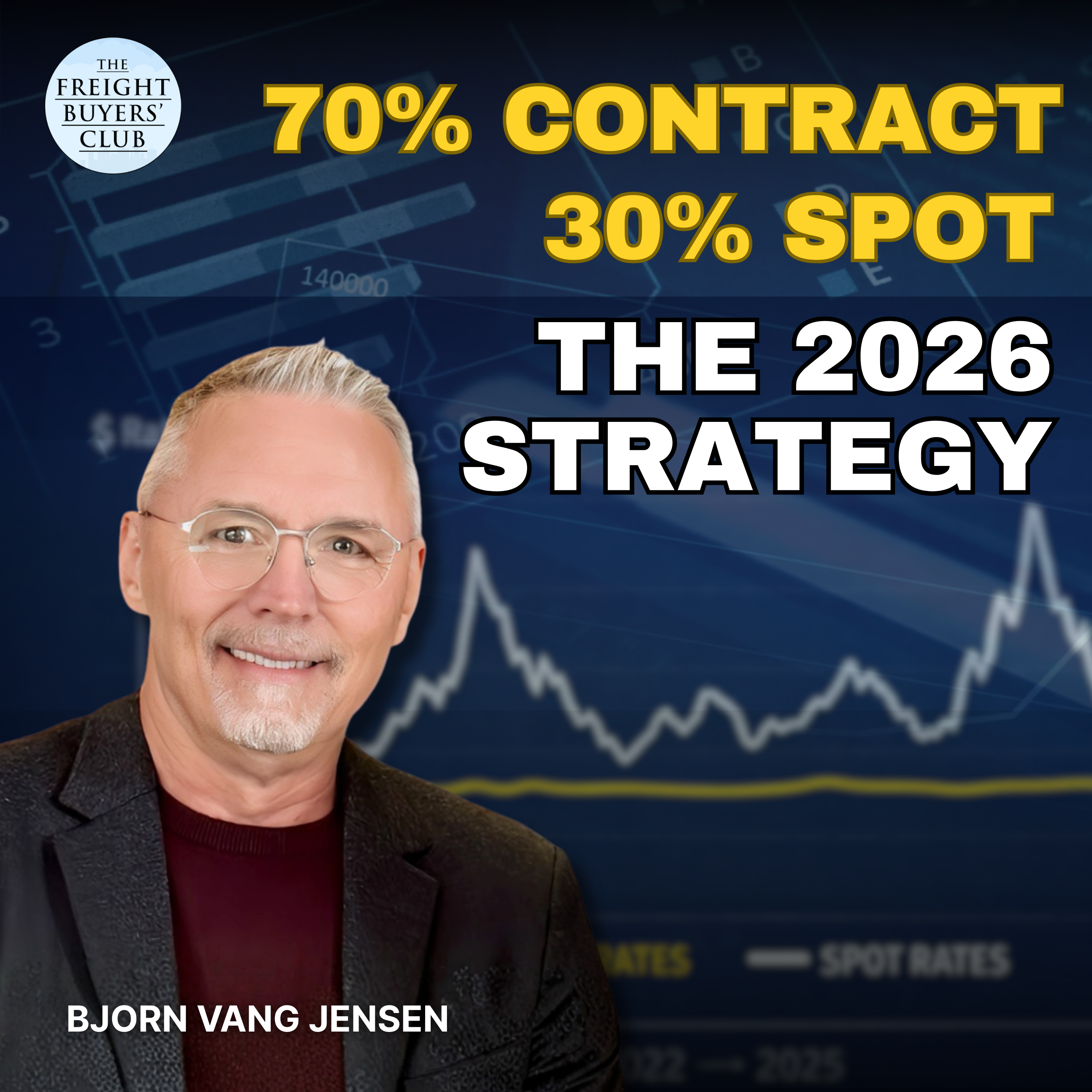
I looked it up just before this podcast. I just went back three years in Europe and then I went back one year in Europe and the Med. If you just look at one year, Asia, North Europe, there were exactly two tiny periods. A little bit in April and a little bit in October. There was short windows where you would have been better off on the spot market than with a contract. For the rest of the time you were a spot, you were paying way over the odds relative to contract rates on the Med, on Europe, Med, Asia, Asia, Mediterranean. The picture is exactly the same, except that back then it was only in April that you would have been better off in the spot market than with contract market. So I think in a very long winded way, getting to the answer. I recommend contract rates. I understand the attraction of spot rates. If it was me as a BCO, I would be 70 on those 2 markets. I would be 70. 30. 70% contract.
Keep 30% of the volume up my Sleeve for opportunities.
That's it. The other thing about contract rates that most people intuitively understand but some don't live is relationships matter.
History matters.
Mutually rewarding business relationships matter. And when some crisis hits and you have been shipping long enough to know that there's no year without one, at least one. Right. Whether it's the trade war, whether it's the pandemic is separate, that's really completely out.
[00:25:58] Speaker A: This podcast being a case in point, which is totally rewritten this morning based on what happened.
[00:26:03] Speaker B: Right. But you know, it could be a major earthquake or it could be a hurricane. It could be the Suez situation that we all faced a couple of years ago. It could be the trade war that we've all lived through since April of this year and the consequences that follow.
There will be one, at least one in 2026, maybe two, maybe three. Right. When that happens, you know where the spot market is going to go and where the contract market is not going to go. So you need to be exposed to growth. I prefer 7030, I think is a good number.
It depends on your business. It depends on your how much you like roller coasters. I'm not a big fan, but others are. Right. So I can't sit here and give you the answer, the magic formula. But I think 70, 30 or 6040 is about right.
[00:26:54] Speaker A: 7030 is pretty clear answer there. The old freight buyers buying advice from Bjorn van Gensen. Right. Bjorn, just to finish up, I want to look at a big trend in 2025. We saw a lot of trade diversified, not just in the Americas, but globally. Ages, exports, found new homes.
We've seen like in Latin America, in Africa we saw a lot of different changes in the container shipping trade. And then on sourcing we had Taiwan plus one, US plus one, China plus one, near shoring, reshoring, all of these things. We've, we talked about all about this all, all year on the freight Buyers Club. Do you expect these trends to continue? Yeah. 2026, is it more of the same?
[00:27:33] Speaker B: Yes. And yes.
First of all, the China plus one. I've been wrapped over my knuckles once or twice a thing, but I see a very, I see a different trend. I see a trend where China is mentioned after the plus sign, where companies right now are those who can. Right. Because again, not all companies are created equal. Your supply basis of us is different based on what you make, based on where you can even source things. I've heard large freight buyers advocate for purchasing officials advocate for a not a China plus one or a China plus Two, but a two or three plus China, which is saying the same thing but a very different meaning. Right.
And I think that's the way it's going to go. You could also argue that, okay, so China changed its factories to Vietnam. Now you're sourcing Vietnam, but you're really sourcing from China. China. You, you didn't find it an independent Vietnamese supplier who could supply you the same things that China could. Right. But I think just don't.
[00:28:36] Speaker A: Customs and Border Protection.
[00:28:37] Speaker B: Yeah, I think most people will be going for three plus China or China plus three. They can call it whatever they want. But China plus three, don't overlook India. India is, has, has benefited dramatically from this. I think they're still in a bit of a spatula, the US Administration, but some of that seems to have calmed down as well. India is big, Indonesia is big, Vietnam is big. Thailand is growing. Korea and Taiwan are obviously also growing. But it will be more of the same. It is a shell game that. It's not a shell game, but it's a little bit of the. What do you call it? Whack a mole. You know, the, the game you have with the, with the moles, you have to hit them with a club. Everybody who works in, in compliance and, and governance and regulatory functions right now within shipping comp, shippers have been engaged in that game since April and that will not go away.
A lot of lawyers, a lot of customs brokers have benefited dramatically from this situation. Unclear to me that, that the population at large has benefited from this. But certainly the whack a mole game will continue not for 2026, but all the way through 2028. So, yeah, more of the same, but maybe even more extreme.
People try to engineer the supply chains for reliability, for cost and for geopolitical upheaval. And it's interesting because for as long as I've been involved in trying to set budgets and working for shippers, we've always mentioned, as we sit down, look at the risks we're talking about. Well, geopolitical upheaval is a big risk, but it's one that we can't manage. And it doesn't always happen. It's. But ephemeral. It's a risk. And you must have that bullet point to show that you took that into consideration.
Now it's real, right? 2025 made it real. Now it's not something that you mentioned. Oh, and there might also be some geopolitical upheaval now. It's like number one bullet point on everybody's uncertainty list, right? That's quite some.
[00:30:36] Speaker A: This is our new world.
[00:30:37] Speaker B: Yeah. Yeah. It will be for a long time.
[00:30:40] Speaker A: Bjorn Van Gen, thanks for joining me today on the Freight Buyers Club.
[00:30:43] Speaker B: Always a pleasure. Like I said, Mike, anytime. And Happy New Year, by the way.
[00:30:47] Speaker A: Thank you very much. Yeah. Happy New Year to everyone who's listening. I'm Mike King. Thanks for listening, everybody. Big, big shout out to Antigos Cloud, the Freight forward and profitability specialist for supporting this episode. Big thanks Tom Matthews and Karen Ball for their excellent production skills. And, well, please, everybody, make sure you're subscribed because we've got some great conversations coming your way. Happy New Year. Here's to a strong saying, a profitable 2020.