[00:00:00] Speaker A: Scan clearly had a bit of a hole in the us
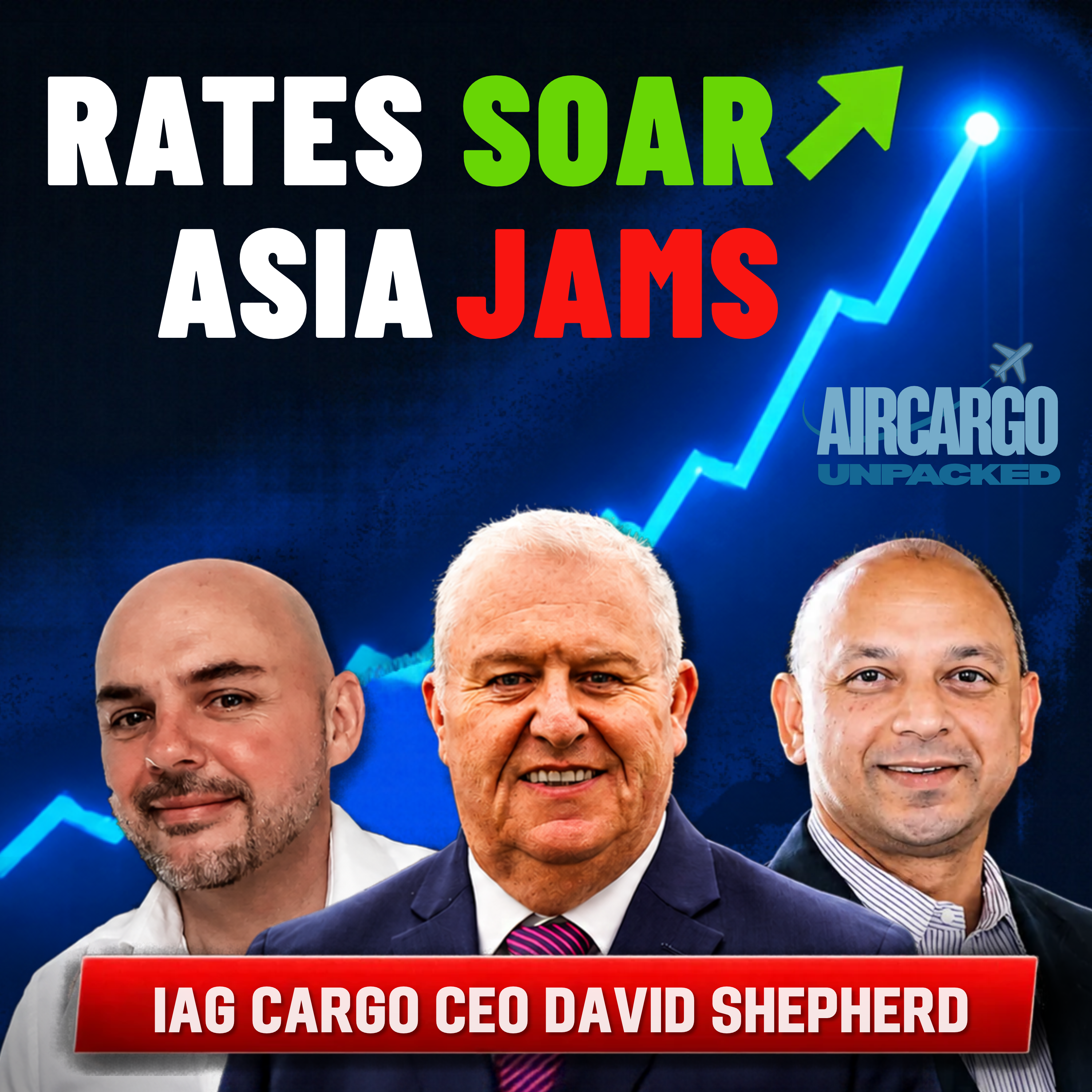
[00:00:03] Speaker B: Prices are higher because of limitation really in the market at the moment.
[00:00:07] Speaker C: So who says there isn't much of a peak season?
[00:00:09] Speaker B: We reckon about 40 to 45% of AI data center infrastructure can move in belly hold capacity.
[00:00:16] Speaker A: They are now a major player in upper deck capacity. Is
[00:00:20] Speaker D: that something that you're lobbying the government about at the moment?
[00:00:22] Speaker A: Should the AI bubble burst, there could be pretty severe implications for air freight.
[00:00:28] Speaker D: We won't tell anyone, Dave.
[00:00:30] Speaker A: Yeah. Who Tell us. No.
[00:00:40] Speaker D: Hello and welcome to Air Cargo Unpacked Freight Buyers Club Production. I'm Mike King and with me, as always, is Neil Joneshaw.
[00:00:49] Speaker A: Coming up, Neil Wilson, Attack Index cast his eagle eye over the latest rate moves and we'll be joined by David Shepherd, Chief executive at IAG Cargo.
And just one more quick note for me, Mike. I don't think I have recorded two consecutive episodes of of this podcast in the same place and today I'm coming to you from. We're in the same city today. We're not in the same room, but at least we're in the same city because I'm enjoying a few days in London. So it's great to be in your time zone.
[00:01:21] Speaker D: Welcome to London. I don't think we've done two consecutive recordings that you've been in the same city or time zone, so.
[00:01:27] Speaker A: Exactly. Well, that's the global nature of our industry. That
[00:01:30] Speaker D: is our industry to a T.
So let's get into it. We're going to run do a quick run through the news, from new tariffs to the midterm surging AI demand to our take on the peak season. But let me a few words first. This episode of the Freight Buyers Club is supported by Freight Suite, the modern alternative to your legacy tms. You know how it goes in air freight. The cutoff is close.
Your team is typing in the data, chasing updates. You know all about this, Neil.
[00:01:59] Speaker A: Absolutely. And you know one thing to say on Freight Suite, they're built by freight forwarders and it covers air, ocean and road. And its AI agents take on the repetitive work so your team can focus on customers and you can move more freight with less people and less administrative burden.
[00:02:18] Speaker D: Exactly. So if you want to boost your bottom line, join the forwarders around the world already running on it. That's Freight suite, the agentic TMS. Check out freightsweet.com.
okay, let's check out some news starting with the midterms. On 3 November, the Democrats won control of both the House and the Senate. Why does that matter for air cargo? Well, since the Supreme Court struck down emergency tariffs in February, the White House has been rebuilding its tariff regime using national security and unfair trade laws.
We've had tariffs up to 100% on patented pharmaceuticals since the end of September. Imported robots and industrial machinery have been declared a national security threat. And tariffs on Canada keep changing. China has also extended its trade truce with the US to the 10th of January.
And Presidents Trump and Xi are expected to meet at the APEC summit in Shenzhen this week.
Now, the Democrats say they'll try to overhaul the whole tariff regime. Canada is their first target. But there's so much up in the air at the moment, and it all links into U.S. politics. What do you make of it, Neil?
[00:03:27] Speaker A: First, wow. I mean, nobody would have anticipated the level of the Democrats sort of victory on November 3rd. It truly was stunning in terms of what happened and where it happened and how across the board it was not just at the top of the ticket, but down ballot too.
So the American people have spoken. Their voices were clearly heard. Right. This was not a close election in many respects, and you can read all the prognostications on it. But one of the biggest issues that Americans felt was the issue of affordability.
Okay, that was one of the single biggest issues in this election.
And the two things impacting affordability were the tariffs and gas prices. Right. That's where people feel it in their pocketbook every day when they try to get through the day.
And clearly with gas prices, the war in Iran has been the catalyst for that.
I don't want to spend any time talking about that per se today, but that is something that I know Congress is going to try and address when it comes back. What the solutions there are, I have no idea. At this point, we seem to be in a bit of a stalemate, but now when it comes to tariffs, the Democrats are in control of the House and the Senate. But remember, the president still has a lot of unilateral power and they have been quite adept at using the different tariff codes and protectionist codes that have existed for hundreds of years. Right. To implement tariffs, whether it's a national security threat or some other threat they've been leveraging. So it remains to be seen how much the new Congress will be able to impact it. I honestly think that there's going to be some rollback of some things. I think countries like Canada are going to come off the list. I think we'll sort things out with the big threat of the Canadas of the world. I don't think anything's going to change with China. I think we'll keep sort of the detente in place. But remember, you go back to 2016, when in the first Trump administration, the tariffs he placed on China, Joe Biden actually not only kept those tariffs, he doubled down
[00:05:37] Speaker D: on. He's been bipartisan for a while.
[00:05:39] Speaker A: Exactly. So I don't see anything moving with China.
But certainly with some of these other countries that have now come under fire, I think that you're going to get some resolution. And I think at the end of the day, Trump does pride himself on being a deal maker. I don't think he is as focused on his own hard line as he is on at times getting deals done.
So let's see how he works with the new Congress. But I know that this is going to be a really big item on the agenda.
[00:06:07] Speaker D: Yeah, we'll be keeping a close track on all of this right through 2027. Over in Europe, the EU's new Euro 2 customs handling fee came in on 1st November. That's on top of the Euro 3 duty on low value parcels that started in July, which had already cut small parcel imports by around 60%.
In business news, our friend Eric Coolish at Freight Waves, amongst others, reports that Scanlobe Global Logistics is buying US Forward. OIA Global, its biggest deal ever, puts it amongst the world's top 20 forwarders. And there's another deal, it's a joint venture in the works. At least Lufthansa Cargo, Swiss World Cargo ANA and Nippon Cargo Airlines have signed an agreement to explore reviving the Lufthans ANA cargo joint venture between Japan and Europe. Neil, thoughts on those deals?
[00:06:58] Speaker A: Yeah, I actually do have a few thoughts on that. I mean, you know, first when we talking about the SCAN deal, right. I think SCAN buying oia, it's actually hard to say oia, I want to say oai, but buying oia, it's more than just geographic coverage and diversification. Right. I mean, SCAN clearly had a bit of a hole in the US and so this does boost their US Sort of presence and I think more properly completes their global network. So that's certainly there. And it's more than just procurement leverage. Yes. Now OIA is going to give them more volumes, going to give them a little bit more leverage over the airlines and the ocean ocean liners. But I actually think there's a little bit more to this and I think what OIA brings to the table is more supply chain diversification. Right. Scan's more of a transactional freight forwarding type. Right. An OIA has always been into more contract logistics and customs, 4PL, you know, even packaging, materials management, all that sort of stuff. Right. So I think that there is a component that they bring new skills to the table, new capabilities.
It broadens Scan's overall exposure to the supply chain and gets them into more parts of the supply chain that are stickier. Right. We know that freight forwarding, traditional freight forwarding is quite transactional, but these other components are more sticky. And so if you can do a good job there, you're in all likelihood going to get more business, more of the transactional business as well. So let's see if they can take advantage of that, roll that out across a global network and make one plus one equal three or four, you know, even in this case,
[00:08:37] Speaker D: build in that depth.
[00:08:39] Speaker A: Exactly.
Now, when it comes to, you know, just really quickly, the, the airline, you know, joint venture discussion, you know, I think it makes sense. Partnering on a bilateral basis has worked well in air cargo. I think the alliances have never worked well, but the bilateral partnerships do. They expand each other's networks, gives everybody more opportunity, diversifies risk, etc. You know, lots changed with ANA especially. Right. In the past couple of years because they consummated the transaction and bought kz and that changes the landscape for an ANA quite dramatically. Right. They are now a major player in upper deck capacity. And so this puts them on very equal footing with Lufthansa. And I think reviving this joint venture at this point probably makes sense. And let's see what they make of it and how it benefits and impacts the overall cargo community.
[00:09:32] Speaker D: Thank you, Neil. Peak season, we'll be looking at rates in a minute, but we're both hearing about a lot of demand on some lanes and it's causing real problems at airports over in Asia. Do you want to go first on this, Neil?
[00:09:45] Speaker A: Yeah, I mean, you know, look, I'll make a couple of comments here. First, I'm going to talk a little bit about Thailand in particular because you're hearing some horror stories out of Bangkok lately with, I don't know, 12, 1300 import ULDs, not broken down freight from late October, still waiting for breakdown. I mean, you know, this going on 20 plus days. Look, air freight is about speed and reliability and when these things happen, it really, really puts a damper on the industry in particular. And I have to say, I don't know. I mean, did we learn anything as a global during COVID I mean, you know, we learned that airport terminals are not warehouses, they are Cargo freight stations, which means that freight has to move in and out and if ulds get backed up there, the whole system gets bunged up, that freight can't go anywhere. And so you just keep compounding the problem as more freight arise because you don't even have space to do the breakdowns. We know the playbook here.
Move the imports off airport, get them out of the terminal, okay? Get them to an off site facility where you can do the breakdowns and export cargo can continue to move through the terminals as they were designed for. You know this is going to require collaboration between customs there and the ground handlers are only a couple of them in Bangkok. So guys, come on, let's go get your act together. Let's get off airport space activated and let's get this cargo broken down because look, Thailand and we're going to see some data from Avion coming up that's pretty, pretty striking, right? I mean Thailand has worked really hard to position itself as an important part of the global supply chain and this sort of meltdown can really have huge setbacks. Right? And so they got to get their act together. Let's get this cargo going and, and we know how to do this now. Rocket science.
[00:11:39] Speaker D: It's not just Bangkok nearly in Taiwan, Taoyuan Airport, Taipei is still pretty congested. They had problems with labour earlier this year needed to employ. There's been very heavy traffic there. They've also had Typhoon Champi Cancel More than 200 freighter flights at the end of October. They've got all this AI and chip making equipment coming in. Last week on the Freight Buyers Club, I spoke to Jeffrey Sheet, CEO of Demerco Express Group who told me cargo's mostly been moving okay, but volumes are at record level so any disruption has a big knock on effect. He was talking about 90 freighters due to the US from Taiwan just this month on the Bangkok point. He told me they're now trucking a lot of cargo out of Thailand to other gateways to avoid it. Neil, any advice for shippers in the region? What should they be doing? Looking at those sort of similar innovative solutions as Democo and trucking to wherever there's capacity.
[00:12:31] Speaker A: Yeah, I mean look, that's basically all you're left with, right, is the option is to try and get to another gateway that might be less congested. But guess what's gonna happen if everybody trucks? You know, you're gonna create congestion somewhere else. I think that the basic thing that shippers need to be pressing for, they need to press the airports, the ground handlers the airlines to get their act together right and solve these problems. Right? You can anticipate these things, you see these problems materializing, get ahead of the curve. Why are we always trying to solve risk retroactively? Let's get a little bit more proactive and get going because I think the fastest way to figuring out the backlogs in many of these different parts of Asia that we're seeing now is at the point where we're having the issue and to get that resolved. Because I think trucking out of Bangkok to wherever a that's not easy, it's costly, it takes a lot of time and you're just going to move the congestion to another airport over time. So I don't know if there are any real big short term fixes here.
[00:13:36] Speaker D: One of the big reasons we're seeing so much strain on some of these hubs in Asia is this demand for AI. Martin Wermer, our head of consulting at Avian, has sent us some numbers on US high tech air imports from Asia Pacific. In the first nine months of this year, Taiwan, Vietnam and Thailand added around 335,000 tonnes between them.
Taiwan's extra volume alone is the equivalent of about 5 extra wide body freighter flights a day.
Now look at these growth rates to Thailand this year, up 122%, Taiwan 72%, South Korea 69%. And surprisingly, China is actually down 4%. I wonder if tariffs may be a little clue into that number.
[00:14:22] Speaker A: Yeah, I'm not surprised that China's down 4%, right? I mean the China plus one strategy, which has been there for quite, quite a while, you're starting to see the impacts of that, right? You're starting to see that even these high tech firms have diversified themselves outside of China. And honestly, just wow, the numbers are remarkable. Think about, for, we know the story on Taiwan, everybody knows about Taiwan right there. It's the, it is the epicenter of the AI boom, right? So we've talked about that. But look at the numbers out of Vietnam and Thailand. They're extraordinary. I mean Thailand might overtake China when it comes to high tech exports, right? Because that's the trajectory we're on right now. I don't think anybody would have anticipated that a couple of years ago. Look, I mean, you know, it all, it really just continues to beg the fact that in these other countries they have to make sure that the infrastructure and all is capable of supporting what has been just a massive sort of, you know, manufacturing shift.
Right?
And you know, really, really hoping that these countries and some of these airports get their act together so they can continue to support this. I think overall it's great to see this growth in the region, see the diversification. I think that's great for the global supply chain. It's great for the region. And I was really not surprised to see these numbers, but I think overall, quite pleased. Mike, I want to say, you know, one other thing. When you're looking at all of this data, right. And all of the breakdowns and all, and it's wonderful to see all this volume. I think my fear is, is that a lot of this is predicated on a.
And the boom in data center, the hyperscalers, et cetera. Right. And it's feeling quite bubble like. And you know, you even see in the stock market trades and all of how AI companies are reacting quite violently on a day to day basis. We all know what's going on with Nvidia and their CEO right now. Right. So there are all these little things that are giving me a little bit of pause because, you know, should the AI bubble burst.
Yeah, okay. There could be pretty severe implications, you know, for air freight given how much volume is being absorbed, you know, by this vertical. Remember the midterms in the U.S. we talked about that. One of the second biggest issues for people was data centers. People don't want data centers in their communities. They're raising electricity rates or consuming vast quantities of water and other natural resources.
[00:16:58] Speaker D: They don't generate many jobs.
[00:17:00] Speaker A: They don't generate many jobs. These are all highly automated facilities. And so people, you know, it used to be that, okay, these are massive investments, but they're not helping the communities in which they're in. In fact, they could be harming them quite significantly. And so let's see where this all goes. But this has become a big bipartisan issue is the growth in, in data center construction. So to be continued,
[00:17:26] Speaker D: to be continued next week, in fact, on the Freight Buyers Club, because I'm speaking to Chris Rogers at S and P Global and Jason Miller at Eli Broad, both experts on the global AI trade. And we're going to be examining it in real granular detail. But we'll be particularly asking, how long does all of this last? Either because people are pushing back against it or because these things are built out. Where does this leave everybody in our community?
Okay, let's move on freight rates. I had a chat with Neil Wilson, editor of Tacindex, a calculating agent for the Baltic air freight industries. Now, a lot of people have been predicting a not particularly exciting peak this year. So I started by asking him, what are you seeing in the latest data as we're moving through into what would be our traditional peak season?
[00:18:16] Speaker C: Well, let's look at the numbers and what we'll see is on the latest week, rates have been rising up 6.6% week on week and 28.2% up year on year.
Now, those rates are well above the previous two peak seasons and they're also now well above the highs of 2026, which we saw when rates shot up in those early weeks after the US Iran conflict erupted back in, back in March, April.
So, and that's with two to three weeks still to go till Black Friday. These numbers are. So who says there isn't much of a peak season? I mean, I think, you know, the numbers are certainly there.
I think that the, you know, other people are saying it's not that exciting. One reason is that it may not feel so good for carriers is the fact that the jet fuel prices have been really high and squeezing profits, which I think is the next thing we want to look at here.
[00:19:07] Speaker D: Yeah, yeah. Well, we know fuel's been a big part of the story all year. What's happened to those jet fuel prices since the US Midterms in the first week of November?
[00:19:15] Speaker C: So we've been talking about how they've been really high and problematic all year. But the IATA Jet Fuel Price Monitor, which tracks the average of these prices, fell. It was down 6.6% in the first week of November to November 6th, putting the jet fuel at an average of 178.95 a barrel. And that's after the US midterms with, I suppose, growing expectations that there might be a quicker end to this Iran conflic and the prices will come down. The thing to bear in mind about this, though, is that the crack spread also widened by more than 10% in that same week, which shows there are still supply chain problems in producing and distributing oil products like diesel as well as jet fuel. So this is not going to be something that will fix really quickly because of those problems all year. And jet fuel is still up close to 100% year on year, or certainly was to the end of that week.
[00:20:07] Speaker D: Despite the nature of this year's peak, we have seen some serious strain this year at gateways in Asia, particularly over the last few months. Whether we're talking about Bangkok, whether we're talking about Taipei, what's that looking like in terms of rates over there?
[00:20:21] Speaker C: So looking at lanes of interest recently, obviously Bangkok has had a lot of rapid growth in the last two or three years. And there's been a lot of coverage of this recently. Disruption due to backlogs on the ground, ground handling problems causing cancellations.
So rates in Bangkok have dropped a bit in the past week or so though they're still well up year on year. And then if you look at the other big airports, Hong Kong and Shanghai, the top two airports by cargo volume, their rates are more or less in line with that. Bao the global numbers, Taipei has been strong all year as we've been noting, and it's still strong on the back of the AI and semiconductor exports. But one I think that we haven't really looked at that I think is worth noting is South Korea, which I think is probably the biggest growth story of the year. I mean both Seoul and Taipei are top 10 airports by cargo volume as well. And Seoul, if you look at our charts, is up 92% year on year to the US and 48.7% to Europe, both rising strongly into this peak season.
And I think this shows most dramatically in the BAI spot rates, which the sole numbers overall take into account. Contract business that's been agreed months ago is a spot rate is really the marginal price. That's what people are paying to move today, tomorrow and that's been really shooting up. That marginal price rising very steeply in the last month or so as you see into this chart. It has to be fair, leveled off a little bit in the last two or three days, but that's a very strongly rising market. The other one that I would point to is look at quickly, we haven't done for a few months is India, which I think has been another very strong market this year. That market, it always had plenty of belly hole capacity and lots of carriers serving it. But it had a big bounce in the early days of the Iran war when there was a lot of disruption back in March and April and it's essentially stayed up there. It's re rated to higher levels. It's up around 80% year on year into the US as well as Europe now. And so it seems to be that that market's moved up very sharply this year too.
[00:22:18] Speaker D: Yeah, big capacity crunch there when they were very reliant on capacity via those Middle Eastern hubs. So that really hurt things in those early days.
Finally, on this month's air cargo unpack, we're talking to David shepherd of IAG Cargo. Obviously the Transatlantic is very much his home market. What's it looking like right now?
[00:22:39] Speaker C: Well, Europe, US is like as I think we've noted in recent podcasts it has a pronounced seasonality with a peak season each year and it appears following its traditional cycle with a rise into peak season happening now. And on the latest week it was up 9.2% week on week, taking it to 22% year on year and still rising. So that's following its traditional pattern as far as we can see.
[00:23:05] Speaker D: Neil Wilson, thanks as always.
[00:23:06] Speaker C: Thank you very much.
[00:23:08] Speaker D: Stay with us. We'll be right back with you where myself and Mr. Neil Jones Shaw will be joined by David Shepherd, CEO of IAG Cargo.
[00:23:18] Speaker E: Every day the world's freight keeps moving. But behind every shipment sits a mountain of admin quotes, bookings, documents, chasers, every file, every single day. FreightSuite is the agentic TMS. Our AI agents do the work inside the TMS, so your team does the work only they can do.
Scale your volume, not your team size freight suite. The Agentic tms, proud sponsor of the Freight Buyers Club.
[00:23:51] Speaker D: Welcome back now to this month's guest. IAG Cargo looks after the cargo capacity of more than 500 aircraft across British Airways, Iberia, Aer Lingus, Vueling and Level, with hubs in London, Madrid, Dublin and Barcelona. And through its recently launched joint business with Qatar Airways, Cargo and Mass Cargo, its network now reaches more than 400 destinations. Its chief executive is David Shepherd. Dave, welcome to Air Cargo Unpacked.
[00:24:20] Speaker B: Thanks for having me, Mike. I'm looking forward to the conversation.
[00:24:23] Speaker A: Hey, Dave, it's great to have you. We are both thrilled that you agreed to join us. You and I have known each other for a long time, but as competitors, and then when I was a customer for my days at Flexport. So I'm particularly thrilled that you've agreed to join us this afternoon. Thank
[00:24:39] Speaker B: you. It's good to see you again then. Absolutely.
[00:24:42] Speaker D: Dave. It's been a year of airspace closures, conflict in the Gulf and high fuel costs. IAG's third quarter results earlier this month showed cargo Traffic down almost 40%, but cargo revenue up about 4% to 294 million euros. What has all of this flux meant for the IAG Cargo network this year? And how have you kept things moving?
[00:25:06] Speaker B: Sure. Well, if we could just talk to the capacity for a moment. Part of that, obviously, was the disruption in the Middle east that we primarily saw March and April, Mike, and then has continued on in most part for the rest of the year with ba, particularly not flying what they normally would to the Middle east. The redeployment of some of that capacity into places like India, which has given us opportunity. But it's also the fact that we have for the first time in a long time not flown freighters into Hong Kong. And that is actually about the fact that rather than actually deploying those aircraft, we're working with our partners through our global joint business to actually satiate the customer demand out in that part of the world without having to deploy that capacity. So on the one hand, the capacity is pretty explainable in terms of what has happened. Certainly on the revenue side we've enjoyed the fact that prices are higher because of the limitation really in the market at the moment with supply chain. We've obviously seen less E commerce in the second half of this year because of changes in de minimis in Europe particularly. But actually as resilient as air cargo often proves to be, no sooner does that happen than we see the sort of by wave of demand for AI based data center infrastructure and stuff like that beginning to take up a demand for that supply chain. So it's been a very interesting year.
Yields and price is well up, but from our point of view, capacity down.
[00:26:41] Speaker D: We'll come back to those changes in the European laws around de minimis in a moment.
Let's look at your global cargo joint business with Qatar Airways Cargo and Mass Cargo. It's now up and running. Can you just give us a bit of insight in how it works? How's it growing, how are you rolling it out?
[00:26:57] Speaker B: Sure. Well, you know, as I just alluded to, you know, it's meaning that we're changing our capacity in certain places to better align our capacity to customer demand. Give customers choices that they've never had before.
We're able through the joint business to link places that Qatar fly to, IAG fly to that Qatar don't. So we're actually able to offer up network opportunities between origins and destinations that very few people actually can. And it's presenting new opportunity to the market in a way that yeah, is pretty unique. We think we've aligned our hubs because that's absolutely critical that we get the connectivity through the hubs. We have one last thing to do which is hopefully aligning. In London, Qatar are handled by us. In Madrid and Dublin we're handled by Qatar and Doha, we're handled by Mass in Malaysia and we handle Mass here in London as well. So we've aligned that so that we seamlessly transfer traffic from one to the other. We've already flown business across Mass, Qatar and IAG in one particular routing.
So it's working really well.
[00:28:09] Speaker A: Hey Dave, that's it's. Great to hear. And I've always been a big fan of sort of the bilateral relationships that you can create in cargo. I've never been a big fan of the alliances because they never really work, but I think these two bilateral, I think for the most part, relationship sounds like that you're off to a great start and it's good to see that you've got the operational ducks in a row. Right. So that seamless transfer of cargo without a lot of additional cost is possible. I have sort of a two part question just, you know, continuing on this thread. So what changes for shippers and forwarders, you know, when they book through the joint business? That's the first part. And then the second thing is how do you build resilience into a partnership, you know, like this when one of its hubs is so exposed to the conflict in the Gulf?
[00:28:59] Speaker B: Yeah.
So I guess taking those two parts in terms of what the customer's seeing, Neil, other than the fact that if you're booking on Qatar out of Vietnam, where IAG aren't present, you're now being presented with destinational opportunities that you weren't before with destination pricing, transit times that are faster than you could ever have enjoyed. So the actual mechanics of how you book, how you're presented with a price, et cetera, how you present it with the inventory, isn't actually changing at all, but you're just being offered a lot more choice.
If I come to the second of those, clearly it's hard to be resilient whenever one of our partners is in a position that Qatar were and we were feeling very much for them in March and April. But you know, the way in which we manage that is to try and find alternative sources of ways to route cargo. So, for example, in that situation, Qatar had freight in certain parts of the world out in the east that either Malaysian or IAG were able to satiate and able to move that would have otherwise flown through Doha.
But thankfully Qatar got up and running very quickly after the initial impact, particularly with their freighter fleet and therefore that resilience didn't need to remain too long. But it certainly it was interesting to see us come together as a team to enable service for the customer that didn't then rely on us needing to move freight through the Middle East.
[00:30:41] Speaker A: Great, thank you.
[00:30:42] Speaker D: We mentioned the EU's new handling fee. Well, changes to de minimis. We've got €2 per item from the 1st of November at on top of the $3.3 duty introduced in July that you mentioned at affected volumes can you just give us a little bit more detail on that? How did that affect how you managed Europe and what cargo was coming into Europe? And did that mix change at all in terms of did you get some AI traffic as well?
[00:31:07] Speaker B: Yeah, well, I think everybody's taking a bit of AI traffic at the moment, Mike. There's so much out there. A lot of it goes by main deck lift, as you probably know, and Iot doesn't have any. But we reckon about 40 to 45% of AI data center infrastructure can move in belly hold capacity and we're certainly getting a share of that at the moment.
In terms of the E commerce flows into Europe. We get probably a little bit less capacity in Asia than we might like at the moment, for obvious reasons, overflying Russia, etc. So we're less impacted by that. What we have observed is others redeploying capacity that maybe we're bringing in quite a lot of E commerce into Europe from Asia and that's being redeployed into places that actually require AI data center infrastructure moves instead. So it's actually watching how other people's supply of capacity is actually moving around the world is probably the way that's impacting us most at the moment.
[00:32:09] Speaker A: Hey, Dave, switching gears a little bit, you know, IAG is probably, if not the biggest, you know, one of the biggest carriers across the transatlantic.
So how is that market looking?
And you know, we've seen rates out of Frankfurt, for example, rose almost 10%, you know, in a single week at the start of November as belly space, you know, came out with the changing of the from the summer to the winter IATA schedule. What are you seeing in terms of growth across the transatlantic and, you know, what are your views on, you know, how that market's going to shape up over the course of the next couple months?
[00:32:45] Speaker B: Yeah, sure, great point. Because the transatlantic market isn't always particularly buoyant. Certainly westbound across the transatlantic. Exactly what you've just described, Neil, is happening at the moment. There is more demand on the transatlantic than we would ordinarily see, even for a peak season, quite frankly. The other thing that's helping us out quite a bit at the moment is BA have deployed quite a bit of capacity into India and we're getting a lot of flow through onto our capacity on the North Atlantic as well. So of course that's then constraining the amount of capacity that's available, whether it's for the uk, for Spain or for European markets. And that's kind of helping us on the yield Side as well. We certainly have seen that demand come from Europe and we're maybe not enjoying tenfold. We maybe need to sort of see what others in the market are doing. But we're certainly seeing buoyant yields on the Transatlantic at the moment. I would say I'd like to see the same level of sort of constraint in the market coming eastbound out of North America. It remains a challenging market.
[00:33:51] Speaker A: Yeah, yeah. But it always has been. I mean, even though the Transatlantic's a bit more balanced than the Trans Pacific. Right. You know, the imbalances exist and I don't.
We still haven't figured out how to close that gap yet. Right.
So switching gears again a little bit, you know, in the us, you know, CBP is consulting right now on rules that require importers to identify every party in the supply chain. And the comments close in the first week of December.
How do changes like that affect a carrier like IAG Cargo?
Or do you really feel that the burden of this just really sits with the forwarder, the consignee, et cetera?
[00:34:34] Speaker B: Well, I think no matter who the burden sits with, Neil, at the end of the day, if it results in less cargo being moved on the network, it ends up affecting us and ends up affecting our stakeholders. So, you know, any problem that's a problem for the shipper or the forwarder ends up as a problem for us. So we're very, very keen on it. We've seen obviously, a lot of change, ICS2 over the course of the last five years come in, in the customs realm. I think governments, states, want to understand better than ever before exactly what's entering their country and totally understandably that they. They want to have more information and data pertaining to that. So we've done a lot of work within the business.
We see our role in that, trying to make that as easy as possible for the customer to satiate the governmental need of the point of destination. But, you know, I take this back to 2006, whenever I was working on a European business in Frankfurt, and acas came in at that time, and that was probably the first time that airlines had to properly transmit customs data and the freight couldn't move until that had been translated to CBP at that point in time. So it's an evolving situation with a different level of granularity of the data that needs to move. And we certainly play a part in that process, even though it's not necessarily our ultimate responsibility for. It won't fly if it doesn't.
[00:36:07] Speaker A: Yeah, no, I. I think extremely well said And I mean, you know, you, you, you, you take me back a while, but I, I remember those days when, when AC came, came into play. I was at United at the time. And you're right, it's a big shift. It was a, it was, there was a lot of burden, but we got through that just like we got through all the other compliance sort of, you know, directives that came our way. And I suspect the industry will, will figure this one out as well.
You've made some allusions to your schedule changes, you know, that you've made particularly as a result of things that are going on in the Gulf and things like that.
We've seen you bringing back flights to Colombo, you're adding flights into Bangkok, which is an absolutely booming, super hot market. Right. Very congested right now.
You like your fuse on that. And Delhi. Can you just take us through some of these changes and how long you think sort of they'll be in place and maybe a sneak peek at what you guys might have in store for spring iata.
[00:37:04] Speaker B: Sure, yeah. I'd love to be able to give you sort of a forward view on that, but obviously can't.
[00:37:10] Speaker D: We won't tell anyone, Dave.
[00:37:11] Speaker A: Yeah. Who? Tell us all. Nobody listens to this.
[00:37:14] Speaker B: I know what a monumental listenership you have, Mike, so I'm going to be a little. It's very
[00:37:19] Speaker D: true.
[00:37:21] Speaker B: Look, we're delighted in particular to be back in Sri Lanka. I'm going to give that a call out because, you know, whether it's Delhi, whether, whether it's Bangkok, that's adding more capacity, I will say we're over the moon to be in Melbourne as well because that started off the back of Kuala Lumpur too, but adds more capacity into a key market in our joint business as well.
But really happy to be back in Colombo. It's always been a very strong market for us. We've always had the Interline business into the Maldives and into the Middle east in order to get it out. Now it has its own flight.
But I must say as well, we're delighted Covid's played its part here because in Covid, as with many other airlines, I think the airlines understood the value of its cargo arm through Covid because of the fact it was probably the only part of the business was generating a lot of cash at that point in time. And what that has meant is we've probably had a growing level of influence within our airline partners over the course of the last number of years.
I don't know whether BA would be flying the amount of capacity into India right now were it not for the contribution that the cargo business was making to it. So we've certainly tried to influence that because it's a hot market for us. Our customers are forever demanding more capacity, and I'm delighted to say that's been a big addition over the course of this year.
[00:38:45] Speaker A: Yeah, no, that's great. I appreciate that. And it's good to see you guys adding capacity, particularly in some of these markets that are really critical for Card Dome. We talked about Thailand in particular, you know, earlier in the show, and you know, their exports are up triple digits. Right. It's, it's, it's really remarkable, you know, what's happened there. But setting geopolitics aside, you know, where are the bottlenecks in the supply chain right now? Speaking of Bangkok and Taipei and, and sort of more specifically, generally, you know, do you see hubs overall being congested? Is it trucking customs, you know, lack of trained staff?
Just curious what you're seeing and what sort of views you have on what's going on around the world right now.
[00:39:29] Speaker B: To be honest with you, we're seeing more fluidity in the market than we have for a long time.
You've already called out the one thing that I probably would have responded with in terms of Bangkok being congested at the moment. But if I look at the amount of business that we're putting through Dublin, through Madrid, significantly higher volumes with handling other airlines now, and, you know, it's moving, the quality levels are remaining at the same sorts of levels. We're always going to have challenges in terms of CBP holding freight in the States for customers, and that probably taking a longer dwell time than we might like. And our handling partners are forever talking to us about the fact that they've probably got more freight on hand that they would want to have. But those are the big issues. The one thing that if I had a magic wand, I'd like to try to change would be the aviation security regulations around bringing freight on trucks from Europe through the uk. That would be a massive change for us. It would put us on a level playing field with the rest of Europe. We think we've got the infrastructure, we think we've got the processes to cope with that. But we today need to re screen all freight before it moves onward in an aircraft. We think that leaves us at a disadvantage. So that is,
[00:40:49] Speaker D: that's something. Dave, sorry to interrupt. Is that something that you're lobbying the government about at the moment? Because those talks with the EU are ongoing, aren't they?
[00:40:55] Speaker B: Certainly I would say, I'm not sure whether to use the word lobbying, but certainly we use, we use our influence with, with, with, with government to try and to, to try and amend those rules, Mike, for sure, you know, those rules get amend that it's not just about Ieg, it's about others in the U.K. marketplace, the U.K. you know, Neil asked earlier on about the transatlantic market. The problem with having those rules in place is that with the amount of capacity there is on the transatlantic from the UK into the US which is more than any other single European country, and an inability to actually move much onto that network that doesn't actually get manufactured or produced in the UK because of those restrictions, it means that, that actually we're a very different market to the US than the rest of Europe and we think that that could be significantly improved with that rule change.
[00:41:52] Speaker D: So I guess I'm putting that on your wish list.
Just looking forward to 2027. A two pronged question. What else is on your wish list and what are your main priorities?
[00:42:02] Speaker B: Yeah, I guess a little bit more stability in geopolitics would be nice
[00:42:08] Speaker D: normality
[00:42:09] Speaker B: if, if I'm honest, you know, I guess easier flying to the Far east for European carriers would help. I think that's, I think because the Ukraine conflict has been going on for such a long time and clearly from a humanitarian point of view, there are a lot more bigger concerns than flight paths over Russia, quite frankly to be worrying about with regards to that. But from an aviation point of view, the restrictions around overflying Russia mean that longer flight times make it frankly uneconomic for passenger aircraft to move to Asia to the degree that they might. And that's something I'd love to see resolved over the course of the next couple of years for sure.
[00:42:52] Speaker A: Well, we can certainly hope, Dave, that your prognostications and wish list hope Santa grants your wishes, you know, this year for sure. And we want to thank you, Dave Shepard, CEO of IAG Cargo, for joining us today. Thank you for your insight and we really, really appreciate it.
[00:43:12] Speaker D: Thank you, David.
[00:43:13] Speaker B: Good. Pleasure chatting to both
[00:43:15] Speaker D: and thanks also to Neil Wilson, Tacindex and the Baltic Exchange for exclusive access to the best data in the business. A big shout to Karen Ball for our production efforts. Thanks of course to Freight suite, the agentic TMS built by forwarders. Do check them
[email protected] and happy birthday to Caroline Joan Chart, who I hope is enjoying the amazing winter weather here in London this week. For more from the Freight Buyers Club and Air Cargo unpack. Please subscribe. Wherever you get your podcast, follow us on LinkedIn and YouTube. This has been air cargo unpacked. And I'm Mike King.
[00:43:50] Speaker A: I'm Neil Jones Shaw. We will see you next.