Episode Transcript
[00:00:00] Speaker A: Are you struggling to manage today's complex tariff environment?
Work with a3PL that combines global shipping with an expert knowledge of Trade Compliance. Demurco Express Group. Connecting Asia with the world since 1971.
[00:00:19] Speaker B: It's a definitely moving target for every shipper in the United States.
[00:00:23] Speaker C: We could be back up against that tariff wall again.
[00:00:26] Speaker B: Section 301 is the most detrimental to my shippers right now.
[00:00:30] Speaker C: More is we wish this were it.
[00:00:33] Speaker A: Surcharges tend to go on quicker than they come off as well. I've noticed. But then I am a cynic.
[00:00:38] Speaker B: Some of our members have a hard time finding their freight.
[00:00:40] Speaker C: Importers are getting sued by their domestic customers for these refunds.
[00:00:44] Speaker B: None of my members thus far have got the cash.
[00:00:47] Speaker A: I might even carry a fish if I can find one. There's no depth to which I will not sink.
Hello, welcome to the Freight Buyers Club. I'm Mike King and today we are going to be covering a lot ground. We'll be examining rising fuel costs and how that's hitting US Trucking and the Trans Pacific container shipping contracting season. We'll be looking at freight fraud and cargo theft and we might even hear what shippers think of US Rail consolidation. But our prime focus today is US Tariffs and trade policy because the Trump administration has had another significant legal setback back and we're going to lead on that. Explain which tariffs are still in play, which are not. And we'll be getting into the refund picture a little later on because there's a substantial amount of money on the table for importers who move quickly. And get this right.
We're also going to have a look at how all of this policy is actually affecting trade flows because in this industry.
How do I put it, let's just say that people sometimes know how to get around rules.
And to be fair, the numbers are already showing exactly who is winning and which countries are losing on this. So plenty to get through.
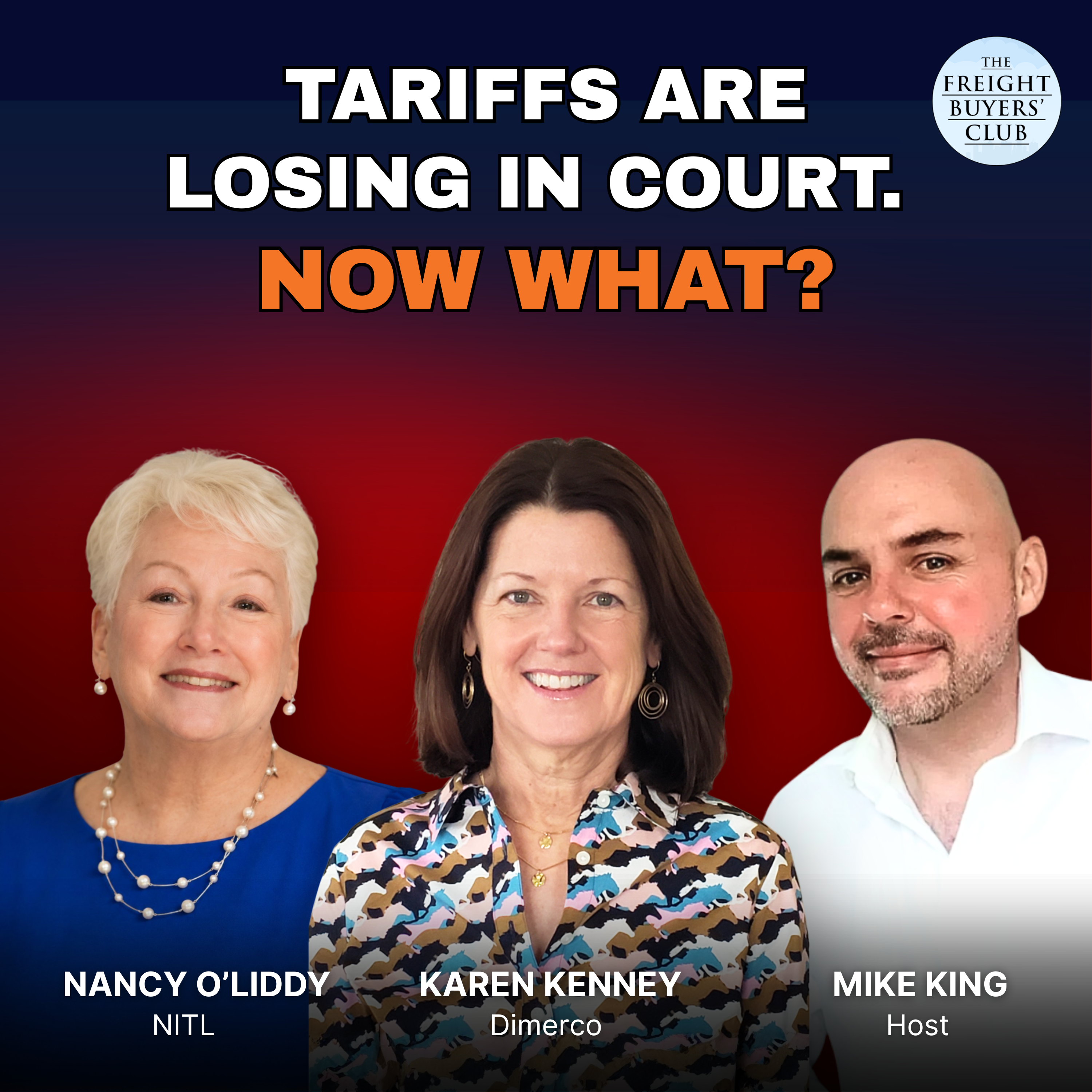
Two great guests with us today, Karen Kenny, founder and president of K2 Trade Solutions and DeMurco Express Group, Trade compliance strategist, and Nancy Aliddy, executive director at the National Industrial Transportation League. Welcome both.
[00:02:26] Speaker C: Thanks, Mike. Really happy to be here and looking forward to the conversation with you and Nancy as well.
[00:02:32] Speaker B: Thank you very much. I think we have a lot to discuss.
[00:02:35] Speaker A: Certainly do, certainly do. Before we crack on. If you are getting value from this show, please do subscribe and follow wherever you're listening. Any of you watch it on YouTube, there's three little dots at the bottom right of the video. Click on those and you'll find a thanks button if you want to buy me a small beer, maybe a pint, maybe a Mercedes, whatever, or just say cheers, you can now do that. Look at you.
Right.
Let's get straight in to the news. Last week, the U.S. court of International Trade Rule 2 to 1 against Trump's 10% global tariff, the Section 122 surcharge the administration put in place in February to replace the IEPA tariff. So this is the International Emergency Economic Powers act tariffs. That was after the Supreme Court struck those down, too.
So two legal defeats in a matter of months of the administration's core tariff architecture. Karen, Nancy, to kick us off your reaction, what does this mean for shippers?
[00:03:35] Speaker C: So right now, unfortunately, it means a lot more work for shippers without any real relief.
This new section 122 case didn't provide a universal injunction like we had with iipa.
And the administration has already said they're going to appeal this ruling probably to the Federal Circuit, eventually the Supreme Court. So nothing's going to happen too quickly.
So the trade unfortunately is in the position of having to pay these unlawful tariffs for a while and also in the position of not knowing what these Section 122 tariffs will be replaced with in July when they expire. So it's tough to plan effectively. So folks will be spending a lot of resources tracking and attacking these tariffs, probably spending money on expensive legal support, hoping that these tariffs will be refunded to them eventually. So you know, the real cost of this isn't just 10%, right? It's 10% plus the cost to track them and file protests and manage refunds and maybe even get sued because we're seeing a lot more of that where importers are getting sued by their domestic customers for these refunds.
[00:04:51] Speaker A: A lot of cost, a lot of uncertainty. Nancy.
[00:04:55] Speaker B: So our members so far and when I speak today, I'm speaking for a broader group as well of shippers because we have other associations that are members of ours as well, which is very interesting, like the Fertilizer Institute, feeding grains. So we we have a broad picture and our members so far they have successfully been able to apply it. But there's many that I've seen where they're record keeping and they're where I think, Karen, they could use you dearly have not got good records. I mean, some of the big shippers do, they have great traffic departments. But some of our little guys and I have a lot of chemical obviously are my members.
So I think this is a lesson of besides the frustration of trying to get your money back and then trying to get the money to your customer, you also are looking at your records and maybe realigning, which is very tough when the tariff party just goes up and down, up and down. So yeah, I think they're very frustrated.
[00:05:52] Speaker A: Thanks guys. We're going to come back on those refunds a bit later, but let's first let's try and give people the wide angle view on tariffs because it's despite these legal reverses, it doesn't seem really like this is going to be the end of tariff policy. The president remains committed to them. I'll use the word committed, even though they're not that popular by most polls.
So Karen, what's still standing?
[00:06:21] Speaker C: So what's still standing are the commodity specific, so called section 232 tariffs, right? These are the tariffs on automobiles, light trucks, copper, steel, aluminum, semiconductors, other stuff.
And I think the chart that we're showing here shows the average tariff rate throughout the last year by type.
And the blue, black and yellow bars on the chart show us the illegal tariffs. And these presented a massive tax increase both to shippers and to consumers. The highest tariffs the U.S. has seen since 1946. And the ones still standing in the chart are the ones there that are in red, pink and gray at the bottom of the chart. These are the original section 301 tariffs on Chinese goods, the commodities specific section 232 tariffs I just mentioned. And folks need to keep this chart handy because remember, the section 122 tariffs were just a placeholder. So we're likely going to go back to those blue and black bars on the chart because the Section 301s that are coming in July will probably replace those tariffs at the same level. We could be back up against that tariff wall again.
[00:07:40] Speaker A: Just for anyone listening, yeah, you can see this on the YouTube version of this podcast and also on Spotify video.
Let's look at what that means by country. We've got another graph here. The global US tariff average sits at 10.1%. But China is in a completely different category.
Now we think that President Xi and Trump are going to possibly meet this week. This is the second week of May, so there'll be plenty on the table there, plenty of deals to be done and some of the things we'll discuss today will probably be included in that. But trade rise, what we have now, it's a real global regulatory patchwork.
And as we just covered, it's changing all the time. Nancy, how does Navigating this impact, your members. I mean, you've already touched on this, but there's no stability.
[00:08:31] Speaker B: There is no stability. And the problem is a shipper doesn't, you know, pick. It's not like spot rate. It's not like highway.
[00:08:39] Speaker C: They.
[00:08:40] Speaker B: Their freight is contracted out. It's out for many, many weeks, and then a tariff, it goes in place. Well, that's not in that contract, and we're paying it. And I can tell you that all of my shippers have paid most of the tariffs. We have more export than we have import, and they have absolutely paid those tariffs.
It's detrimental. It is absolutely detrimental.
[00:09:02] Speaker A: Yeah. And Karen, you know, just the way that it varies by country creates. It's very hard to navigate.
[00:09:08] Speaker C: Yeah, absolutely. And the new tariffs that are coming in place are going to vary both by country and commodity. Right. So it's going to get even more complicated.
[00:09:19] Speaker A: Complexity never ends. Okay, for those watching, you can now see our third graphic tariff rates by product type. And this one is striking because you can see how dramatically steel and aluminium have moved over the last year and how high those tariffs are. They did reach up to 50%. They've seemed to come off. But you've also got semiconductors, pharmaceuticals, automobiles, all on different trajectories. Karen, what are the key things importers need to understand when they look at this?
[00:09:46] Speaker C: So, unfortunately, what they need to understand is that more is coming.
We wish this were it, but it's going to continue to get way more complicated. The administration, unlike the IEEPA and Section 122s, they think they're on strong legal footing with these section 232 tariffs that you see in the chart and the section 301s that are likely coming in July, they believe in this, they're going to double down on this.
These 232s that you see in the chart here aren't significant 50% in some cases.
And they're going to get more complex because those 301s that are likely coming in July will stack on top of these 232 tariffs.
So importers need to get involved, lobby through your trade associations for exemptions.
Those who are pushing the hardest and loudest are probably going to get what they want, either lower or higher tariffs in specific commodities.
So it's really important to stay involved in your trade associations.
[00:10:51] Speaker A: This stacking point is really important. I want to make sure people really follow this. So just say, for example, you're importing Chinese goods. You're not just paying one tariff. If I'm Understanding this correct, you could be paying a section 122 on top of a section 301 on top of most favored nation rates, which are the baseline World Trade Organization tariff rates. So this all adds up very quickly.
Karen, any examples of what that looks like in the real world?
[00:11:19] Speaker C: Yeah, that's right. Many of these tariffs do stack, especially those Section 301 tariffs that we'll likely see more of in July.
Just as an example, I have a client that imports metal tins, right? Essentially low value packaging material.
And right now already they pay a 50% section 232 rate, plus a 25% section 301 rate that's from the original Trump administration, plus a 2.5 most favored nation based tariff rate. So that's like almost 80% of on really low value merchandise. And we're probably gonna see more of this right, coming in July because these 301s generally stack on top of the 232s. And remember, some of these 301 cases that have been opened are open on China. So we could have China 301s stacking on top of China 301s on top of China 301s.
[00:12:19] Speaker A: Nancy, your members are the ones living with this day to day.
Before we get further into the detail, which of these tariff pillars, I'm going to put you on the spot here. Section 232s, 301s. The USMCA situation, which is going to due to evolve a little bit further later this year, which causes the most operational headaches for your members. Is this like choosing your, I don't know, least favorite sin or worst family member?
[00:12:47] Speaker B: Well, just think about, just think about what Karen just said. 80%.
I mean, how are we even moving this rate that doesn't even include the movement of it, that's just the tariff of it. So moving freight right now is pretty tough.
And that's not a good work word. I would say something else, but section 301 is the most detrimental to my shippers right now. We represent obviously industrial shippers. So I have a lot of chemical, I have steel as carrot, and that's a, that's a killer. That association is lobbying hard to get that exempt and they got pretty far. The other ones are, I have timber. I mean, I just, I'm in the worst spot as far as these tariffs, as far as my membership.
And I feel for them. They, they're staying strong. We stay strong. As Karen said, behind association, you can hide. So there's no retaliation, which is a huge Part of why people join associations so that when we're fighting for them and we're, we're up there on the hill and we're at fmc, they don't have to worry that they won't get their stuff on a ship. I mean, once we pay all the tariffs, we still got to get it on the ship. And that's been a real difficult situation as well. So, you know, like you said, low cost materials do not always make it on the ship.
Sometimes they got left behind or a blank sale. So there's so much more to it than just the tariffs. It's a tough field right now, it's always been. But I think right now you'd have to be extremely bright and really strategic about how you're moving your freight right now.
[00:14:22] Speaker A: We're going to look at a few of those other challenges a little bit later on, including some of the implications of what's going on in the Middle east at the moment and fuel costs and the container shipping environment.
But that's the landscape for tariffs as it stands.
So essentially we're simultaneously in a period where importers are chasing refunds on these IEPA duties that should never have been paid. $166 billion worth of through the new Consolidated administration and processing of entries or Cape Portal. Quite a mouthful there that opened on 20 April. While people are also trying to figure out what the tariff environment looks like once the legal dust settles, hopefully our analysis there gives you some idea of where that's going. Nancy, the reform process, how your members finding that is the money flowing? Are brokers equipped to handle the volume of claims? Are they charging fair fees? Are members getting consistent advice or are they finding conflicting guidance out there? I mean, I could ask more questions, but I think that's plenty to be going on with.
[00:15:24] Speaker B: Yeah, let's start. So so far they say the system is working.
None of them have received a refund and so they're spending. You know, it takes, as Karen said, is complicated. That system is complicated because you have so many items involved in a movement. I mean, it's a lot of paperwork to move freight. And so if your paper is not quite in order, then that takes it that much longer. What's also frustrating and time consuming right now is telling your customers are all over them, when am I getting my share? When am I getting my share? Well, first we got to get my share. And then you have the problem of if you use brokers and you didn't use the same broker through the whole time you were moving Freight. It's a nightmare paperwork wise. So a lot of shippers do use brokers, as you know, it is complicated. I'm very anxious to see when somebody receives a refund. Like I'm kind of ready to celebrate. But they said May 11th and 12th was going to be again when the cash was actually going to be received. But none of my members of SPAR have got the cash
[00:16:32] Speaker A: of individual shippers, are they? Do they actually know what they're entitled to or is that a sort of question mark for a lot of them?
[00:16:38] Speaker B: Well, maybe it's a shot at the dark, but. But I think they think they know what they're expecting. And then there's also the interest on the money that they lost. So that can also really impact their budget because the budgets are all hurting from all of this. So that that's going to be interesting to see if we get the full interest from the time that it started and the time the money was let go. I don't know. Karen, what are you hearing? My members, they can do this system, it's time consuming, but then your paperwork better be in complete order.
[00:17:09] Speaker C: Yeah, it has to be in order. And I did have some clients that received their first refunds today.
[00:17:15] Speaker B: Oh, you did? Yeah.
Okay, we can celebrate that.
Let's celebrate. One got one. Right.
[00:17:22] Speaker A: So Karen, for importers who are struggling to refund, to navigate all this process, then, I mean there's all these classification questions, documentation. We've touched on another few things there.
I guess your advice is contact me, is it?
[00:17:37] Speaker C: Surprisingly, it's not.
Although I'm happy to help, they can contact me.
I think my advice is twofold. First of all, if you're struggling with your broker, they're not communicating or you think they're taking an unfair share of your refund, it's time to go look for a new broker. It's not just about these refund processes. Remember what we said before, Things are about to get even more complicated than they already are now. So you need a good partner, you need a buddy, somebody by your side that's going to help you through all of this.
And then secondly, I would say that folks can certainly file for these refunds themselves. There are many customs brokers and forwarders out there that are providing value added support that have training tools that are doing one on one sessions, like myself to help.
So reach out to folks that are willing to walk side by side with you and give you a hand.
[00:18:37] Speaker B: Mike, just to add to that, there were, from what I understand, 11 million entries were submitted.
So I, I'm thinking this is going to take some time. I mean AI and everything is great, but that's a lot of work. And as we know, most of our agencies are underfunded and underemployed, so.
And for CBP is one of them, they lost a lot of the very much high talent. And so when, even when these rules come down, they have to be able to explain it. And they, some of them have got no experience in this. So it's been interesting to work with them on this as well.
[00:19:14] Speaker A: Yeah, that's a good point. I mean, Karen, how many, how many of these are you dealing with? Not all 11 million, presumably.
[00:19:21] Speaker C: Thankfully not all 11 million.
[00:19:24] Speaker B: Right.
[00:19:25] Speaker C: Because I like to eat and sleep sometimes too.
But I would say at this point I have helped just over 50 importers and these are folks who are getting back anywhere between $1,000 and one importer, $91 million.
And to a person, to Nancy's earlier point, this is their top priority, right. This is their chance to regain the ground they lost over the last year.
Super important. And folks are laser focused on it.
[00:19:56] Speaker A: Did you just say $1,000 to $91,000,000? That's, that's quite a big range, right?
[00:20:03] Speaker C: It is.
[00:20:05] Speaker A: Is there a common theme with this? Karen, you mentioned data earlier.
Is that one of the challenges when you're trying to work out it's not just about what's owed? Right. It's about the information that underpins it.
[00:20:17] Speaker C: Yeah, absolutely. Having access to the right information. I've done a lot of work in this space also auditing companies entries to help them prep for this, look for risks and opportunities.
And I haven't yet reviewed a company's entries and found one where there weren't significant over and or underpayments. One company had overpaid the tariffs by a couple million dollars.
These tariffs are just too complex for importers, brokers, brokers software packages to get right every single time.
And importers need help to get it right so they don't leave money on the table.
[00:20:57] Speaker A: Yeah, I did see, I think it's Gaia Dynamics report. We'll put this up on the screen. Actually, if you're on Spotify or YouTube that examined over 300,000 line items, I found that roughly a third of entries contained discrepancies.
So I mean that's the dollar impact then's running into tens of millions.
[00:21:15] Speaker B: Oh yeah.
[00:21:16] Speaker A: So you've got overpayments, underpayments, often with the same importers data. So it's more than a refund. Exercise, isn't it? I mean people, I think people may be listening from around the world are going, okay, well they paid this to get this much back. But it's not, it's way beyond that. It's far more complex.
Especially if you're thinking about underpayments, that's going to be a bit of a shock to anyone. Nancy, are your members on, on top of this risk now, do you think?
[00:21:42] Speaker B: I would say for the most part, yes, we have all size shippers, but we do have a majority of larger shippers and I haven't heard any complaints about getting through it, just hoping to get their money back. And I think Karen mentioned the stack problem. I think some folks may not understand the stacking properly in this refund and I think that's, some are going to lose money on this. I think especially if you did it quickly and I mean everybody was trying to do it quickly so they got their money back. But I, this is one of those exercises. I think I would have taken a little bit more time before I put my data in. But we'll see. So far so good. So far so good.
[00:22:22] Speaker A: Okay, thank you guys. Let's take a quick break and then we'll be back. With rising shipping costs, rail consolidation, fuel surcharges and cargo and tariff fraud, who would want to miss all that?
If your supply chain runs through Asia, why not work with a company that has been connecting Asia with the world since 1971? De Merco Express Group Foreign.
Welcome back. Right, tariff fraud because where? Well, when we've got a complex, fast moving tariff regime with large sums of money at stake, there sometimes are people trying to game it. Now they're broadly two forms this is taking. Let's start with transhipment fraud. There's a report from Altana that found the U.S. missed out on an estimated $107 billion in tariff revenue last year alone. Goods made in China routed through Vietnam, Mexico, India.
Countries subject to lower duties to disguise the origin. Karen, you were telling me about the impact of this for importers, particularly what it might mean for the usmca.
Usmca? The United States, Mexico, Canada agreement that replaced NAFTA in 2020. I'm doing brilliant with acronyms today, Karen, that might be re extended for another 16 years in July, but it seems like it likely won't. What's at stake?
[00:23:49] Speaker C: Yes. So first, in defense of my importer peeps, remember that not all transshipment is transparent to the importer. Right. So the importer may have moved production to Vietnam or Mexico and the supplier tells them that all the components are coming from those countries. And it's not apparent to the importer that they're not. Right.
Not all importers have the resources to trace these components.
But either way, importers are interested in how this impacts them. And I think with all of this data coming out, remember the Altana folks and many of their competitors have deep connections inside the administration and government agencies.
Many of them have contracts directly with government agencies.
So with all of this coming out, this just validates what the administration already believes to be true. Right. It adds fuel to the fire in USMCA negotiations are coming up. So this puts even more pressure on those talks and puts pressure on an administration that is already looking to crack down origin compliance.
And I think that wants to potentially change USMCA rules of origin to potentially limit the amount of Chinese component material that can be in a product and still qualify under usmca. There's a lot of chatter about this right now.
[00:25:17] Speaker A: What does any of this mean for an importer who's maybe built their supply chain around Chinese inputs assembled in Mexico, just as one example?
[00:25:25] Speaker C: Well, at best, right now, right, they're paying zero tariff, right. The product qualifies under USMCA, the last true free trade agreement in the U.S.
but looking down the road, there's a possibility that they may have shifted production to Mexico or Vietnam and it could backfire. They could be importing a product from Mexico that has a lot of Chinese components, but have to claim China origin on that product and pay the higher China tariffs when it comes across the border into the US under the current
[00:25:59] Speaker A: rules of origin, a tariff shift is enough to qualify, even if the product contains significant Chinese content.
[00:26:06] Speaker C: Yeah, that's right. So as long as you have the tariff shift, you're good. You can have lots of Chinese content, but if you have the tariff shift, you still qualify.
But there are those in the administration, Congress and domestic industry that are putting pressure on to change those rules of origin. So even with a tariff shift, if the rules change, if the content, Chinese content, for example, is above a certain threshold, you wouldn't qualify anymore.
And all of this data that's out there, all of this chatter, is just adding to the pressure on the administration and Congress to change those rules of origin.
[00:26:44] Speaker A: So, I mean, this comes up in those negotiations, that trade agreement for North America, I guess it comes up when Trump and Xi meet for sure, whenever that happens. But this is, obviously, it's a global issue. We've seen huge increases in trade with Vietnam. Again, with preferential tariffs with the US versus say China.
I've been hearing about people trans shipping in Latin America. There are other parts of Southeast Asia. It's not just about usmca CA yeah, absolutely right.
[00:27:14] Speaker C: It impacts usmca, but it's global.
And by the way, Mexico is really sensitive to this issue too. So there's a lot of pressure inside Mexico to reduce Chinese inputs and reduce Chinese influence on the Mexican economy.
But this impacts across global trade. Right now, as the administration is potentially getting those 301s ready, Section 301 tariffs for July, they're dusting off all of those framework agreements that were signed with countries like Vietnam and Thailand and Taiwan and Japan and Korea. And all of those agreements have transshipment language baked into them. So if we look at these trade statistics, we see volume shifting to these lower tariff countries.
And so tariff revenues are declining and the administration could be in the position to have to do something about this. And that language is already in these agreements teed up and ready to go. So I think that makes diversification of sourcing really important to importers because it's going to be really tough to navigate these origin rules down the road.
[00:28:27] Speaker A: Nancy, presumably your members watching this very closely, particularly companies who've maybe moved production to Mexico, Southeast Asia.
Yeah, it's just more uncertainty, I suppose.
[00:28:38] Speaker B: Well, I think it is just so difficult right now. And Karen, I don't even know as we are trying to protect and educate our members where to go at this point because a lot of them moved from going through China because they thought that's what the administration wanted. And a lot are actually going through Vietnam and then you have the trouble around the seas. So freight is becoming very, very costly. And I'm not sure if you know that just be not just the tariffs. I know that's our, our focus today.
But many of foreign countries will just drop your freight wherever they want because they're done. And it's kind of like a little punishment. And some of our members have a hard time finding their freight. We had many members that had freight in Iran when the war started. So it is such a complicated supply chain right now that we're always trying to stay one step ahead to try to help them.
But as you said, now we're going to have this other problem how much material was made in China. It's quite consuming for my members right now to figure out which route to take when they thought they might have been doing the right thing to get out of China.
So is this definitely moving target for every Shiver in the United States.
[00:29:51] Speaker A: Let's look at another type of fraud risk then. There was a great piece in the Washington Post from Linda Miller, who was deputy Executive Director of the government's Pandemic Response Accountability Committee.
She draws a direct parallel between this and the pandemic era paycheck protection program fraud. That's PPP fraud. She's very specific about how it is now happening or will happen.
So this is not fabricated claims, it's interception business email compromise. So we might see a convincing email directing a controller to confirm banking details. The underlying claim is valid, but then the money just goes to the wrong place. Karen, for importers using brokers to file through cape, what should they be checking?
[00:30:40] Speaker C: This is a great point, Mike. This is such a substantial risk that CBP actually just had a webinar about this trying to help importers protect their refunds. We're going to see epic amounts of fraud here. There's just too many ways that this could go badly that bad actors could take advantage of importers.
I think my tips are obvious, right? No rocket science here. Only work with people you know well and trust. Don't click on any shady links.
Importantly, check your ACH refund account numbers consistently in ACE to make sure they haven't been changed. There's a lot of money here on the table, so move slowly and think before you act.
[00:31:20] Speaker B: So we're actually having a fraud webinar at one o' clock today.
It is getting frightening. Most of my members don't get stolen goods as much as the fraud, the cyber fraud, because they're moving industrial materials and it is stolen. I mean, we're giving out a lot of information when we do our wire transfers there. I mean, it's just so open.
It's just frightening, actually. And so we're doing one this afternoon just on that issue, actually.
[00:31:51] Speaker A: So, Nancy, will people be able to get that after the. After the date? Because by the time they're listening to us now, that will have already happened. Will they be able to find it on your website?
[00:31:59] Speaker B: I can make it available. They can reach out to me and I can make it available. We try to keep it only for members, but I'd be happy to share. This issue is. Is all encumbersome for every shipper, right? And the more we can keep it down, the better. And if people have secrets, let's tell it right. If you have found something that keeps them away from you. I really think this new database. I would hate to be responsible at CBP for this database and the protection of it?
[00:32:24] Speaker A: No. Well, we did a, we did a podcast on. On AI and we were talking about Claude Mythos last week.
And I mean, that's only being released to a certain small group of 50 or so companies that have been licensed for national security or government as a trusted company by the government. But there's already been a breach of that. And the reason why that had been limited in terms of where it goes, it could get into every single bit of software. So presumably that includes the cbp. So that falls into the wrong hands. I mean there's a clear direct way that that could happen.
Karen, I guess like a single compromise broker firm could be more, I suppose a force multiplier here. That one breach, you could possibly have hundreds of redirected refunds. I mean, is that theoretical, Karen, or Nancy? Nancy, is this something that NITL is actively communicating to members?
[00:33:18] Speaker B: Oh, yes, we are. This afternoon will be one, but we're going to be doing many because it's just getting worse and they're getting smarter and none of us understand the whole, I don't the AI world of more knowledge. It's frightening to me how we can protect our own information, especially because of the information they have to put into this database to get the refunds.
[00:33:42] Speaker A: Karen, thoughts?
[00:33:44] Speaker C: Yeah, I agree with Nancy. I think there are a lot of potential points of compromise here, both on the government side and on the importer side.
And the last thing an importer needs on top of all of this other complexity. Right. Is having to deal with chasing down stolen refunds.
[00:34:04] Speaker A: Okay, thanks for that. Let's pivot away from tariff, but let's stay with fraud in the U.S. double brokering. Right. We covered this in some depth. On a previous episode of the Freight buyers club, Mark McCullough, CEO of Gabruda Vice North America, told us how double brokering scams cost his company $600 in. In a single year.
Now, the way he sort of roughly described it, he tells a way better story than me. So please look at that interview with Mark on the Freight buyers club on YouTube.
But it starts small, so you have a legitimate looking load. They build trust over time and then all of a sudden that trust disappears and so does the load. Even with the best vetting technology, the criminals are changing their methods faster than tools can keep up. Nancy, is this something you come across a lot with shippers that you speak to?
[00:34:54] Speaker B: So prior to working with knitleague, I worked for tia, which was the domestic brokers. And this issue has been and will always be probably one of their top priorities. We and many of the associations are working with FMCSA to figure out a way that when somebody registers, we need to have more signals fly up. Right? We need to.
So if there are chameleons, which there are millions chameleons, there's a way to stop them before they even can get a license. We've asked for red light, green lights from FMCSA. I've been lobbying on that for over 12 years. I think we got to stop it where it starts, right? We got to know how they got through FMCSA because that's where they get their license. It is quite complex. And we actually are going to have a meeting soon with FMCSA on this issue.
We've been talking about it for years. How do we get to a database that can actually prevent or stop the chameleons? The email issue is a different thing. The email issue, where they're acting like they take over your email, it sounds like it's coming from your company, is another whole disaster, really. And it is happening. It happens every day. Especially I think right now, the highest one being hit on that is pharmaceuticals, which is frightening.
So there's quite a bit of theft in pharmaceuticals at the moment.
[00:36:14] Speaker A: Target high value goods. Just back on the FMCSA point. Nancy, you've been lobbying for 12 years. Have you got any sense that something might happen now in year 13?
[00:36:24] Speaker B: Well, it's a good thing. It keeps us in jobs, I guess.
They're working very hard. It is a new administration. And I will say for transportation, they are working really hard to get rid of those carriers that are fraudulent, shouldn't be driving in the US But I think there has to be, it has to happen in that database. There has to be some flags that go off to say, oh, this guy's familiar. This is like his third license of a different name. How do we stop that? We're not there yet, but we'll get there. I think with this administration, we may actually get something that will send flags.
[00:37:02] Speaker A: Well, let's hope so. Watch this space. Uh, okay, let's talk about something that is adding to an already difficult picture for US shippers. And it has nothing to do with tariffs if you're tariffed out. But is it another driver of increased costs and that's fuel? Because the, the cost environment has completely changed since the start of the war in the Middle east at the end of February. And for companies running transport networks or negotiation carrier contracts, whether that's domestic trucking, whether that's container shipping, whether that's air cargo, all of this is a real, an immediate problem. On top of everything else that we've already covered. Now we've got a graphic on screen from the American Automobile Association.
We've got diesel right now is like around about five and a half dollars per gallon.
Well, it might have changed slightly by the time you see this, but it's not far off there now. A year ago it was about 60%. Well, it was about three and a half dollars. So it's up 60% year on year. Regular gas. Gasoline is up nearly 45% over the same period.
Nancy, you guys represent shippers across every mode. What's driving them insane?
[00:38:17] Speaker B: I have to say a few of my members have decided to retire.
Yeah, I cannot play this game anymore. And that was actually more on the terror side. But it is interesting, you know, when you've been doing it for 25 years, 30 years, and now this probably is the worst supply chain we've had in a really, really long time. I had a year in my head, but I don't at the moment. The ocean carriers, because I always have to clarify. The ocean carriers, the fuel has doubled and they have already stated, and it was in the Journal of Commerce that that double is going back to the shivers, which means the shivers are going to have to get it back to the customers. That's a big jump to put that back on the Shiver as well. And when spot rates start. And now we're talking about trucking right now. Every person's budget must be so.
I mean, I just don't even know how you prepare it to take the hits. We're getting fuel surcharges. We're fighting right now at different ports because some ports are still charging Covid fees. Hello, we're out of COVID Call it something else if you want, but stop charging us Covid fees. So we is a never ending, I will say a fight for all of these issues for our shippers.
The fuel's killing us. The fuel's killing us. And you can only store so much. Right. You can only store so much domestically because that's another cost. A lot of them were trying to do that when before the tariffs started. Let's load up these warehouses. But you know, there's also product time frames. So it's. It's detrimental. Yeah.
[00:39:52] Speaker A: Any, any carriers listening here? This definitely applies to air and ocean.
They. There are profits to be made on being quick to get your fuel surcharges out. I'll put it like that, that lag period. But if you can get, if you can get it paid quickly before you have to pay it yourself, then that is actually a profit margin for a lot of carriers and some of their intermediaries on the ocean side. The Federal Maritime Commission did push back on carrier applications for fuel sayer charges. I guess you welcome that, Nancy.
[00:40:23] Speaker B: Oh, for sure.
Now, whether it happens, they did a pushback, but sometimes pushbacks from the agencies are not enough and they can't control rates. So we work very closely with the Federal Maritime Commission and the Surface Transportation Board for rail. They have tough jobs because they are very limited on what they can control. It's very limited. But no, that was a blessing. Please, anything to help the supply chain move freight is a good thing. Yeah.
[00:40:53] Speaker A: So I guess the thing to take away from that is wherever mode of transport you're in, make sure you check the terms and conditions of your contract and see how exposed you are to rising fuel costs, surcharges and the rest of it just back on the Middle east. So obviously we all want a ceasefire.
I've said this on the podcast before when we've heard, oh, there's, you know, it's peace in our time or.
And these things, oh, it's all straight of Hormuz is open.
Please, you know, define what peace is. Define what open is. What does that mean actual practically? Because there's plenty of examples of this historically. And until you don't get a free flow of goods, until everything feels safe for insurance, for the crew, for the ships, for the cargo, people aren't just going to throw cargo through the Strait of Hormuz until they're sure it's totally safe, not in any sort of meaningful numbers. And we've had this endless loop of announcements and market bounce backs and as I say, it's been very hard to follow. It's been a bit Groundhog Day. So I'm working on the assumption that a full reopening of maritime traveling homes will not happen overnight. Even if there is overnight a deal signed, we could still be weeks away from normal, could be much longer. Karen, from a supply chain planning perspective, are you seeing these fuel surcharges and these uncertainties around the Middle East?
We've had a Trans Pacific contracting season as well, last few weeks, or maybe going back a bit further, but it depends on the length of the contract.
These are all getting jumped in with tariff conversations as well.
It's a complex environment.
[00:42:30] Speaker C: Yeah, absolutely.
Domestic capacity is tightening up, rates are going up.
Significant impact from surcharges based on what's happening in the Middle East. But this is driven, I think right now mostly by the surcharge bonanza that we've seen.
The carriers are good at that and I think if you look at their recent financial results, we'll probably see more of it.
But to be fair, fuel prices are up, right? I think jet fuel prices are up like 40% over the last year. But I think most of the price increases are related to surcharges because volumes are still soft.
[00:43:11] Speaker B: Yeah, correct. Yeah.
[00:43:13] Speaker A: So you think the surcharges are doing work rather than the base rates, Karen?
[00:43:18] Speaker C: Yeah, yeah, for sure. I think capacity is still plentiful. The base rates have bumped up marginally from contract season, but no big moves on base rates. It's almost entirely on surcharges. There's a shipper that I know that cracks me up and he referred to the current market as being a series of paper cuts.
So no death blow like we saw during the pandemic to shipping. But their market conditions are pushing rates up mostly in the form of of surcharges.
And remember that once the conflict in the Middle east does end, these fuel costs aren't going to turn around in a day. Right. It's going to take time.
[00:44:03] Speaker A: Surcharges tend to go on quicker than they come off as well. I've noticed.
[00:44:07] Speaker B: Yeah.
[00:44:08] Speaker A: But then I am a cynic. Nancy, are your members feeling death by a thousand paper cuts or is there something more serious? Any legs chopped off?
[00:44:18] Speaker B: No legs shifted. No legs yet.
[00:44:20] Speaker A: I'm thinking of Monty Python now. I don't know.
[00:44:23] Speaker B: Well, I don't think it's a flesh wound.
[00:44:26] Speaker A: You might have to look that up if you're under about 45.
[00:44:29] Speaker B: Right, right.
So we're gonna have to figure out. And Karen, I agree, I haven't heard them use that phrase actually, but it just, it's this never ending unknown. Right. Every day is a different thing and you've not quietly figured out the problem before it or how to get your money or make money moving freight. And really part of the problem now is getting it to the customer. Seriously getting it to the customer with ocean carriers. And you remember the Red Sea, that was a nightmare. Trying to get around it and the money it cost to get around it. We really need to get the waterways working.
That's a big A, big deal. And I think our members, it's just this unknown of every morning waking up to another tariff or another added problem like the war in Iran no one expected. And I was actually at TPM when that happened and with all the shippers and everybody Transportation and oh my God you could feel the pressure of how am I going to get my freight? How am I going to get it out of there? How am I. I was like you could see it. You could see it on their faces. Yeah it's. It is very tough times for supply
[00:45:36] Speaker A: chain for sure, for sure.
If, if anyone is a Monty Python fan actually you should really check that out on YouTube. I never saw it on the TV when came out originally but I have followed it up. But if I get any request right here's I'll throw this out there. If. If anyone has got a request for me to do a little to video piece about something to do with the freight market from exactly where they filmed the fish fight on a lock in London. Where I'm sitting is about 100 meters away from where they film at. So I'll promise I'll go and do it. I might even carry a fish if I can find one.
So there's no depths to which I will not sink.
Nancy, before we wrap up Union Pacific and Norfolk Southern have filed a second major application with the Surface Transportation Board and the nitl. The NIT League I know you sometimes call it that has called for it to be denied unless the applicants can demonstrate clearly that the combined railroad would enhance competition and the benefits out weigh the harms. Tell us about that.
[00:46:42] Speaker B: So Nitleague has been on the record since the last merger with KCPC and that there should be no more mergers. We we already between rail only having five class ones ocean carriers we only have five that move like 90% of the freight.
There is no competition and the more we take away other rail providers there is no way that it can be competitive. We already have enough trouble with it not being competitive. Now I have a lot of members that are dependent on a certain rail because they're captive. And if we do this merger what happens when we do have another crisis? What happens if we have a hurricane? What happens if they decide to deny a route?
How can we keep this market competitive if we do that? There are many people that think that it's a good thing. There has been a great amount of retaliation by one of the railroads to people who use them now stating that if they don't support the merger they will remember who they are. That's how big rail is.
I think we need to make that very apparent. It is apparent. We told it to every doj, we've told it to fmc.
No one should be afraid to do business in the United States.
So we are very much working with the American Chemicals Coalition, which is humongous. And there's quite a few of us working together to try to stop the merger. The last document is almost 8,000 pages, so it takes time to figure out what was added and not added and did they answer the correct question. So we're not against any particular rail, we just are against mergers.
So you just need to make that clear.
[00:48:34] Speaker A: So, yeah, we know who you are. So it sounds like the politics of vendettas is seeping into the business community a little bit.
The railroads would say bigger network, more efficiency, drive down costs, better service. But your view is fewer players, less leverage, higher costs, more or less 100%.
Thank you very much, both of you.
Karen Kenney is founder and president of K2 Trade Solutions and Democo Express Group, trade compliance strategist. Karen, thank you.
[00:49:09] Speaker C: Thank you, Mike.
[00:49:09] Speaker A: It was a lot of fun, and it was indeed. Nancy Elidi, executive director then at Lee, the nation's oldest freight transportation association, representing shippers since 1907. Nancy, thanks so much for coming on.
[00:49:24] Speaker B: It was fabulous. Thank you. Hopefully we've got the word out.
[00:49:27] Speaker A: I think we've definitely done tariffs, haven't we?
[00:49:31] Speaker B: The never ending tariffs?
[00:49:33] Speaker A: Yes. Well, I'm sure we'll be back to it later in the year.
Thank you everyone for listening. This episode was produced with the supporter of DiMerco expression group. Big thank you to Tom Matthews and Karen Bull for their excellent editing. And if you found this useful, please do subscribe and follow wherever you're listening. And don't forget where that thanks Button is on YouTube. We'll see you.