Episode Transcript
[00:00:00] Speaker A: Your head's on a swivel right now. Right. In terms of stuff that's particularly coming out of Washington, freighters is a completely
[00:00:07] Speaker B: different animal to passenger bellies.
[00:00:09] Speaker C: That drop in capacity must be being reflected a little bit because the rates have been edging up.
[00:00:13] Speaker A: It's September, Mike. It's a little late to be starting these conversations.
[00:00:17] Speaker D: It wouldn't be the same without Neil though, would it?
[00:00:19] Speaker B: Albeit for me to talk on behalf of any of them. I mean, we have seen DHL use Muscat as an alternative hub.
[00:00:26] Speaker A: The world has become addicted to air freight.
[00:00:37] Speaker D: Hello and welcome to Air Cargo Unpacked, a Freight Buyers Club production. I'm Mike King and with me, as always is Neil Jones Shaw.
[00:00:47] Speaker A: Thanks, Mike. Coming up, the best rates analysis in the game from Neil Wilson. Attack index, a nasty new regulatory squeeze out of Washington and a look at who's putting real money into new freighter capacity.
[00:01:01] Speaker D: And a little later we'll also be joined by Mike Duggan, head of cargo at Oman Air, to hear his take on what's going on in the Middle east, how he has navigated the last few months and what happens next.
But first, Neil. So I've spent a week over at the EU Cross Border E Commerce forum in Liege, Belgium.
My takeaway from that was that despite the big change in EU de minimis rules, this isn't a trade that's really going away anytime soon. But really growth has really stalled. Ryan Key Rouse that rotates at E Commerce demand year on year is now 0%, although tonnage wise it's 23% higher than two years ago.
In Europe, the picture is particularly stark. EU de minimis changes at the start of July had a big impact on that market. We saw a lot of front loading through to the end of June and then a 24% drop in traffic in July when we also saw a 30% decline in China. Europe freighter capacity that was something like 120 flights a week.
From various conversations I had in Liege, what we're seeing is this E Commerce business consolidating into something that looks very different. It's moving away certainly for low value products from a B to C model. Instead we've got these more complex B2B supply chains. We've got freight coming into Europe in bulk, by air and by ocean to cut those customers minimums bills.
Actually there was a really good point on that from the European Commission because they're rather happy with these new revenue streams. They're bringing in an extra 31 million euros a week on this de Minimis change since the start of July. So they're doing quite good. Yeah, but for cheaper products the big E tailers have now set up EU fulfillment centers for block wide delivery is basically what we saw happen in the US over a slightly longer time frame last year.
So Neil, give us the insider's view on how these changes change the air cargo demand outlook as we're moving forward.
[00:03:01] Speaker A: Yeah, thanks. Thanks Mike. And I wish I could have joined you in lie. Sounds like you guys still had a lot of interesting discussions going on there. I think we've seen this playbook before, right. We saw it play out in the US as the US made their changes. They ended de minimis.
We saw a lot of lower end products get front loaded. A lot of ocean container shipping, original distribution. Right. You're paying much, much lower CI value with the tariffs that were, you know, that were implemented. And so, you know, that is how it's playing out in Europe as well. Some of the higher end, maybe the less popular SKUs that can't be front loaded because they just don't know what people are going to order, those are still going by air, you know, the, the larger SKUs by volume are going to be distributed, you know, regionally. But I think there are a couple of important numbers here. So yes, we did see a 24% drop in traffic in July. It would have been very, very much expected and anticipated. What's important, we also saw a 30% drop in capacity. You know, so the industry is reacting rationally, removing capacity, actually removed a little bit more capacity than the demand dropped. And this again creates more rate stability. It doesn't create a lot of volatility in rates because you're trying to keep things in balance. That's really important. Ten years ago this industry wouldn't have done that. We would have still flown everything. We would have, you know, it would have been big money losing operation. Now granted fuel was much lower, you know, things like that. We weren't dealing with some volatility in certain input costs. But look, I think the industry is just approaching the supply, demand balance much more rationally today. They're reacting faster.
Nobody wants to lose money, nobody wants to burn cash. And in this environment it's, it's just a silly thing to do. And your life expectancy as a senior executive in a cargo business, if you're burning cash is not going to be very long because you're going to find yourself unemployed. So I think that you've got to take, you know, proper decisions and I think that when it comes to demand overall E commerce is a bit of a whipsaw. You can change demand very quickly just with a one regulatory change boom, you know, 20% of demand disappears. But the overall the underlying air cargo market still continues to be quite strong. You know, the high tech, the AI, mobile phones, you know, we just see Apple with their new launch, you know, host of new, popular new products. They're very bullish about this new product line. Well, you know, that's what's going to fuel air freight. Right. So we still have all of that traditional demand that's underpinning this market. So overall I continue to be bullish on demand. This peak season may be a little more muted than others given the externalities and the war and things like that. High fuel prices, consumers having a little less money to spend because they're spending it on the gas tank. That being said, I think overall demand, you know, strong. And we'll see what Neil Wilson has to say about, you know, yields when he does his section as well.
[00:06:04] Speaker D: Yeah, and I want to get your thoughts later on how people can prepare for peak season.
But yeah, a few other takeaways, not necessarily all, all linked up. Some, some hubs have, have lost more than others.
Budapest, Liege but places like Stansted Cologne have won some volumes.
It seems that freighter capacity that's been taken off that lane hasn't been fully redistributed elsewhere. Not exactly clear why that is. It seems some of those older 747 400Fs of conversions were taken out of service. Maybe this is maintenance. Maybe they're waiting for a market opportunity separate from that. The view from a rotate survey was that most people expect E Commerce to pick up again towards the end of the year.
[00:06:47] Speaker A: Well, time will tell. I mean elsewhere in the market we're seeing ongoing strong computing and and semiconductor exports out of Asia, especially from Taiwan, which we know is the AI, you know, origination point for a lot of this demand which is really helping replace some of those imports into Europe, although this isn't as pronounced as demand into the US for AI related tech.
[00:07:10] Speaker D: Thanks Neil. Okay. As listeners and watchers know, each month I sit down with Neil Wilson, editor of Tacindex, the leading global price reporting agency on air freight rates and the calculating agent for the Baltic air freight indices to look at what's going on in rates markets, what's driving things. But this month was slightly different. Check this out.
So Neil, here we are in Sunny Liege.
Give us an update. How have rates been the last month or so?
[00:07:44] Speaker C: Well, great to be here. Mike, it's been an interesting day out there. Interesting comments in the hall.
Well, we've had a very exciting year, very volatile year, as we've talked about every month, but this month has been pretty unchanged. It's been pretty unremarkable in terms of the rates pretty flat, up 0.6 over the last four weeks to the latest week we've got. And this is like, it's kind of bizarre given all the macro issues we know there are with government debt, the questions about the AI theme and of course, what's going on in the Middle east and the straightforward moves. But the. The rates, despite jet fuel, which we'll come on to later, being up a lot, haven't really moved a lot.
[00:08:22] Speaker D: We discussed in the last episode about this disconnect between China us, China Europe lanes, some of it linked to what we were discussing here in the Edge about E commerce demand and de minimis changes on July 1st into Europe.
How's that looking at the moment?
[00:08:40] Speaker C: Well, this again picks up from last month. So moving on from the BioO, which is a global chart, to the China Europe and China us. If you look at the China, China, Europe, you can see it's only up about 10% or so year on year now. And there has been a. There's been a pronounced drop since the end of July. We'll see the volumes there have dropped and the prices have dropped given that change on the E commerce rules on the small parcels moving to the flat rate.
Whereas China us, which was impacted last year when they dropped the de minimis there, that's up 30% year on year, so much stronger than China Europe.
[00:09:12] Speaker D: And are we seeing any outliers there in terms of rates?
[00:09:17] Speaker C: Yeah. So we've talked about various different lanes on the last couple of podcasts, and one we looked at last time was the transatlantic Europe us, which is a kind of typical seasonality to it as a peak season, and it goes up and down different periods and that's pretty much in line with the global averages, up 17 or so year on year. Whereas if you look at Europe, China, where we've been talking about how the volumes have dropped and the rates have dropped, when you look at the other way around, that's a market which typically doesn't have much seasonality. It's pretty bumps up and down along the same kind of level all year. And it's really because of the volumes going back and not as much as the volumes going in, if you like. And I think what we're seeing there is that drop in capacity Must be being reflected a little bit because the rates have been edging up.
Europe, China has been edging up. And so you look at specific outbound lanes. Amsterdam up a lot to Mumbai to Dubai, to Shanghai to Tokyo, ex Frankfurt's up a lot, ex Paris is up a lot. So is this because the capacity's dropped? Something we're going to look at further.
[00:10:19] Speaker D: Thank you. Middle east as well. We have to go there. Jet fuel prices, no sign of a cessation in hostilities.
What's been happening?
[00:10:27] Speaker C: So jet fuel, we've been watching this again very closely every month and looking at the IATA jet fuel price monitor with the ongoing on off kind of hostilities in the Arabian Gulf, Persian Gulf some call it, it's up another 9% month on month on the latest numbers there and that's 90% up year on year, which is a lot more than the air freight rate. So obviously, as we said before, if that kind of situation persists, even though the cost of business are not all about jet fuel, it's maybe 25, 30%. But the impact of a 90% increase in jet fuel has got to be felt in the rates at some point. If that continues.
[00:11:07] Speaker D: Many thanks to Neil for his time. And TAC index in the Baltic exchange for the continued support of air cargo unpacked. We love their exclusive data.
Neil. What is clear from those numbers is that this is still very much a seller's market. What advice would you give buyers as we look forward to the peak season?
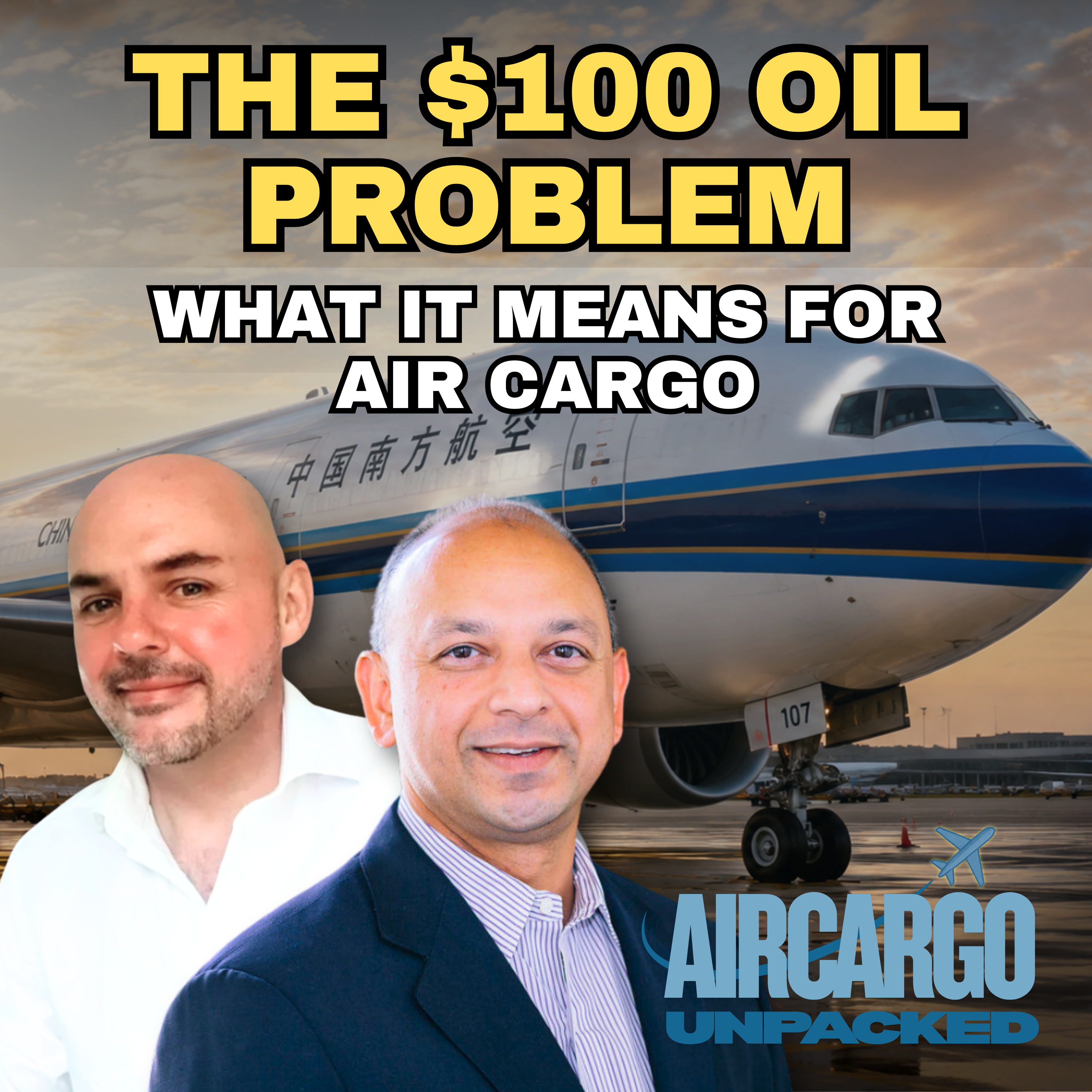
[00:11:27] Speaker A: Yeah, I mean, I think, you know, what Neil confirmed, right, is that rates continue to be quite strong. We've seen obviously some changes in Asia, Europe, driven by eu. We see stability, you know, traditional stability in the transatlantic seasonal, you know, you know, stuff going on. Something that we've been used to and have dealt with. Obviously China into the U.S. you know, remains quite strong, obviously, you know, driven by, you know, AI and also a bit of a resurgence in E Commerce, particularly E commerce flowing into Latin America. And I think, you know, this is, this is part of my point is that I think that this peak season is not going to be a blockbuster. It's not going to be like, holy crap, you know, we're off the charts. Demand is flowing out of warehouses around the world. I don't think we're going to be in that situation. However, I think the peak season will be good, especially given all of the macro factors that we've talked ad nauseam about. Fuel prices have spiked. We have to keep an eye on that. They're over $100 WTI and so that's a concerning point because how quickly those can get passed along, those will eat up that margin on that freighter flying really, really quickly. And so airlines are going to want to pass as quickly as possible. And how, you know, forwarders and shippers and all react to this remains to be seen because this spike has just happened in the past two to three weeks of as, as hostilities have really sort of ramped back up. So let's see what role that plays. I think overall demand is going to be decent. I think we will see some more capacity get pulled given the high fuel prices. So the less fuel efficient airplanes are going to see fewer block hours flown. It's just natural.
You know, the most fuel efficient airplanes or utilization will probably keep up or maybe even tick up a little bit. But carriers that have a diverse fleet will certainly try to de. Emphasize the fuel hogging, you know, aircraft, you know, for sure. But I think that overall buyers need to continue to be creative, look for creative routing options, look at expanding the number of carriers they work with.
It's September, Mike. It's a little late to be starting these conversations. I've always said if you're, if you're a big buyer of air freight, particularly in the peak season, you need to be having these conversations, you know, in the March, April, May timeframe, not in September, but opportunistically, there will be opportunities for them to look. But you gotta be creative. You cannot try and jam a square peg into a round hole.
You've gotta try and find the mix of capacity that's gonna, that's going to allow you to keep your supply chain moving at a reasonable cost.
[00:14:06] Speaker D: Top advice, Neil.
I just want to pivot slightly. We've got some US Regulatory news. This month, Customs and Border Protection published a proposal demanding visibility into every party in an import supply chain from the foreign factory right through to the final delivery address.
The same week, the House of Representatives passed a bill setting up a dedicated Justice Department task force to go after trade crimes.
So between the two forwarders in the US Market, that's a lot more reporting and a lot more scrutiny, isn't it, Neil? Or is this just more paperwork or do you think this has got teeth? What's your view?
[00:14:48] Speaker A: Honestly, Mike, I don't know. I mean, you know, there's been a lot of stuff coming out of Washington. You know, make your head spin at times, right? Whether it's actual legislation or it's executive orders, they seem to be coming at you. You know, then people are challenging things in the courts, government Officials are ignoring court decisions, you're going back to the courts. So, you know, your head's on a swivel right now. Right. In terms of stuff that's particularly coming out of Washington, I do think that this legislation is grounded in something that's right in the sense that you have to make sure that your supply chain is secure. You have to go after these, these trade crimes because they are increasing in scope and they do have a damaging effect overall. And so these are things that need to be dealt with.
What I hope is that all the burden of this isn't placed on the backs of the forwarder, for example. Right. That's, that's sort of. And I do feel the forwarder, given that they're the glue of the supply chain, that they're the ones that, you know, take the end to end responsibility, that they will, they will, you know, somehow sort of face quite a bit of the reporting burden on this. But I'm actually hoping that a lot of this will fall on the shippers as well because they truly know the origins and all of their supply chain. So look, time will tell on this. I know I've said that a couple of times, you know, today to, to see how this, how this shapes up and how forwarders are able to, to deal with it or even, you know, what changes they may make given they've implemented now. I'm sure they're getting a lot of feedback. I don't. None of these things settles out exactly as it was planned. They, they often will tweak the programs based on what they learn during real life implementation.
[00:16:35] Speaker D: Thanks, Neil. A couple of stories I want to just go through quickly before we hear from Mike Duggan at Omanair.
Plenty of freight orders in the pipeline. Ethiopian Airlines is reportedly closing in on an order for up to 10 Boeing. Freight is a mix of 777Fs and the newer 777.8F. Indian carrier AFCOM signed a letter of intent for up to 4 777.8Fs of its own on top of the order MSC Air Cargo placed back in July.
Obviously these are long term plays. It's hard getting that capacity in if you're trying to expand.
We've also got a shortage of freighter conversion options, airframes and engines more broadly. It's a tough market if anyone's trying to grow.
[00:17:14] Speaker A: Yeah, I mean, look, I mean the OEMs have been quite supply chain constrained for years now. This isn't new news from that perspective and it's good to see these carriers investing broadly into their future. Because you order an airplane today, you're not going to see it for at least three years.
[00:17:33] Speaker C: Right.
[00:17:33] Speaker A: So and maybe even longer in some, in some cases this is both on the passenger, on the freighter side. So I think that what these disclose is that there is bullishness about the order. And if you look at some of these airlines are doing these order, you know, Ethiopian, you know, in Indian carrier Afcom, you know, these aren't the traditional, you know, Qatar adding another 10 airplanes this and that, you see sort of this broader sort of optimism right, from carriers in different geographies, you know, adding or signing up for new capacity. So I look, I think that having a bit of the supply side constrained, it's not a bad thing for this industry. It keeps yields in a place where everybody's making, you know, a healthy enough margin to again continue to make these investments, to continue to grow, to continue to modernize, you know, our, our industry.
And overall, I think that demand and supply balance is going to continue to be one that will benefit the industry over the next three to five years. I don't want to project beyond that because of too many that can happen. But I think for the next three to five years, I think we're going to be in overall pretty good shape because remember during COVID we didn't retire any aircraft. We there's still a lot of aircraft that really have no business flying.
And so there's going to be a reckoning. And so again that that will squeeze capacity a little bit more probably in the next couple of years. We'll have to see how that all plays out.
[00:18:58] Speaker D: Okay, thanks. Something a bit harder now. On Sunday 6 September, an Amazon Prime Air cargo flight, a Boeing 767 operated by 21 Air, overran the Runway at Miami International and struck ground vehicles and a fence.
Five people died, all in ground vehicles, not on the aircraft. There was more injuries. Beyond that investigation is ongoing. Miami's pretty much back to full operations now. And our thoughts, of course are with everyone affected.
Neil, we're talking on 9 11, so this feels particularly poignant.
What does this awful incident in Miami, which of course comes after the UPS tragedy last year. What does this mean for how the industry thinks about safety on the ground, not just in the air?
[00:19:46] Speaker C: Yeah.
[00:19:46] Speaker A: And first and foremost, you're right. We are talking on 9 11. This is a very sad day in the history not only of the United States, but also for aviation and the impact it's had on the world since then. Right.
And you know, I was at United at the time. So, you know, having lost two airplanes in, in that tragedy, you know, it's. It's something that, that's very close to my heart because I remember like it was yesterday what everyone went through. But speaking on this latest primary cargo flight, you know, it is really tragic what happened to those people on the ground. Just wrong place at the wrong time. I don't think there's anything that could have been done right that you could have planned for to mitigate, you know, the outcome there. Now, you know, of course, they have these safety thresholds at the end of runways to stop aircraft that might have overrun. You know, Miami didn't have that at the end of this Runway.
So maybe there is opportunity to put things like that in. I know that many airports, given they're in urban centers and land constraints, sometimes putting those in is impossible because you then can't have the service roads and things like that that you need in order to keep your airport running. But again, a very big tragedy. I think what we're going to find out, and we're seeing a lot more information now out of the ntsb, is that we've got to focus in on the flight crew here. You know, and some of the decisions that were made. They tried to power back up, then they decided to not power back up. They lost valuable seconds that could have been used for braking. They, they went quite far down the Runway before their main landing gear hit the Runway, which knows won't activate the, you know, the air brakes or the spoilers. So a lot of things going on here that are incredibly tragic and the outcome was obviously one that we all regret.
But let's see what the, what the outcome and what the investigators finally reveal. But it looks like we're going to have to maybe rethink some, maybe flight deck training and things like that when it comes to situations like this.
[00:21:48] Speaker D: Thank you, Neil. Yes, a somber reminder that resilience and safety in this industry can never be 100% guaranteed. This is a good moment, I think, to bring in this month's guest who has been dealing with a lot of disruption and risk this year.
Joining us now is Mike Duggan, head of cargo at Oman Air, where he spent the last two years rebuilding the airline's cargo strategy.
Mike, it was great seeing you in Liege last week. Welcome to Air Cargo Unpacked.
[00:22:20] Speaker B: Yeah, we could have done this in Liege. It seems like only yesterday.
[00:22:24] Speaker D: It wouldn't be the same without Neil, though, would it? We've got to have Neil.
[00:22:27] Speaker B: Come on.
[00:22:27] Speaker A: Come on.
[00:22:28] Speaker B: Yeah, well, we missed you, Neil.
[00:22:30] Speaker D: We did indeed. Thank you, Mike. It's been a turbulent year for Gulf aviation. Where does a man airs cargo operation stand now? I mean how turbulent was it? How's the recovery been, what's working, what's not? Please update us.
[00:22:45] Speaker B: Yeah, well when the war kicked off I had loads of people contacting me, concerned for my well being, et cetera. And actually the main reply that we had in Oman was what war?
We weren't under threat. And from a aviation perspective, Oman Air didn't cancel any of our normal flights. We had to cancel flights up into the Gulf and affected more affected regions, but we kept flying all the way through and in fact, as we became a bit of an evacuation port for people stuck in the uae, we put on a lot of extra flights into Europe.
So the main impact for me initially was trying to fill those extra flights, find cargo for them from, because it was all complete new network dynamics that we had to play with. So.
And then later on as things moved on, we started to see green corridors and logistics channels changing, using the likes of Oman to feed especially UAE because of their consumer requirements there. But really it's been business as usual, apart from that small impact on that fuel price element.
[00:23:55] Speaker A: Mike, it's really good to hear somebody from the region saying that it's been business as usual and it sounds like you guys are doing quite well now when you look at the conflict and you know, a lot of people probably didn't really even know where Oman was located geographically. Right. And Muscat, it's, you know, it's not the first country and city that come to mind when you think about the Middle east just for the layperson, but it has really put Muscat in Oman on the map as an alternative logistics hub. Geographically you're actually quite well positioned. So you, you mentioned you put on a lot of extra flights to Europe and I imagine that little bit more opportunistic given everything that was going on in Dubai and Doha, et cetera. But how does this change your view on, you know, dedicated freighters, more long term investments and truly, you know, rather than opting for just BSAs and truly turning Muscat into a long term logistics hub, not just one that's involved or benefiting from the conflict.
[00:24:57] Speaker B: Yeah, Oman actually if, if you do look at a map as being trading centrally in that part of the world. For centuries traders used to sail boats up and down the coast of East Africa, around Arabia to India and Oman was a well established part of that traditional trade. So you're right. We are a smaller country in, in terms of, you know, gdp, populace etc than our local neighbors. But we do benefit from the same geography and we can legitimately develop ourselves as an alternative supply chain. Port Muscat Airport itself has had a lot of investment in the last 10 or 15 years. A dual Runway, brand new air passenger terminal. Our cargo warehouse is also relatively modern, only operating about 50, 60% capacity. So. So there's a lot of scope for growth.
In terms of freighters. We've been looking at freight. We actually had a narrowbody freighter till last year. We sold that for financial reasons, not because we wanted to get out of the freighter business.
As you know yourself, Neil, freighters is a completely different animal to passenger bellies, especially when it comes to profitability.
And I'd like to consider that, that whilst there is a demand, we need to grow step by step and organically rather than take a big jump step into 740, 777 freighters purely because of the risk that's involved with that we have a reasonable sized domestic market that would provide some demand for outsized cargo. But ultimately Oman Air is well positioned as it stands to look after the local requirements in Oman.
And also now with the changes which I guess we'll get into a little bit, we're also feeding and defeeding more into the rest of the region as well. So I think the, you know, looking at partners on a block space or capacity share arrangement is going to be our next sensible step to increase capacity in a main deck environment and feed and defeed the Oman air network in Muscat. So that's the strategy that we've got in mind at the moment and it hasn't really changed as a result of the war.
[00:27:12] Speaker A: Yeah, Mike, I think that makes a lot of sense and you're right, I do very deeply understand, you know, the freighter economics and very, very different sort of equation than just operating the bellies. And I also appreciate the incremental approach you're taking, you know, to watching the purse strings and making sure that the P and L can support whatever investment decision you make. It makes a lot of sense. I'm going to keep coming back a little bit to one thing is that this war has sort of reshaped the dynamics in the region. It's shaken confidences in previous cities and ports and airports that were considered extremely safe, not vulnerable to any externalities and things like that. And it's shaken that, you know, perception in both passengers and I think cargo customers minds. What I'm going to come back to, I'm wondering, because the distances in that region aren't that great. Have E commerce companies have, you know, integrators and all been looking at Oman, you know, as a distribution hub, moving out of places like Bahrain or Dubai, Doha, etc. And feeling a little bit safer and more insulated in a maskat? Or is it still just too turbulent in the region as a whole? And overall people aren't making long term investment decisions as yet.
[00:28:30] Speaker B: I mean it's albeit for me to talk on behalf of any of them.
I mean we have seen DHL use Muscat as an alternative hub from Bahrain during this period and I know they've been very pleased with the response that Oman Airports was able to give to them in terms of supporting getting an operation set up quickly, etc. And we hope that they'll continue to use MUSCAT as an alternative hub. And indeed Oman Air and myself, we're talking to them potentially about using or utilizing the capacity that they have available for us. I think what I can see happening is that the likes of DHL and others will probably move away from concentrating on that single hub dominant requirement. So Bahrain, they need to have a backup facility and they develop that with Riyadh, they developed that with Muscat during a conflict. And I guess we'll see that with the sea freight and other modes of transport as well. I think I'm on with our 2040 plan for logistics investment in the country. We're well set up to develop and build from there.
[00:29:35] Speaker D: I'm very interested in those logistics investments, but just back on the reshaping of the region in terms of how it's going to look in the future in terms of logistics.
We did a podcast with Drury a couple of weeks ago looking at some of these big port investments as a result of the war investments outside of the Gulf itself. So we're talking Jeddah with long rail option into the UAE and then the UAE ports, Corfican, Fujairah, there's other options as well. There's Salalah, there's Sohar.
Do any of these work for you? If Jebel Ali loses some of its magnetism as a sea air hub, do any of these work for you as if people wanted to offer sea air options out of Oman?
[00:30:17] Speaker B: Yeah, certainly. I think there is an opportunity on the sea air side of things. There always has been. We've been looking at it for a while.
Salalah is a well established port. It is a couple of hundred kilometers further south, so it is a slight drive to feed Muscat airport, but we have an airport in Salalah that we could also use if we need to. Of course that doesn't necessarily have the Oman Air network to combine that with. In Moscow itself we have Mutraport, which has a limited capability but would probably serve the start of a Sea Air product quite easily.
And as you mentioned, SOHA just announced a 400 million US dollar investment combined between the Omani company Asiad, who's our sister company, and CMA cgn who also happens to have a small freighter airline as well that we could potentially work with. I definitely see the capability opportunity for Sea Air where we're positioned. I think we need to do a bit of work on our processes in the port for handling cargo quickly, dealing with the customs elements so that it can come in bond very quickly from the port through the airport. But once we have those elements sorted out, definitely there's an opportunity for us.
[00:31:29] Speaker D: As you mentioned it, Mike, this is Oman's National Aviation Strategy 2040. It targets a million tons of air cargo a year and I think Cargo's contribution to GDP, I think the target is above 3.5% or thereabouts.
What does Oman Air's own role in getting there look like? Is this more destination? Is it more freighter partners maybe like CMA cgm and is there any other investments out there that would be relevant to this sort of logistics opportunity I'll call it in the future? Is there anything else in the pipeline?
[00:31:59] Speaker B: Yeah, well, look, first of all, if I take the Oman Air angle, myself and a team joined Oman Air, as you said, about two and a half years ago and we were tasked with transformation to turn the airline around and we've been successful to change quite a lot of things.
Our passenger aircraft utilization has gone right up. We've got rid of loss making routes, we divulge quite a bit of the fleet and now the airline is headed back in the right direction. The first time ever. Last year we reported EBITDA profit. So we have to be careful that that's our original mandate was to get Oman Air back on a solid footing.
But in the longer term, certainly we also see that Oman Air will require to expand and grow again. But we don't see that growth as a.
There's not a ambition to become another emirate or Etihad or Catarro is, if you excuse the pun, that flip has sailed. So we will grow, we'll grow step by step diligently and looking at specific routes and I guess that's why my freighter strategy fits in well with that side of things. And as it demonstrates its success then we can get into whether it's ACMI or bigger partnerships, joint investments in aircraft, et cetera. So that's where we stand at the moment. But we're only two and a half years into the transformation. We've still got another year or two to really get onto a sound footing and then set out our strategy for expansion in the next 10 years.
[00:33:29] Speaker A: Hey Mike, thank you, thank you for that. I wasn't over in lie Asia at the E Commerce forum, however, I did get a lot of pictures from the forum.
Some, some of those from, from, from my friend Mike King over here. So it looks like you guys were having a, having a, a great time and we won't tell anybody that it was more fun than work probably. But it's great to see that that conference was well attended. So speaking of E Commerce, Mike, is this an important market for you and and not least since changes in the EU de minimis rules and so give us a view on that, but also give us a view on how you see the E Commerce peak season shaping up for basically now until the end of the year and what are your expectations not only for the market in general but specifically for Oman Air.
[00:34:21] Speaker B: Right. Well, I think there are two sides to this.
E Commerce as a product is already important to Oman Air in general. We probably carry a lot in our bellies without it being declared as such day to day as it is, but as a fundamental part of freighter capacity requirements in the last few years and I think still going forwards, it is an important product for us and a lot of big shippers there and that's why I was in the Asia to meet with them and talk Turkey. In the E Commerce environment there's going to be a new normal with de minimis as We've seen the US develop into a new normal over the last 12 months and I think Europe will go through a similar transition and there were a few views exchanged on that yesterday and day before.
So I think it's going to remain an important part for us internationally where Muscat is well located as a hub between Asia and Europe.
In addition to that we need to consider both the Middle east and Africa and that's where I think the sort of slightly medium term areas of real growth that we'll see and Muscat hopefully is well placed to especially for Middle East. We fly passenger aircraft right across the region and we're also now you may have seen developing a particularly robust RFS bonded airport to airport service between Muscat and the UAE and hopefully looking to expand that into Saudi Arabia, Kuwait, Qatar, Bahrain as well. E commerce will be a key part of that. The economies in the Middle east are, are maturing very, very quickly.
People have mobile phones and are buying stuff from, you know, they're following in the footsteps of Americans and Europeans.
Quick access to quality, well priced items that can be delivered within days.
So the Middle Easterners are all jumping on that bandwagon and certainly will have a demand for it. Africa, of course, remains still a huge continent that needs to be.
The logistics elements of it are developing, they're getting better, but I'm sure that we can be part of that development as well. I see Muscat being extremely well positioned between Asia, whether it's China, Vietnam, Thailand or the others and those two segments in addition to our traditional Europe business. So hopefully we're well positioned. We're not going to, I'll emphasize I don't ever see us being in the same scale as Emirates or Qatar having a fleet of 20777 freighters to service that. But I think we, you know, in a boutique, hotel style niche environment, using the buzzwords, I think there's a definite opportunity for us, we love management.
Yeah, I think there's a definite opportunity for us to create a specific product using Muscat to service those needs that I described. So.
[00:37:13] Speaker A: Hey Mike, I, I appreciate that a lot and thank you for that answer. Just really we're, we're running short on time. But I do want to take, you get your view very quickly on you're a leader in the industry. You've been in this industry for a long time. So take taking a wider lens.
How do you feel the peak season globally is going to shake out in just 30 seconds?
[00:37:33] Speaker B: The troubles that we've been having in the last two years, let's call them the risks, the changes in the environment, politically, geopolitically, wars, fuel prices are through the roof. But they keep threatening to come down, but then they jump back up again.
From what I can see, I don't see a diplomatic solution coming very quickly in the region. I think this is going to keep playing out. I think if it does solve itself quickly, then if steel prices can come down and back to a reasonable level, then the world has some level of escape. If it continues, then I do have concerns about where 2027 will go. These prices are going to start to impact businesses and purchasing powers of people around the world.
Having said that, on the flip side from an el cargo perspective, we are now so well geared up globally to moving goods around the world, be it AI, infrastructure, be it computers, mobile phones, perishables, we move so much foodstuffs out of the likes of India and Thailand, flowers out of Africa.
We're not going to change that very quickly. Demand is always going to be there. From my perspective, I think the infrastructure and global purchasing patterns are well established now. And despite what people may talk about in terms of near shoring and sustainability, elements of, oh, it's not good to buy flowers in because they've come on an airplane, et cetera, there are all sorts of counterarguments to that. So I think there will be a traditional peak purely because people buy more in the coming months. Towards the end of the year, Western people, I don't think it'll be massive.
And we look at freighter fleets, as you may have documented, I'm not sure on a previous podcast, there's a definite shortage of capacity developing in freighters at the moment. So. So that will even out the supply demand side of things, such that I think we'll still see sustained business growth in the air cargo environment.
But no, I don't see some kind of huge peak reaction to the end of the war. I think there's still a lot of troubles in the world that need to play out from the demand side, but fortunately on the supply side, we may be somewhat insulated.
[00:39:50] Speaker A: Thank you, Mike. I appreciate that. And I think you're right. The world has become addicted to air freight and I think it's a pretty strong future for the industry as a whole, you know, over, over the next several years.
Well, that's all for this month's air cargo unpacked. Mr. Duggan, thanks so much for joining us today and providing so many fantastic insights.
[00:40:12] Speaker B: Oh, thanks for having me, guys. Lovely to see you last week, Mike and Neil. Hopefully we'll get to catch up soon. So thanks again.
[00:40:19] Speaker D: Yeah, excellent, Mike. Thanks so much for coming on.
And thanks to a deity, Neil Wilson, TAC Index and the Baltic Exchange for exclusive access to the best data in the business. Big shout out to Karen Ball and Tom Matthews for their sterling production efforts. For more from the Freight Buyers Club, subscribe wherever you get your podcasts and follow us on LinkedIn and YouTube. I'm Mike King.
[00:40:43] Speaker A: And I'm Neil Jones Shaw. We will see you next month.
[00:40:48] Speaker C: La.