Episode Transcript
[00:00:03] Speaker A: Earlier this year on the Freight Buyers Club, we used a single moment, the release of an AI model called Claude Mythos deemed too dangerous for open access. To ask a bigger question. Who controls the most powerful tools in this industry and what happens once they end up inside a business?
Today we're picking up where that conversation left off, but turning the lens around because control of the technology, if you think about it, that's only really half of the story. The other half is what you actually do with it when the ground underneath you, your operating environment won't stop moving. I'm talking about trade wars, I'm talking about COVID the Red Sea, the Black Sea, the Strait of Hormuz. Sanctions lists that expand every quarter, tariffs that rewrite the economics of trade lanes overnight.
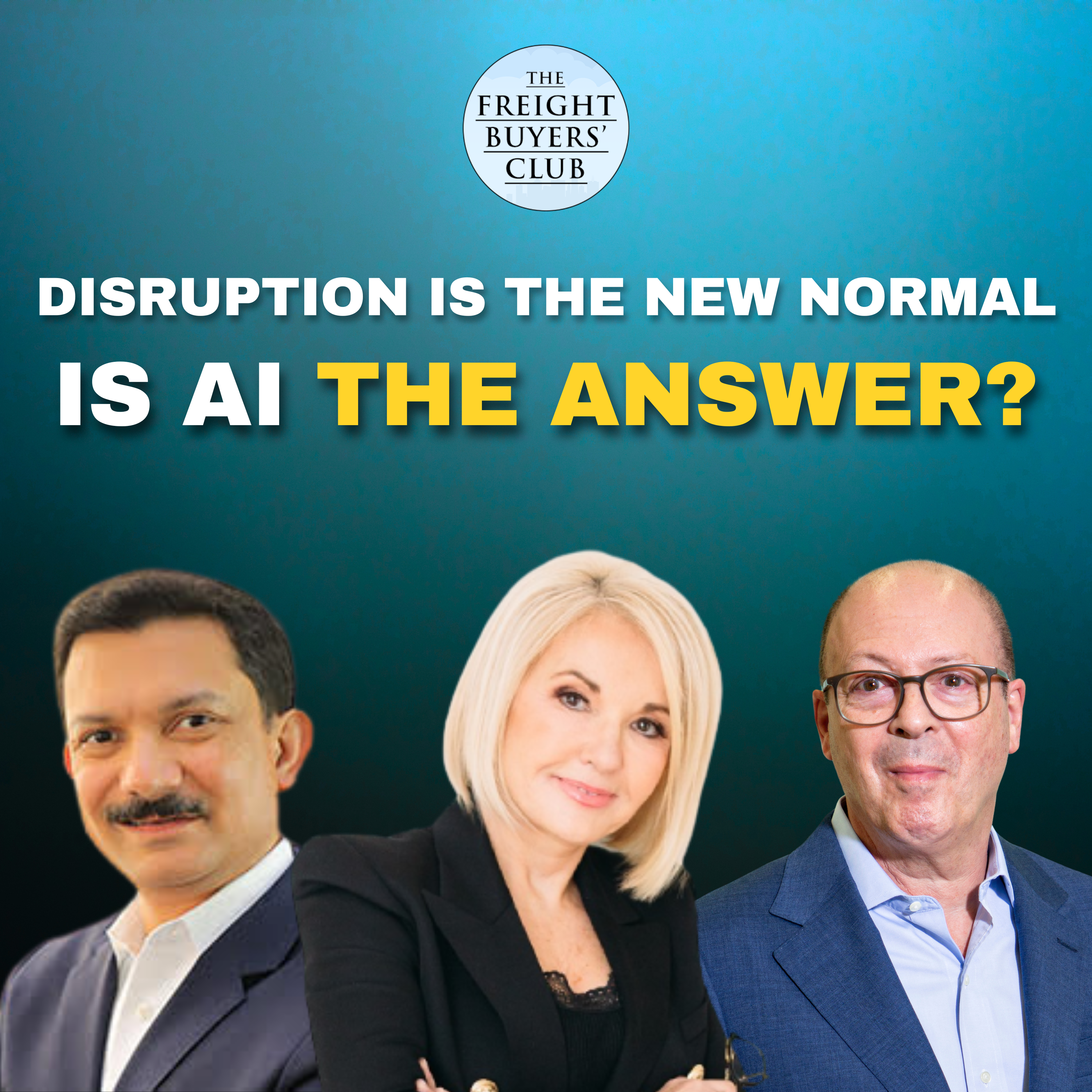
Six years in disruption. It's not really an event anymore. It's essentially the day to day environment that we all operate and work in. So the question today isn't whether AI is exciting, it's whether earlier risk identification, deeper data and better decision infrastructure actually hold up against a world that simply refuses to behave predictably. To answer that, I've got three people who each stood in a different corner of this problem. An operator who was ran digital transformation at the world's largest shipping line and spent seven years trying to get rival carriers to agree on sharing data.
We've also got the strategy chief who's building the platform that's supposed to turn all that data into a decision.
And I'm delighted to say we have an academic who's literally being called into court to test whether a company's forecasting claims actually hold up. Along the way, we're going to pressure test the industry's newest buzzword head on agentic AI.
What it promises and who's accountable when it gets it all wrong.
So let's crack on.
Welcome to the Freight Buyers Club. I'm Mike King and, well, let's put some names to those three vantage points. Andre Sima spent nearly 39 years at MSC, the largest shipping company in the world. The last five and a half of them as global Chief Digital and Information Officer before stepping down this spring. He also chaired the Digital Container Shipping Association Supervisory Board for seven years. Essentially the job of getting fiercely competitive container lines to agree on shared data standards. He's now an independent board member and strategic advisor. Andre, we welcome to the Freight Buyers Club.
[00:02:54] Speaker B: Yeah, Mike, thanks for having me. And looking forward to this conversation with my old friend Pawan and my new friend Nader.
[00:03:03] Speaker A: Well, that will come into those two people right now. Thanks Andre. Pawan Joshi is Chief strategy officer at e2open, where he's worked since 2003 across product strategy and sales leadership. He holds a PhD in industrial engineering from Wisconsin Madison East. The e2open, of course, was acquired by WiseTech Global last year in a deal worth around $2 billion. So Pawan now sits inside the same group as Cargowise. Pawan, welcome to the show.
[00:03:31] Speaker C: Thank you Mike, appreciate the opportunity and great to see you Andrej again. And Nader, great to meet you. Look forward to the discussion.
[00:03:37] Speaker A: Thank you Pawan and the aforementioned Nada Sanders is Distinguished professor of Supply Chain Management at Northeastern University's the Maury McKim School of Business and past President of the Production and Operations Management Society, who even created an award in her name. She's published more than 100 papers on supply chain strategy and business forecasting, is a fellow of the Decision Sciences Institute, and she's ranked in the top 2% of scientists worldwide by Stanford University, no less. Oh, and she's also the award winning author of the HU Humankind, Machines and the Future of Enterprise. Nada, welcome to the show. I hope I got the book title right there in in my rushed intro.
[00:04:23] Speaker D: You did, you did. And Mike, thank you for having me on and I'm really looking forward to the discussion and just even the little bit of what we had before beginning recording has been wonderful. So I'm looking forward to this.
[00:04:38] Speaker A: No, we're on a top 2% of scientists in the world. We know. I can't wait to hear what you've got to tell us.
Let me set up this section because I think the framing for this matters.
For years this industry has treated disruption as a series of one off shocks that we react to. We used to call them black swans, trade war, Covid, the Red Sea, Hormuz, sanctions, tariffs. And each time really the instinct has been to respond faster once it's already happened. The argument now is that the real shift isn't reacting faster, it's identifying risk earlier and using data and network depth, not just software features, to move from prediction to decision to action before that disruption hits everybody's supply chains. AI sits inside that as an enabler, more a support actor than a headline act.
So Andre, you have spent so much time at MSC basically through each one of those shocks. So from that position, has the industry, do you think, gotten better at spotting risk or have we just gotten faster at reacting to it once it's already happened? And is technology being used to help with either managing risk or reacting to it? If I can put it like that,
[00:05:57] Speaker B: yeah, that's a, that's a hefty question.
[00:05:59] Speaker A: Yeah, yeah, there's a lot in there.
[00:06:02] Speaker B: There's a lot in there. I'll give you my perspective, not necessarily from, obviously from my experience at msc, but I think we've mostly gotten faster at firefighting. And a lot of the reasons for that, I'm sure Pawan, you would agree, is that you can't really anticipate risk if the data you're using is still dirty or incomplete or sitting in silos.
And so if that data isn't clean and standardized, all tech does is give you a faster, high definition view of a message that's already happening.
So I think it's not about fancy dashboards and continuous reporting. It's about being able to automate execution that actually does something to solve the problem before it hits. And that's not an easy task. So a lot of what I'm going to say is going to be based on data. And if we have the right data
[00:06:56] Speaker A: today, I'm sure everyone will come away from this thinking, yeah, clean data might be foundational to however you manage risk. But we'll come back to that in a bit more depth in a moment. Nada. We've moved from surprise disruption to sustained disruption, if I can put it like that. For shippers and forwarders, what does good planning look like now and how is it different from, say, the playbook five years ago? And a secondary question, can technology help balance the trade off between resilience and optimization?
[00:07:26] Speaker D: Thank you, thank you for asking me. And I'm also going to add that we will talk about the data because, boy, that is something I'm passionate about as well because we have so much dirty data. But to, to answer the question, so five years ago, really, if we look at, prior to Covid, right, it would have been 2020, a good supply chain. Good supply chain planning was largely about creating the best plan you could. Right? You forecasted demand, you optimized inventory, picked the most efficient routes and then you had exceptions if something went.
But that model assumed, and you mentioned this is that this is something that occurs occasionally, but we operate for perfect conditions. Good planning for now really means designing for continuous change. So I think it's a very different approach. You still optimize, but you optimize now across multiple possible futures rather than around one future. This is where my own background in forecasting comes in. And I've really pulled out a scenario plan which has been part of our toolkit for years. But it is something we are leaning into heavily now, scenario planning, alternative suppliers, routes, visibility into the supply network, all of this. And this is where technology really helps us manage this trade off between resilience and optimization. And I think in the past resilience meant, and we all know this adding buffer, so it meant more inventory, more suppliers, more capacity. I think now we're really optimizing for resilience.
So we used to ask questions like, what's the lowest cost supply chain if everything goes according to plan? Now, as you already mentioned, it's not going to go according to plan. We could almost guarantee that. So now we're looking at, well, what are the best performing supply chains across a range of conditions. And we optimize across that, being very flexible to be able to switch over.
[00:09:35] Speaker A: Thank you, Nadha. Yes, yes. Scenario planning. Yeah. Plan B. If the Strait of Hormuz was closed, for example, something that we're all grasping with at the moment. Pawan, your ocean Shipping index tracks 70 million containers annually across your network.
This is the visibility under it. Nader just sort of referenced slightly there, this ability to see patterns before they cascade, before we see these domino effects. What are you actually seeing in that data? Are companies using it to plan ahead and build resilience? Are they still mostly reacting after things have gone wrong?
[00:10:13] Speaker C: I think it's a combination of both.
I'll take a step back and really talk about the index. What it really does is it actually takes a very large panel of activity that's going on in the supply chain, especially around ocean shipping, and puts it into context. And the context is when did somebody say, I need a container to. When that container was actually delivered. And we actually look at every single step in the middle across 70,000 containers on an annual basis and increasing. Right. So that panel is pretty broad, but it's also very timely because right when you actually book, it's not when you receive the shipment. Are we creating the panel? It's as a container is moving. We continue to add to it. Now there are some of our clients that are actually using that information to better understand when the container is going to arrive, which is great. Right? But going back to Nada and Andre's point is you're still reacting based on when the container's coming in. What you're not realizing, what oftentimes our customers don't do, is take a step back and say, what if that container did not arrive on time? What would I do? Where are my buffers? What's my resiliency plan? What are my alternate suppliers? What are my alternate modes? Of transportation if that container is running late. Right? That's where the scenario planning comes in. But some of our customers actually use it in a much more fundamental way. Like we saw during COVID the booking to receive time was extremely large. But none of our customers went into their TMS systems and changed the lead time around ocean shipping. Right? It almost doubled in many cases because of port blockages, container shortages and all that. But the TMS that was actually creating the bookings continued to operate on a lead time which was half of what it really was during that period. So guess what happened? Every container was running late. Why was it running late? Because it was not booked ahead of time because the journey took twice the amount of time, as an example. So there are these pockets of visibility and use cases of information that get used, but they don't get used in a holistic manner. Right? If my supply plan actually assumed my lead time to move from Shanghai to Long beach is going to get doubled, I would actually create my lead times differently. I would create my forecast horizon differently, I'll plan my transportation differently. And it should automatically readjust based on my current way of working. But if we don't, if we continue to operate in silos, the resiliency and the scenario planning become more and more difficult. And that is really, I think at the crux of it. There is a lot of information that is flowing through our networks. It's just that it's not being used in the right, right time at the right place.
[00:12:34] Speaker A: Pawan, just a quick one on that one. Where's the resistance to that? We've done multiple podcasts on the freight Buyers Club on container shipping reliability, right? So people know that there's going to be delays. Maybe Andre will have a view on this later. Why aren't people taking those.
You can plan around this, right? This information is available.
[00:12:54] Speaker C: It's available, but it sits in silos. It goes back to the point Andre was making earlier, right? It is. It is sitting inside systems. It is sitting inside systems that don't belong to the buyer or you want to think about it, the brand owner whose, whose freight is moving. It is sitting inside the ocean shipping liners systems. It is sitting inside the forwarder systems. Even if it moves into the brand owner system, it's probably sitting inside the transportation department, which is not talking to the supply department often enough, not talking to the replenishment department often enough, not even talking to the demand planning department often enough. And I'm talking about really talking, right? I'm not even talking about information sharing happening automatically. And this is something that we've been working on. I mean, the whole Inception of Edo Open back 25 years ago was exactly this was to solve this problem. And in my mind, the root cause of this problem is not that data is not available. And it's just that the way our businesses are organized and departments within business are organized, they're broken up into silos. Each silo buys their own system and software and they manage their own data. There's very little visibility across the silos. And I'm still talking within a company.
[00:14:01] Speaker B: Right.
[00:14:01] Speaker C: And supply chains, 99% of the activity happens outside the supply chain. If you look at any big brand, chances are they're not making their stuff, they're definitely not moving all their stuff. They're for the most point in time not selling their own stuff. Right. So if I'm sitting in the middle, I don't have visibility, optimizing my manufacturing, inbound manufacturing process. I can't move stuff because I'm relying on carriers and forwarders and then I'm relying on retailers and distributors. Tell my stuff. If I'm still broken up inside my silos, inside my organization, imagine the scale and size of the problem outside. Right. And that is really the orchestration problem.
It is an orchestration problem that is anchored in the balance between optimization and resilience. And we are seeing that more and more important in this day and age where changes are happening across very fast pace.
[00:14:49] Speaker A: Fascinating. Nada. So, I mean, following up on this, really, you've got a back catalog of books and research papers about forecasting and resilience.
What concrete practices within businesses or within teams within these silos that Pawan was referencing there, what gets people to move from reacting to events towards identifying risks, planning those scenarios that you talked about before.
So before their operations are affected, what's the best ways or a benchmark people can aspire to?
[00:15:23] Speaker D: Yes. So I'll give you a few examples of a few practices. But what I want to do, if I may just for a second underscore what we've already said, because I think it is so critical. It's the issue of the data and dirty data and the silos. And as someone that has been doing this for a while, as this team has as well, it is somewhat frustrating to see that we're still talking about this, right. That these internal silos that don't have visibility with one another and that aren't talking to one another, these are some really fundamental problems. So now, as we see this advancement in AI agentic AI and all of it in terms of what's happening.
We haven't even gone back in terms of restructuring, making sure we have flows inside the organization, let alone within our, you know, with our, with our partners. But back to what you're asking, I think it's really important to distinguish between visibility and then early warning capability.
So right now more companies have more data than they've ever had before, but they still react late. And I think in large part it has to do with the fact that they haven't designed the process to turn that signal into action. And it goes back to what has already been said. I'd say there's a lot of things I can add to it, but I think I can think of at least a few really concrete examples. One, companies have to really move and look beyond transactional data.
Traditional data that we use relies heavily on orders, on shipments, historical demand. But those are really lagging indicators. Right? And I think we need to, as organizations really begin to look at external signals that are going to give early risk notices, this would be supplier behavior, port congestion, weather, geopolitical events that are happening on a moment by moment basis. So we have a lot of other kinds of things.
So it's a different kind of data.
Two, I think we need to move, and I've already mentioned this, from a single forecast to a range of possible futures.
So rather than saying here is what we think will happen, I think teams should be saying, okay, what are the three or four plausible ways this could unfold? And then how would we react to each one of these? And then I third, and I think you've alluded to this is I think it's really important for organizations to, to predefined trigger points, right? It's not enough to identify risk, but you need to have trigger points that are set in advance. For example, you could say something like if lead time increases by 20%, if a supplier's reliability falls between a certain threshold, if geopolitical risk crosses a certain level. So you have these thresholds, you know, very similar to what we've done in quality control for decades, but you have them preset and what they do is they trigger automatic reaction. I think it's really important to do that. So I think what we need is to shorten the distance, if you will, between that signal understanding and be able to take action.
[00:18:55] Speaker A: The difference between that trigger, that risk trigger that you just talked about, can we look at that through the reference point of your book Hue Machine, which argues that AI isn't necessarily replacing people, it's about there's a future where we have a genuine integration, where each side gets better, together, you're stronger. That type of integration, I'm interested in how that works in terms of forecasting risk. Is there a case from that book, maybe, or a real life example where you've worked with a shipper or a manufacturer where you've watched that integration work or maybe fail in terms of those trigger points?
[00:19:33] Speaker D: Yes. Let me start with a general example and then I'll give you one that has to do more with shipping. But I think the central argument in the book, the Human, is that the winning model was never going to be human versus machines. And I think that is something that is more true than ever. So all along we've been saying, what's better? You know, is AI going to replace humans? And so forth in the book. And there have been two editions. Now we're going to work on a third one. And then I'm actually working on another book, the Agentic Enterprise. All of that, the foundation and really the crux of my work for a really long time, decades now I'm getting older here, is that they have to work in tandem. Humans and machines have to work in tandem. I saw this decades ago when I was a young doctoral student. That was. We had the birth of neural nets and all of it. And we cannot replace decisions with the information, the data, because at the end there are humans and trust and other kinds of things. That's the essence of what the human machine is about. We have many, many cases in the book.
One, just a good example that I want to start with was Unilever, because I think it's just a really good example of something where you could take things that are very rote, you give it to machines and in case. I think the example that we started with was the hiring process where basically they're using technology to handle this high volume early stage screening while preserving human involvement for the consequential decision. This is, I think, an overall meta example that I think is really important because human decision making, expert judgment, the kind of things that listeners have, they have experience, it's a scarce resource. As humans, we do get tired, right? We get decision fatigue. So we have to preserve decision making for the things that really matter. So what Unilever did is they basically redesigned the process so technology, AI was going to process the screens through the candidates in a very automated way. Identify patterns, narrow the field. But then when it comes time to hiring, it remained up to the human. That is a really important thing. And Then when we look at other examples, principles in supply chains. I've personally seen this with Maersk, with Amazon. The amount of information that is confronting an operator is simply beyond the human scale. It's beyond what an operator can process. You could have thousands of shipments moving. I've seen this with Maersk.
Changing demand, port congestion, inventory position, you've got supplier issues, weather, all of this is coming at them. They can only process so much. This is where AI can be extraordinary, it can monitor all of that. Then what it does, it detects anomalies, it can predict where a bottleneck might emerge and then it gives alternatives and you pass it over to, to the human, the human that has the experience, the judgment.
So we really then ask the questions, should we reroute the shipment? Should we pay more to protect this particular customer? This is where human judgment comes in. It's the humans that understand the customer, supplier.
But you can't waste that judgment, Mike, on, you know, tire people out on the road things. That was the lesson in the Hue machine. And what I'm seeing now is it is more true than ever.
[00:23:30] Speaker A: Well, where does the HU machine end and agentic AI begin and how does that factor through into the future of risk forecasting?
And a secondary question to that is there's an awful lot of AI companies out there promising all sorts of different things. I mean, you've been an expert witness in cases along these lines.
What should people be wary of when vendors tell them that AI can make these decisions for them?
[00:23:57] Speaker D: Oh boy, once you get me started. So I have done a lot of expert witnessing.
I haven't recently only because I commit so much, Mike and I really try to do a good job and we get paid well for that. But let me tell you, you earn every cent.
For me personally, the expert witnessing was especially valuable because you get to see under the hood.
Everybody talks about how everything is great, but I can't tell you how many times I've seen companies that have bought software packages. I'm not picking on anyone or any consulting company to be surprised as to how many hidden costs there are. I could tell everybody out there, I can almost guarantee you you will encounter hidden cost. So you need to really plan for that. Add ons, even silly things like I've seen companies say, but what if we want to query the algorithm in this way versus that way and then you get the usual, well we can do that, but it will cost you extra.
So that is definitely something to be cautious of. I've already mentioned, it has been said the Data issue, the process flow. Those are things that are really fundamental, I think so many promises are being made right now, especially as AI moves from gen AI to agentic AI, which is the next stage of the integration model. It's not the end.
What I am working on, I can tell you I'm working on this right now. I was working on it yesterday, I'm talking to companies, is where the human enters the process.
So the human machine and everything that I've said up to this point is completely valid. It's true, more than it's ever been. But the issue now becomes where does the human come in? So with traditional AI, we often imagined a person sitting next to the algorithm. The AI makes some kind of a forecast. The human decides whether or not to act. You know, it can press, you know, accept or not. Agentic AI changes all that because now the system can do everything, can take action, it can observe the outcomes, it can continue acting.
So the agentic AI doesn't invalidate the human machine, but it makes the design of this entire process more consequential. It also brings in the question of where does the human come into play early on, checking in the data or somewhere throughout the process?
And that is something, again, like I said, I am literally working on at the moment. And it's going to vary in terms of the size of the company, the decisions that are being made. The human may no longer approve every shipment rerouting or every inventory adjustment. So it's also going to be about now setting up those boundaries. What level of uncertainty is acceptable, when do we escalate the model to the human level, and when do we automate? These are really hard things to put into, into processes. And this is where I think the key is redoing, readjusting processes. One of the things that you know is as an operations, I'm operations supply chain person, we're pulling out the old playbook, not just in scenario planning, but also in terms of workflow analysis and workflows and bottlenecks, because we have to actually rethink what that process is. And where do we put the humans?
Do we put AI not to create bottlenecks, but to actually optimize the entire decision flow? And it's really hard.
One other thing, if I may, that I want to add that I think is really important is also to include when does the AI stop acting?
So I can tell you, AI is going to continue generating endlessly and creating, as we all know, a lot of slop.
And we've all seen this, right? You get one iteration, two iterations, and then it just continues. And then it sort of, you know, just really is a downhill process.
One of the things companies need to do is also put in when is good enough and when does the system stop acting. So all the things that I mentioned, the trigger points, when do we escalate, need a handbrake and when do we stop?
[00:28:36] Speaker A: Yeah. I want to get your view on what this means for the workforce a bit later, but let's bring Pawan in here.
From E2open's perspective, from your perspective, Pawan, running one of the largest supply chain networks in the world, connected over 500,000 enterprises, roughly 18 billion transactions processed annually. I read.
How far has AI actually taken us so far in terms of real prediction, real forecasting, or real resilience? Or is all of this promises at the moment? What does your AI strategy look like if I simplify it in that way?
[00:29:12] Speaker C: Yeah. So I would talk about it more in terms of the practice rather than what we are building right now.
I think there's been a lot of use of AI in systems. The challenge is that's not the right way to unlock a lot of things in AI. And I'll build upon what Nada said. Right. Our systems, our processes, our organizations are designed on the technology constraints from 50, 60, 70 years ago when we did not have the connectivity that we have right now. There was no Internet back then. We could barely talk over phones back then. And those phones are landlines, hardwired. We did not have compute the way we have it right now. Right. Forget cell phones, where you can actually check stuff. Barely. Desktops were barely there. And even if they were there, there were green screens, no graphical interfaces. So you actually had to tab through and do that. Right. And the largest memory, the largest processors that we had on those desktops were very, very limited. And if you had to do something, you had to actually go borrow time on a mainframe to run systems and processes. Now in that technology constrained environment, guess what happens?
Processes get broken down into bite sized chunks that can be solved with the compute and the power that we have. Right. And when you do that, all of a sudden now you're designing your people around that. So all of a sudden your org structure looks like not a planning department, it looks like a demand planning department, a supply planning department, an inventory planning department, a transportation planning department.
Right. Fast forward 70 years from then, we still have organized our systems, our processes and our people are still organized the same way for the most part.
Right. Very little change now. Technology has moved so far ahead, right at the click of a button. Now we're having this conversation pretty much live, right? There's very little lag in our communication process. We have systems now that are hyper connected where you can on the cloud, run such a large compute payload in milliseconds and bring that data back into desktops. We have more power in our cell phones than we had when we launched Apollo to the moon.
Right? That's the technology. Now if you take a step back and think about what are we doing now, in many ways we are doing what we were doing 50, 60, 70 years ago. I run my forecasting process, I shoot it over, my supply plan runs, I shoot it over, procurement process happens, I send a PO out. That process has not changed for the most part now what has really changed. And when I say AI, there's a lot of AI being used. I would say I would use AI as a technology, an evolution of the technology.
It's there. And we've been doing concepts around demand sensing, which takes not just last year's forecast and last month's forecast. We're looking at open orders, we're looking at weather patterns, we're looking at inventory availability on the retail shelves and coming up with a forecast that can be executed in lights out mode.
But guess what, that's just one piece, one use of AI in one place, just around forecasting.
The true power of AI is to take a step back and really rethink and reimagine what the processes should be now that you have hyperconnectivity, real time visibility and compute at the tip of our fingers, and not just at the tip of our fingers, at the edges, like the edges of capturing a data to be able to make decisions around what happens. Like a good example, I'll use an ocean container example. I mean, we move a lot of freight on reefers, refrigerated containers, right? If we can monitor the temperature on a real time basis on that and make that available to the distribution center. Anytime you break that cold chain, you're not only recognizing that container has gone bad or the cold chain is broken, you can actually say, regardless of whether the container arrives on time or not, I will have a shortage at my distribution center because all that material that I'm bringing in is probably going to get quarantined or thrown away, right? So, and it may be a six week long journey or a four week long journey and I get that signal way ahead of time that I can now process not as, not in terms of agent, but just as a Raw input into my supply planning process and say, you know, container worth of stuff is now offline. I got to figure it out. I have three weeks to figure out what I do. And that is really the unlocking the power of technology. I would say not even AI of technology is to really be able to connect the dots and close the loop.
One of the first classes that I did when I came to the US in grad school was control systems. And you realize an open loop control system where you tell somebody do this and don't find out whether that person did that or not, is an open loop system. It's designed for failure and a closed loop system is what you want. But if closing that loop takes you four weeks, it's too long. In this container example, if it takes you 4 milliseconds, that over the last 7 days I have constantly seen temperature going out of band. That is what I want to bring in. And that gives me an opportunity to actually open up the aperture and come up with multiple decisions. That philosophy and that concept is really what we have built our technology on at E2 open in that heritage as well as cargoise on the forwarding side. Right? So that is really what drives us is to be able to unlock the power of technology, bring in all sorts of technologies that's available, including AI, to solve the problem based on the right technology at hand. AI, nada touched upon. This is not always the right way to do things. In fact, it in many ways is a cost prohibitive way of doing things because there are better ways to actually connect and provide visibility. I still remember, Andre, you presented to us when Intro was formed, the communication hub that sits on a ship. It's still sitting in our office. It still inspires us to say, look, it worked. It works on a ship. It doesn't work when you're connecting multiple enterprises across the globe, right? So if we take that tool set and apply it to the current complexity of our supply chains, it'll not work. And then we'll create all these band aids and throw people at it. And that is really the power that we think is to start thinking and reimagining. It's not an easy process. It's like changing engine of an aircraft while it is still flying. You can't bring your supply chains to a stop and say come back in five years when we redesigned it and then we'll sell you the product. You got to continuously do it. And that's really where the challenge comes in is how do you change, in my mind, the order of Operation should be, how do you reimagine your business process? How do you reimagine the people that are going to support the business process? And then technology comes in to say, here's the best way to solve that problem. And it's going to be an incremental evolution. But recognizing that need is I think, the first and foremost thing.
[00:35:37] Speaker A: Thank you, Pawan. I think we had an unexpected guest there and I wouldn't want any of our listeners to feel a bit left out. So have we got a name for the dog, please? Just in case they can hear the barking and I wouldn't want to. I want to welcome them properly.
[00:35:50] Speaker C: I apologize for that. But that is a Lambo. We named Lambo Lambo. Yeah.
[00:35:55] Speaker A: What's the breed?
[00:35:56] Speaker C: He's an Aussie doodle.
Global citizen is what I think.
[00:36:02] Speaker A: A global citizen. Well, welcome Lambo to the Freight Buyers Club.
You're here for the highlights, Pawan. ETA Open just became part of wisetech Global last year. There's a deal I mentioned earlier with $2 billion brought e2open's network planning, trade and supply chain capabilities in to the same group as CargoWise's global logistics execution platform. Sorry, stumbling over that, that most freight forwarders used. Does that kind of scale and that that amount of data, does that change what's possible in future? Or is more data we've sort of been referencing is data pointless? It doesn't matter how much you've got until something else changes. How does that play out? Do you see it?
[00:36:48] Speaker C: No. For us, there are two pieces of inspiration, right? One is going back to reimagining the business process, right? If you think about bringing products and services to market to how you and I consume it, it's kind of. I would largely break it up into three broad categories, right? People who are making stuff, right? All the compute that we're using today to have this webcast is there's one group of people, second group of people is who actually help sell that stuff, right? We all bought our stuff from different kinds of Amazon or whatever the other stores are we bought them from. And then the third group is people who help move the products from where they're made to where they are sold. And oftentimes it's components, raw materials, but in oftentimes it's actually finished goods that get into it. So if we look at those three broad audiences, Wise Tech and e2open recognized a similar design pattern of the problem 30 years, 20, 30 years ago that came from different directions. CargoWise looked at the world in Terms of the movers of product and said a lot of that stuff is disconnected, especially around international shipments. Right. And that's where Cargowise was born. It incrementally built over a period of 30 years or so to get to a point where now you have everything unified. Where if you do an international shipment, whether you do air, ocean or regional shipments, or you actually going through chest to pure customs clearance, border crossing, all those capabilities are unified as a process flow on that platform and the underlying participants are wired into that system through an underlying network. What that really means is if I'm connected to a ocean carrier or a port or to a particular government agency for customs clearance, I can use that connection for all my customers, all my forwarders that are operating on that platform. Right. That was CargoWise's vision E2Open came from, for solving a similar design problem from the perspective of people who are making products and selling products.
Right? So very large brand owners that had actually outsourced their manufacturing process, outsourced their distribution process, outsourced their selling process and transportation process needed a platform for orchestrating that entire end to end process. And that's where E2Open was born. Smart, right? So if you think about the aspirational way of designing a system that connects these processes together and connects these entities together, that is really what we're trying to do. We're bringing one of the largest quote unquote BCO manufacturer, brand owner platform, with the largest transportation platform into one quote unquote group structure that allows us to reimagine the business process and not stop up at the boundaries of what a brand owner does, but continuing that boundary beyond the brand owner to somebody who's moving their products within and taking the boundary where the forwarders processes start and stop and blending that into the brand owner's boundary. So if I need stuff to be moved internationally, well, I do all my planning, forecasting, planning, transportation, all that stuff and collaborate with my suppliers and then hand it over to the forwarder and say okay, move this 10,000 widgets from point A to point B, guess what happens? There is a process drop. We want to actually continue that process into through cargoise. And when cargoise drops and says oh, it's been delivered, then you start the EDO Open process and say okay, it's available at the distribution center. Now how do I get into the hands of the end consumer? How do I orchestrate the distribution process? How do I actually better plan my supply now that it's available within region? How do I transport it or how do I actually get it to that. That is really the ultimate vision. So the underlying process definition is in the platform. The underlying network that comes with the platform is what really brings the data in. So if you want to think about data quality, oftentimes people will give you the data that they have. It's not, it's bad data, it's just that they don't understand the context in which you want to use the data. Whether it's meaningful to you or not. They don't provide the context along with it. And this is what Andre's DCSA is trying to do is not just talk about data standards, but also talk about the process standards that go along with with it in the high tech space. We did that with Rosette 20, 30 years ago when Edo Open started, we were on the board of that where we are basically saying, look, everybody has data, but how do you actually transport the context of that data so that somebody actually understands it and can use it? It is bad data when you don't even know what it really means.
[00:40:52] Speaker B: Right?
[00:40:52] Speaker C: It's bad data. When I give you here's my inventory position and you look at it and say, hey, is this actually netted inventory based on your forecast or is it actually total on hand inventory where I have to do the net?
Right. If you don't have that context, you don't know if the shipment is arriving late. Well, it is late as of what date, Right. If you give me that information, those are all very important things. So coming back to what we really want to do is to be able to think about the end to end process and let our customers drive us towards what level of end to end nest do you need? Because it's their readiness that allows us to put that in. As a technology provider, we have signed up for the technology challenge in the people process technology part. But we still need the other two dimensions of the stool, which is how do you reorganize your processes and how do you reorganize your people to leverage the technology?
Coming back to what I earlier said, technology has moved so far ahead in the last 70 years or so. We need to move our processes and our technology and it's a question of reimagination. So what we are really doing is we are saying how can we as technology providers be ready for that challenge as soon as our customers sign up for the challenge?
[00:41:57] Speaker A: On the other side, is there any part of that chain power and that is adapting to what you're offering or to the technology that's becoming available faster than another Part of that chain. So your footprint runs from manufacturing planning all the way through to the last mile delivery.
Are they moving at different speeds? If I can put it like that,
[00:42:18] Speaker C: across that value chain, a hundred percent. I think.
Like I said, Mike, at the end of the day, everybody that buys software has a business to run, right? They're not going to pause that business and say, let me reimagine my process, let me rewire my systems and then I'll come back to do it. So it always is a function of where the burning problem is and it changes industry by industry and in some cases, customer by customer. Like during COVID the biggest problem was where's my container? Am I going to get that container or not? And how is it going to get from where it is to where it needs to be? And am I going to be able to fill it up because I don't have the people to run my physical operations at the right facilities? That was problem du jour. And a lot of people actually solve that problem either through brute force or through deployment of technology.
Right now it's all about what happens when the tariffs change. Because it's not if they will change. We've been conditioned to talk about it when it will change. So how do I actually make my transportation such that I'm bringing as much as I can within a region so I don't have to get exposed to the tariffs that may or may not change? That's, you know, topic du jour right now with the whole USMCA and U.S. canada and just between in the U.S. region, but even globally, it continues to have a play there. Right. So really where I'm going with this is our clients oftentimes gravitate towards the problem at hand, but the clients that are actually further ahead in terms of their maturity of thinking realize that the business environment has changed. 70 years of very stable, global structured way of dealing has been upended in the last 15 years. 10, 15 years, right. Which means that all that wiring that we built and all the interconnectedness that we built is actually exposing us to a lot more risk, that needs a lot more resilience. And the clock speed of change is very, very dramatic. So some of our more mature customers are actually taking a step back and saying, look, the way of doing this with our systems and people and technology has to change. And that's where a lot of the transformation activity is happening. And a lot of activity that's happening around being able to run the business, but being able to make these incremental decisions with the long term vision insight that these things have to change right now, but things around it also have to evolve.
[00:44:25] Speaker A: I want to bring Andre in a sec on container shipping and data and standards. But just before we finish, Pawan, on your network, where's the biggest pushback across that network? Obviously one of your orders might go through the entire value chain. Manufacturer, supplier, logistics provider, retailer.
Where's the pushback or where's the bottleneck? Is it standards? Is it trust?
[00:44:47] Speaker C: So it definitely is trust. I would say trust is number one. I think standards is super important.
But I think going back to the point Andrej was making earlier, we have over the last 25, 30 years used technology to quote, unquote, work around the standards. Because one of the things that oftentimes is true is unless the standards are well thought out and adopted, people will say I adopt the standard, but they'll always be workaround. It's standard as long as you can do these five things around it.
And that is a true definition of a standard that is either based on just information exchange that has not thought through the business context of that. And that's why I think DCSA is extremely unique in that mode. So our resistance really is, number one, I don't trust you with my information.
Right. I don't know what you're going to use it for. And this is getting even worse in the day of AI because I don't trust you. I don't trust the AI that you're going to use because any information that I give you might show up tomorrow someplace else because I don't know what governance you have. Right. So trust is an absolute important issue. The second is the standards, but we can work around some of those standards. I think the third is helping people understand what is in it for me. If I give you my data, how do I benefit my business? And that's where the collaborative nature of a network becomes really important. If I'm a supplier and I actually tell you what's happening in my factory, you get better information on whether the certainty on you as a supplier being able to deliver to the PO commit or the promise that I had, that's great, but what do I get in return? Well, if the customer says what you get in return is anytime things change on my side, Right. Forecast is a forecast. If my plans change, I'm going to immediately tell you what it is so you can adjust your manufacturing process.
Well, if there's a give and take in terms of business outcomes, then data sharing becomes a part of. Okay, I understand now what we are trying to solve for mutually. So I'll give you my data in the context of that mutual solution of the problem and you provide me that data. And now I'm not talking about data and moving, I'm actually talking about solving a problem with information that is being exchanged to help me solve that problem. And all of a sudden you move away from noisy bad data to a contextualized information way of sharing information to solve a specific problem. And that is really, I think, an evolution that needs to happen. We play a role from a technology standpoint, but at the end of the day it comes back to process evolution. How am I going to work with my suppliers not throwing a PO over the firewall and telling them what tell me every single step, but when I throw a PO over the wall, this is what I expect you anytime I make a change, I'm going to be cognizant about the fact that this change may be too late in the manufacturing process. So I will buy that inventory from you, but I'll give you advanced visibility.
[00:47:27] Speaker A: Andre, I'm not sure I need to ask you a question. I think I can just go trust in container shipping. Please discuss.
I think Pauan set up the perfect pivot. You chaired the DCSA, the Digital Container Shipping association for seven years and spent 15 years on Intra's board.
From that perspective, where's the blocks on progress in terms of, of shipping, in terms of trust, visibility, standards?
[00:47:54] Speaker B: Well, actually it's funny Mike, the way you mentioned that I was listening to Palan with a lot of interest because of course we've been dealing with Intra and Ethrop and WiseTech for years. But one of the reasons that I really pushed with Maersk at the time for the DCSA was because of the 15 years at Intra. I knew that when at Intra we created standards in 2001, 2002.
[00:48:21] Speaker A: Just explain what Intra did for anyone who's not familiar with it. Sure.
[00:48:24] Speaker B: Intra was, let's say the first. We called it an E business platform, but there wasn't actually any business. It was an E commerce, I don't know, E sharing platform for, essentially for bookings and shipping instructions, developing a standard format that everybody could use and more or less understand each other. So that was the goal.
At the same time we started to create standards. So I think that was, it was a positive way forward. But in the 20 odd years of intra there wasn't that many standards being developed simply because nobody probably thought it was of any interest.
So when we created DCSA there, the goal was we have been doing this for 20, 25 years now. We need a solution. We need to create these standards to help us create a foundation where people can build solutions and speak the same language.
So I think you were asking me if that was progress or what's blocking progress. I think we've progressed somewhat.
And again, the tech is not the issue.
It's really about adoption. And as Paul is saying, about trust.
Trust, trust in sharing information, trust in adopting standards to share that information.
Sometimes it's a vicious circle.
So seven years with DCSA taught me one thing, is that getting fierce competitors to agree on basic definitions was hard, but it was feasible. But getting the adoption, I think is another story. And that's the difficult task that, that DCSA has today.
And again, without common standards, everyone could have visibility, but they're not necessarily looking at the same thing. And we still don't get predictability, which I think is still the talk of the town. This is what customers want.
[00:50:19] Speaker A: Let's look at predictability from the technology perspective we were discussing earlier, which took me back in time to my own formative years as well. You were telling me about when you first started at msc, container positions were up on cards on a wall. And I remember in my family's trucking business, you know, there'd be like a blackboard. And now we've got all this real time tracking AI networks. But is there a different way of working now or is it really the same people doing sort of something similar, but it's sort of dressed up as modern?
Where is 40 years of technology taken us?
[00:50:55] Speaker B: And the answer to your question is yes, we moved of course, from these physical cards on the wall to, let's call it semi real time digital tracking. I think that works for everything. Mostly relying on edi, by the way. Still today, still edi, yeah. Oh, yeah, still. Well, you have smart containers, of course, that provide their location and sometimes what they're doing.
But because swipe containers are still a very, still have a very low penetration, it's not yet something you can actually use.
And the thing is, as soon as an exception hits, what do people do? They just pick up the phone again, write an email or open some offline spreadsheet that was updated three weeks ago. You were talking about updating rates and things like that.
So digital transformation, and that's something that I've tried to work on for the past couple of years. It's not about just buying new software and it's really still and always will be about getting people to break all these habits and as both of you mentioned, to redesign the processes.
And that's a tough process with or without AI.
[00:52:13] Speaker A: Well, okay on AI then.
Are you seeing similarities with this to the blockchain evangelists of 10 years ago? Or is AI different? Do you think
[00:52:27] Speaker B: it's funny because the Blockchain Evangelists of 10 years ago are the same, Are some of the same people AI evangelists of today?
[00:52:36] Speaker A: They're the vendors Nada was talking about. Watch out for them.
[00:52:40] Speaker B: But the funny thing is you'd get yet 10 years later, the people would contact me and say, oh, I'd like to have a talk with you when I was with the company.
And I would say, but don't you remember you already talked to me eight years ago about blockchain and what have you been up to? And so blah, blah, blah, blah, he
[00:52:56] Speaker A: now wants you to buy it in crypto.
[00:52:58] Speaker B: Yeah, exactly, exactly. And well, some colleagues do that, but so for me it's relatively simple. I mean, you know, show me where any technology can solve a problem. Problem, right. If we have a problem to solve.
But don't show me another demo, don't show me another 300 slide PowerPoint. If you can take a simple routine exception away from an operations person, for example, or read documents without somebody typing everything in again, then I'm interested. Otherwise, we've all seen this movie before and, and we're not going to be able to benefit from a lot of this new tech until we fix the underlying processes and look at documents. How many companies have come to us in the past, I keep saying us to MSC, in the past 30 years. We'll read all your documents for you. Well, nobody succeeded. So you still got people reeking and reeking and wreaking.
I can give you an anecdote. And this has to do with Intra, actually. So you back Wisetech E2 open intra.
One day my boss, the big boss of the company, calls me up to his office and he says, oh, we're meeting somebody from Maersk today, somebody that I still talk to today. And I said, okay. So we had this meeting and they explained to us what they were trying to do creating the E business platform. And so I listened, I listened very carefully and I was a bit a techie, still, long hair, coffee, smoking, of course. And so I was writing, taking notes, and the guy leaves, you know, bye, bye, great seeing you. And the boss says to me, what do you think? And I said, boss, what is edi? And you know, we don't have all that. We just have simple databases and the boss said to me, then let's do it. And it's thanks to that meeting that we actually got into modernizing what we were doing and a little bit the way we were working.
But the truth is we haven't changed much in the way we work. And when I say we, I think it's everybody, you know, in the ecosystem. Maybe a few are a bit more modern, but that's where we are. So let's do AI blockchain.
Trying to think of another one.
[00:55:17] Speaker A: But your general point is that shipping does need more technology.
It's implementation, I think.
[00:55:25] Speaker B: Sorry, did I interrupt you, Paul?
[00:55:27] Speaker C: I was saying implementation and adoption.
[00:55:30] Speaker B: Yeah, yeah. I mean, especially on the standard side, if we don't have. If we don't get adoption. And, you know, you take for example, the E bill of lading, which is something MSC and myself, we pushed a lot during COVID If you still only have 10, 15, 20% of original bills that are E bills, then you don't have critical mass, so you cannot change your processes.
[00:55:53] Speaker A: Well, that's been a slow adopter, though, hasn't it? E bills of lading.
[00:55:58] Speaker B: It's been a slow adopter, and not because it's not useful, but because it's not enough.
Because, you know, if you look at.
Okay, you can also blame the banks, but it's not really true anymore. If you look at the pile of documents you need for a shipment, you take out the bill of lading, you've taken out the title of property, but you still have all the other documents. So now the work is on getting all these other documents digitalized and having them being authorized and accepted by the different regulators that need to accept them.
So that's part of the work in progress? Yeah, with dcsa, for example.
[00:56:35] Speaker A: Okay, thanks, Andre.
Let's just do a little. I want to go through an agentic AI with all of you, just to see where. What we're all thinking. And I sort of summarize where we've all. We've all referenced it a little bit. So basically, a quick definition.
Traditional AI tells you what's happening and what you should do. Agentic AI decides what to do and does it. Here's where I want to start, and I want all three of you to answer this one succinctly, if possible, because this might be the longest podcast we've ever done. Everything about the mature eugenic AI and supply chains like a football match. So 90 minutes.
Has kickoff actually happened yet? And if it has, what minute are we in? Please feel free to elaborate on the why bit, as well as giving me a number. Nada.
[00:57:22] Speaker D: Sure.
Thank you. I would say kickoff has definitely happened. Okay. But I would say we're about 10 minutes in with a lot of teams still figuring out formation.
So the idea here is obviously we're no longer talking about agentic AI in a lab. We're seeing the capabilities that we discussed. Right. But I wouldn't personally put it beyond the 10, you know, 10th minute because companies are still really, and we've heard this a long way from true autonomous supply chains. Also, if I may, we heard a lot about trust. One of the things that, that in my experience, and I recently talked to people in shipping, one of the things that they've said to me with, with this, with the gentic AI, with AI, all the capability, they're saying, especially in shipping, relationships matter more than ever. The human element. And one of the things. And I'll stop here, but what I want to add that is a real concern for me is that we are going to potentially lose the human expertise to be able to develop these relationships, to share, to talk, negotiate, know what to do in the clutch. Okay. Because what's happening is we don't have a pathway of people that are coming in and training them. If we take people now that are early coming into the company early in their careers, they don't have the expertise that people that are well along have. And we're not creating the pathway because we are now really relying so much on the AI. Making sure that we keep the talent and develop the talent, I think is going to be a really key thing.
[00:59:06] Speaker A: A very good point. Yeah. I mean, we've seen this with, with talk about reshoring manufacturing or something. Well, that's great. But if you haven't got the people or the experience to do it. Absolutely not just about the cost. Pawan, the floor is yours. Agentic AI.
[00:59:19] Speaker C: So I look at football, it's a team play, Right. And I look at agents on a team play, I don't see agents playing as a team right now. I think we still have each of those players in their heads are using AI. Right. But is there the choreography that is needed for the business to actually make an order of magnitude change? No. So going back to your question, I think individually it's probably in the 10, 15 minute period, but as a team that is reimagining how they're going to play now that they're wired differently or have the ability to communicate differently and not just through voice. We still trying to figure out what that would mean. And I would equate that to the process reimagination. The technology is there, but what does soccer look like? What does football look like when you are actually able to communicate telepathically? That is really the analogy I would bring in. And I think that's where we are. We are still trying to figure out is this still going to be a game of football or should we call it something else?
[01:00:16] Speaker A: Your description could have perfectly described exactly how I'm feeling about Liverpool at the start of this new season in the Premier League. In fact, Andre, please, your views.
[01:00:28] Speaker B: Look, I'm definitely not a football expert, so I was going to say we're past kickoff, but maybe five minutes in, but I'll say 10. So that I'm sort of average out with the speakers here. I, you know, honestly, honestly, if you've been in this business for a couple of years, do you really want to let a machine reroute a ship or pay an invoice or move a container without any human intervention or human approval?
Of course not. So I understand you need to start somewhere, but I think before anybody trusts an algorithm to decide, we need to see, actually, we need to see it work on a small scale. So what I would say is we need more pilots with proper data.
And it all goes back to the data. If we don't have the data, we're not going to get any good results.
And at the end of the day, if I look at it from the carrier perspective, customers don't choose a carrier because of a nice app or a shiny website or because they use AI.
They use a carrier. They choose a carrier or they stay because the carrier is reliable, easy to work with. So tech, in my opinion, should make that happen in the background, but it shouldn't be the selling point. And I won't name names, but we've seen it in the past.
Technology, sorry, doesn't keep your customers happy.
[01:01:55] Speaker A: No, we've definitely seen that in the past. Nada. I want to bring you in on that. You talked before about where the line stops, right, with AI, this is where the integration, whether it works or not, the human, the human machine. Is this the, the danger, Whether we've got the data and the standards, is the danger that. I mean, do we actually want AI to reach full time in the football match, full autonomy?
[01:02:16] Speaker D: I think in my opinion, absolutely not.
It's really frustrating that we're still talking about data silos, process redesign, and I say frustrating because we've seen time and time again, right, new initiatives come on board and then we simply think it's a plug and play. This is not a plug and play. AI is not a plug and play.
So on the one hand we have so many shiny objects, but I think when we're talking about shipping, we're talking about the criticality of timeliness, of routes, of it all comes down to trust, being able to communicate and being able to know what to do in the clutch. So to me, the people element is absolutely critical. And I think we have to be careful that we don't have this sort of what I call symbolic human oversight or symbolic human in the loop. You know, we actually have to have meaningful human engagement. And this is going to go back to the redesigning the actual process.
My biggest, biggest concern, as I already mentioned, is that we are not looking forward and preparing the workforce. One other aspect of this is who is accountable.
So you cannot delegate authority and accountability to the machine. So agentic AI, right, it can act, but who's ultimately accountable when things go wrong and things will go wrong. And this is where the human needs to have oversight, they need to have action, they're accountable. They also need to know what to do. I personally think that the companies that are preparing for this, making sure that their workforce really is seasoned and is growing with the organization and gets this knowledge and works with their partners, those are the companies that are going to be the winners in the long run, not the ones that are chasing the shiny object. And it's not to say that we're not going to use AI. Obviously we are, we're going to implement it, but I think we need to do it cautiously.
[01:04:29] Speaker A: Pau Ann, feel free to come in on any of those points from Nada, but I was going to ask you about the deployment of this, of agentic AI. So over the next two to three years, where do you see these capabilities, like maybe creating credible customer value? Is it about identifying exceptions, recommending actions, Is it about coordinating workflows or, or maybe taking bounded action under predefined rules? Or is it something else that I've not thought of?
[01:04:57] Speaker C: I think over the next few years you'll see AI helping in more of the mundane basic tasks. Right? We've seen some good results around document scanning and digitization. It's way better than what it was during the OCR days. But again, I agree with Andre. The proof is in the pudding. We gotta take it out for a spin. But those would be pockets where, where humans are doing mundane, repetitive work that is basically mind numbing. At some point in time those would get automated and There would be better adoption there because nobody wants to continue to build a career on typing printed document into the computer. Right? So I think that's a lot of that. It's going to be workflow orchestration when somebody new joins in. How should you go through a workflow even though you're manually clicking on it? Because going back to Nada's point, you need oversight, you need some of that stuff.
Even though the agents can do it, can the agents actually guide you towards. 90% of the time this is what you do. 10% of the time when there is an exception, you call your boss, right? That kind of thing. There's a lot of that work that will get done. A lot of the work that will get done is around document generation of those documents. Like oftentimes you type documents in because yes, it is in some system. That system, the only way out can communicate to you is through a PDF document. You got to retype it, re key in the PDF. What if you could actually connect to that system and actually get that information because it's already digitized there. So there I think again the emergence of leveraging of standards and adoption of standards is required. But if they're not there, maybe there is an agent that can actually take the to and from and map it up. Right, Automate that process. We've done that historically through traditional EDI maps and all that. But there's ways in which we can do it much more quicker where you're not letting the humans, you don't have the humans document everything and then can code it. The agents can kind of self evaluate the from and to and come up with their maps. Those are all areas that I think are ripe for handing it over to the AI. And we should do that. Just like we, when Internet came in, we actually took, you know, the phone call and the communications out and replaced them with emails and all that. That absolutely will happen and will happen very quickly. And in many ways it's already happening. The question then is when you free up people's time and get them out of this typing business and can you actually get them out of the Excel business? Because right now Excel is where people are pivoting over. Okay, it's in the system now. I want to download it because I want to process it in my way. That's the individual brain thinking, can you get them out of the Excel? When you get them out of the Excel, that's when you're beginning to unleash the potential. And the unleash the potential is thinking about resiliency contingency, thinking about scenarios. Right. Not worrying about data in that because they trust the data because it's incrementally built up to a point where you said machine, I can connect to that machine, get that data and it's in my context, I can connect to that particular thing. It's available, I can. Instead of processing it myself, I trust the system that's processing. Okay, now what do I do with my free time? Well, I start thinking about what if this happens, what if that happens? And I think that's the evolution that'll take. AI is definitely going to help in these incremental chunks, but eventually the process redesign is where scenarios, scenario planning and evaluation and resiliency will get codified and that's where the humans will come in. It's should I push the button or not to reroute the shipment? Well, what are my alternatives? What does it really mean? What is the cost profile? What is this? What is that? What does it mean to my customers? What does it mean from a port congestion standpoint? Do I have capacity at that port? Right. All those decisions come in and yes, the agents can surface that information over to the thing and saying look, Here's a 360 view of option one, option two, option three, which one do you want to pick? And it could very well be that the person picks up the phone, talks to person on the other side, going back to another point in relationships and says look, here are the three things that I have available to you. Which one do you recommend? Because you're closer to the situation at hand.
And that is where I think we need to move our people and our intelligence to and take them away from this mundane business of hey, is my EDI failed because this segment did not have the right people piece of information. That is from the seven, that is from 50 years ago. We got to move past that. We're still stuck in that mode. Right. And that's where I think the future is there.
It'll evolve in those incremental chunks in my mind. Thank you.
[01:09:07] Speaker A: Pawan. We're running short of time, so I'm going to finish up here. And we've covered an awful lot of ground.
I want to give each of you one minute. Maybe not a prediction, but maybe give me a product recommendation. The one thing you think this industry is currently not taking seriously enough stuff about what's coming down the pipeline. Nada. Do you want to go first?
[01:09:30] Speaker D: Yes, thank you. I've already alluded to this, but I think they are definitely not taking seriously Enough. The erosion of human expertise. I think it is much less obvious than say data quality, governance and the kinds of things that we were talking about. But I think as AI takes over so many decisions, what's going to happen five years from now in terms of the people that are not making decisions? How will they know and learn? I don't think that we've figured out how to do that or really thought about it because they're going to have to have the expertise and knowledge. That's actually one of the reasons, if you've seen the numbers now, the latest numbers in hiring are tending more towards more senior people because I think a lot of companies have let go of too many senior people. But we need that knowledge. I think erosion of human expertise, particularly in this industry, that needs a lot of knowledge, trust, relationship building. I think it's something we're not taking seriously enough.
[01:10:35] Speaker A: Andre?
[01:10:36] Speaker B: Oh, I think what nada said is critical. I think that's a very, very, very important topic for me.
You know, I think when I listen to people, I think the industry wants to, you know, jump straight into the exciting part.
You don't want to build a house, you just want the house to be built from one day to the other. And so everybody wants AI, but nobody wants to spend the time cleaning up data, fixing basic processes or reviewing processes.
So if you don't do that first, you're not solving the problem, you're just doing the same back process faster.
And on top of that, which we haven't mentioned a lot, you're adding costs, costs.
And that reminds me of the third tech that I wanted to mention was the cloud. We didn't mention the cloud. We don't talk about the cloud anymore. But today everybody understands that it's cool, but it costs a lot of money. And I think that AI is going to reveal the same thing eventually. Not that you shouldn't do it, but you got to change the processes.
[01:11:37] Speaker A: Pawan, do you want to come in on that?
[01:11:39] Speaker C: I'll just build on that. I think the most important thing in my mind is to reimagine the business process. Not inside your four walls, but what happens outside your four walls. How do you actually connect all of it together?
And to do that you need people, you need seasoned people who've understood the problem, who've lived the problem, who are open minded enough to reimagine and design the operations for the future. Technology will come in and you cannot take one piece of technology, which is technology du jour, and say that's the solution. You have to pick from an array of technologies. We have massive evolution of technologies across the board. Should not be enamored by just cloud or blockchain or AI. You got a fit for purpose technology. It's perfectly fine to have compute running in your own data centers or your own offices leveraging some aspect of the cloud that may have some component of blockchain embedded for maybe the financial reasons and financial side of the world.
Maybe you're using AI for some parts of the thing. Maybe thinking agentic in some parts, but definitely making sure that there's human in the loop with what Nada talked about. Appropriate trigger points. Like we have to be. That's I think the imperative. Technology. There's so much technology that's available. I don't think technology is the problem. It is what is it that you want it to do in the future?
[01:12:59] Speaker A: Okay, thanks. And this is definitely the final question really quick on this as well.
And I want people to go hopefully away with some sense of optimism because it's easy to be very pessimistic about things like job displacement and AI taking decisions that used to be made by humans and the knowledge that can be lost.
So Pawan, to you first. What's the version of technology in our trading world that is positive? Just one would be good.
[01:13:27] Speaker C: I think all of this is positive. Right. One of the things. But how do you actually take knowledge to the future? Right. If you look at just that one piece when we could not write or we could not print at scale. Right. What was our means of communication? Well, we communicated verbally and we made people remember things. Right. It was books that were. People had it in their heads. Well, printing press came along and all of a sudden you didn't have to remember. You could read it.
[01:13:53] Speaker A: Go back further than that. We looked, we had the dark ages, didn't we?
[01:13:56] Speaker C: Exactly lost everything. Exactly. Now fast forward Internet, everything is at our fingertips. Right. Fast forward AI. It's not just data that's at our fingertips. It's actually processed information. Right. We got to look at that positiveness. We can find whatever we want to find if we are knowledgeable about what you're looking for.
And we are also thoughtful enough about understanding whether it's right or wrong. Because there is a lot of hallucination that still goes.
Like if we had that mindset, imagine that being at our fingertips. That is what we have to look forward to. The technology is up there. We have a lot of things going for us. It's not all doom and gloom. I think what we are really Talking about is how do you actually take it to the next level. We are already in many ways at that level, where we are actually benefiting from where we were as an evolution of humankind, if you want to think about it that way.
[01:14:46] Speaker A: Nader, tell us why this is in the new dark ages.
[01:14:49] Speaker D: Oh, I agree with what has been said. I think this is a really fantastic opportunity in terms of the data and information that we have access to and the knowledge. But I think the future for companies that really succeed is not going to be how much intelligence we automate, but really how wisely we combine that machine intelligence with human judgment. And that's something that I've been talking about all along. I think it is absolutely essential to maintain the human judgment. And the other thing too, if I can add, because AI and this technological capability is becoming more commonplace, right? We're all going to access it. We already are. It's going to become standardized. So what's going to be the competitive advantage, the distinct, unique thing that helps a company excel? It's really going to be talented because that is something that is not going to be easily copied. So I think talent, cultivating it and then having that talent know how to use machine intelligence and AI and be able to extract knowledge, intelligence signals and mesh with them is really where the future is going to be.
[01:16:06] Speaker A: Andre, why is this good for container shipping or supply chains? Or why is this like, like, let me put another way, why is this like blockchain but positive on steroids?
[01:16:18] Speaker B: You know, shipping has a lot of problems to solve. But I think one of the biggest issues where technology would finally be helpful is keying in data. And, and if you look at, if you look at the processes today, I mean, people are keying the same information five times, 10 different systems, blah, blah, blah. A complete inconsistency. I think if you.
The day we managed to solve that and it hasn't come yet, that'll free people from playing, you know, where's my box?
From the customer side? Where's my box 24 7? Instead, they could be handling difficult exceptions. They could be taking care of customers. And I think what Nada was saying about using tech intelligently reminds me of two days ago when I was trying to solve a problem on a professional platform that Microsoft purchased in 2015.
And it took me three days to go through five different bots who were asking me the same question and replying the same silly response until I got a human.
So somebody must have thought that was a great implementation of an AI bot. Well, that person should be fired. So I think.
I think what Nada said is critical. You need the right people to do the right things, but people need to know what they're doing.
And therefore, keeping people in shipping, particularly aware of how shipping works and what part works and what part needs to be improved is critical. Otherwise, it's going to be lost. A lot of knowledge is going to be lost.
[01:17:54] Speaker A: Well said, Andre.
Thanks for that. Thank you, Pau and Panky Nade. Honestly, this is the longest podcast we've done, but I could easily go another hour because I've been absolutely fascinated listening to all three of you. Yes. So thank you all for joining me on the Freight Buyers Club today.
[01:18:11] Speaker D: Thank you for having us.
[01:18:12] Speaker B: Thank you, everyone. It's been a lot of fun. Yeah. We should do it again.
[01:18:16] Speaker C: Yeah, let's do it.
[01:18:18] Speaker A: Let's do part two. Let's do part two.
The Revenge.
[01:18:22] Speaker D: The Revenge.
[01:18:24] Speaker A: The Dark Age. No, not the Dark Ages. The Renaissance.
Thank you all and thanks as ever to Karen Ball and Tom Matthews for their excellent editing. If you enjoyed this episode, please do subscribe. Follow us wherever you're at your podcast and share it with someone in your network who needs to hear it. We're on YouTube and Spotify with the full video on every other podcast platform for audio and you can find us at the Freight Buyers Club.com. thank you for listening and watching. This is the Freight Buyers Club, and I'm Mike K.