Episode Transcript
[00:00:03] Speaker A: On April 7 this year, Anthropic released an AI model called Claude Mythos. It was so capable of finding vulnerabilities in software that the company decided it was too dangerous to release to the world. Access was restricted to around 50 large companies. The US Treasury Secretary summoned the biggest banks for urgent talks. The Pentagon had already stepped in weeks earlier. The Economist called it a watershed moment, the point at which America woke up to what it had built. Today, on the Freight Buyers Club, we're using Mythos as the way into a much bigger conversation. Who controls AI? What it does inside companies when it lands. What it means for jobs, for risk, for data, for the future of logistics technology itself. Three of the sharpest voices in the industry. Let's get into it.
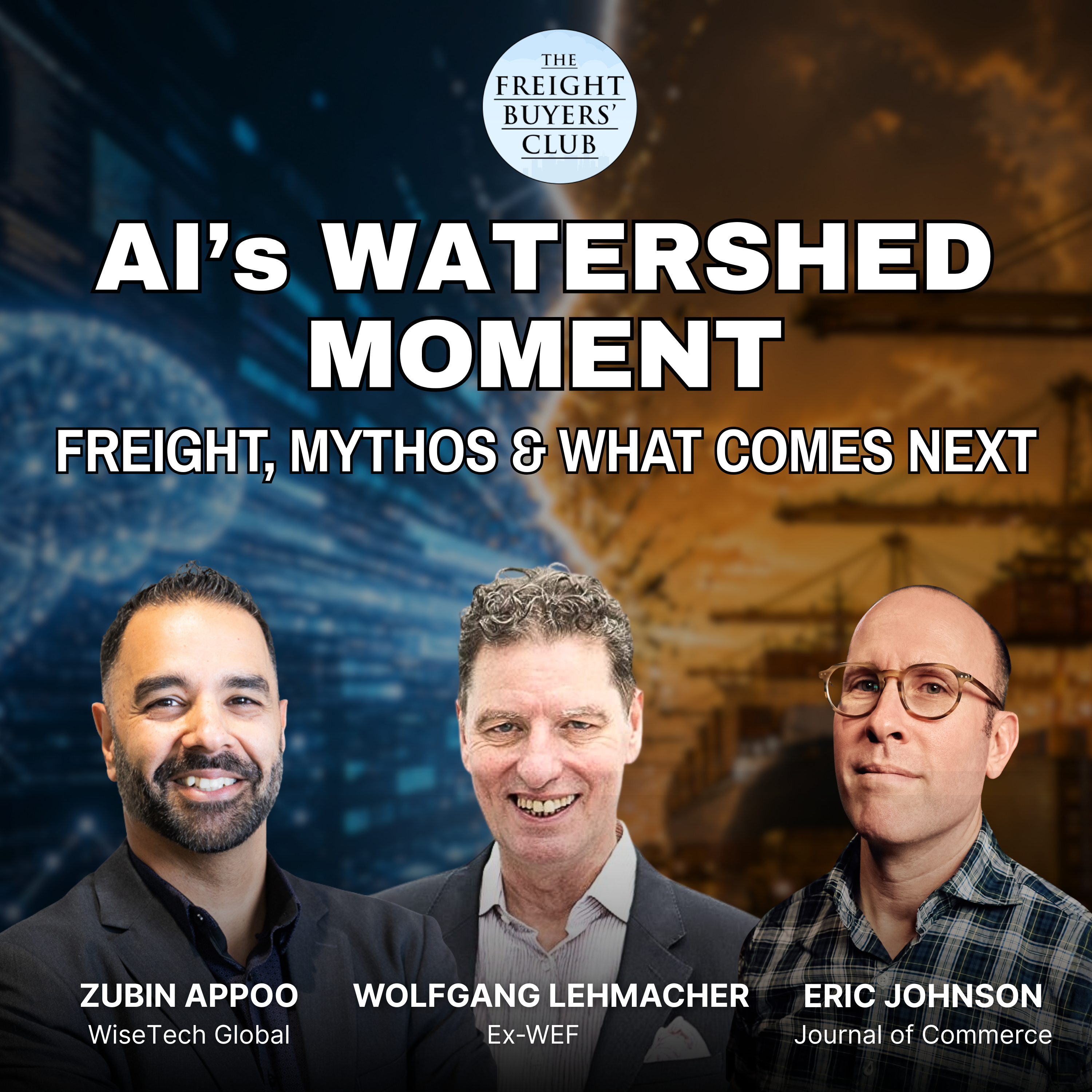
Welcome to the Freight Buyers Club. I'm Mike King. Today we're going to be covering all things AI and logistics technology. But as promised, we'll start with the latest leap forward in AI. And I have three guests today who cover this from every angle. A journalist who has spent years interrogating the gap between what technology vendors promise and what actually happens at the customer level. The CEO also is joining us of the dominant software platform in global freight forwarding. And we also have a former architect of global trade and supply chain policy at the World Economic Forum who now watches how competitive structures shift when transformative technology arrives.
Eric Johnson is senior Technology Editor at the Journal of Commerce, part of S and P Global. Eric, I think last time we spoke you were interviewing me on football.
It's also quite nice that I'm now asking the questions. How are you?
[00:01:52] Speaker B: I'm good. I wore my football shirt in honor of our last conversation. So, yeah, nice to be here.
[00:01:58] Speaker A: I truly am honored. I really am honored.
Go Leeds.
Zubin over In Australia, Zubin Apu is CEO of WiseTech Global, the company behind Cargoise, a platform that touches an estimated 80% of global manufactured trade flows and is used by 24 of the 25 largest freight forwarders in the world.
Zubin, welcome.
[00:02:20] Speaker C: Thank you. Great to be here. Exciting time in technology, exciting time in logistics.
[00:02:24] Speaker A: Isn't it just? Isn't it just? Thanks for coming on. And Wolfgang Lehmacher is a global supply chain strategist, former head of supply chain and transport industries at the World Economic Forum, former President and CEO of GeoPost Intercontinental and one of the most prolific thinkers in this space. Wolfgang, welcome back.
[00:02:44] Speaker D: Thank you for the invitation, Mike, and looking forward to continuing our conversation.
[00:02:49] Speaker A: Ah, you're always welcome. So, guys, let me set up the frame for this first section because I think the framing matters here. The argument about Mythos is essentially this, that for the first time, a piece of AI is being treated less like a commercial product and more like a controlled substance. The mechanism being used to control it, restricted access to a vetted group of around 50 large trusted companies.
Create a system where who you are and who you know, it sort of determines what tools you can use.
The economist says that creates insiders who can secure themselves against frontier threats and outsiders who have to hope for the best. In any other industry, you'd probably call it a cartel.
So what does this mean for freight and logistics? Eric, to you first, if I may. You've covered various software eras, erp, cloud, the VC decade, with all the hype around blockchain, early AI and now this latest step forward. So for you, what does this rapid advance of AI with Mythos mean for our industry? And are you worried that this might create a two tier system of access?
[00:04:05] Speaker B: I mean, it's an interesting question. I think I've sort of had the feeling over the last year that we're sort of entering this like Manhattan Project era of AI. Um, especially as someone with not a technical background and really learning this from a very layman's user kind of perspective is this seems extremely, kind of concerning and dangerous and exciting and exhilarating at the all at the same time.
[00:04:32] Speaker A: Right.
[00:04:33] Speaker B: And so when the news broke it for me, it sort of exacerbated this notion that the people who are closest to it are also the ones who are most concerned about it.
So that's my first. I didn't even get to the point that you asked about, which is this sort of like two tiered access element. I actually might argue that it's not so much about who has access to the most powerful model, it's who is small and medium sized, who would never have access to any of these models, who has access to a model that's pretty powerful in and of itself. So it doesn't need to be. You know, when you think about tiers of access, you don't need to have access to Mythos to amp yourself up into the hierarchy. You can use a less powerful model, a less powerful tool, and still sort of lever yourself up the food chain. That's what I think about more than I think about sort of this exclusionary kind of access to a powerful piece of technology. I mean, the reality is big companies and governments have always and will always have better access to tools than smaller companies will. I don't think AI changes that in any material way.
[00:05:47] Speaker A: Interesting. So Manhattan Project, but you're not that worried.
[00:05:51] Speaker B: I didn't say I wasn't that worried. I said I don't know how to feel. I don't know how worried I am. I think I'm worried about how unworried I am. So, Wolfgang, I mean, you've spent a
[00:06:02] Speaker A: lot of time watching how major technology transitions reshape competitive structures.
Eric's making me rethink this because I'm thinking a little bit like the Economist did. I'm thinking comparisons to Rocker Feller and Ford and these big moments in industrial history when a small number of individuals have this massive amount of power over technology or progress and governments being forced to step in in the past.
Are you with Eric? You're not too worried about how that affects our industry? Or are you a little bit like me and maybe you are a bit worried. And let me give you a specific scenario. A company like Palantir, for example, which already has national security clearance, it's backed, it's got these close government relationships, and it's already in our industry.
If that had access to frontier AI, does that hand a company like that and doesn't have to be Palantir, would that give them a massive advantage?
[00:06:56] Speaker D: Mike, as always in life, we have the two hearts in our bodies on our minds. So on the one hand, I'm with Eric. It will not have a major impact on the industry as such because the industry is very fragmented, very distributed, self organizes itself and probably absorbs whatever shock comes. That was always my baseline of optimism.
On the other hand, yes, Palantir has a structural advantage because it has built over 20 years relationships and capabilities that are not easy to copy.
Just imagine the time Palantir had and also where it sits in the current geopolitical context.
We are living in times of high political tensions, me first strategies and protectionism.
So a company that is positioned from a government and relationship perspective has clearly advantages compared to purely commercial platforms.
How that plays out needs to be seen, because there are also limitations to this place where Palantir companies sit.
Because we are, as I said, an industry that is vast, has hundreds of thousands of players that need to work together, and not everybody can be cleared.
So if Palantir companies stay in their space, that space is quite limited.
[00:08:46] Speaker A: Zubin cargowire sits at the heart of critical trade infrastructure. By any reasonable definition, that is strategically significant.
When you look at Mythos at this moment in time, are you worried about these tools being gated? And if so, do you want to be in that room and. Or do you need to be in that room? Because sitting where you are, at the center of global trade, for us, you know, this is the sort of access that you would want, isn't it? Presumably.
[00:09:11] Speaker C: Look, it's a. It's a great question. The first thing is this is an incredibly exciting time, as I said earlier, both for technology technology, but also for global logistics and global trade. And yes, through cargoise, we sit at the center of much of the world's global logistics. And through E2Oaken, the company we acquired in 2025, we sit at the center of much global trade and global supply and global demand planning and demand sensing. But we are a deep technology company and for 32 years we've invested significantly in becoming one of the largest technology players in the world. In this space, if not the largest, we have immense amounts of data about global logistics and trade. We have deep domain expertise across our, you know, 7,000 staff across the world. We work with forwarders, we work with bcos, and more importantly recently, we work very closely with government and customs authority departments. So because of that rich data that we have and all of those connections that we have, and more importantly, because of the sort of the technology and innovation culture that we've built over those years, we are investing deeply in AI, not just for ourselves to be far more efficient, but also for our customers. And putting that AI in the hands of our customers, in the product rather than on the side of the product, gives our customers this incredible opportunity to be far more efficient than they could be without these products.
So we are accessing all of the models. Now, obviously you're right, Mythos is gated, but we have the capability to use all of the models and even to build small and even medium language models in the future.
[00:10:48] Speaker A: I guess in a sense this is like the fragmentation versus scale debate.
In my experience, like shippers and forwarders, they tend to avoid any sort of concentration of risk in a single platform. Do you think, Zubin, that Mythos access could make that harder or maybe just advanced different advanced models of AI versus what your competitor has?
Or would that make that instinct stronger?
[00:11:15] Speaker C: Look, it's a really good point. I actually think that the market is changing and the market is moving from this model of let's use a certain product for freight and a certain product for customs, and a certain product for AI and a certain product for clearance and classification, to a model where customers are saying, if we have a single ecosystem, a single product that brings all of these capabilities together and a single product that has AI at its core, Rather than AI just tacked on at the end. That's a much more sensible proposition. It means they don't have to spend time building technology integrations, data flows, managing master data in, you know, one, two, three or more than two or three or five systems. They manage it in one system. So I actually think that if we do this successfully, and we will, being the technology sort of powerhouse that we are, if we build AI deeply into our core product, we make our product far more capable than it's ever been before and far more sticky and I think, powerful for our customers than it's ever been before.
[00:12:17] Speaker A: Okay, excellent. Thank you, Zubin. Well, as you've raised it, I guess Wise Tech made some of its own noise via your restructure earlier this year. Do you want to walk us through that and why you did that?
[00:12:31] Speaker C: Yeah, sure. So we have this philosophy, and I've sort of prescribed to this for many years, that we must constantly be disrupting ourselves, otherwise someone else will come along and disrupt us. The same applies for the industry. We have disrupted the industry over our 32 year history by introducing changes that we think is what the industry needs even before the industry has necessarily understood that those features or that capability is needed. Things like electronic documentation, things like having everything in one system with centralized master data, and now things like having AI capabilities and Personas and agents built into our platform.
So we made the decision quite early on in February this year that we would restructure WiseTech to really take advantage of what these large language models mean for us to predominantly initially at least in software development and in customer service. Now this happened really after Anthropic released their Claude Opus 4.6 model and OpenAI released GPT 5.4 in sort of late November or late December 2025.
And we quite quickly saw how many people in our team were adopting AI to accelerate their roles. We saw software development tasks that would have taken months, sometimes taken potentially up to a year, now taking days and sometimes even hours. We saw mundane work that developers didn't enjoy doing but had to do being replaced overnight by developers building agents to do that work. We saw things like code reviews, which is where another developer checks the quality of the code being created before it gets released to our customers, being done at much higher quality and of course at a higher pace than humans could do.
So we decided that the right thing to do was to reshape WiseTech to take advantage of those opportunities. And that does mean that we will remove up to about 50% of our product and development and customer Service teams. Some of that is happening right now as we speak. Very difficult thing for us to go through and very difficult decision for us to make given these are our people. But it is the right decision for us to make and the right way for us to show our customers, customers that what we are doing by driving efficiency inside wisetech is exactly what our software allows them to do by driving labor efficiency into their businesses.
[00:14:46] Speaker A: What does that look like in the future in terms of an AI lean wise tech? What should people expect from you?
[00:14:53] Speaker C: It's a very difficult question to answer because this world is changing so rapidly. I mean, I've never seen technology move at the pace that it has in the last at least 12 months.
I think it's fair to say there will be more opportunity for us to be leaner. But that applies to every company in the world really, unless you're, you know, laying bricks or building a house. But any, any technology oriented business is going to see opportunities here to be far leaner than they can be. And not just leaner for the sake of, you know, reducing cost, but leaner for the sake of, you can produce far more output with far less human input. And that means you get higher quality, it means you get faster release to market. It means we are in a position where we are giving value to customers at a much greater rate than we have been for our 32 year history. It means we're releasing software and releasing functionality both on the logistics side, but also now on the trade side and the supply and demand side faster than we've ever been able to do before. And more importantly, put aside the speed and you know, cost impact that has for us. It means we can build these agents, this agentic capability into CargoWise and into the E2 open trade products and what we call tradewise in the future so that customers can take advantage of what this means. We have, you know, many customers of all sizes, small, medium, large, saying to us that they know they have to adopt AI because everyone's talking about it, but they don't know how to do that because they run their business on Cargoise or an E2 open. So the expectation is on us putting AI into the product to enable them to be more efficient, more productive, win more business. That's exactly what we're doing with this
[00:16:33] Speaker A: crazy disrupted world that we've, we've had at least the last five or six years. It's, you know, unprecedented.
When you look at that from your customers perspective and you're looking at how you're going to evolve your own company.
How do you gameplay the challenges your customers might face in the future and how you might be able to use AI to help them?
[00:16:53] Speaker C: Yeah, look, I think that's a. It's a great question. And some of the recent events in the world, you know, the Middle east conflict and the closure of the Strait of Hor have really highlighted what we can do here.
I really do think we're entering this era of not just providing systems to manage data and systems to replace documents, you know, digital systems. We're entering this era of, know what you might call intelligent logistics or intelligent global trade. The closure of the Strait of Hormuz, all these other geopolitical events have escalated this need for us not just to manage the data, but to put tools in front of customers that help them predict the impact of these disruptions and to make changes to trade lanes, to make changes to route optimizations, to make changes to rates far earlier than they otherwise would have been able to do for far more proactively rather than necessarily reactively. And this sort of vast amounts of intelligence and data that we have, that we've collated over the years that relate to, you know, tariffs in the U.S. all the tariff refunds that are happening, the tariff changes, sanctions, embargoes, restricted parties, denied parties, terrorism lists and so on. Being able to manage that vast amount of data is not something that our customers can do at a high level or at a deep level. It's exactly what we can do if we harness that data and then apply intelligence layers on top of that. We don't just surface that data and say to a forwarder, here's a list check. If the parties are restricted party. We say that when you're going through the workflow of what a forwarding or a freight forwarding logistics operation looks like, we will gate it. And at this point, we will check sanctions. At this point, we will check embargoes. When the customs clearance is entered, we will review the good description, the commodity, the origin, the destination, the transshipment ports, and we will red flag if we think there's something that needs to be checked by the forwarder or by the responsible party.
So I do think this goes back to my earlier point about disparate point systems no longer being a viable option for the industry. You need to have an integrated system with AI built into its core, not tacked on at the end with deep, deep amounts of data driving that intelligence layer that is built into the products.
[00:19:06] Speaker A: I want to come to Eric and Wolfgang on some of those issues, but just to finish on this section, Zubin, if, say I'm a freight forwarder, I've been marker operator, I haven't got a chief AI officer and I'm watching all of this happen. Is this an opportunity or a threat for me?
And what's your call to action to them?
[00:19:29] Speaker C: Look, this is an opportunity really. It's an opportunity for our customers to say they are not just going to do what they've done for the last X years, they are going to lean into AI hard.
They're going to do that through cargowise or through tradewise, through our products that they use. And they're going to accept the fact or even take advantage of the fact that this is an opportunity for them to be far more efficient, productive, but far more intelligent or far more decision making than they had been before. Not be a system that sits there at the back and helps customers automate documents and do customs clearance, but actually put the power of AI into their customers hands as well. Make their customers far more capable. That's how we become more successful and that's how our customers become far more successful.
[00:20:17] Speaker A: Eric, I get quite a bit of a taste for this myself, but not as much as you, I suspect your professional life. You're getting approached by vendors all the time and you're always trying to work out what's actually true. I'm sure I've heard you say somewhere else, possibly to me in a bar, that sometimes there's a gap when you're thinking about it or working it through. How do you bridge that gap?
[00:20:45] Speaker B: So okay, I mean I have to be realistic and say, let's take Zubin for example. You, I mean Zubin is exuberant about what, what wise tech is right now and what it could become. If he wasn't that way, he wouldn't be in that role or he shouldn't be in that role. He would be doing his customers and his employees and his shareholders at Disvalue or you know, so I walk into every, you know, sort of conversation with a vendor knowing they're going to be far more excited about this than anybody else in the world.
[00:21:18] Speaker A: Right.
[00:21:18] Speaker B: So that's a, that's a, an expectation that I, that I have in any conversation. So what is, how does that translate into what you asked?
There's two sides and sometimes 10 sides to every story.
[00:21:29] Speaker C: Right.
[00:21:29] Speaker B: So customers, especially paying customers, have high expectations.
It's almost impossible to make them completely happy in any scenario. Right. So I really focus on not necessarily sort of the, the outlier complaints about a specific arrangement that a Software user has with a vendor I'm focusing on. Am I hearing the same thing over and over and over about the same vendor with the same, you know, sort of issue? Right. That's where I know, okay, maybe this software is not really hitting the mark on the whole rather than, oh, this is just a bad match between this vendor and, and this customer. So that's one thing, you know, I think the other thing that I feel like has become a bigger issue over the last 10 years and Zhuin touched on this a little bit like the pace of development of technology in the background.
The sort of expectation to, or I should say the expectation is not the right word. The compulsion to over promise in a lot of cases has led to expectations.
It's harder to meet those expectations.
[00:22:41] Speaker A: You could give examples here, Eric, if you wanted to.
[00:22:43] Speaker B: I don't want to necessarily throw anybody under the bus because it's not really about that. I think there's too many examples for me to point to any one vendor. And it's really across every sort of category I cover. Right. And we're seeing it now with sort of the AI agentic, sort of pure AI agentic providers. Right. So the issue is that the inner workings of software have somehow revealed themselves in a way to users in a way that they didn't before. You know, when cloud was becoming the norm rather than this sort of weird outlier 20 years ago, no one was going, well, tell me how cloud actually works. Right. It was more, how did I pay for this, how do I access it on my computer? They didn't care about like the inner workings. It's not like, you know, you get those watches where you can see how the mechanism in the back works. Right?
[00:23:34] Speaker A: Yeah.
[00:23:34] Speaker B: Okay, great. That's a cool thing to look at. I have no idea how it works, even if I can see it. So why do I have a compulsion to know how this thing works? And we see that, we saw it, I think most prominently in a negative sense with blockchain, where there was this and I was part of the problem. There was this intense drive to understand what blockchain was, how it worked, you know, who, who cares? Honestly, who cares? And AI is the same thing. It should not be that everyone needs to be a master of the technology or the tool itself. It should be, what is the outcome? Is the outcome that you seek being delivered by the company that you're paying to deliver that outcome. And so I would put it on the sort of user to not get swept away by whatever a salesperson is telling them or a CEO on a panel talking to me or you, and more about what was your expected outcome, did the outcome get achieved? And whatever the tool was to get there, whether it was a hammer and chisel or a neural network, like, that's the most important thing and it should remain the most important thing for people in our industry.
[00:24:41] Speaker A: But do you think this is. We've got. There's so many AI products out there. I mean, I think, like, I mean, I don't know what your inbox is like, but I get so many approaches. People want to come on and tell me all about, want to talk about what's going on in the straightforward moves because they're trying to promote an AI product. I was like, what do you know about what's going on in the Strait of Hormuz? I want someone in operations to tell me that, not someone who's trying to flog me an AI product. How do you differentiate? And how would a buyer differentiate when there's just so much noise out there?
[00:25:11] Speaker B: Well, first of all, I have an agent sorting out all those emails through a special one that opens your mail. Yeah, there you go. So it's a great question. It's honestly one that I try to ask a lot of vendors because I think it's a. It's one of the more important questions. How do I tell if your AI is better than, you know, your competitors AI, like, show me a way. So I think if you decide that, you know, you have to do some research, you have to think, you have to see if this software is. Is actually addressing the problem you have or the thing you want to address from an investment standpoint. That's on you. Second is, okay, you've decided they are in the right category for the thing you're trying to solve, then you have to put it on them to say, show me, you know, do you need data from me? Do you need a sandbox to play in? Show me that your AI delivers a better, faster, more accurate, more robust answer to the question that I have than three other ones that I'm testing and that. And they should be able to do that. I'm sorry, in this day and age, that should be. That's a basic question to ask in an rf.
Rf, whatever the RF you choose to use.
[00:26:20] Speaker C: Hey, one point I want to kind of add in there. I think, Eric, your point about being a black box, AI being a black box and people should not be worrying about the internals is a very good point. And yes, everyone's talking about AI right now, but ultimately I think you made the sort of the hammer and nail analogy. Ultimately, it's another level of automation. For years, software vendors in logistics and trade have been saying, well, let's automate the mundane tasks. Let's automate the things that customers do so that they can be, and this is the important bit, be more efficient and be more productive. AI is quite remarkable in how much more efficient and how much more productive it lets customers be and lets vendors be as well, to be honest, internally. But it is just, it's another layer of what we've been doing for many years. And yes, we talk a lot about it because it's kind of, it's relevant and it's exciting and it's quite a step change. But it's just another example of things that vendors, all vendors, including WiseTech, have tried to do and done successfully for many years.
[00:27:20] Speaker A: Yeah, that's a good point, Eric. Just so I was just thinking about something else. It's not Leeds, but it's tribal. It's tribal knowledge. It's not about the supporters club.
I heard you talking about this. And this, as I understood how you explained it, is what you define as the stuff that lives in people's heads rather than in a system.
Are you concerned at all that if AI absorbs all these tasks that this knowledge disappears and if so, where does that leave the next generation? Where do they learn?
[00:27:53] Speaker B: Yeah, I think I started thinking about this middle of last year, you know, when, when we started thinking about what an agent, you know another word for an agent might be a digital worker. Right. You hear that kind of phrase bandied about and it's. That's a decent way to think about it. It's a new employee and you're training it over time and it like learns probably faster and it doesn't take breaks and all those things you've heard. But so I started thinking middle of last year, okay, all of the stuff that people say in our world and Lord knows there's a ton of it. The manual data entry, the repetitive tasks, the things that you work on on the desk early in your career that you then look back on and go, oh my God, I can't believe I filed X number of entries or I did this many booking requests or whatever it is, if that goes away because it's perfect fodder for an agent. It's repetitive, it doesn't tend to be outside of a guardrail.
Well, what does that do to the learning process that the brain undertakes in an industry? So can you essentially hire someone who skipped Those steps of understanding the building blocks of a shipment and building blocks of compliance. And we don't know because we don't. We've never been in this, in this environment before where that's even an option. It's always been a thing where you've had to learn it. You've had to learn the basic blocks, you've had to work your way up. So we will learn over the next few years, whether it was as important as maybe I think it has been in the past, or maybe a lot of people think it is.
It's just. It's impossible to know. I do think that there is value in understanding minutiae that at the time seems terrible, boring.
A call at 9 at night from the other side of the world to resolve something.
These are things that you look back on and you're like, oh, that was terrible. Part of my job. But there was probably a lesson that you learned in doing that. And is a model as sophisticated as it might be, a mythos level sophisticated model? Is it ever going to learn that thing that, you know, kind of annoys a human being enough to learn how to avoid it the next time?
I don't know. It's really up for debate.
[00:30:12] Speaker A: Yeah. Wolfgang, this. The idea of where, where does the supply chain go with AI? What does the human still bring? How are you viewing it? Is my first question. And secondly, should we be worried about AI now or should we be worried about AI in five years? Is now the inflection point or is it in the.
[00:30:31] Speaker D: If I take an industry perspective, I'm not worried. And I put my operations hat on. I was a dispatcher, so I have filed a lot of stuff and I have filled a lot of forms.
And yes, we learn something, but we learn how to file and we learn how to fill forms.
If that is not necessary anymore, then we learn other things.
That's my simple perspective.
Taking another child dream. I always wanted to be an astronaut.
Now dispatchers might be the future astronauts because we play with technology.
It's not a pleasure to, let's say, run 15 trucks and deal with 15 drivers and 15 customers and have endless conversations.
It would be much better to supervise that and overlook this on a dashboard, have conversations when they really matter and focus on the interesting things of the job to make things work. Anyway, that was the role of every operator, or is the role of every operator to make the things work.
And times have changed. So I was a dispatcher in the 1980s.
Times have changed a lot since the 1980s.
Yes, it's all Accelerating.
That's probably through being a vendor perspective. I'm involved in a lot of implementations of systems.
I don't see that much acceleration there.
So the industry is traditionally, as I am very thoughtful and very careful about massive change because it is heart surgery.
We are moving the goods in the world, we move what people need. So I'm not worried about it. On the other hand, as somebody who needs to think a lot, needs to read a lot, needs to be very much, much on the, on the high end, luckily side of, of work, I also enjoy the boring work because the boring work gives me a break, gives me, gives my body that is always excited to find new things, a recovery moment.
So there is a need for a variety of tasks, but that might even play out in the AI world or in the AI powered world.
It's hard to imagine how that could be.
But as a, as a continuous optimist and a believer in humanity and the creativity of humanity, I believe we will work it out.
[00:33:39] Speaker A: Yeah, I sort of find myself smiling then I was reminded of, I think I must have been about 8 years old and that was my job in delivery, delivering newspapers around Liverpool. And I think the only thing I learned from that was how to get sacked, if I'm absolutely honest. Anyway, I digress. Wolfgang. Everyone in this industry treats their data as a competitive weapon.
You know, is there optimism here? Is the collective intelligence actually achievable?
[00:34:07] Speaker D: I believe it's achievable. And you know, Mike, it's close to my heart. The topic is close to my heart because I work on ecosystems that focus on primary data sharing. It's also a dream and I always have chased my dreams and realized them at some point.
The barrier in the way of data sharing is not technology and the solution is not encryption or blockchain. Although I have written a lot about it, it's a plus.
The driver of a change is governance and is trust.
Are we able to overcome the impediments put in by commercial incentives to build trust? And we can also name competition. Can we overcome competition in the area of data sharing for the interest and the benefit of the entire industry?
And we are working on together with Michael Lind, Rise, astar, vtt, Taltech. We have been working for the last three years on the Virtual Watchtower, which in fact has technology at its core.
But the most important element of Virtual Watchtower is that it is a community with like minded people.
So there are so many people around and particularly on the shipper side that are ready to share data and that can't wait to see that dream materializing that. I believe that we will have never been so close to the realization of that. And it will never be the entire industry. It will never be one ecosystem, it will never be one technology.
But we have the ability to build ecosystem that means to group people that are like minded and also use much more the drive of the shippers, of the cargo owners to make data sharing more a reality, I guess.
[00:36:29] Speaker A: Wolfgang Digital twins is very pertinent to this conversation. It's sort of where this data sharing lands. In practice you can create a live model of a supply chain that reflects reality in real time.
Can you give me an example of a real one and maybe someone in the industry who's actually doing this?
[00:36:48] Speaker D: It's always a challenge to single out individual parties. I would say Lenovo in manufacturing has a good digital twin.
And I was on a panel last year where when the whole Liberation Day impact was unfolding and somebody on the panel said if I hadn't built a digital twin that would be totally lost.
So I know where my inventory, where my inventory is, I know where production stands and I have quite a good grip on transportation. I believe that transportation is on the weaker side. We still have a lot of, let's say blind spots in the visibility of transportation.
One of our partners in Virtual Watchtower says is they are lacking 60% of visibility.
I'm contrasting that against some of the vendor statements, but that's how they feel about it. A digital twin can have different shapes. I usually distinguish between one that is basic, that is very descriptive. That's what in supply chain we call visibility.
But that's a dashboard that's monitoring. In fact, that's not a real twin. A real twin is a tool that can simulate different options in real time that can deal with a lot of data. That's where I'm very close with Sooben that can help alter in the thinking process of the supply chain.
Professionals and even transportation companies are not that far behind.
Based on my knowledge. DB Schenker is monitoring constantly millions of shipments, factoring in external impacts and rerouting shipments. There are tools in use that give the dispatcher the possibility to just with a prompt. As we work now with the well known tools, put a problem and say Mary and John didn't show up today.
What does that mean for my, for my roots? And then the system which within seconds changes the entire planning of the day.
So it's very much happening in the back. So I'm with, with Eric. Nobody cares how this happens.
Some people test These tools and they enjoy it.
Others sit a bit on the fence and wait, who will win the race.
But on the one hand I'm saying the industry is slow, on the other hand, it's better than many think.
[00:39:43] Speaker A: Horses for horses. Thank you, Wolfgang. I want to bring all three of you back in for this next section.
As I mentioned earlier, we're in this world of constant risk, tariffs, geopolitics, climate, cyber supply, shocks, compliance, exposure.
For a freight buyer, you're exposed to a lot and trying to monitor everything is pretty much humanly impossible.
So I want to ask each of you where technology actually helps and maybe where it doesn't. Wolfgang, you've written a lot about resilience as a design parameter. And when I look at the modern world, there's a lot about, you know, just in time versus resilience.
How does technology make you help you bridge that gap between those two things as we, as we're looking forward?
[00:40:28] Speaker D: Technology is very important for resilience because resilience for me is all about optionality.
And in the past we have pre planned more or less our overall operations and the operations, some operations. Think about container ships. They ran almost like bus lines with some delays, but they were running very regularly.
What happened in the last seven years, if I take that number, Mike, is that these buses took detours, didn't show up, had other problems, were stuck.
And that meant that we had to figure out alternative ways and technology helps.
Going back to the digital twin, if I know what is happening in the world and we will come to the point whether we want to share data or not, but we come to the point where everybody is in some, in one or another way, in another way capable to see everything, everything what has happened with vehicles and ships and trucks and planes to everything what is happening around it.
There will always be some zones where that's not the case. That gives me on time ideas on what I can do.
In that sense, digital twinning of the world, of our ecosystem is the foundation for resilience. When I put on this, on top of this, the ability to simulate endless options and optimize them based on different factors, cost, time, emissions, risk, and have people on top of it that are able to do what the machines are not able to do, factoring in people, displacement, brand reputation, risk.
The shortest route might be a very dangerous route. If I have the right mix, then I'm resilient.
So coming to my favorite point, if we get the machine, human mix right, And I also want to say that I don't see an AI agent as a collaborator. I also haven't seen my software tools before or Google or whatever as a collaborator, it's a tool. But if we get this tool, human relationship, right, and most importantly alter our decision making processes because even if we have the right humans, the right tools, if they cannot decide because there is a lot of gatekeeping, then the people might be able to fix it. The tools might be able to give the best solutions, but the people are not allowed to do what they, what they are recommended to do.
[00:43:37] Speaker B: For sure.
[00:43:39] Speaker D: It's a big mix and it's cultural, it's organizational, it's technological.
[00:43:47] Speaker A: Eric, technology. Where is it cutting risk for shippers and forwarders and where do you think it's being oversold? Maybe as a risk solution when really just better visibility on a problem might fix it.
[00:43:57] Speaker B: Well, I think the problem when we discuss this is we have to talk in generalities, but we have to think about even amongst just shippers, right? Each of them have different issues that are critical, sort of existential essentially for their businesses, right? Like if you're a, if you're a commodity shipper, you have a different thing that is existential for you than if you're in an extremely sophisticated, you know, sort of high tech shipper with a million different components and a very, you know, kind of convoluted supply chain, right? So it's really hard to say there's one piece of software. I know, Mike, you keep asking for specifics, but we're like, oh no, it's fine. It's a big old world and there's a reason why it's so fragmented, right?
[00:44:43] Speaker A: I know you'd never try and pin anyone down on.
[00:44:45] Speaker B: Yeah, no, no, no, I, believe me, I know I've been in your shoes before trying to get like a specific answer. And I hate when people prevaricate. But I think the challenge for shippers is, you know, hearing Wolfgang opine about the digital twin. It sounds amazing, right? But like most shippers are in, most shippers in their transportation and logistics teams are usually at the back end of a line of people with their hands out asking for money within their companies, right?
And unless they are a very supply chain, very logistics driven company, they will wait a certain number of years to get a big enough investment to do anything significant. So in light of that, they have to think about small digestible problems that can be solved. And the ones that are the most problematic are obviously the ones to tackle first. If you have a component from a region that is geopolitically at unrest and that component stops everything else from happening. Obviously that's something you're going to, you would have keyed on a long time ago.
There's other things that don't become apparent until something breaks or until something goes against the pattern that had previously been happening. And then you address it.
It's very difficult for a shipper to say we are going to completely change our entire end to end even transportation network, forget about supply chain and then kind of become this ultra resilient kind of company at every single node. It's impossible. You can't do that.
[00:46:20] Speaker A: Right.
[00:46:20] Speaker B: Like it's, it's just impossible. So you have to have a plan to attack the things that are the most in need of attacking first. Whether it's a very small thing that means a lot downstream, or whether it's a big problem that touches a lot of different things. And it's easy to address because there's a piece of software that directly addresses it. And you just, you know, to, to Wolfgang's comment about gatekeeping, you've just never been able to convince anyone that it's, it's actually a big problem before. So I have a big problem with buzzwords in general. But things like risk and resilience adjust in time versus just in case, like every single person in supply chain. These are like, they're in your brain to start with. No one goes, oh, I never had to worry about risk before. I've been in supply chain for 30 years, but I never worried about risk until the Strait of Hormuz closed. Right. Like no one ever thought about it that way. They're all, they stay up all night thinking about risk. That's the problem. So how do you mitigate it? I think is the problem. And the only way to mitigate it, especially in a large global organization, is you have to piecemeal. You have to not piecemeal it. Bite size it, it has to be a digestible problem that you can make progress on and, and go from there. Yeah.
[00:47:32] Speaker A: You can't replace some of those concepts, can you? Zubin and I can. Zubin. Or one of those risks. Compliance risk, one of the most expensive in the industry.
You guys sit at the center of customs compliance for all of the world's largest forwarders, more or less.
What does AI actually change about how that risk might get managed day to day, now or in the future?
[00:47:54] Speaker C: Yeah, look, I think the interesting point you made earlier and one of the questions was about visibility. I don't think this is about giving people better visibility. There's too much data in the supply chain, there's too much sort of expectation on logistics operators to get through more jobs in the day. There's too many jobs simply to get through. It's not really about, let's work harder. And you can solve this by just having more visibility tools or having more exposure to the data. This is actually where I think AI actually does shine, because of just how capable it is of processing large amounts of data and making inferences and kind of surfacing data that people need to see.
Some real examples I can maybe call on. In late 2025, the Australian border Force publishes what they call essentially like a compliance update, where they publish stats about the quality of compliance happening in Australia.
And they reported about 32% of import declarations in the last financial year contained an error.
Now, obviously, you know, the immediate reaction is, well, an error means the wrong tariff or the wrong duty was paid or the wrong tax was paid. But you got to kind of take a step back and think, actually, the risk here is that something that should not have been allowed into a country was allowed into the country and that could have, you know, actual security implications or biosecurity implications for the country.
And off those 32% errors, a large proportion of those were actually classification errors.
So again, you know, talking about wisetech, because that's my job, and talking about the product that we sell, we have built a tool called a customs classification agent called Compliance Wise, and also the AI Classification Assistant, and that specifically is targeted and helping with these classification errors. It looks at all of the data points that the operator has included or was imported from the document that the responsible party provided, the importer or the exporter. It looks at patterns about what that shipper or that importer or exporter has done in the past. It looks at locations that the goods are going through. It looks at where are the goods created. It asks questions. So if someone is shipping a metal rod, it'll ask what type of metal, what's the purpose of the metal? What are the dimensions of that metal rod? And it'll land on conclusions that is sure not impossible for a human to land on themselves, but very difficult for a human to land on themselves when they're trying to get through 500 jobs in a day or 500 jobs in a week.
That's where we can use AI to do things inside cargoise that were pretty difficult for us to do before. We could provide all the visibility in the world and surface all of the data in the world. And then say, here, human operator, you make the decisions We've given you everything and still you get that 32% level of errors in Australian border force compliance wise and the AI classification assistant and AI in general and large language models in general make that problem probably more than any other problem. Make that type of problem, that high amount of data problem far, far easier to solve and far easier to put intelligence in the hands of users rather than just putting data in the hands of users.
[00:51:01] Speaker A: Thank you, Zubin. A couple of quick questions to finish guys. In, in three years, who wins? Not, not which company, which type of company? Is it the large platform that has the data, the network, the AI investment? Maybe it's the nimble mid market operator adapted faster than the incumbent. That's the ERIC example from earlier on. Or is it my paper tiger, the Palantir type actor with government relations and frontier area access?
Or maybe it's something none of us has named. Zubin, do you want to go first?
[00:51:34] Speaker C: Sure. Look, I think the answer is, it is that disparate point systems don't win. Disparate point systems that solve one problem only and require integration or data transfer or some sort of consolidation of multiple systems, they are going to be displaced and systems that bring all of the aspects of logistics and potentially trade together in a single consolidated system where AI is built into the system, not tacked on at the end, those are the systems that win and I think those are the, the systems that actually deliver value to the industry.
[00:52:09] Speaker A: Wolfgang, just jump in whenever you're ready.
[00:52:12] Speaker D: Yeah. The leaders from my perspective, will be the ecosystem orchestrators who treat data governance, organizational interoperability and collaborative intelligence as the core infrastructure.
That's for me, the vision of the future enterprise. Because the fundamental problem in logistics is not optimization within enterprises, it is the coordination across enterprises.
So the leaders will focus more on the ecosystem level and on collaboration with the people upstream and downstream in the chain.
And it is not about the best technology.
It's about being able to align everyone around you, around the common mission and solve problems individually, but also collaboratively on eric.
[00:53:14] Speaker B: So I mean I got into journalism so I didn't have to make predictions. And no one hold me to this.
I sort of default. We've said it a bunch today.
This industry is fragmented and Mike, I think you said it. The individual companies within it sort of have a preference to not be overly concentrated on any specific third party. Right.
I default with what I'm seeing in the market, the technology market at large, that access to really powerful technology is as democratized as ever. So theoretically a single person is not going to recreate wisetech, it's not going to recreate Oracle, it's not going to recreate a bunch of other name household names that we know. But a single person now can sort of manage a bunch of agents to build something pretty quickly and pretty effective. And so if I think about that, I don't know if the fragmentation in our market diminishes, if that is always sort of out there as a possibility. So that's not to say that because there is a theory that that sort of approach, we talked about this at tpm, Zube Internet. There is a theory that that sort of approach makes SaaS software go away. But I don't agree with that either because I think people like to have foundations that they believe and trust in and are familiar with. But the, but I don't know if it cuts down on fragmentation if you, if you put really powerful tools in the hands of more people and they, and those tools work really fast. So my view is our fragmented industry will just continue to stay fragmented in a new sort of era of fragmentation.
[00:55:00] Speaker D: Eric, I would say it gets even worse.
Right, Because AI will optimize the fragmented world, which, well, make it even harder to break the silos.
[00:55:15] Speaker B: Yeah, well, yeah, everybody will have their own configurations and custom customizations that they, their internal teams can do, theoretically.
[00:55:23] Speaker A: Right. So interesting.
[00:55:25] Speaker B: Fascinating.
[00:55:26] Speaker A: Okay, guys, a last question. The, the, the case. Well, certainly the case for pessimism is easy for me to make. Job displacement, competitive concentration, gated access, tribal knowledge. Is there a case for optimism? Is the same technology that's disrupting this industry we've all discussed, it's making things easier to do or things that were impossible before. You can run a supply chain with the kind of visibility, resilience and precision that would have looked like science fiction 10 years ago.
So I don't know. Give me your best possible outcome. Zubin.
[00:56:01] Speaker C: Yeah, look, I think it's a difficult time for the world because AI is moving so quickly that people don't know how to deal with it. People don't know what it means for society. People are looking at the job losses and people are wondering, you know, whether this is actually going to help us or harm us as an overall society. But I would say that this is something the world has gone through many times, right? The industrial revolution, the technology revolution. Now the sort of AI revolution. People adapt. This will change jobs and it will replace some jobs, let's be honest. AI will replace roles. And I think when people say AI won't replace roles, it'll only make People more productive, I think they're really kidding themselves. And there's a bit of spin going on there, but the roles that get replaced, those people like we have for all of our careers and for all of history, we adapt, we learn new skills and this creates new skills. You're seeing that because of the vast amounts of data that AI can process, you do need humans in the loop to review that data. You do need humans in the loop for that really complex sort of processing. At the end. We are becoming a far more efficient and far more productive society because of technology.
AI amplifies that. But I think it's an incredibly exciting time, as I said at the start, to be both in logistics and to be in technology. And we will adapt, everyone will adapt. And this will lead to quite a different world for us, but a very exciting world.
[00:57:26] Speaker A: Eric?
[00:57:28] Speaker B: Well, I mean, as the guy who started off talking about the Manhattan Project, I, I should probably be, I should probably explain if I'm also optimist. I will channel Wolfgang and Zubin here and say we really have no choice but to be optimistic about this. The alternative is we're all pessimistic and we all sort of become nihilists and like think there's no point to life anymore. Right? So, you know, if, if you take the view that these tools are really detrimental to society, it's sort of incumbent upon you to change that narrative. Right? There are things that can be done that were never done before if you learn how to use these tools effectively. Right? So I think that's sort of where I am, and I wholeheartedly agree. I actually don't think it's spin at all, Zubin. Even if it sort of serves the direction you're going, if you don't think this is going to have a material impact on what the workforce looks like and what we do in the future, you're not paying close enough attention. I mean, very frankly, when you. And when, when wisec announced it was laying off whatever percent of its company over the next two years, you know, my first thought was why does a company that has an established presence and an established product need as many employees as it had? Well, the answer is probably it didn't, right? And that decision was made in light of the technology that's available. So I think there's going to be a lot of, you know, sort of self reflection that everybody is going to do about where they are, where their company is, where their industry is, where their sector is, and say, look, a lot of stuff that we just kind of carried on with before because we didn't really know there was any alternative. They're gonna, they're, they have to, they have no choice but to look at the alternative now. And they will find interesting things to do and they will find different things to do. And, and yeah, I mean, it sounds like a, it sounds like a meteor hit the US and we're sort of like, we will find a way to survive. Like, you know, it's, we're not there yet, hopefully.
[00:59:27] Speaker A: Right.
[00:59:27] Speaker B: And so let's, let's like, figure out what this looks like before the meteor hits, essentially.
[00:59:35] Speaker A: Yeah, I see or see it on like multiple levels because you have got this sort of the macro, the mythos, the, the. How does it change our society?
What does that look like? And then there's the. More the, the industry level, what does it do to competition? But then it's the individual level as well. It affects every single one of us. Um, it's sort of interesting.
[00:59:53] Speaker D: Wolfgang, your thoughts from a technology point of view, we are living in golden times, so we have the chance for a moonshot. Technology is a tool, so it depends how we use that tool.
And the thing which I have seen is that with all the technology we got, we haven't overcome our, our fundamental challenges. And here is what makes me optimistic. The new technology, AI, et cetera, forces a reckoning with organizational choke points, with choke points which we have tolerated for decades, which have bothered me when I started my management career, which is decision latency, siloed data. We have mentioned it all, misaligned incentives.
And what I mean with it makes me optimistic is that the tension between what is possible and what we make out of it as an industry gets higher and higher, and that contrast between what technology enables and what organizations do becomes glaring. So we have the possibility to get on the spaceship and build an industry which will look very different from what we have today.
[01:01:21] Speaker B: One more bit of optimism, I would say. I think in previous tech, I've been covering technology closely for 15 years and in the industry, 20 some odd years.
What I observe in this moment is the penalty for waiting a little bit and not head in the sand. But waiting and reading and understanding is not as severe as it would have been in the past. So I think that what I'm saying is the ability to catch up because the technology works so quickly is easier now. So don't feel overwhelmed by what's going on and don't feel like you have to spend a million dollars tomorrow.
Like you can catch up quickly as long as you really understand what's going on in the market and you understand what you need. So I think that's an optimistic kind of development.
[01:02:10] Speaker A: There's clearly no Luddites on this podcast, is there? Zubin, Eric, Wolfgang, thanks for joining me today.
[01:02:17] Speaker C: Pleasure, Mike, thank you.
[01:02:18] Speaker B: Thanks for having us.
[01:02:20] Speaker D: Thank you, Mike. Thanks everyone.
[01:02:22] Speaker A: If you enjoyed this episode, please do subscribe. Follow us wherever you get your podcast and share it with someone in your network who needs to hear it. We're on YouTube and Spotify with the full video and on every the podcast platform for audio. And you can also find us at www.the freightbuysclub.com. thanks for listening or watching. This is the Freight Buyers Club and I'm Mike King.