Episode Transcript
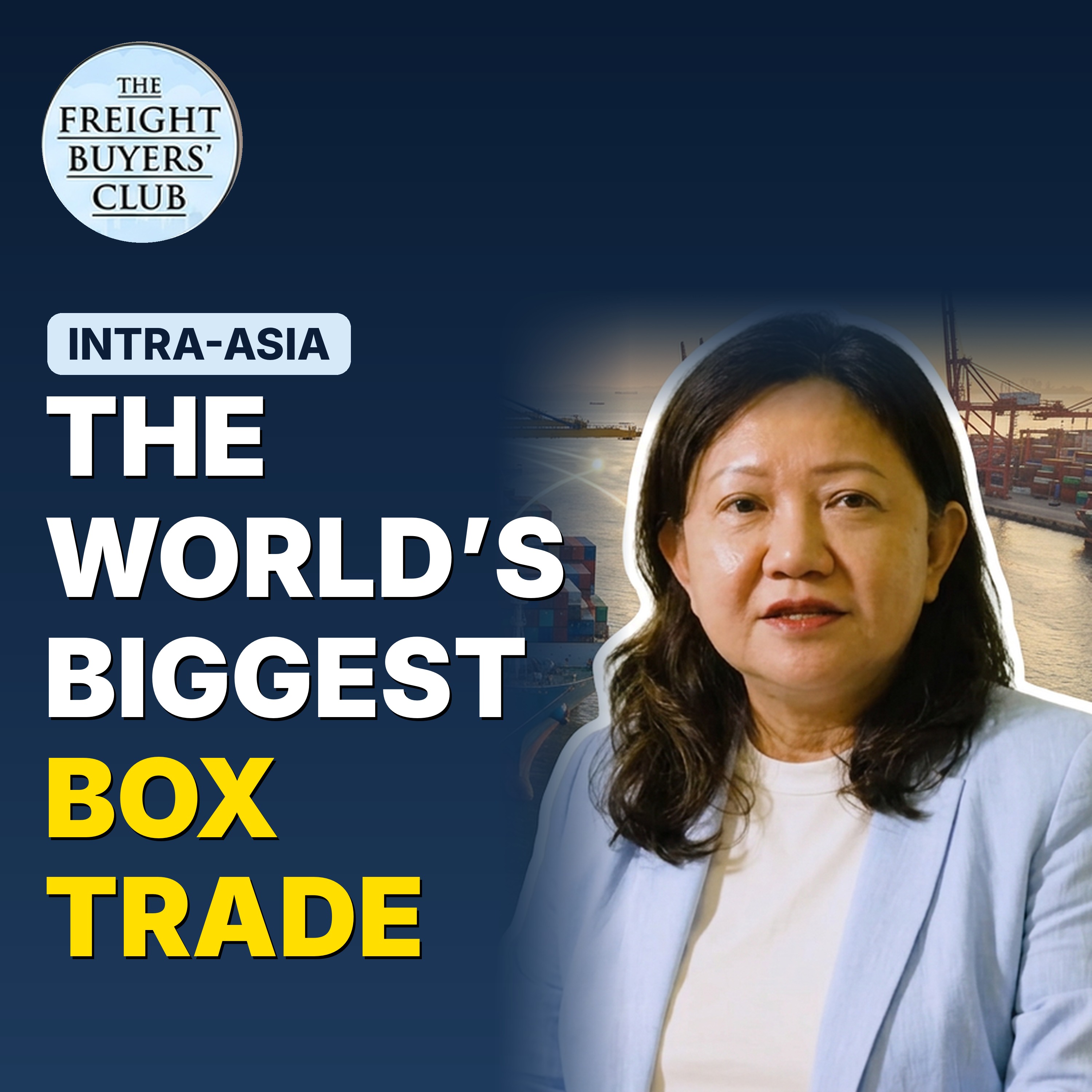
[00:00:03] Speaker A: Hello, the Freight Buyers Club. Mike King here. I'm over in beautiful and dynamic Singapore and I'm at Maersk's head office over in Southeast Asia with Elaine Lowe who's the area MD for Southeast Asia. AP Muller Maersk. Elaine, welcome to the Freight Buyers Club.
[00:00:23] Speaker B: Thank you, thank you.
[00:00:24] Speaker A: I wanted to start because we don't get a lot of coverage in the media of the Inter Asia container trades.
So I wanted to try and put some meat on those bones.
It's the biggest container trade in the world, which a lot of people don't realize.
They might also realize that we're at three year highs in terms of where rates are. The Drury Intra Asia container index has been spiking all year, but the last few months it's really gone vertical. Can you explain a little bit about what's going on on those trades and what's driving that increase?
[00:01:00] Speaker B: Sure, I can.
I think obviously the big driver is demand. Intra Asia is the largest trade, but it is also one of the most complex trades in the world.
And there's a lot of demand because there's a lot of expansion. I think if you look at primarily not just China, but the Asian customers, they are going overseas. There's this big push around expansion and you look at two parts of that. That is from a manufacturing perspective, a lot of people are going overseas within Asia, not so much US and Europe to expand their manufacturing from a production perspective for various reasons, cost reasons, et cetera and all that. So that drives automatically a lot of the Intra Asia demand.
[00:01:46] Speaker A: This is China plus one sourcing strategy.
[00:01:48] Speaker B: It's part of that, it's part of that. But there's also a lot of Malaysian companies, there's a lot of Singapore companies that are also going overseas, but they go around the region as well.
They don't take a big leap into the US and Europe. The other part is consumption. Asian consumers are growing. In fact, one of the highest growth. If you look at Philippines, Indonesia, Vietnam, the growth of Intra Asia comes from the growth of their consumer demands. So there's a very big consumer market and the population growth just absorbs a lot of that product. Yeah. So the moves is one for manufacturing and one for consumption. And that automatically creates a lot more demand in Intra Asia.
[00:02:34] Speaker A: Are you seeing demand spiking on any particular lanes? And looking at the rates from a distance, it looks like Shanghai into India, Shanghai into parts of Southeast Asia are particularly seeing this surge in demand or at least price.
[00:02:46] Speaker B: So I mentioned manufacturing, right. One of the big drivers is China. China getting out into Southeast Asia and into Asia. So they're in Malaysia, they're in India, they're in Singapore. There are many parts of Southeast Asia as well. And that's a push of having that demand coming in because they are, they are moving a lot of raw materials, a lot of product that's into manufacturing.
And on the other side, there's also a lot of feeding. If you walk on the streets today in Southeast Asia, I think 60, 70% of the time you will find a Chinese brand.
So the consumer markets are also bubbling and growing and that's pushed by a couple of industries, the automobile industry, automotive EVs. That's a lot of demand there. And there's a lot of consumption around the electronics, really, the technology side. And I think that's all driving the Chinese money that's out and then consuming within Southeast Asia.
[00:03:47] Speaker A: Are you seeing a lot of the AI business coming in? I know Malaysia's attracted a lot of investment on that front. Is that, is that one of those drivers as well?
[00:03:55] Speaker B: AI doesn't really drive the physical product movements from a shipping perspective, but it is a subset.
[00:04:03] Speaker A: You're an integrated supply chain company now.
[00:04:05] Speaker B: No, no. So that's a lot of information and database and technology, digital platforms, etc, that. That's a driver. Yeah. What is, what is the other industry which a lot of people don't talk about is the semicom industry, the chips that's driving the phones. And that's part of the AI evolution as well.
There is a big industry here that feeds into the semicon. And the semicon industry is a big industry and it's monopolized by a couple of players from the chip manufacturing, but the entire ecosystem that feeds into the manufacturing.
You have the equipments and this is one of the top five industries in Singapore that's focusing on semiconductor. And you have a lot of the peripheral ones like Malaysia, who supports the infrastructure. And then you also have Taiwan mentioned. Taiwan Intra Asia, but Taiwan is one of the biggest chip makers in the world. You have the big, big boys like tsmc, obviously. So those are the industries that are really driving the force behind.
[00:05:05] Speaker A: Can we also look at some of the supply side as well?
We've had a lot of disruption to services. We've had quite a busy typhoon season over here in Asia.
We've also had your own CEOs talked about port congestion and a lack of capacity in certain parts of the world. Can you tell me how that's played out during this summer and how serious is the lack of capacity at port?
[00:05:28] Speaker B: I think a big Part of our job is to support disruptions. I think disruptions will not go away.
That's in the market, that's Typhoons and that's the geopolitical situations that drive a lot of those changes. And I think as merced, we have been very supportive to our customers.
The resilience come in and the reliability is also a big part of our business because our ships are arriving on time and that plays into part of our focus as well.
So what we try to do as MERS is to be flexible, to be adaptable. As you must have heard, the adoption of Gemini this year, that came in just in time, through all these disruptions have allowed us to become a lot more flexible, a lot more adaptable. So we can make a lot of network changes by having this Gemini network in place.
[00:06:27] Speaker A: For anyone who's not sure what the Gemini cooperation is, that's a Maersk Hapag Lloyd.
It's like a shipping alliance and it's not for all of Maersk or Hapag's routes, but it's on some of their key ones. And it involves a commitment of 90% reliability or 90. Is it 95% reliability?
[00:06:46] Speaker B: 90. 90. 90.
[00:06:48] Speaker A: I'm not putting words in your mouth. Can you just explain how that works over in Asia? What are you hitting those targets and where are your major hubs? Because it's a hub spoke system, isn't it?
[00:06:56] Speaker B: Yes, it is a hub and spoke. Exactly. That is applied in logistics. We applied it on land, but now you're applying it on in shipping on the ocean side. I think that has worked very well and that was one of the enablers for us to be able to stay resilient to all the disruptions that are in the marketplaces.
The logic for that is because with a hub and spoke you have a more flexible network. You have your shuttles that are coming into your main hubs and you are able to make changes, I would say, and be able to make the changes in time to mitigate some of these disruptions at the same time. So that helped us a lot in terms of being able to support ultimately reaching the goal of reliability.
[00:07:45] Speaker A: On the disruption that we've seen and you mentioned geopolitics, how, how have your customers been? I guess there's been some disruption or peak season type surcharges that you've had to pass on and obviously fuel has spiked. How have you conveyed that to your customers?
Not the easiest of conversations.
[00:08:04] Speaker B: No, I think we follow the market. Yeah. I think MERS is not doing anything that's different from the marketplace.
A lot of these are driven by demand and supply.
So when demand goes up and outweigh supply, in this case, I think a lot of instances out of Asia, you definitely will see, you know, the cost. Yeah. And the prices going up. And I think what we need to do is to be market relevant, stay competitive and be able to support our customers.
[00:08:37] Speaker A: I think that's back onto the port capacity again.
Where have you seen the congestion most these last few months this year?
Is it in Singapore, is it in China, is it in Vietnam, is it in Bangkok? Is that issues?
[00:08:53] Speaker B: So one of the things that we need to remember is while the demand goes up, while shipping capacities are evolving, there is a lot of lack of infrastructure development in a lot of ports, in particular to Southeast Asia. You have many, many small ports. I think we have a range of just Southeast Asia alone, hundreds of small ports. If you go to some of these islands in Indonesia, in the Philippines, that's where the congestion comes on the land site. And these small ports are not structured to weather these increase in demand. So the infrastructure constraints in those ports are the ones that actually constrain a lot of the movements in and out of the country.
So if you just go and investigate the number of small ports that are lack of infrastructure. Every single port in Southeast Asia is full.
There is not one port that is free.
So you have naturally a lot of that constraints at the bottleneck. And that is why, you know, Vincent is mentioning also, you know, the land site is creating all these bottlenecks that are also pushing the demand.
[00:10:02] Speaker A: Technically speaking, in Europe we see that one of the other issues with this is bigger ships going into port. Obviously creates its own challenges. How does that play out on the intra Asia trade? I guess that you, you're cascading bigger ships onto these trades. As demand increases, then that, then that moves the pressure onto that port. Hinterland interface, I guess.
[00:10:24] Speaker B: Right. Not really. I think we, we don't put big ships into all these small pots. Yeah, I think that's not the, the direction. The direction is to work with. I think a lot of these small ports are not served by big ships. They are served by barges. They are served by intermodal activities and feeder vessels. Right. And a lot of these are where we work in collaboration with a lot of these partners and drive them to the main ports, which are basically Singapore as a main port.
Our major hub is Tanjong Parapas, as you know, in Malaysia. Johor. That's a big, the HBM hub there. Yes, that's a big transhuman hub for us where all the vessels do merge. So we, we bring, it's like a ferry, we ferry all of the cargo into the main ports and that could be a combination. We have our own in Intra Asia vessels but we also use a number of partners to support us especially through the barges and all. It is a very complex market and it's, it's absolutely mind boggling if you just look at the number of ports that you have here.
[00:11:28] Speaker A: Thousands of twin twins isn't there?
[00:11:30] Speaker B: So that is the complexity. It's not about putting it into the main, moving it to US Europe or Intra Asia. The complexity is the underdeveloped infrastructure in all the small ports in Southeast Asia.
[00:11:42] Speaker A: Okay, great.
On the Inter Asia trade, I'm fascinated about this. I speak to carriers a lot over the years on the Asia Europe trade and the Trans Pacific about how you think about the business from a contract versus a spot. How are you set up on those InterAsia trades? Does it vary by lane?
[00:12:00] Speaker B: It does, it does. So depending on the, depending on the trades, depending on the balance. Right. So I think our job is to strike a balance between contracted demand as well as spot demand. Yeah. And every customer supply chain has seasonalities. It doesn't work with, you know, it's not stable or not consistent throughout the year. So there will be spikes and there will be support needed on ad hoc sports, etc. We use that to, to also support the contractual commitment as well. So it's a balance. Yeah. And every trade has their own demand and supply on the model ship.
[00:12:38] Speaker A: And presumably this year we've seen a huge divergence between spot rates and contract rates. So your customers with a contract will be rather happy. Those on spot less so.
[00:12:48] Speaker B: Yes. And the buying patterns are different. Right. Some buy 6 months, some buy 12 months, some buy 24 months, some buy quarterly. So it's a mixture in combination we are committed to keep our contracts and our commitment to our contractual customers. But at the same time we are also here to service beyond the contractual commitments that we have with the customers when their demand goes up. So we were substantiated with some spot demand as well. On the supply side, we're going to
[00:13:18] Speaker A: do a separate short interview about Maersk's move into air cargo. But can you just to finish, Elaine, can you give us an overview about what you're offering your shipper customers or forwarder customers in Asia or Southeast Asia now versus pre merce transformation before you became an integrator? What does that look like? It's a platform for a Sales pitch.
[00:13:41] Speaker B: Yeah. So I think, Merce, as an integrator, what it means is we provide more value propositions to our customers in the form of being able to offer more optionalities when there is trouble for our customers, whether it's in the Middle east or whether it's Asia, any part of the world. So those are options to support our customers. And yes, we would love to do more and get more involved in the customer supply chain. And one way to do that is to be able to expand our service scope beyond just the ocean container shipping port to port.
If we extend it to land site, if we extend it to warehousing, providing storage, or at certain times where it's urgent, we fly the cargo as well. And that's where the air freight comes in. That is why we are here for as the integrator. And being able to do that in the last couple of years has given us a lot more confidence to stand in front of the customer and say, we're here to solve your problems.
And we see that as the world becomes more complex and more disruptions, you need that, you need that muscle and the ability to expand your scope, not just from a shipping perspective. And it doesn't mean bigger ships as well. So that doesn't really help, as you have seen the bottlenecks in the ports and all that. So having the flexibility and the adaptability to offer more than just a shipping service helps a lot of the customers. And that's how we create the integrator vision for that man.
[00:15:14] Speaker A: Alela, thank you for joining me today on the Freight Buyers Club.
[00:15:17] Speaker B: Thank you.
[00:15:18] Speaker A: Thanks all for listening. Be back soon.