Episode Transcript
[00:00:02] Speaker A: Welcome back to the Freight Buyers Club. I'm Mike King. Now, for decades, global logistics ran on a simple premise. Find the cheapest, fastest route and the boxes will flow. Nobody paid much attention to supply chains.
Basically they just worked. But that era is over. Trade is no longer just commerce, it is a contest. And semiconductors, rare earths and tariff codes have become the weapons.
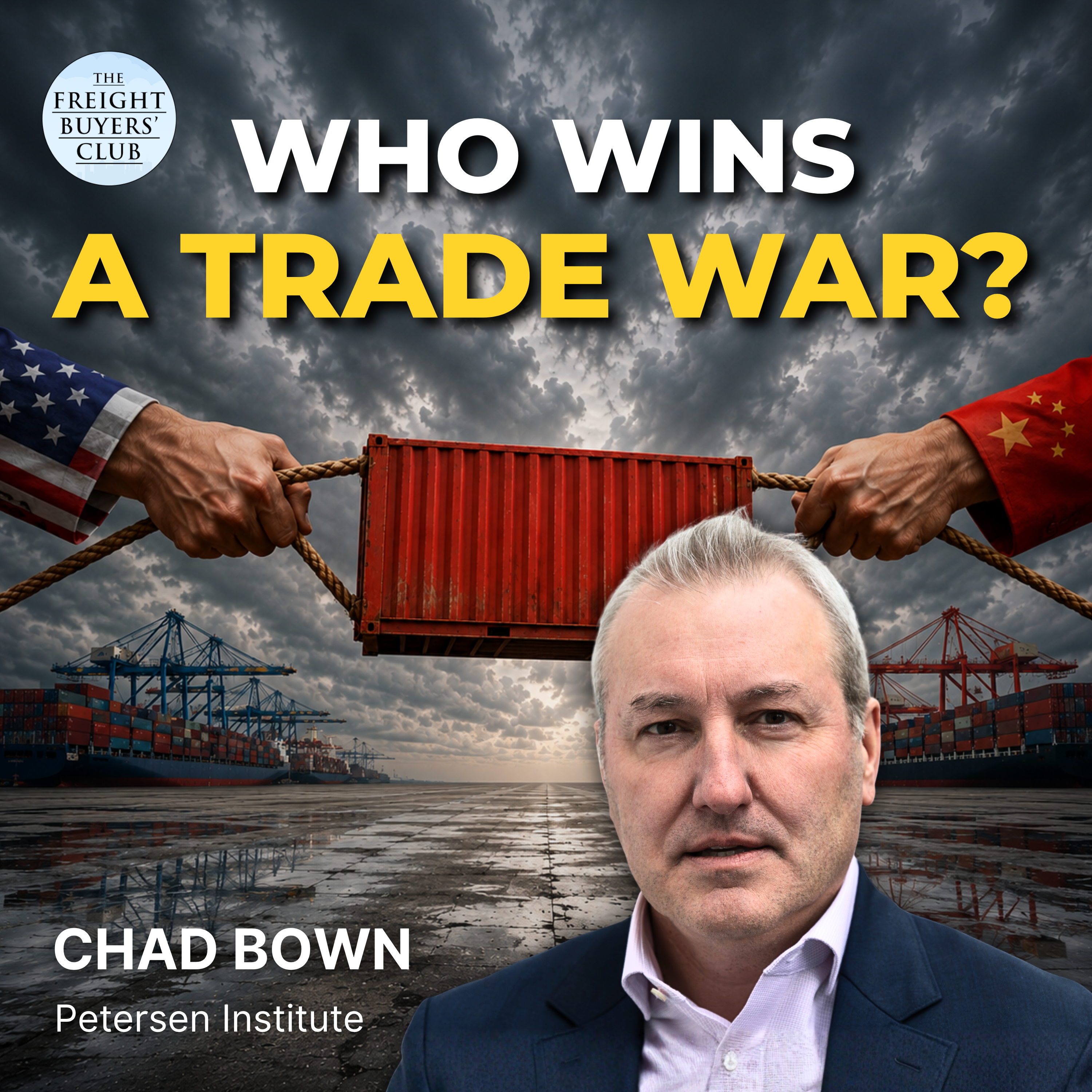
My guest today has spent his career at the center of this transformation of global trade and the rules that govern it, or used to govern it. Chad Bowne is the Reginald Jones Senior Fellow at the Peterson Institute for International Economics and host of the excellent Trade Talks podcast. He has been chief Economist at the US State Department and economist in the Obama White House. With the Financial Times columnist so Maya Keynes, he has written how to Win a Trade War, a friendly guide to an unfriendly world. Chad, how are you? Welcome to the Freight Buyers Club.
[00:01:01] Speaker B: Thanks so much for having me. It's a huge pleasure to join you.
[00:01:03] Speaker A: Well, it's a huge honor for you to come on with that glittering cv. Before we get going, I'll just quick note to our sponsor on Tegos Cloud, the freight forwarder, profitability specialist who are supporting this episode. Do check them out at Ontigus Cloud. If you're a forwarder and you want to boost profits, let's be honest, who doesn't? Chad, I love the book. I like the, the light approach you take to what I think is a pretty heavy, you sort of dwell on it. It's, it's an almost, I'm not depressing, but it's, it's definitely a, it could go in that direction. Especially if you're one of those people like me, you still see the benefits of the old rules based order. What I like is that in the book you don't pretend that those old rules are coming back. It's all about planning ahead, which is the sort of advice that supply chain leaders and procurement professionals really actually need right now. So we're going to, we're going to keep bringing this conversation back to what the future might look like. For those listening who are in the business of sourcing and planning, supply chain, shipping and logistics. But let's start first with the big picture and where we are now in plain terms, as you see it, who are the players in this trade war at the moment and what are they fighting over?
[00:02:18] Speaker B: Well, thanks for framing it and I really appreciate that because you've done it exactly. You've interpreted it exactly as we meant it. So my co author Samaya Keynes at the Financial Times is A brilliant economist, analyst, writer and storyteller.
And I really attribute all the praise to her for making it a fun, lively, light reading. Because what we're trying to do in this book, right, is recognize that in the world going on out there, President Trump especially is a very polarizing figure. And what that tends to do is incite a lot of folks yelling at each other from either side, right? Tariffs are the greatest thing ever. Tariffs are the worst thing ever, but without a lot of nuance in the conversation. And so what we're trying to do in this book is to cut through that and to provide an explanation of what's going on out there in the real world. But. But in an evenhanded and hopefully even fun way to kind of keep the reader engaged here, right? So as a little bit of background, Samayya and I started working together about 10 years ago. We did the trade talks podcast that you mentioned. And back then, we were two of the biggest proponents of the rules based trading system. It was us who was the first ones out there saying, nobody wins a trade war, so you shouldn't even fight it, right? It's just, it's silly. And as economists, we know that, right? And as economists, we know that it would be better for everyone to put their guns down and to stop fighting.
The reality is, unfortunately, that that's no longer the world in which we live. We're now being forced to fight a trade war. It's been thrust upon us. And so given that we're in this new world, what we try to do in this book is, is to arm you for that fight, right? And the first thing that we do is we think about it. Well, just like real world wars, right, of the military sort, to win a military war, you have to do the prep. You know, you don't just run out onto the battlefield and start shooting with a big gun, right? You have to do the preparations, the logistics, the planning. And so what we do in this book is we do that, right? We walk you through all, all of the homework that you, the aspiring trade warrior, needs to know before you can actually head out there onto the battlefield.
[00:04:36] Speaker A: I do like your vivid use of things in our everyday lives. You've got a vivid description of what this trade war means for companies. The Hollywood vision of Matt Damon and Anne Hathaway as CEOs, but as you're just saying there, as also heroic soldiers trying to man the barricades as globalization comes under attack.
Is that how you see the now for many business leaders, particularly those who have global supply Chains.
Yeah.
[00:05:03] Speaker B: And so, you know, the way we try to interpret it is companies, whether they like it or not, are the soldiers in this trade war and oftentimes they really dislike it. Right. And so we try to explain to the world, right? So yes, our audience is companies, but it's also policymakers too, why the companies aren't necessarily eager to do the fighting on your behalf, right. And to try to explain to those policymakers the constraints that companies actually face.
So to do this book, right, to research this book, we went out and we interviewed, you know, over 100 people, corporate executives from all sorts of sectors out there to really understand things. Like if a government asks you to move your supply chain, right. And to find a new source of supply, how realistic is that? Right. Do these things already exist right now out there that you can easily switch and find somebody else, or is it going to take you a long time?
If a long time, how long is it going to take you? Right. And the answers that we found were somewhat surprising.
First in the sense that there was a lot of differentiation across sectors.
So it depends entirely on whether you're talking about semiconductors. For example, we now know it may cost or take three to five years to build a new semiconductor facility to manufacture chips. Mining, on the other hand, can take decades. Right. For, you know, all of the exploration you need to do, all of the permitting that you need to have take place, let alone, right then it is, you've got to start the work of the excavation and get all the capital equipment there to actually then turn it into something that can be commercially viable.
Similar sorts of stories for the pharmaceutical industry, right, where you have to go out and not only establish facilities that meet all the scientific requirements necessary to produce life saving drugs, but a lot of regulatory hurdles as well, and they have to face these inspections before you can ever start making things for the public writ large. The point being, when you've got a trade war ongoing, you have to know about your companies and your industries if you're ultimately going to make it work. And that requires a lot of information and a lot of working together between governments in industry.
[00:07:32] Speaker A: Yeah. A side point on the tariffs, we did have someone on this podcast who, who was using an ingredient in their product, Madagascar vanilla. And when tariffs went on Madagascar at 67%, they complained and they were told, well, go and find another source. I was like, is there another Madagascar? Because there isn't another source of Madagascar and vanilla. But no one was listening on that. Big picture, though, Chad, your book argues that the west cannot prevail by relying on legacy WTO frameworks that much of the post World War II architecture underpinning globalization is now outdated.
As we enter a period of, let's call it more assertive or strategic economic diplomacy or what, what trade scenarios do you see emerging in the, in the years ahead and how might these shifts reshape the physical flow of goods across global supply chains? A bit of a big question for you.
[00:08:26] Speaker B: Yeah, no, and I, and, and it's. That is the question. Right. So, and it's a really hard one because President Trump in particular seems to have a new trade war that he wants to fight every day. And so it's really difficult for, I think the public to understand what's going on here and what are the things that are maybe temporary that are very specific to President Trump in his view of the world versus what's the there, what's going to outlive President Trump. Right.
And the key argument that we make in this book, and you know, I think we can substantiate it a number of different ways, but the key thing that has really changed and it's not just something facing the United States, right. This is a change that Europe especially is now confronting, is the challenge posed by China.
Originally, the worries that China brought for the international trading system, the rules based trading system that we thought about, worried about maybe beginning a decade or so ago, were its system of subsidies, state owned enterprises, industrial policy, its five year plans, its economy was just fundamentally different from ours. And the rules didn't seem to work in providing the right buffers and interface that we needed to engage properly with the Chinese economy. So that was a long known concern.
But I think more recently there's become, there's become an even bigger challenge with China.
And, and I think this was at least for me, best captured in President Xi Jinping's a speech, a famous, now famous speech that he gave in 2020, his dual circulation speech where he said out loud he envisioned a trading system for China to be engaged in that would be one in which China was not going to be dependent on the rest of the world for any of its supply chains or what it needed. But he wanted the rest of the world to be very dependent on China for our needs. Right. The United States, uk, Europe, Japan.
So that was his articulation. Right. And when you think about it, you say, wow, a rules based system requires a willingness to be interdependent with each other. I will export to you, you'll export to me, we'll have some frictions, but we'll work it out. This was China viewing the world of no, we're not going to have interdependence, we're going to have one way dependence where you're going to be dependent on us and we're not going to be dependent on you.
And then you look at the data and it starts to seem as if not only are these their goals, but they're achieving their goals. Right. First it's market share targets that they laid out in the, you know, the Made in China 2025 Industrial Policy for lots of high tech goods, whether it's batteries, electric vehicles, semiconductors, things of that nature. But it's also in the macroeconomic data. China's exports are booming to the world even though they've basically now been shut out of the US market, but they're not importing from anyone. And then finally, you saw, as they made clear last year in 2025, they were also going to weaponize these one way dependencies and cut off other countries from essential inputs. So when they shut down exports of rare earths and permanent magnets and next period, you know, mature node semiconductors that nearly shut down the auto industry of the Western economies worldwide, that made clear to everybody, wow, we have become way too dependent on China for these essential inputs.
That is the trade war that we have to fight right now to extract ourselves from being able to be coerced from China.
[00:12:04] Speaker A: I want to come back to what people talk about as the China squeeze and how that affects lots of countries.
But just on the US element of it, if I go back, say two years ago, there seemed to be cross party consensus that China, as you've just outlined there, because China has written it down, this is who your trade war is with. Right? This goes back to the, the first Trump presidency and, but followed through with Biden when obviously you're involved yourself.
What is US Trade policy now? Because it doesn't seem to be about China. It seems to be trade as a weapon to use, you know, against, for all, against all, for all reasons, against all people. If you go, I'll use your Hollywood analogy, it'd be war on everyone with Michael Penner and Alexander Skarsgard. Check it out, everyone. It's really good because that's what it feels like a little bit.
So what's going on? Are you a buyer of the idea of reshoring, of bringing manufacturing home, of resilience, self sufficiency for the US or is this the Trump Monroe Doctrine for trade?
Or do you see, maybe this doesn't survive this President Maybe the US Swings back towards its allies and the west becomes a thing again with a trade policy to match what's going on there. And we'll come back to China. This is.
[00:13:15] Speaker B: Yeah, well, I think to understand President Trump, you have to understand that he has had certain views about trade imbalances and tariffs that date back generations. Right. Since the 1970s and 1980s.
And getting him to change his mind about what the trade war is that needs to be fought right now is a really, really difficult issue. We try to do that in this book. Like we would love for President Trump to read this book and to really understand the issue.
I would say that the Trump administration, you know, as I was mentioning before, part of fighting a trade war is doing your homework. Right. I don't think they had really done their homework before they started this trade war in 2025. Right. They didn't really realize how vulnerable the American economy was to China, having built up these one way dependencies of the west on the Chinese economy. They were thinking about no, though, why
[00:14:15] Speaker A: didn't they understand that please buy our grain is not a great negotiating tactic? Yeah.
[00:14:20] Speaker B: I think they were still living in a world of the first Trump administration where if you think back what happened then, they put a lot of tariffs on China. President Trump views, you know, the American market as the crown jewel that everyone wants access to. You know, the American, the amazing American rich consumer. And so when he cut that off from China back in 2018 and 2019, he thought that that still gave the United States a lot of leverage. And what I don't think he had realized was that China in the intervening period had built up its own strengths. Right. It had invested in dominating these sectors that lots of countries were reliant on, whether it was rare earths or permanent magnets. These aren't the only examples that China is dominant in. So I think this was a fundamental miscalculation by the US government in 2025 and not recognizing that today China is just very, very different than it was back in 2018, 2019.
[00:15:25] Speaker A: If you look Chad, at say US China trade with the rest of the world now versus 2000. So back in 2000, US would have had the strongest trading relationships with almost every country in the world. And now that would be true of China. So that seems like a big China win for me in terms of soft power, maybe. But although if you also, if you go to some of those countries, a lot of them aren't happy with their relationship with China. But can I. Your book is very optimistic. So I'LL just say, is there a possibility at any point that we misunderstand China? Because I think we talk about it in almost sort of super efficient, monolithic, almost Soviet terms. There's like top goal down, goal driven. Everyone's marching to the same beat. Whether that's like securing supply chains, cornering where there. So you just mentioned there.
But when I talk to people in China, it seems more chaotic. Even in terms of those international actions. It's not all state led. She might be setting these broad goals, but in some sense a lot of this is out of weakness. The export drive, you know, there's a lot of economic weakness at home. Is there any chance that we look at China as almost that too? Monolithic? Is that even a word, almost heroic when it comes to trade?
Are we framing it right? And if we're not, is another trading relationship possible with China?
[00:16:44] Speaker B: I think there is a big risk.
That's exactly what you articulated, which is that we think all of this is by clever design of, of China somehow. And the point that we make in the book is that's not it at all. Right. Some of this is just sort of the result of really bad, really inefficient Chinese policies that they themselves would end up doing better out there in the world and for themselves if they could somehow figure out how to rein them in.
[00:17:14] Speaker A: Right.
[00:17:14] Speaker B: So today, for example, they have all of this excess capacity in terms of their production and they're continuing to invest and they're not shifting their economic model more toward domestic consumption and allowing their population to sort of enjoy the fruits of all of that work. They would be better off themselves if they changed their own economic model. They'd be more productive in the global economy if they were to head in that vein. So we don't, absolutely, we don't want to present them as a model, and they're certainly not a Soviet model. And what we do in the book is we try to explain how to understand the Chinese economic system and the role of Chinese companies. Right. There's also, you know, there's often a caricature that they're all, you know, driven by the state and many Chinese companies. That's not the case at all. Right. The Chinese private firms oftentimes are trying to behave just like Western private firms. Right? They're trying to make profits, they're trying to not do the things that the government wants in terms of having to source locally from, you know, Chinese inputs that may be inferior, that they would, they would much rather buy American or Western chips, for example, than The Chinese ones. So yes, 100%. Now, the optimism question right there, I'm a little less optimistic. While I agree there's a lot of individuals in China and a lot of companies in China that would like to see it head in that direction, really the question is about Chinese policy.
And right now that's led by President Xi Jinping and he's given no signs that he envisions a change in the policy trajectory of the country.
And until that happens, it's really difficult to see a change in the arc of China's relationship with the world. And I think the challenge at the moment is, and what we try to do in this book is making the world understand.
Right. And so you said, yeah, for a lot of other countries out there, they're now much more trading with China. But that comes with costs.
Right. And the costs may be like what happened last year for Europe and Japan. It was a US China trade fight that led to China imposing those export restrictions on rare earths and permanent magnets. And yet Europe was hit by it too. Right, And Japan was hit by it too. China applied these things to everyone. Right. So I think that's what we're trying to do in the book is to bring the world along. This is not a US China issue. This is a really a China rest of the world issue that we all need to better grapple with.
[00:19:44] Speaker A: Yeah, I thoroughly agree. It also depends on what that trading relationship is. I'll go back to something else on the Chinese economic model. If you go back in history, back to the Industrial Revolution, Europe, US later got rich, then Japan and South Korea. After the Second World War, as wages rose, all of these countries, they moved away from cheap manufacturing and that moved on to poorer countries.
China's not doing that.
It's holding on through its wages have risen, but Automate is holding on through automation. It's got a managed currency even as it's building high tech EVs for export.
How dangerous is that Chinese squeeze for manufacturing inside developing countries?
[00:20:26] Speaker B: It's the China challenge is affecting the entire world right at, at the moment. And so it at the high end, we're now seeing it directly impact the juggernauts of European manufacturing. Right. So high end German automakers, machine tools. Right. The strengths of the European industrial base for decades are now under threat. But as you said, at the same time that China's moving at the high end into more advanced manufacturing that's traditionally been dominated by high income countries, it's not vacating the more labor intensive ends. Right.
The paths to economic development that have been there for generations. Now, my colleague at the Peterson Institute, Arvind Subramanian, has a new piece of research that's out that's just exactly on this point, right. That it's actually amazing how China is not vacating the production of clothing or shoes or toys. Right. The pathway for development that would expect it to be next up for Africa, say, Sub Saharan Africa. It's just not leaving that. Right. And that's a real challenge that those countries face in terms of their own paths looking ahead for economic development.
[00:21:44] Speaker A: For anyone listening, Chad's done a great interview with Arvind, actually, on trade talk. So I'd suggest check that out and we'll try and put a link to that podcast and Arvind's paper in the notes.
Just on that point, you mentioned Sub Saharan Africa.
I'll just bring this back to our home audience here a little bit because we had Nigel Pousi on who runs container trade statistics. The best volume figures for goods trade in by ship. Sub Saharan African container imports were up 33% in the first quarter.
That's like a million extra containers, more or less, almost all of it from China. But it's not just Sub Saharan Africa. Central and South America were up 17%. He thinks that China made a deliberate pivot to the Global south in late 2024 to get get ahead of US tariffs. How does that flood of cargo fit your idea of the China squeeze?
[00:22:37] Speaker B: Yeah, I mean, I think we've seen that. Right. And so I think, again, another miscalculation on the American side was thinking that China was just hugely dependent on the US Market for its exports of consumer products. And we've seen that to not be the case. Right. Since all the tariffs went ON Beginning in 2018, 2019, China's exports to the rest of the world have continued to boom. Right. Originally it was Europe, and now Europe is at the front lines and they're trying to figure out, do I impose export restrictions and new rules to try to limit the damage that's being caused to our industrial base. And when they do, well, then the next question is, well, where else are these things going to go? If it's not the United States, if it's not Europe, it's oftentimes going to be in into other emerging markets. Now, the challenge is, right, it depends on what the product mix there is. So it's going to be.
There could be huge benefits. Right. So if China wants to export a lot of solar panels, for example, to Sub Saharan Africa in ways that can be utilized to help those countries build out their, you know, infrastructure and electrical grid that would and help deal with climate change concerns at the same time.
That would be hugely positive. I think it's going to be much more difficult if you're talking about high end electric vehicles because the complementary needs there is. You need to have the electrification in the first place. You also need to have the charging infrastructure in a concentrated place to be able to recharge those vehicles, which as we've seen in the United States is part of what's held back the adoption of EVs here too. So anyway, it depends, I think on the products as to how effective the strategy for China will be over the long term in terms of seeing markets like sub Saharan Africa as viable for its sort of excess manufacturing that's no longer being able to be shipped to either the United States or Europe.
[00:24:35] Speaker A: Just on Europe, I think it's in a bit of a pickle, if I might put it in a very English terms.
For years there was Russia for energy, US for security, China for everything else. That model couldn't be more broken. I don't know what the relationship with the U.S. obviously it's obvious with Russia and Europe's got these existential problems almost with China. I think I'll just give you some stats from this physical side that we cover on the freight buyers club. Europe now imports 3.5 containers from the Far east for everyone it sends. Back in 2023 it was 2.4 to 1. So that's an imbalance widening by nearly 46% in three years.
I mean, that doesn't sound sustainable to me. What, what do you think Europe's options are? And you know, what does winning even look like for trade in, for, for Europe?
[00:25:27] Speaker B: So this is it. I think largely Europe is going through right now what the United States went through with the, our China shock in say the 2010s.
And we made a lot of difficult decisions and many were unpopular at the time in terms of import restrictions and tariffs and things of that nature.
Europe is facing. Europe's at the forefront of it today, the United States. We used a bunch of policies, tariffs that were unpopular at the time because they didn't seem to be consistent with the rules. Europe is trying to adopt a different approach with its use of tariffs on China, following the rules, using things like trade remedies, anti dumping, countervailing, anti subsidy tariffs, things of that nature. The challenge is there's so many imports from China in so many different sectors and doing the tariffs that way is incredibly Bureaucratically intensive and very, very slow. And by the time Europe gets around to doing it, it might be too late in the sense that the industries in Europe might already be gone, they might already be bankrupt, the workers might already be unemployed. Right. So I think this is the big challenge that Europe faces. It's, it's being inundated right now not only with imports coming in from China, but China's increasingly sophisticated and they're competing them out of exports to third markets that they have in common, too.
Right. So this absolutely is a critical moment for Europe today.
[00:26:51] Speaker A: Big questions, Chad. A lot of people in this audience are the people who actually own and move the cargo. Most of them sit on top of long layered supply chain. So this would be like tier 2, tier 3, tier 4. Sometimes they don't even know who their real suppliers are as they zoom around the world.
You've got a really good example in your, in your book. You explain the complexity of these supply chains. I think it was a lipstick supply chain with a plastic casing made in China, filled in Mexico, shipped to Canada. I think it was via, via Texas. But a lot of the people listen to that. They'll know a much more complex supply chain than that. So if you were, if I can just put you on the spot, if you were a shipper or a freight buyer staring at this fractured future trade map, how would you rationalize where you would source from? Is there a sensible way to think about that? How you might spread your risk across regions, build in redundancy, pay more for certainty? Or is this all just guesswork and we'll just have to see what happens and where the cookies crumble?
[00:27:53] Speaker B: Yeah, so that's a you exactly. You hit the nail on the head with that example. The other one I have from my personal experience is I was actually in the White house back in 2011 when the Fukushima disaster hit. And, you know, so this was travesty in Japan. Offshore earthquake, tsunami, Tens of thousands of Japanese were killed in flooding. And then on top of that was a potential nuclear disaster right of this thing. My job in the White House at that moment was to write a memo to the President of the United States explaining to him what, what the likely impact on the American economy was going to be through supply chains.
And this was a period of time where we were still almost at 8, 9, 10% unemployment. We owned General Motors, the U.S. government did, because we'd had to bail it out during the financial crisis in the United States. We've got a lot of Japanese companies, automakers Honda, Toyota, Nissan, Subaru, sourcing parts from Japan. American workers are reliant on these things.
This was the shortest memo I ever wrote. Because back then we had no idea about supply chains, right? I think we've learned a lot since then.
But even talking to companies today, as you mentioned, oftentimes they don't know, right? They can't get the information from their suppliers. We talk to big multinationals, they say, well, what do you know about your tier 2, tier 3 suppliers? They would tell us we can't get that information. They won't give it to us because they're worried that if we know it, we'll use it against them. We'll use it against them in our pricing decisions.
We'll cut them out of our supply chain decisions, right? So a lot of these companies you just don't know. And you're left in the situation which you just articulated, which is, what do you do when you don't know where your dependencies are?
And I think what you have to do is you have to recognize what some of the long term trends are that we point out in this book.
The challenges of, especially China and its willingness to weaponize through the use of export restrictions.
There's no sign in which that's going to go away. And when it's building up these dependencies, I think it becomes increasingly worrisome.
Governments now are recognizing that and trying to create incentives for companies to look elsewhere that oftentimes looks unpopular. It's like, why did you put a tariff on China?
Because the government wants companies to look somewhere else outside of China. So where they're, you know, artificially making the Chinese stuff more expensive.
That only makes sense for a company's perspective. If that tariff on China is going to be there in the long term, right. Then it's worth it for you to find an alternative supplier in a Vietnam or an Indonesia or US or Europe or wherever. It's just going to be temporary.
You'll wait it out, right? Or you make the investment and then, holy cow, it wasn't worth it for you because somebody else can buy it from China even more cheaply.
In any case, the point of all that is to say we don't think these long term concerns with China are going to go away. And that's an important thing for not only policymakers, but for companies and logistics providers to understand as well.
[00:30:56] Speaker A: Okay, I got you.
You called it that didn't sound that optimistic, but you do call it an optimistic guide. So let me put it to you straight. Five years from now, the companies that came through this in good shape, what did they do that the ones who got hit didn't? How do they win their own company trade war?
[00:31:16] Speaker B: Yeah, they do their homework as best as they possibly can. Right. They understand their vulnerabilities. The other thing that we point out in this book though, is oftentimes it's really hard to know all of your vulnerabilities.
But what you can do is you can build up strengths, you can make yourself indispensable somewhere to somebody else to be able to make sure that when a disaster strikes, you're needed and that you can't be bullied. Right. And I think that's how not only countries should see that, but companies should see that as well. Right. Build up strengths, makes yourself indispensable in your supply chain, with your customers, with your suppliers, so that if bad things happen, you know, they'll look to you. Right. I'd say that's the first thing. The second, optimism.
I don't want to mislead anybody. We do not think that this challenge is going to be overcome anytime soon. In fact, our optimistic scenarios, when we get some kind of cooperation are really out into the 2050s.
Where the optimism comes from is we're really worried right now that we're not even talking about the right issues in this conversation of trade wars. And with that comes a feeling of helplessness.
And what we wanted to try to do in this book is to allow people to feel empowered, have better command over what's actually happening out there today, what's going to be happening tomorrow and in the future. To give companies, people, agency to feel as though you're better informed and you're actually making productive decisions that are going to be useful for your future.
So that is where the optimism comes from, I would say. But you're right, it's not a this thing is going to be over tomorrow sort of optimism.
[00:32:59] Speaker A: Just, just the last one. If you fast forward, I was going to say five years, but let's say 10 years. What does a normal sourcing decision look like then? Is the idea of, you know, cheapest and fastest, is that gone for good? Does some version of it come back? Or are we stuck in some sort of new fractured regional whole bunch of regional supply chains and trading partners overlapped by bilateral deals, that of the soil that we're seeing a lot more of, excluding China and sometimes excluding the U.S. i might add, where do you see that decision making process in 10 years?
[00:33:35] Speaker B: I don't think cheapest and fastest is going to be the way to go, I mean, even without the geopolitics of the US And China, we were heading into a world over the last six to eight years with a combination of weather related events because of climate change. So floods and droughts and wildfires, earthquakes, and then the pandemics, which meant that, you know, in the past, the way that the supply chains worked that was incredibly efficient and functional is they took advantage of economies of scale, super cheap to have all stuff done in one place and then source from there with geographically concentrated shocks, whether it's the kind that we just talked about, climate or public health, or now geopolitical shocks. China shutting down trade flows, you're going to need more sources of supply. That's going to be more costly because you're not taking advantage of the scale economies that you were able to take advantage of in the same way in the past. So that's just a factual reality that we have to address. That's going to mean higher costs. This is sort of like taking out insurance. It seems costly in good times, but when the bad times hit, that's when the premiums pay off for you. Right. When having a negative shock, you're able to find somebody else.
My favorite example, not favorite, but a really interesting example, and this I'll end on this one, was to see what Apple did in response to the first trade war they had. The iPhone in the United States was not hit with tariffs. Back in 2018, 2019, basically a third of what we bought from China then was exempted. Nevertheless, Apple went through the effort, painstaking effort, Foxconn and all of its suppliers, to build up an entirely separate supply chain in India for assembly of the iPhone. Even though there were no tariffs, there was no reason for it to have to do so. But sort of anticipating that the tariffs might someday come. Well, sure enough, at the beginning of 2025, the second Trump administration did put tariffs on China, on smartphones and everything else. There was no avoiding it anymore. But the fact that Apple had made those investments meant that it was quickly able to pivot and start sourcing from India, the iPhone instead.
And. Right. Its supply chain was virtually undisrupted. Right. And prices for iPhones didn't suddenly skyrocket in the United States or anything like that. Of course, those were huge investments that I'm sure Apple had to take to diversify. But in the end, you know, when they were hit with the tariff shock of the second Trump administration, it paid off for them. And I think that's kind of the world, unfortunately, that we probably have to prepare for going forward.
[00:36:10] Speaker A: Chad Bowne, thanks for joining me today on the Freight Buyers Club.
[00:36:13] Speaker B: Thanks for having me, Sam.