Episode Transcript
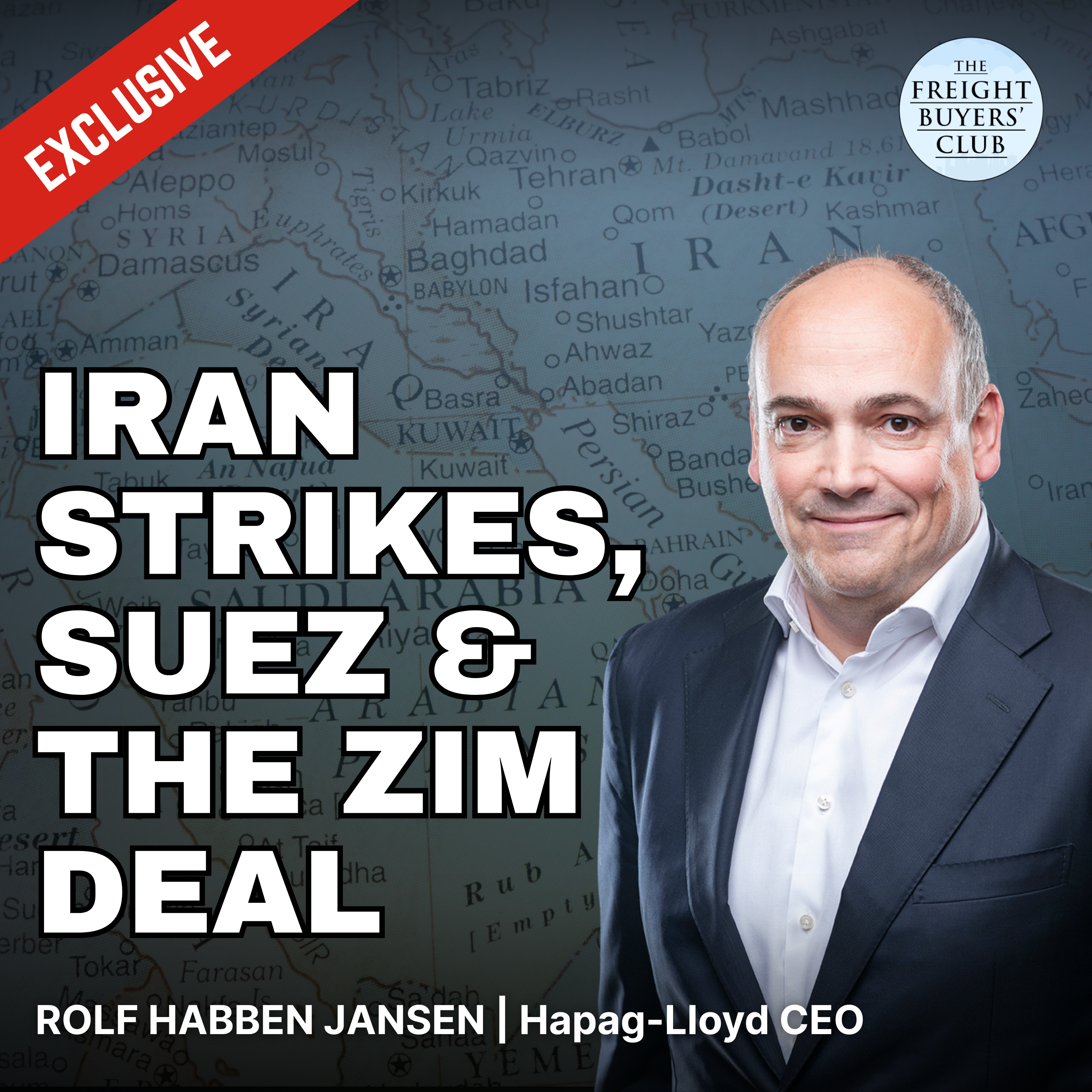
[00:00:03] Speaker A: Mike King here at TPM Long Beach. This content is brought to you by the Merco Express Group. And I'm joined today by Rolf Haben Janssen, who's the CEO of Hapag Lloyd. Welcome back to the Freight Buyers Club, Rolf.
[00:00:13] Speaker B: Thank you.
[00:00:14] Speaker A: Rolf. There's a bit been this big deal between HAPAG and Zim, either a merger or an acquisition. I don't know how you'd phrase it. What does this mean for freight buyers? Does this mean better network, better service or less competition?
[00:00:29] Speaker B: I think in the end it should mean of course the former.
We believe that ZIM and Harpa Cloid are potentially quite a good match because we have very similar strategies focused on value and delivering excellent quality. And if we would be able to join forces, then we can for sure offer an even better network to our customers.
[00:00:45] Speaker A: One shipper did speak to me who's a customer of your own and also Zim and they talk more about Zim being a value proposition or a budget proposition and you guys being more on the quality end of things.
How does that work out in terms of you capturing and retaining all of that ZIM cargo?
[00:01:02] Speaker B: I think, you know, SIM has some real good strengths and some really good products that we will try to keep and we'll try to combine that with what we are doing also within Gemini in terms of delivering high quality and on time performance. And I think that combination is potentially very good.
[00:01:16] Speaker A: And just were you expecting to do maybe is this the last of the acquisitions from Hapag Lloyd at the end of the pandemic windfall that you had or more acquisitions maybe ports on, on your, on your radar? And a second question to that. Do you think this will herald more consolidation within container shipping?
[00:01:34] Speaker B: I don't know. I think consolidation in container shipping happened largely in the last decade. I think this is an opportunity that we believe might make sense. Whether something else is going to come in the future is always very difficult to predict. But this is a logical step. Whether it triggers something else, I don't know. I personally don't think so.
[00:01:53] Speaker A: On the Gemini cooperation with Maersk, obviously we're about a year in now. Are you happy with the service, the reliability that you're providing? And we're here at the Trans Pacific contracting season, are people paying for a better service?
[00:02:08] Speaker B: I think generally we're very happy because we have been able to deliver on that schedule reliability promise of 90% basically from day one. I think there were a lot of people that were very skeptical about that, so very happy about that. Customers also recognize it and we see that also here at TPM when we speak with customers, that all of them recognize that our service has improved dramatically. And in the end that should also allow us to get somewhat better prices because we create value and people should be willing to pay for that.
[00:02:34] Speaker A: A year on and geopolitics is still dominating the international freight and trade in landscape. The most recent of that is the attacks on Iran and the closure of most of the Middle east and parts of the eastern met. What does that mean for your operations? How many crew and ships are stuck in those areas and how does that play out moving forward in terms of is this the end in the foreseeable future to return into the Suez Canal?
[00:02:57] Speaker B: I think that's still very early days. I mean the whole event, all the events started 48 hours ago. For now we have several ships stuck in the Persian Gulf. That's of course not good. The rest of the network is not really effective. And as far as it's around a return to the, to the Red Sea and Suez, I mean that's anybody's guess. I guess at this point in time we will always remain cautious there.
60 days ago we were quite close to starting to think about getting back to Suez. Right now that looks again like a little bit further out with higher war
[00:03:29] Speaker A: risk premiums, with higher oil costs, a lot of uncertainty, but possibly higher contract rate or spot rate. How does this work out in terms of how you will look at your outlook for 2026, which is due to be published on March 26?
[00:03:45] Speaker B: I think this probably the most difficult outlook we've ever had to make because there's many factors that play a role here. Cost is going to go up significantly, that we know for sure. You just looking at oil, looking at insurance premiums, looking at storage of containers, etc. Etc. Of course that over time will also mean that some of the rates are going to go up. But that's something that's going to come a lot later. Yeah, and probably also not sufficient to cover the additional cost. We'll try to take to make our best guess as far as the outlook. But for sure it's difficult at this point in time.
[00:04:16] Speaker A: How do you see the global container shipping supply and demand balance? Everyone talks all the time about excess capacity, too many ships entering service. Obviously Suez, whether you turn there or not, will impact on that. But maybe can you explain a little bit more how you see the demand side?
[00:04:32] Speaker B: I'm a little bit more optimistic about the demand side because also when you look the last two years we saw global growth of six and a half and close to 5%, which is a lot. Also in a historical perspective, and especially when you also look at the dominant legs which actually drive how much capacity you need, growth was even higher. If that continues for one or two more years, you know that will eat up all the additional capacity that actually has been ordered. So for now, can there be a couple of quarters where it's going to be weak? Yes, of course, that's always possible. But underlying demand for container shipping is actually in my book, still fairly strong.
[00:05:06] Speaker A: So you see a bearish market as temporary, not structural?
[00:05:09] Speaker B: That's correct.
[00:05:10] Speaker A: Just a final one on the US in the presentation we had this morning, you suggested that US Inventories weren't that high or relatively low. How do you think that plays out in the next few months? Because last year we saw a big front loading with changes on tariff policy. We've had start of another year, start of another round of tariff uncertainty. How do you think that plays out on the Trans Pacific and the Transatlantic?
[00:05:31] Speaker B: Difficult to judge at this point in time. But I think what we see is that inventories are indeed definitely not super high. We also see that that shippers have become a little bit more, you know, a little bit calmer than they were last year when everybody was rushing from one announcement to the other. So I think we'll see a fairly normal pattern that as inventories continue to deplete, then at some point in time they'll need to restock and then we have to see when that rebound comes. Does it come somewhere in the course of the second quarter or maybe a little bit later? But I do expect that that comes in the course of 26.
[00:06:00] Speaker A: Rolf Howard Janssen, thanks for joining me today on the Freight Buyers Club.
[00:06:02] Speaker B: You're very welcome.