Episode Transcript
[00:00:00] Speaker A: E Commerce finds a way. It always finds a way. It figures us out.
[00:00:03] Speaker B: You have to be at the table or you're gonna be on the menu.
[00:00:06] Speaker C: Does it feel like the government's been stealing from your members too?
[00:00:10] Speaker B: And what's happened is, is that the bad guys are now smart.
[00:00:14] Speaker A: Live by the sword, die by the sword, right?
[00:00:15] Speaker D: It depends very much what happens with the U. S. Iran situation and the straits.
[00:00:21] Speaker B: No one is correct, including the White House. But I won't.
[00:00:33] Speaker C: Hello and welcome to Air Cargo Unpacked, the Freight Buyers Club production. I'm Mike King and with me, as always, is Neil Jones Shaw.
[00:00:41] Speaker A: Thanks, Mike. But before I do a quick intro, I have to tell everybody I'm. I'm broadcasting from the beautiful Hyatt Regency at LAX airport today. I didn't want anybody to think this backdrop was my office or my living room or something. I've got a reputation to protect, you
[00:00:56] Speaker C: know, it's definitely too classy for you, Neil.
[00:01:01] Speaker A: So, you know, I have to to make sure that set the record straight.
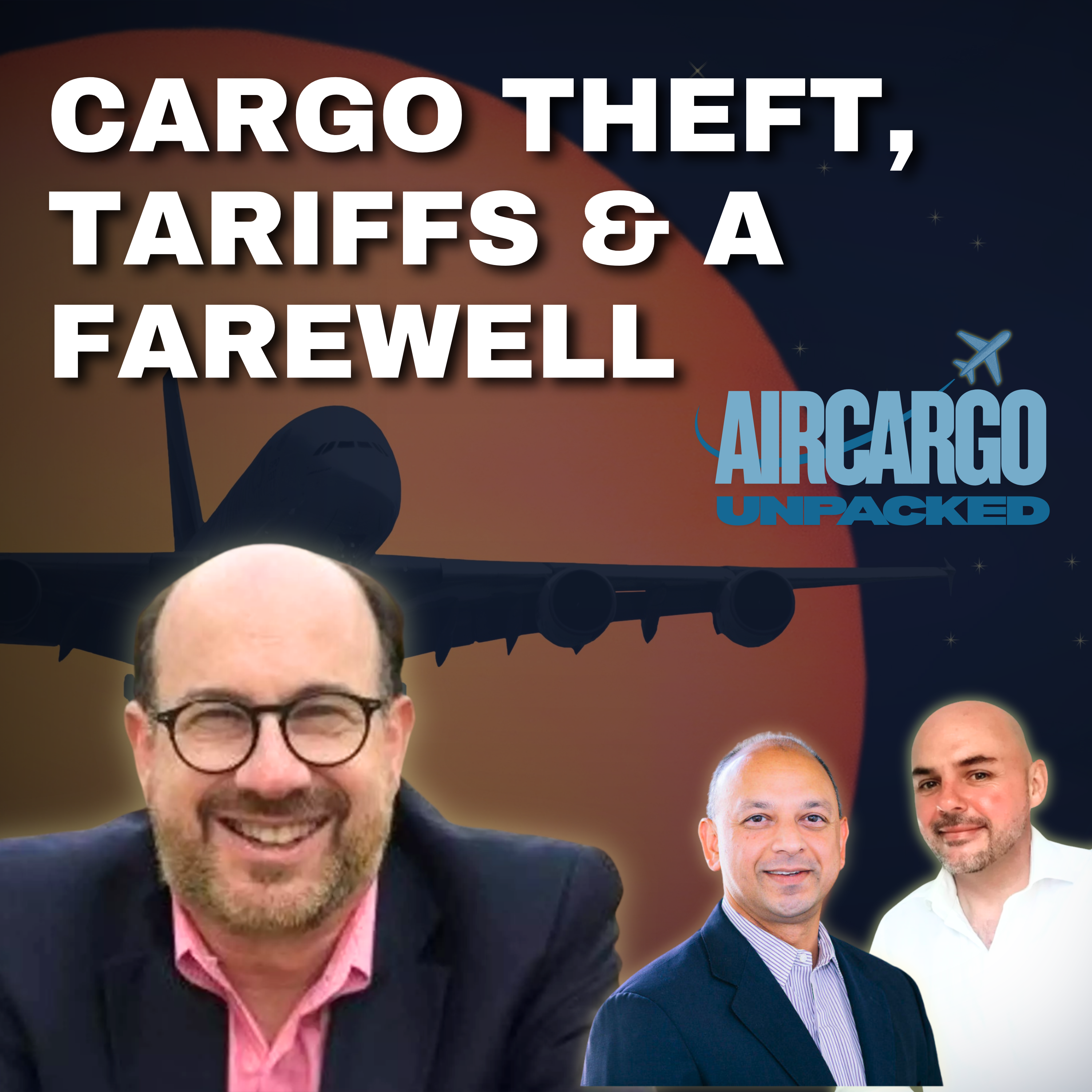
Anyway, getting back to the show, coming up, the best rates analysis in the game from Neil Wilson. Attack index, cargo theft tariffs and a fight over who's liable on an airway bill.
And we'll be paying tribute to a friend of mine and this show, Jan Krems, who has announced his retirement from United Cargo.
[00:01:25] Speaker C: And we've got a very special guest joining us today. But before I introduce him, a quick message about the Freight Buyers Club and Air Cargo Unpacked.
Because we are now averaging 20,000 downloads a month across podcast platforms and we're chasing 10,000 subscribers on YouTube and well, you can help if you would like, hit subscribe, hit follow, maybe drop a comment telling us what to cover next. And if you fancy being a partner to the leading video and audio products in the market aimed at people who get unreasonably excited about container rate supply chains and air cargo markets. Drop me an email or reach out on LinkedIn now as promised with Neil and me for the whole show today is a genuine industry legend. After two decades leading the organization, he's announced his retirement at the end of the year. He's the executive director of the Air Forwarders Association. Brandon Fried. Welcome to Air Cargo Unpacked, Mike and
[00:02:21] Speaker B: Neil, thanks for having me. Yeah, I'm a legend in my own mind. Wasn't that.
I'm glad to be with you guys today.
[00:02:29] Speaker C: You're so welcome, Brandon. We've had a lot of changes this year to where air cargo capacity is deployed in terms of what's driving demand.
We touched a little bit on this before we came on it. From your view or from the viewpoint of your members, how would you say 2026 has gone? What have been the big movers, the big bottlenecks?
[00:02:51] Speaker B: Yeah. Well, I'll go first. I'll just tell you that my members are telling me that the story of 2026 is AI related equipment moving into these data centers and out of the data centers.
I was at a meeting a few weeks ago and I asked a few of my members what their volumes were like and they said they're just busy moving freight in and out of the data centers. I said, out? I thought you were just stocking them. They said, brandon, the technology is changing so rapidly that in a lot of cases, these servers are just there for like barely a year and we have to move them out and then move another load back in. So I just think that is really extremely interesting. Despite what you're hearing about data center development being restricted in certain places, it's a happening story now in air cargo.
[00:03:45] Speaker A: Hey, Brandon, you know, I'm glad you brought up, you know, data centers and AI and I actually read a statistic and I won't get it exactly right, but I've heard almost every kilo involved in data center, I think, gets shipped several times over. Right, because it gets imported, it gets reworked. Oftentimes it gets exported, it gets shipped somewhere else to get installed. You just mentioned it becomes obsolete very quickly.
That's a lot of velocity on every kilo. Right. And just like when E Commerce exploded, it was the greatest thing since sliced bread. It was growing at 20% plus you know, for year over year over year.
I'm curious what your views are on the AI buildout. You know, there's a lot of backlash against data centers, right. In many communities. Some of it hasn't been well thought out in terms of power consumption and the impact on the water supply and water tables and all that. Do you think that the pendulum, like, we're getting too dependent on AI, you know, for our volumes? And do you think there's a risk right now or do you think, hey, it's got a long way to run?
[00:04:47] Speaker B: Yeah, well, I see this as a bubble, like, you know, anything else. But there are other bubbles in the past.
This is a little different. You know, I, I look back at, at some of the previous bubbles that, that we had in the past. Like, you know, blockchain as an example. Everyone had to jump on the blockchain bandwagon, but this isn't that this is different. And I think in a credit to the AI industry is that they basically went out to the consumer first and said, hey, try us, look at us, ChatGPT, Gemini, you know, all these clauds and others and the consumers allowed to dip their toe in so they can see the value of it going forward.
But there will be a shakeout sooner or later. Nothing good lasts forever in our industry. We've all seen that. Unfortunately, when you get old enough you see that it's a roller coaster, it's on a merry go round. And so I expect that there will be a bursting of the bubble sooner or later. But you're right though, this AI industry faces headwinds because communities are starting to see the realization of what, what it's like to have these data centers, Neil, just as you described. I mean, you know, they're not employers or significant employers. Maybe once a day a center is built, there's 50 people running the thing and there's talk about they tax the electrical grid and there's a water consumption issue. So it'll be interesting to see what happens. It has headwinds. We'll see.
[00:06:22] Speaker A: I agree with you. You know Brandon, you actually gave me another idea I think that we should have in a cargo AI sort of system and we should call it a branded. So that's what we're doing.
[00:06:36] Speaker B: Well, what's interesting is I talked to a few of our Florida members and they're building internal AI setups. So whatever they call them, you know, so that their employees and their customers can go in and take advantage of these AI learning modules that are specific to those companies in our industry.
And I think other industries are doing it. I'm sure it's not just the freight forwarding industry, but that's really fascinating to me how good they are. I can't tell you. I've never used one. I've used chatbots before. If that's related to it. I don't like those at all because they're never helpful.
[00:07:11] Speaker A: So.
[00:07:13] Speaker C: But you know, maybe double down on that one, that's for sure.
[00:07:16] Speaker A: Right, that's very good.
[00:07:18] Speaker C: Everyone likes a chat bot.
So enough on chatbot, but let's get into one of the biggest stories of the year for E commerce, which sort of leans into that demand analysis a little bit. This is the EU's de minimis change. From July 1, the EU removed its €150 duty free threshold. Every low value parcel entering the bloc now pays a flat €3 customs fee ahead of full tariff rates. In a couple of Years.
This follows the earlier removal of de minimis in the US last year as multiple reports have suggested. We've seen quite a sharp drop in volumes and freighters have been redeployed on that China into Europe route. Brandon, your members went through the US version of this already. Was this expected and would you say we should expect it to continue?
[00:08:06] Speaker B: Yeah, so a lot of our members don't even have any nexus to E commerce or no direct nexus to E commerce. Most of them maybe were shipping pallets in the warehouses, but very few actually focused on consumer deliveries that the typical e commerce scenario brings. But yeah, we've seen that this had an impact on US cargo. There were a lot of airlines and some of our members that were dependent on this and they saw significant drops. So it's not surprising that when the EU implemented its de minimis cutback or style cutback, same thing happened. No surprise there. And those freighters have been redeployed.
[00:08:51] Speaker A: Let's take a look at what has happened in Europe. I think, you know, Liege is a good benchmark, right, for how Europe reacted or how consumers reacted to the end of de minimis for €150 exemption. And you know, the E commerce volumes into Liege, which is probably the largest e commerce focused airport in Europe. Right. A lot of these big Chinese freighters and all that, you know, they come into liaise, the E commerce companies have built sortation and, and distribution facilities from there. So they, they double down on that and the numbers are down, you know, quite significantly, like 24% year on year. I think 41% from June. Obviously there was some front loading going on in June so it's maybe not the, the most accurate sort of measure. I think the 24% is, is better.
But look, I mean, you know, live by the sword, die by the sword, right. I mean, you know, they doubled down on E commerce and you know, the legislation changed and just like what happened in the US we could see this script playing out in Europe. This was not, shouldn't have been a surprise to anyone that the low value shipments either disappeared altogether or got, you know, reduced significantly. And, and obviously now people are pivoting towards the higher end shipments which you know, where the surcharge either is already in place or you know, matters less. Right. It's a, it's a, it's a smaller percentage of the, of the value of the goods. But here's the thing about, you know, Liege is that I think they saw this coming. I think, you know, this legislation's been talked about so their Overall volumes were actually up marginally, not, not hugely, but they were up a little bit. So they've been diversifying away from E Commerce. I'd say five years ago would have been a much bigger hit to the airport. But you know, pharmaceuticals, data center equipment, even you know, flowers coming out of, you know, Africa and South America, all of these sort of products helped make up some of the difference. So rather than being up 10, 11, 12% like they have been, they were up 4%. So it's still growth, it's slow. I think that this is going to continue for the balance of this year. We've got another. They're going to be adding a separate processing fee later in the year. So we're not done here. But I do think that if we come back and we talk about this a year from now, I bet you that a lot of these volumes will have recovered because E Commerce finds a way. It always finds a way. It figures us out. So we'll see if I'm right, if I could.
[00:11:15] Speaker B: You know Neil, I agree with you anecdotally there are still lots of Amazon and UPS and FedEx and whoever else's ex outside my door every day dropping boxes at my neighbor's houses and mine of course, probably most at mine. And it just, you know, this horse is out of the barn and it shows. It's a resilient market. The consumer's willing to pay for the convenience.
[00:11:42] Speaker C: We watch out how those supply chains reform. I think some of that will be going by ship and being distributed regionally certainly in Europe. I think it has done to a
[00:11:51] Speaker B: certain degree in the US you got to remember they saw this coming as Neil alluded to is they saw this coming in advance. They stocked with a front loaded warehouses. They were much more methodical on how they got goods into the US and that's what's happened. It's a story of success on their
[00:12:12] Speaker C: part and there's a lot of information out there now that shows that as that process has happened and those supply chains have been reshaped, that we've seen more reliance on specifically Chinese suppliers. So US or European suppliers, partners have lost out a bit. But we'll come back to this later in the year because I want to look at this from a rates perspective, this change in de minimis rules in the eu. And I spoke to Neil Wilson, who's the editor of Tacindex, the leading global price reporting agency on air freight rates, the calculating agent for the Baltic air freight industries about exactly this. I started by asking Gim if we've seen this decline showing up clearly in rates into Europe from Asia in recent weeks.
[00:12:59] Speaker D: Hello Mike and great to be back on the podcast again. So to look at this China x China key lanes comparison, we look at China US versus China Europe and if we look at China, China US you can see that the market is off from its highs, but it's still pretty strong.
It's up say 1.1% in the latest week we have before the recording here, and it's up some 30% year on year, which is bigger than the global averages which we will get on on the next point. If you compare that to China Europe, you can see that's dropped off much more since this end of the de minimis regime at the beginning of July and It's only up 12% year on year.
So obviously the market has changed since the end of that. There's less volume, which I think you've probably had other contributors to the podcast noting with some of that shifting onto Transpac out of China or other lanes out of Asia such as ex Korea.
So clearly, although the volumes dropped, the rates have dropped even more. China, Europe. Now having said all that, there are some signs, and we hear this anecdotally, that the market is starting to adjust to the new flat rate customs duty regime and that rates are beginning to stabilize and then firm up in the last week or two, like on the latest week we have on the chart there, you'll see that it's up very slightly 0.3% week on week it seems to have stopped dropping. The market is beginning to adjust I think as well what we're seeing and
[00:14:29] Speaker C: that global market, Neil, how's that reflected there?
[00:14:33] Speaker D: So to turn to the global picture, which we tend to do every month, we look at the Baio chart which is our global index, all outbound lanes and you can see that unlike July when that was falling, we had a interesting conversation about that last month because it was falling five weeks in a row while the jet fuel price was going up four weeks in a row. And that seems a very strange circumstance. In August it's been sort of more flat, flat to slightly up, less dramatic movement, but it's still up some 19% plus year on year to the latest week. So rates are still elevated.
And yeah, it's been I suppose a quiet month. We often see that in the summer season because you get demand easing a little bit, people going on holiday and capacity increasing a little bit with the more passenger belly hold, with people going on holidays. So those things have been going on. But in the background, of course, we've got these tensions still going on in the Middle East.
You've got continuing problems with ocean shipping and blockages in the Strait of Four Moors, which you're probably covering quite a lot in your ocean shipping podcast. So rates have been flattish in the last month, but elevated still from where
[00:15:40] Speaker C: they were, as you mentioned, no end to those problems in the Middle East. And we saw Brent crude hit over $100 towards the end of July. It then dipped again, but it's back up around about 90 US as we are speaking at the end of the third week of August. How's that impacting air cargo rates?
[00:15:59] Speaker D: So, yeah, this is interesting, isn't it? We talked about this last month that jet fuel is not the only input into the costs of running air cargo. It's about a third on average, given the cost of the equipment and the personnel and the other things you have to pay for. But it is a very, very key, important input, clearly. And so when rates are going up last month, that's adding to the pressure. And if you look at the latest IATA jet Fuel price Monitor, which I think takes its numbers from the Platts data, you'll see that rates were easing into early August the first week or so, but have been going up again through the middle of the month, an increase of 8% plus in the week to August 14th and still up 76% year on year. So that's an awful lot more than the F RA rates have been. So the question is, if jet fuel continues to be that expensive and difficult to get, perhaps going forward, then surely that's got to have some impact on rates going forward too. It depends very much what happens with the US Iran situation and the Straits.
[00:17:03] Speaker C: What other major movements are we seeing, Neil, in other outbound markets?
[00:17:07] Speaker D: Yeah, so ones that we've touched on in previous months when we've done the podcast. Southeast Asia rates have been softening or so in the last week or two, but still well up year on year. There's a kind of summer low season effect in August there a bit, perhaps. North Asia, by contrast, rates are still firmer. I think we touched on this last month out of Seoul and Taiwan, there's still strong demand for semiconductors, another AI related kit. And that's despite those stocks dropping a bit in the last month or so. And I think looking forward, we've touched on this maybe later in the year. The sources are saying that the demand from the hyperscalers in this sector could be key to the strength of peak season.
If that continues to accelerate, then there's going to be more capacity move to there and maybe there might be a bigger peak season or not, depending on what happens. That's a swing factor. E Commerce is about the same, but the AI sector is a big swing factor. So just for this month, I thought we'd look at a couple of things we haven't done for quite a few months or for most of the year. And one is the Europe US Market, the transatlantic, which is obviously a big sector. And you can see that has a lot from the chart. It has a lot of seasonality. Typically peak season is quite pronounced and it's still pretty strong. Year on year it's up 17% but has been easing off as that summer season has been continuing down 5% in the latest week on the chart there, reflecting I think perhaps belly hold capacity on the transatlantic routes being expanded this part of the year and demand softening a little bit.
Another one that we haven't looked at that I thought we might touch on this month is the US outbound Chicago Bai 50, which is typically a very volatile. The rates go up and down very sharply week to week there.
But you can see that looks very strong year on year, up 53% percent plus 3% in the latest week. But I think one of the things to note there is that that's contrasting with very weak levels a year ago when there was a lot of things going on with standoffs on tariffs and trade issues and so forth, and the volumes dropped a lot. So it looks very strong, but it's versus a very weak point last year. So it's not really out of line with the global market.
[00:19:23] Speaker C: Brandon, just heard from Neil Wilson. Take us through where rates stand from a forwarder's point of view, the forwarders who are actually buying that capacity. How is a rate environment like this one changing the conversations you're hearing about?
[00:19:36] Speaker B: Yeah, so you know, the freight forwarders are like architects for logistics and we're brought in by customers to mitigate the impact of high costs and complex logistics challenges. And we're seeing that now more so than ever. You know the story on the rate so far with our members report that rates are high, they're elevated. Fuel is a big factor now because of what's going on in the Middle east, specifically with Iran and of course the circumnavigating of ships that have to go around the Cape Horn instead of going through the Middle east channels. So they're asking us for alternatives, they're asking us for other ways to Avoid the challenge. But right now that the higher prices are here to stay and you know, it's cyclical and it might, it'll probably change sooner or later, but this is what we're dealing with today.
[00:20:33] Speaker C: Neil, a quick a two prong question for you if I might. We just heard there last time we did our show we had Brent was over $100. It's since dip but then it's past 90 again. As here as we're talking third week in August, that's one thing. And then on the other side, we just heard there about this tremendous strength not only on the transatlantic, but US Outbound cargo freight lanes are performing particularly well or at least the rates would suggest they are.
Thoughts on both of those?
[00:21:02] Speaker A: Yeah, I mean, really quickly, Mike, and echoing what Brandon said is that the rate structures sort of post Covid have changed. I think that we're in a little bit less of a boom and bust cycle now. You know, the asset owners have gotten much smarter about how they price their cargo. They don't get as desperate as they did before. Drop rates to $2 out of Asia to the US that wasn't going to pay for the asset. It wasn't going to pay for the variable cost or the fuel. Right. And companies, you know, used to I think behave irrationally, which at the end of the day isn't good for the industry. I do think we are in a different sort of age now of air cargo. There is a lot more discipline on the rate side. Yes, rates are much higher than they were pre Covid. They are going to stay much higher than they were pre Covid because of this, because of this new whole pricing methodology from airlines in particular, because it all flows down from airlines. Now to answer your question specifically, Mike, look, I mean there is no end in sight to what's going on in the Middle east right now. Everybody claims they have the leverage. Everybody claims they control this and that. You know, nobody is correct.
You know, we're in a good old stalemate and a standoff. And so it's just going to depend on the mood of the oil traders. Right. One week they're feeling a little bit better, the next week they're feeling bad. You know, the Houthis flare ups and now they're feeling bad because that other channel gets, the Red Sea gets, gets potentially blocked off. So I think that we're going to be in this situation for weeks, if not months.
[00:22:33] Speaker B: Yeah, no one is correct, including the White House. But I won't get political.
[00:22:37] Speaker A: Yeah, we keep politics out of this. Brandon. So, but I think that we are going to be in this elevated and uncertain state now for probably the balance of the year. I hope not, but I fear that that's going to be the case. Now. As far as rates on the transatlantic, I mean, it's a silly season, right? You know, you got all this extra belly capacity for the summer that will put a damper on rates. I am encouraged by US Outbound. I think US Outbound has been strong. I think US Manufacturing has been quite strong. There has been, you know, decent resurgence in that. A lot of this can be, you know, recycled AI and all of that stuff, you know, being, being exported and stuff like that. But it's good to see US Rates sort of quite buoyant and on the backs of strong demand. So being an American, I love to
[00:23:25] Speaker C: sort of see that the Star Spangled Banner is flying high today on this podcast. But let's bring it down, shall we? Brandon Cargo theft. The general freight numbers out of the US are pretty startling. Losses up 60% year on year to nearly $725 million last year. You can see this on screen if you're watching on Spotify or YouTube. The average theft now worth over a quarter of a million dollars as criminal gangs get more targeted about what they steal.
Is that something your members are feeling? And separately, I'm going to bring these together because we just said we weren't going to be political, so I'm going to be tariffs. Your own AFA survey found 83% of forwarders reported reduced shipping volumes because of tariff policy, with customs delays and rising costs piling on top of.
So let me put both to you together between the criminals and the customs bill, does it feel like the government's been stealing from your members too?
[00:24:27] Speaker B: Yeah. Who's the thief? Right.
[00:24:28] Speaker C: Well, I couldn't resist.
[00:24:32] Speaker B: Right. So obviously let's talk about tariffs first. I mean, you know, tariffs, we came out against tariffs. Obviously we think that it curtails productivity. Even though we are seeing what Neil just mentioned where, you know, we're seeing good productivity in the United States from a long term perspective, we feel that high tariffs are counterproductive to US Productivity and gdp. But with that said, I want to be clear. It doesn't mean that we throw tariffs out altogether. They're a very useful and essential bargaining tool in trade negotiations. So that's the tariff side of things.
And by the way, the way these tariffs were rolled out create a lot of uncertainty and uncertainty hurts that. It hurts US consumers, it hurts manufacturers because the investments are not as plentiful because they don't know what the next, Forget the next 20 years, they don't know what the next 20 days are going to bring. So that's an issue.
[00:25:32] Speaker C: Sorry, I'll just interrupt you there, Brandon. We've just done a podcast out last week and I had Mark Chadwick from the Global Shippers association, one of the biggest aircraft freight shippers, and he was saying that complexity that you talk about, I mean that was really striking because we covered this with Neil last on the last episode of Air Cargo Unpacked too. If you just go back to like the third week of July, not only are people still trying to get their IPA tariffs back, then they've had the end of another regime which they had to get their heads around. Then they've got to reclaim that back, presumably. And now there's more tariffs coming in.
It's really difficult for cash flows. Right.
[00:26:09] Speaker B: It's an endless tax on cash flows. And you know, you gotta remember that you're seeing a lot of good financial results now. It's cause they're getting their, their, their IEPA refunds back. Right. And, and you know, I think FedEx reported there was an increase there, but those are pass through this could back right. To their customers that had to pay those, those a lot of the big
[00:26:30] Speaker C: shippers got had good Q2 results on the back and they were boosted by exactly those refunds. Yeah.
[00:26:35] Speaker B: And you know, when the ipa, when the Supreme Court of the United States struck down the IPA tariffs, we knew it would just be a matter of time before other vehicles were implemented to collect money. So they're not going away.
And I think in a lot of cases, the US Industrial sector and manufacturing sector businesses in general are kind of baking these tariffs in to their products. They kind of know what's going to be that they're not going to all of a sudden disappear. So they're kind of ready for it. And it's, this is just something that again, I go back to the uncertainty and how they were introduced and we could deal with uncertainty all day long.
But you know, I think what kills our members is just not knowing and having to deal with customers who are uncertain themselves.
[00:27:26] Speaker C: I sidetracked you slightly there, Brandon. So theft is another problem that won't go away either. Yeah.
[00:27:32] Speaker B: And so here's the other, the other thing is this cargo theft. So we started, it was first called the Truck Theft Committee and then we realized that it's not just truck theft, it's cargo theft in general.
And we're seeing it throughout the industry. And I've been. I speak to a lot of groups and I've asked show of hands, I'm gonna have a thousand people sitting in the audience, and I've asked who has not been impacted adversely by this, you know, the scourge of truck theft and cargo theft. And not a hand goes up. Everyone has pretty much been victimized. And what's happened is, is that the bad guys are now smart. They've gotten smart. They sit around tables, have board meetings, and they're good on their automation, and they're. They're ripping, you know, not only the forwarders and the brokers off, but the. The actual manufacturers, because what they're doing is, is that they're infiltrating our email systems. And, and, you know, this is why you have to practice essential computer hygiene and making sure you have two factor authentication and all the things that you need to fight this, because once they get into your email, they can masquerade as trucking companies and as. As buyers and sellers. And anyway, so we're seeing a lot of issues. What we did was we changed the name of the committee to the Cargo Theft Committee, and we basically got behind the National Retail Federation in supporting their Combating Organized Retail Crime act querca.
And basically this would fund Department of Homeland Security investigations to have more money to start fighting this more. What the biggest challenge we've had late is that when we approach a state's police department, police authorities, they really pretty much washed their hands of it once they learned that the shipment possibly went over state lines, because they have no jurisdiction over state lines, and the bad guys know it, and it contributes to the challenge. So right now, this legislation is up in the Senate. We'll see what happens to it. There's a lot of pushback. There was some ICE funding that people were talking about in there, but we're hoping for a good result because we have to fight it. I mean, this is where these.
These numbers are not sustainable, and it's. It's victimizing everyone.
Oh, and by the way, real quick, people ask me about air cargo. Air cargo is extremely safe because of all the security measures. We can talk about that, too, but we're still dependent on trucks going to and from the airport. So it's an issue.
[00:30:18] Speaker A: And at the end of the day, it's a consumer that's going to pay, right? I mean, $725 million in theft. I mean, it's going to get passed along, you know, maybe not directly or within weeks, but it does because you know, those have to be recovered. But it's a big problem. You know, it's funny because overall crime in the US is down significantly. Violent crime, I mean, numbers are staggering. We've gone back 60 years, 70 years, right. In many localities in terms of murder rates, violent crime and all that. I guess, you know, they've shifted people, shifted their attention to this sort of crime. And, you know, cargo theft is on the rise. And, you know, unless we get a real handle on it, I don't see this abating much.
[00:30:58] Speaker B: And what scares me is that a lot of them aren't even reporting it now because they've gotten no satisfaction in previous incidents from the legal authorities, from the enforcement authorities, you know, and they're not getting insurance claims on it. So they're just, they're deciding they won't report it.
And what really gets me is that the automation, the technology that's been deployed to ride along with shipments that at one time was the panacea, so you'd know where your shipment was at all times, that's been hijacked now.
And so they have a way of making you think that your shipment's going in the direction it needs to go, when in fact they've stolen the loads because they've worked out some kind of a geo fencing rig that, that counteracts the intent of those gizmos. So we're discussing it and we're working very actively with other associations to fight it.
[00:31:56] Speaker A: Brandon, thank you for all that great commentary on cargo theft. I want to bring up another story that's very much in your world. It's IATA's revised direct airway bill framework, which came into the force on the 1st of July.
Now, what this does, it could shift the liability that's traditionally been with the shipper, things like misdeclared cargo, concealed dangerous goods, packaging failures onto the forwarder. And it's not just AFA that's unhappy. FIATA has formally invoked a review mechanism, and in Australia, they've even been calls to take this to the Swiss courts. What's the timeline here? What happens next and why has the AFA been so critical?
[00:32:35] Speaker B: We feel that the fact that we're on that Master Bill Lane doesn't mean that we are the actual shippers per se and responsible for acts of errors and omissions on the part of the shippers. Those still go to the actual shipper itself. We're the intermediary. We brought the shipper to the airline. But the fact that we're on the master airway bill shouldn't change that. We're in the process now of coalescing with other like minded associations.
We're going to be going direct to the airlines. We've got a law firm right now that's helping us draft a pretty substantial white papers with our points and you'll be hearing a lot more about it shortly.
[00:33:17] Speaker A: Great, thank you for that Brandon. Seems like there is more to come.
[00:33:21] Speaker C: Brandon, before I want to ask you a few questions about your plans the last few months at afa. But first just a bit of a shout out really. A bit of news that came in. Jan Krems is stepping down as president of United Cargo at the end of September after more than 12 years in the role and over four decades in the industry.
He's been on here famously calling Cargo very, very sexy. He'll be succeeded by Chris Bush who's been VP at United Cargo for the past seven years. Neil, you know Jan very well. What should people know about what he leaves behind?
[00:33:53] Speaker A: Yeah, I do know Jan well. I've, you know had had the pleasure of working with Jan for a long time now. I mean I'm going to date myself but it's, it's been well over 20 years. Jan has had a very storied career. He's really focused on two, you know, two places where he worked. Air France, KLM Group obviously you know, on the Dutch side of that and then United and I had to work with him sort of in both capacities. Look, I mean Jan has been a leader in this industry. He's always been a very commercially minded executive.
He always put the forwarder first. He, you know, really promoted the relationship side of this business which we know is really important.
And he, he has, you know, particularly in his time at United looked at, you know, innovation as a way and adapting to situations has been, you know, the hallmark really of what he's done. And I'll just give you one example is that during COVID United was the first carrier to operate what affectionately became known as praters. I remember because on my days at Flexport I was a first customer and I'm, I don't know if technically I was a first, but I'm certainly going to claim I was. I'm pretty sure I was the first customer to take a whole load of those praters and signed a contract for 150 flights and it saved our bacon really. And you know, they were the first carrier to do it. They saw the opportunity. They really saved United's butt Cargo did during those that year and a Half where coded was at its worst. They operated thousands and thousands of flights and put pilots to work and got airplanes running some reps. So that was really good. I think, you know, United acknowledged that in their press release on him. So again he's had a great career. You know Tiaka, which I'm on the board of. You know, we recently bestowed hall of fame honors on Yan. I think those were well deserved. And you know, I think he'll have a fun retirement. I don't think he'll exit the, the industry. I don't know anything that anybody else doesn't know. I think he'll probably, you know, hang around it a little bit, maybe take on a board role or something like that. But hopefully, you know, enjoy his retirement in Spain and, and doing some travel. I know Brandon, you, you know Jan for a while.
[00:36:02] Speaker B: Yeah. You know, I gotta tell you, 80% of the shipments that are flying in the bellies of passenger planes are said to be managed by freight forwarders and Jan Krems knows it. And he has looked to freight forwarders not as business channels but as partners and it shows. I think he is one of the most personable, exciting, forward thinking airline cargo executives in our industry and we've got some great ones out there, I want to add.
But it has been an absolute pleasure to work with him. He is always entrepreneurial, as Neil just alluded to with the freighters. And also Jan was early advocating on the benefits of automation, digitalization.
I'm going to miss working with him. Hopefully he'll stick around in the industry somehow so that we'll, our path will cross from time to time. He's been a great asset to us and well done Jan. Hopefully we can
[00:37:03] Speaker C: get him on to have a few words before the end of the year or at some point in the future.
Brandon, so you're retiring? Barnstorming career over 20 years leading the Air Forward Association. Now I've heard this story, it's about you getting into the business and it was almost by accident, but I mean, tell me if I've got it wrong. So the way I remember it is there was a relative who was a forger who put you to work in the warehouse and from there it was run through fine art, logistics, legal document delivery, eventually building up your own operation in Washington. This is all before afa. So tell me about that path. Brilliant. How did it end up at the trade association?
[00:37:44] Speaker B: Yeah, well, you know, 25, it's been almost 45 years or so. I took a wrong turn out of college freight business and I never look back. I just think this is one of the most, the most exciting industries out there. I mean, every day it's a new problem and it's fast moving. It's just exciting. And if you, if you're an aviation geek like I am, this is a perfect place for you.
So I'm, you know, I am stepping back from my role at the Air Forwarders association, so I'm retiring here. I'm not disappearing.
I'll be around, you know, told people on, and I've taken the position.
I'll be the vice president of lunch.
So you come to Washington, I'm there to have lunch and give you a worthless opinion or two. But I'll be out there serving on some boards and taking some projects on within the industry.
And one of the things I'm going to miss the most and I want to stay in touch with are the people it's all about. I just love working with the people, present company included. And it's been just a delight to represent the air forwarders here in the States.
[00:38:59] Speaker A: You know, Brandon, you've had nearly 25 years of leadership at the AFA. Your membership is now, you know, north of 225 corporate members.
What are you most proud of during that time period? Is there anything that, that you can single out?
[00:39:16] Speaker B: Yeah, you know, I, I mean, that's a, that's a great question. I appreciate you answering it. I, I, that we've had a seat at the security table. You know, I watched the, there was a show on Netflix recently about the, the crash of Pan Am 103 that occurred back in the mid-90s.
And you know, that that unfortunate incident really is the bedrock of modern day security, cargo security and working with the Transportation Security Administration and Customs and Border Protection and all the things that we worked on together and we created. You know, there was known shipper program and of course we're screening Cargo today using K9s, thanks to the efforts of the Air Forwarders association and other groups as well. But being here to keep us safe because in the end, failure is not an option in that department.
And you know, as a graduate of Syracuse University, when those kids were killed on that airplane, I realized that we, I had a higher calling in our industry to keep things safe and keep cargo moving, but at the same time make sure that it was moving in a secure manner. And that as I, as I pull back, I hope that tradition continues because it's important.
[00:40:32] Speaker A: Thanks for that, Brandon. You know, if you would have asked me that question as to what your you know, single biggest accomplishment was I would. But I would have said the same thing as being at the table for the security discussion because you heavily shaped it. I think we're in a much better place today than we ever have been. It's not perfect, but we made a lot of progress. So I do thank you for those efforts both. When I was the head of both United and Delta Cargo, I was also on the forwarder side at Flexport. I've been very involved in the K9 screening. Your leadership on the security topic has been absolutely critical. And so as an industry, I'll just tell you thank you for that because it really moved us in the direction we're at today and got us to the point we're at today.
[00:41:16] Speaker B: Well, thanks, Neil. It's been a pleasure.
[00:41:19] Speaker C: Brandon, if I may, just zooming out beyond everything we've covered today. Tariffs, cargo theft de minimis, airway bill changes.
What's the single biggest challenge facing air freight forwarders right now or maybe over the next decade, in your view?
[00:41:35] Speaker B: I would say uncertainty and foolish regulation, regulations that are. That are enacted by people who don't understand commerce, nor do they understand our industry.
And we're going to have that fight forever. That's why you have to be at the table or you're going to be on the menu.
[00:41:55] Speaker A: The last one for me, Brandon, as you hand this over, what's the one thing you want your successor and the wider industry to hold onto from your time at afa?
[00:42:07] Speaker B: That's a great question. And I would say that remain engaged not only with large companies, but with the small ones as well. Everyone's got a story to tell and a perspective that needs to be heard.
[00:42:18] Speaker A: Well said. Well said. Well, that's all for this month's Air Cargo Unpacked. A huge thank you to my friend Brandon Fried, retiring executive director, director of the Air Forwarders association for two decades of leadership and for joining us for the whole episode today. Thank you, Brandon.
[00:42:35] Speaker B: Thanks for having me, guys.
[00:42:37] Speaker C: Yeah, thank you, Brandon.
Very noticeable as you were giving your answers that the ones that are about you were a lot shorter than the ones that were about the industry. That probably says it all about your career.
Just wrapping up a big shout out, as always, to Neil Wilson and TAC Index and the Baltic Exchange for exclusive, exclusive access to the best data in the business. For more from the Freight Buyers Club and Air Cargo Unpacked, subscribe wherever you get your podcasts and followers on LinkedIn and YouTube. I'm Mike King.
[00:43:05] Speaker A: And I'm Neil Jones Shaw. We will see you next month.